Home
Services
About us
Blog
Contacts
App for Window Cleaning Company: The Complete Guide to Building Software That Transforms Your Business
Running a window cleaning company in 2026 means juggling dozens of moving parts at once. Crews are scattered across town, clients expect instant communication, equipment needs tracking, and safety regulations demand meticulous documentation. A spreadsheet and a phone just do not cut it anymore. What you need is an app for window cleaning company operations that brings everything under one digital roof.
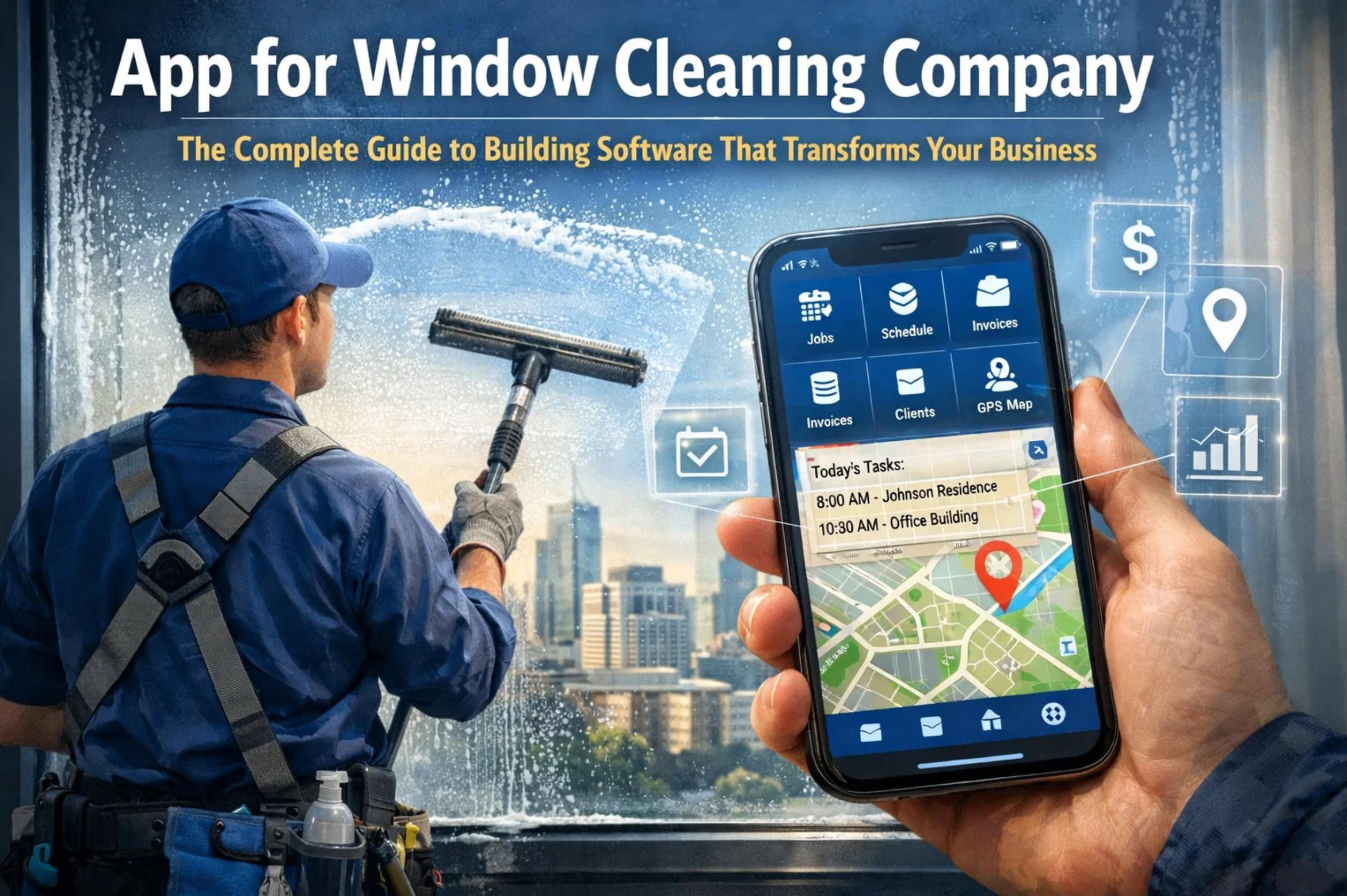
At A-Bots.com, we have spent years building custom mobile applications for businesses that outgrow generic tools. With over 70 completed projects spanning mobile development, IoT solutions, and enterprise platforms, our team understands that no two businesses operate the same way. A window cleaning startup with three employees has very different needs from a company maintaining 150 buildings across a major city. That is exactly why cookie-cutter software often falls short, and why a custom app for window cleaning company workflows can become the most valuable tool in your arsenal.
Our development team works with React Native, Flutter, Node.js, and Python/Django to create cross-platform solutions that scale with your business. Whether you need a lightweight scheduling tool or a full-featured platform with real-time GPS tracking, safety compliance modules, and client portals, A-Bots.com has the expertise to build an app for window cleaning company use that performs reliably from day one. We also provide QA testing services for companies that already have an existing app but want to ensure it works flawlessly in the field, where dropped connections and harsh conditions are part of the daily reality.
This guide walks you through every feature that a well-designed app for window cleaning company operations should include. We will use real industry data, examine how established companies like Big Apple Window Cleaning in New York City manage their complex operations, and show you exactly where custom software makes the difference between surviving and thriving.
Why Your Window Cleaning Company Needs a Dedicated App
The window cleaning services market is enormous and still growing. According to Fortune Business Insights, the global market was valued at approximately $151 billion in 2025 and is projected to reach over $162 billion in 2026 alone. In the United States, the industry generated $2.9 billion in revenue in 2023 across roughly 44,000 businesses. These numbers tell a clear story: competition is fierce, margins are tight (typically between 2% and 10%), and the companies that operate most efficiently win. An app for window cleaning company management is no longer optional equipment. It is a competitive necessity.
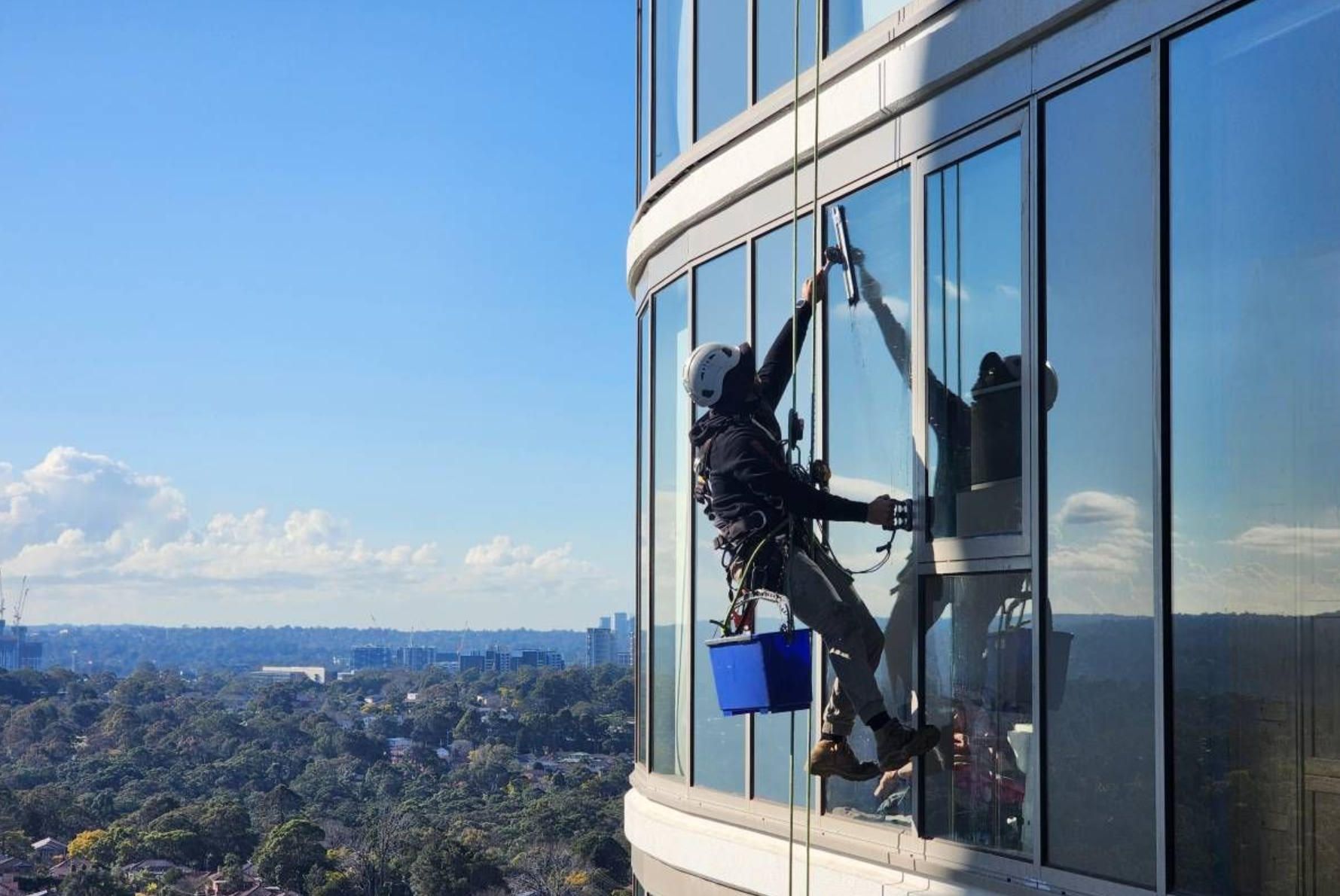
Technology adoption in field services has accelerated dramatically. Research from FieldServiceSoftware.io shows that 67% of field service organizations now use fully integrated mobile solutions, a 41% increase from 2020. In the cleaning industry specifically, around 70% of firms use digital tools for scheduling, payroll, or customer communication. Companies that implement field service management software report productivity increases averaging 24% within the first year and save approximately 6.3 hours per technician per week on administrative tasks alone. Yet many window cleaning businesses still rely on phone calls, paper forms, and manual spreadsheets to coordinate their daily operations, losing hours to tasks that an app for window cleaning company workflows could handle automatically.
"We used to spend Monday mornings just figuring out which crew goes where. Now the app does it before we finish our coffee." — A sentiment echoed by window cleaning operators across the country.
Consider a company like Big Apple Window Cleaning, which operates across all five boroughs of New York City and Long Island, maintaining over 150 buildings. Their service menu spans regular window washing, post-construction cleaning, facade cleaning, glass restoration, pressure washing, skylight cleaning, solar panel cleaning, caulking, and high-rise window cleaning using rope access systems. Managing that range of services across six geographic zones without a robust app for window cleaning company operations would be a logistical nightmare.
The question is no longer whether you need software. The question is whether you should settle for a generic off-the-shelf solution or invest in a custom app for window cleaning company needs that fits your operations like a glove. Let us explore what features matter most.
CRM and Client Management: The Foundation of Every Great App
Every successful app for window cleaning company operations starts with a strong CRM (Customer Relationship Management) module. This is where you store everything you know about your clients: contact information, property details, service history, preferences, and billing records.
For residential clients, the CRM tracks individual homeowners, their property types, the number and size of windows, accessibility challenges, and preferred scheduling. For commercial clients, the picture gets more complex. A building management company might oversee dozens of properties, each with different cleaning schedules, access protocols, and billing arrangements. Big Apple Window Cleaning, for example, handles both residential homes and massive commercial buildings in Manhattan. Each commercial client may require different access methods (rope descent, aerial lifts, BMU systems, or water-fed poles) depending on the building's height and design. A smart CRM captures all of these details so your team never shows up unprepared.
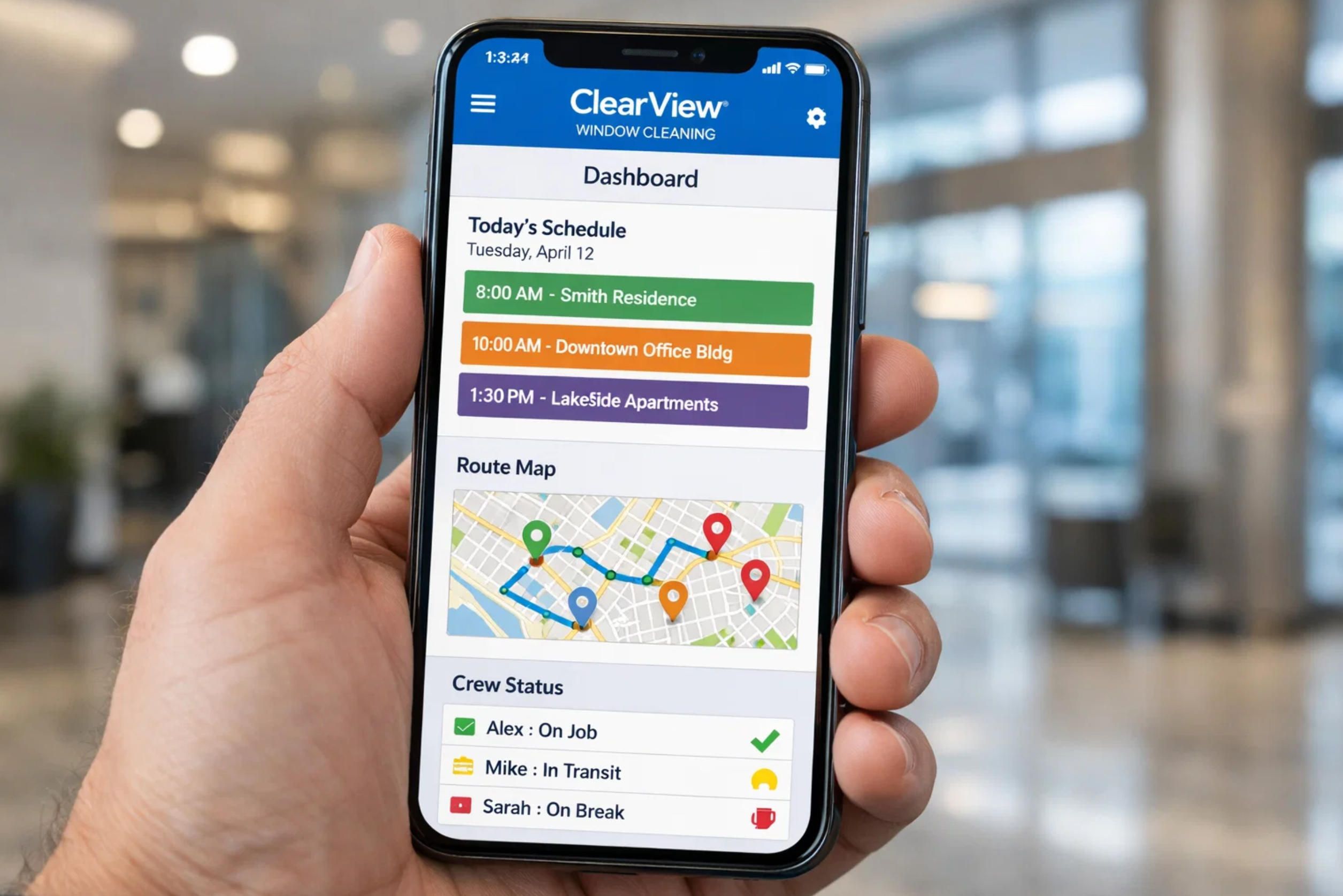
The real power of a CRM within an app for window cleaning company use comes from automation. When a recurring client's service date approaches, the system automatically generates a work order. When a new lead fills out a contact form on your website, it appears instantly in your CRM pipeline. When a job is completed, the system triggers an invoice and a review request without anyone lifting a finger.
According to industry data reported by Gitnux, CRM software adoption in the cleaning industry has increased 18% year-over-year. The reason is straightforward: companies that track client relationships systematically retain more customers and win more repeat business. For a window cleaning company that relies heavily on recurring contracts, especially in the commercial segment, a well-built CRM is not a luxury. It is a revenue engine. When that CRM lives inside a dedicated app for window cleaning company use rather than a generic business tool, the data it captures becomes far more actionable.
A custom-built CRM also lets you segment clients in ways that generic tools cannot. You might want to separate high-rise commercial accounts (which require OSHA-compliant documentation) from residential one-time cleanings. Or you might want to flag clients who need initial-wash services versus those on regular maintenance schedules. Big Apple Window Cleaning offers six distinct service categories under "Main Services" alone, plus six "Special Services" and five "Other Services." A custom app for window cleaning company CRM needs can handle these distinctions natively, rather than forcing you to twist a generic platform into something it was never designed to be.
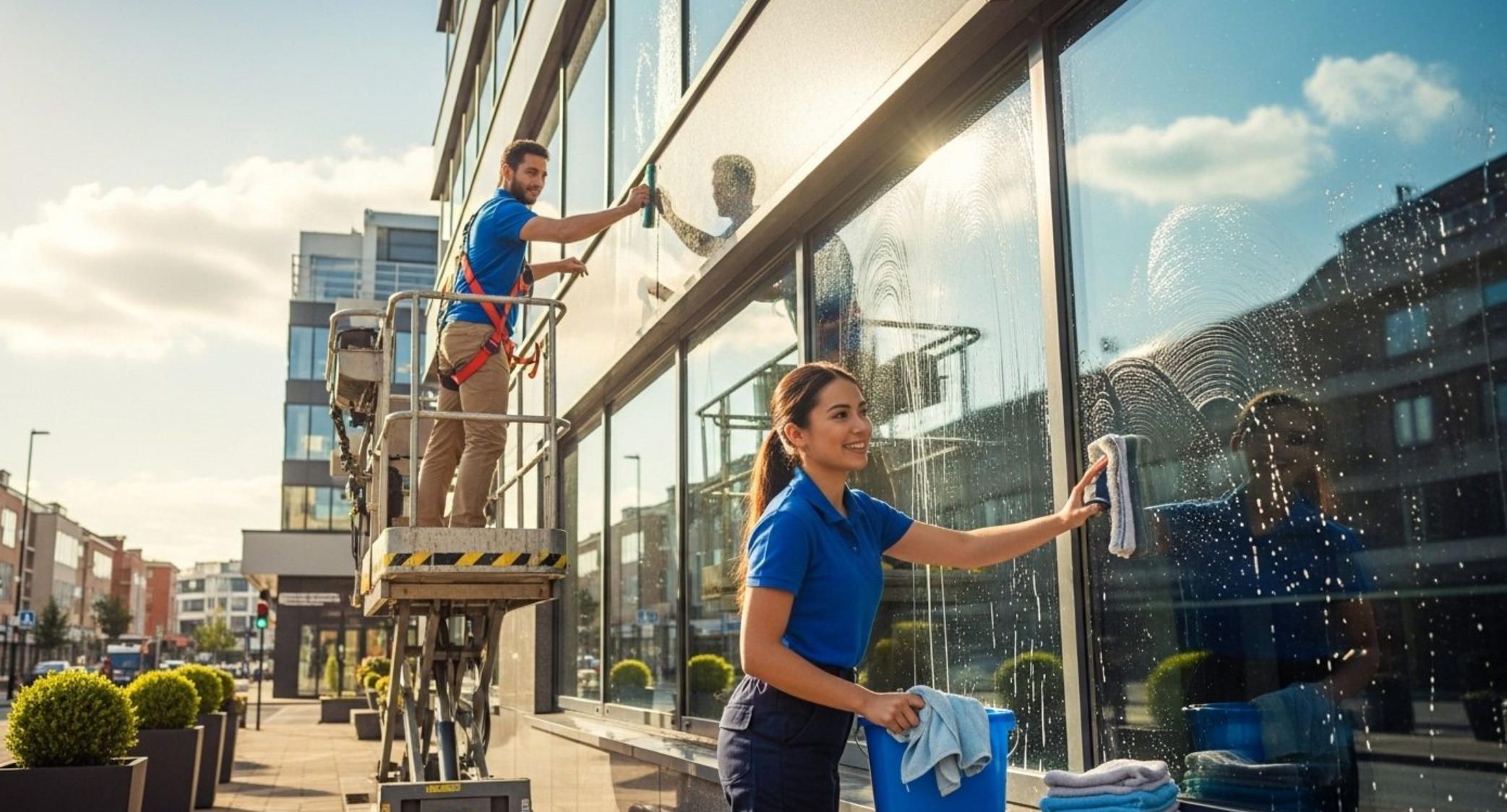
Smart Scheduling and Route Optimization
If CRM is the brain of your app for window cleaning company operations, scheduling is the heartbeat. Every day, you need to assign the right crews to the right jobs, account for travel time, handle cancellations, and squeeze in last-minute requests without creating chaos.
Research published by FieldServiceSoftware.io found that route optimization algorithms reduce travel time between service calls by an average of 17%, allowing technicians to complete one to two additional jobs daily. For a window cleaning company operating in a dense urban environment like New York City, where Big Apple Window Cleaning dispatches crews across Brooklyn, Queens, Manhattan, Staten Island, the Bronx, and Long Island, those saved minutes add up to thousands of dollars in additional revenue each month.
A well-designed scheduling module within your app for window cleaning company workflows should include drag-and-drop calendar management, color-coded job assignments, crew availability tracking, automatic conflict detection, and real-time schedule updates pushed to field workers' phones. When a job runs long or a crew gets stuck in traffic, dispatchers need to see the impact immediately and reassign resources.
Route optimization is particularly critical for window cleaning because job durations vary wildly. A residential exterior cleaning might take 45 minutes. A high-rise post-construction window cleaning could take an entire day. Your app for window cleaning company scheduling needs to account for these differences, factor in equipment loading and unloading time, and still generate efficient routes.
The best scheduling systems also learn from historical data. If a particular Manhattan office building consistently takes 30% longer than estimated, the system adjusts future time allocations automatically. This kind of intelligence is difficult to achieve with off-the-shelf solutions, but straightforward to build into a custom app for window cleaning company operations designed specifically for your workflow. The more data the system collects, the smarter your scheduling becomes, and the more jobs your crews can complete each week.
"Our old system treated a 3-story house and a 40-story skyscraper like the same job. The new app knows the difference, and so do our profits." — Window cleaning operations manager on upgrading to custom software.
Safety Compliance and Documentation: Where Custom Apps Shine Brightest
This is where an app for window cleaning company operations delivers the most unique value, and where generic field service tools fall shortest. Window cleaning, especially at height, is a heavily regulated industry. The Occupational Safety and Health Administration (OSHA) has specific regulations governing every aspect of high-rise work, and the consequences of non-compliance range from hefty fines to tragic accidents.
OSHA regulation 1910.27 addresses scaffolds and rope descent systems (RDS) used in window cleaning. Key requirements include a prohibition on using RDS at heights above 300 feet unless alternative access methods are not feasible, mandatory written certification from building owners confirming that anchor points can support at least 5,000 pounds per worker, and required training for all employees who use fall protection systems. Additionally, anchor points must be recertified by a professional engineer at least every 10 years. Tracking all of this manually is a recipe for missed deadlines and compliance gaps. A properly designed app for window cleaning company safety operations turns this regulatory burden into an automated process.
For a company like Big Apple Window Cleaning, which is the only team in New York City certified by the Society of Professional Rope Access Technicians (SPRAT) and holds certification from the International Window Cleaning Association (IWCA), compliance documentation is extensive. Each employee undergoes over 257 hours of field training. Every building they service has unique anchor point certifications, inspection records, and access method requirements. Their $11 million insurance policy demands meticulous record-keeping.
A custom app for window cleaning company safety management can handle all of this. The safety compliance module stores anchor point certifications by building, with automatic alerts when recertification deadlines approach. It tracks individual employee certifications (SPRAT, IWCA, OSHA training completions) and flags when renewals are due. Before dispatching a crew to a high-rise job, the app verifies that all assigned workers hold the required certifications for the specific access method being used.
The International Window Cleaning Association worked with OSHA to develop the ANSI/IWCA I-14.1 standard, which provides guidelines for equipment use, training requirements, and safety measures for workers at height. A purpose-built app for window cleaning company compliance can map these standards directly into digital checklists that crews complete on-site, complete with photo documentation and GPS-stamped timestamps.
Jeff Klass, former President of the IWCA, has emphasized that technology plays an increasingly important role in maintaining safety standards across the industry. Digital documentation eliminates the paper trail problems that have plagued the industry for decades: lost forms, illegible handwriting, and missing signatures. An app for window cleaning company safety tracking replaces all of that with searchable, timestamped digital records that stand up to any audit.
No generic scheduling app offers this level of safety integration. This is precisely the type of feature where a custom app for window cleaning company operations, built by an experienced development team like A-Bots.com, delivers irreplaceable value.
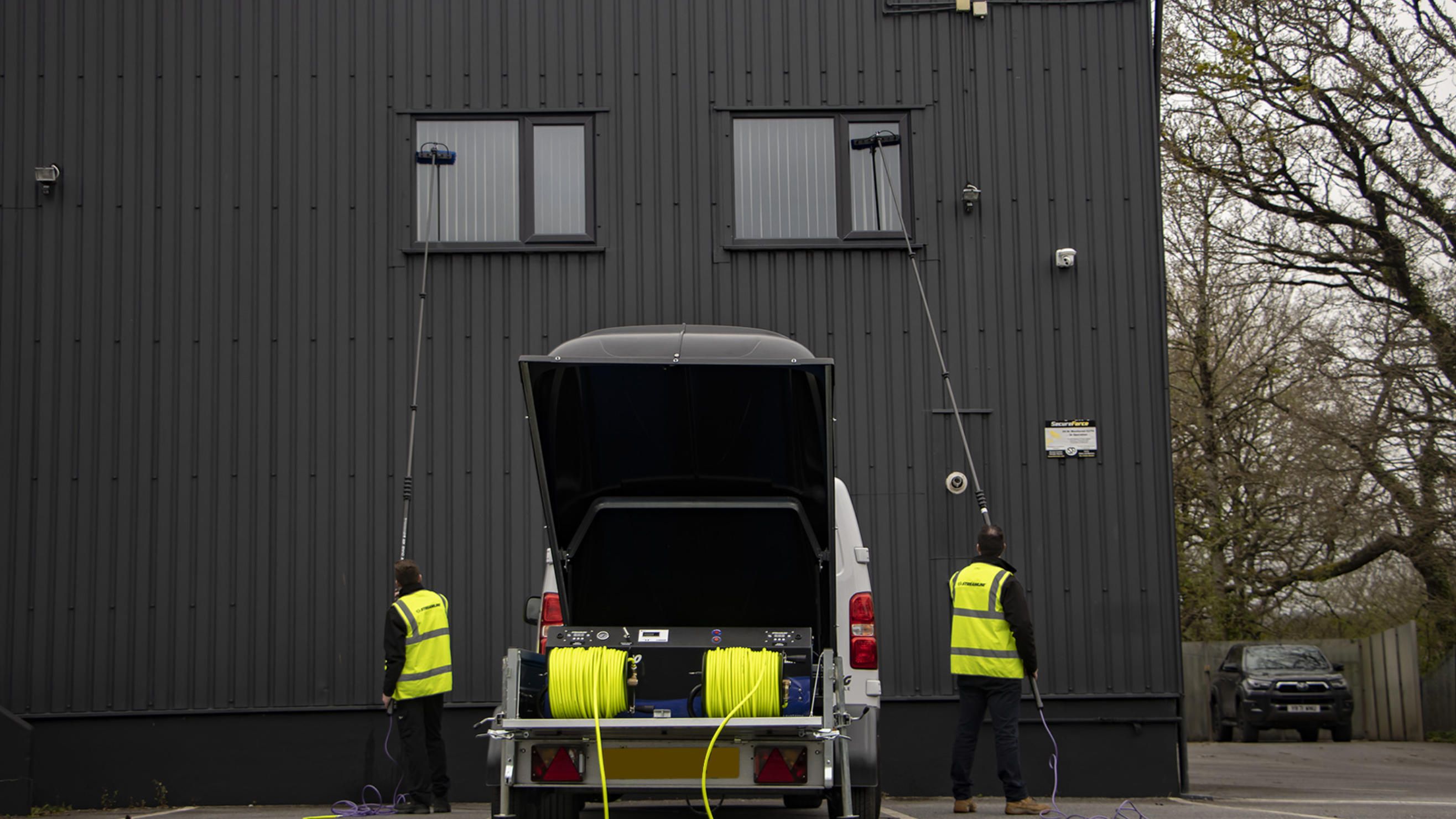
Inventory and Equipment Tracking
Window cleaning requires a surprising variety of specialized equipment, and managing it poorly costs real money. Beyond the basic squeegees and cleaning solutions, professional companies maintain rope descent systems, harnesses, helmets, water-fed poles (which can extend up to 70 feet), aerial lift components, and chemical supplies for specialized jobs like glass restoration acid washing. A comprehensive app for window cleaning company equipment tracking prevents the kind of last-minute scrambles that lead to delayed jobs and unhappy clients.
Your app for window cleaning company inventory management should track every piece of equipment by serial number, monitor its maintenance schedule, log inspections, and alert managers when items need replacement or servicing. Water-fed poles, for instance, require periodic filter changes. Rope descent systems need inspection before every use per OSHA requirements. Cleaning solutions need reordering before stock runs out.
For larger operations, equipment tracking also includes vehicle fleet management. Big Apple Window Cleaning deploys crews across six zones in the New York City metro area. Each service van carries a different equipment loadout depending on the day's job types. An effective app for window cleaning company inventory management connects equipment status to scheduling: if a high-rise job requires rope access gear and the only available set is across town, the dispatcher knows immediately and can adjust.
Research from FieldPromax indicates that companies using software for inventory management alongside their field service operations report up to 40% productivity gains. When your crews never arrive at a job missing a critical piece of equipment, you eliminate wasted trips and frustrated clients. This alone makes the inventory module one of the highest-ROI components in any app for window cleaning company operations.
The inventory module can also generate purchase reports that show consumption patterns over time. If your teams are going through squeegee rubber blades faster during summer months (when heat makes rubber degrade more quickly), your app for window cleaning company inventory management can forecast demand and create automatic purchase orders. This kind of predictive supply chain management, common in manufacturing, is now accessible to service businesses through custom mobile applications.
Estimating, Invoicing, and Payments
An app for window cleaning company financial operations should make the entire quote-to-cash cycle seamless. When a potential client requests a quote, your team should be able to generate a professional estimate on the spot, factoring in the number of windows, building height, type of cleaning required, access method, and any special conditions.
Big Apple Window Cleaning offers free estimates through their website, and their pricing varies significantly depending on the service. A regular window wash costs far less than post-construction cleaning (which typically runs two to three times higher due to the additional labor involved in removing paint, tape residue, and construction debris) or glass restoration acid washes. An app for window cleaning company estimating can store pricing formulas for each service type and automatically calculate quotes based on the parameters entered by your sales team.
Once a job is completed, the app generates an invoice, sends it to the client via email or through the client portal, and accepts payment through integrated processors. According to industry analysis, 55% of cleaning companies now accept contactless or mobile payments in the field. Immediate payment collection dramatically improves cash flow, which is critical in an industry where the average profit margin sits between 2% and 10%. An app for window cleaning company billing that automates this entire cycle pays for itself quickly.
The invoicing module should also handle the complexities of commercial contracts. Many commercial window cleaning agreements are structured as annual or multi-year contracts with monthly billing, which requires automated recurring invoice generation. Integration with accounting software like QuickBooks ensures that your financial data stays synchronized without manual data entry. A purpose-built app for window cleaning company accounting integration eliminates the double-entry errors that plague businesses still transferring numbers between disconnected systems.
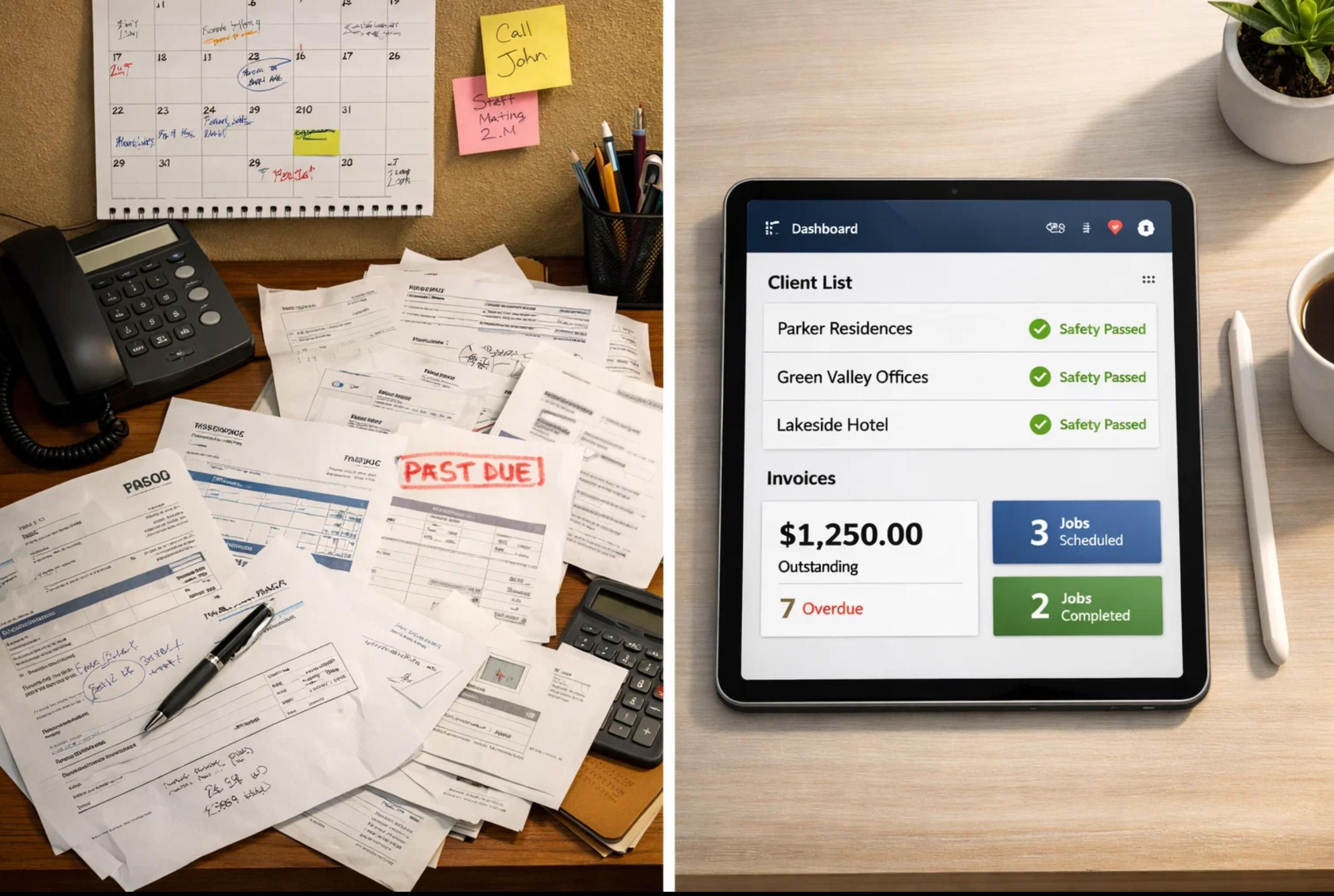
Client Communication Portal
The question of whether an app for window cleaning company operations should include a client-facing component depends largely on your client mix. For residential customers, basic communication through automated text messages ("Your crew is on the way" or "Your cleaning is complete") is often sufficient. But for commercial clients, a dedicated portal within your app for window cleaning company communication adds significant value.
Building managers overseeing multiple properties want self-service access to their service schedules, completed job reports, and invoices. When Big Apple Window Cleaning maintains over 150 buildings for commercial clients across New York City, each building manager benefits from being able to log in and see exactly when the next cleaning is scheduled, review photos from the last completed job, and download compliance documentation for their records.
The client portal does not need to be a separate app. It can be a secure web-based interface, accessible through a personalized link, that pulls data from the same backend as your main operational app for window cleaning company management. This approach keeps development costs manageable while still delivering a professional experience that differentiates your company from competitors who communicate exclusively through phone calls and email.
For prospective clients, the portal can include an online booking form or estimate request, similar to what Big Apple Window Cleaning currently offers on their website. This digital intake feeds directly into your CRM, creating a seamless pipeline from first contact to completed job. The ability to accept new business around the clock, even when your office is closed, is one of the most immediately visible benefits of investing in an app for window cleaning company client acquisition.
Off-the-Shelf vs Custom: Why Generic Apps Fall Short
The market is not short of generic field service management tools. Jobber, Housecall Pro, ServGrow, Orcatec, FieldCamp, and a dozen others all offer scheduling, invoicing, and basic CRM features aimed at service businesses. Many of them specifically market to window cleaning companies. So why would you invest in a custom app for window cleaning company operations instead?
The answer comes down to three factors: specialization, scalability, and competitive advantage.
Generic platforms treat window cleaning the same way they treat plumbing, lawn care, or HVAC service. They offer a one-size-fits-all approach that works reasonably well for simple operations but breaks down when complexity increases. None of the major off-the-shelf solutions offer built-in OSHA compliance tracking, anchor point certification management, or access method verification. None can automatically check whether a dispatched crew holds the specific SPRAT or IWCA certifications required for a given high-rise job. These are not niche features. For a company like Big Apple Window Cleaning, they are essential operational requirements. A custom app for window cleaning company compliance solves these gaps from day one.
Scalability is the second issue. Generic platforms charge per user, per month, and costs escalate quickly as your team grows. A custom app for window cleaning company operations has a one-time development cost (plus maintenance), and you own the software outright. For larger companies, the return on investment often materializes within 12 to 18 months. You also avoid vendor lock-in: if a SaaS platform changes its pricing, limits features, or shuts down entirely, your business is disrupted. With a custom app for window cleaning company management, you control the code, the data, and the roadmap.
Jim Robinson, CEO of Clearview Group and a veteran of the commercial cleaning technology space, has noted that the cleaning industry is at a tipping point where companies that invest in technology tailored to their specific workflows gain a measurable competitive edge over those relying on generic tools.
The MarketsandMarkets FSM report projects the field service management market will grow from $5.10 billion in 2025 to $9.17 billion by 2030, driven largely by demand for solutions that go beyond basic scheduling. The companies funding this growth are not buying more generic tools. They are investing in platforms specifically designed for their industries, and a custom app for window cleaning company operations is a prime example of this trend in action.
A custom app for window cleaning company needs, built by a development team that understands your business, eliminates the workarounds and compromises that generic tools demand. Instead of adapting your processes to fit the software, the software adapts to fit your processes.
AI, IoT, and the Future of Window Cleaning Technology
The most forward-thinking window cleaning companies are already looking beyond basic operational software. Artificial intelligence and Internet of Things technology are opening new possibilities that will reshape the industry over the next five years, and the smartest operators are building these capabilities into their app for window cleaning company innovation right now.
AI-powered scheduling is the most immediately practical application. Rather than simply assigning jobs based on availability, an AI scheduler analyzes historical data (job durations, traffic patterns, seasonal demand fluctuations, crew performance metrics) to generate optimized daily plans. Research cited by FieldServiceSoftware.io shows that AI-driven scheduling reduces operational waste and improves SLA compliance significantly. For a New York City operation covering six zones with different traffic patterns and building access schedules, AI scheduling built into your app for window cleaning company dispatch can add meaningful capacity without hiring additional crews.
IoT integration opens another dimension. Smart sensors on water-fed pole systems can monitor water purity levels and filter status in real time, alerting crews before equipment performance degrades. Environmental sensors can feed weather data into your app for window cleaning company scheduling, automatically postponing outdoor high-rise jobs when wind speeds exceed safe thresholds. Technavio reports that the robotic window cleaners market is expected to grow by $5.40 billion between 2025 and 2030 at a CAGR of 29.7%, signaling that automated and semi-automated cleaning solutions will become increasingly common.
Drone technology is also gaining ground. Drone-based window inspection systems can survey building facades before cleaning crews arrive, identifying problem areas, assessing glass condition, and even measuring window counts for estimating purposes. According to Gitnux, drone window cleaning for high-rises can operate 20 times faster than human cleaners, and while the technology is not yet ready to fully replace skilled professionals, it is rapidly becoming a valuable supplementary tool. An app for window cleaning company field operations can integrate drone survey data directly into job preparation workflows, giving crews detailed visual maps of each building before they even arrive on site.
"Ten years ago, we carried a squeegee and a bucket. Now our app tells us the optimal route, the weather forecast, which certifications we need on-site, and when to reorder supplies. The squeegee is still important, though." — Field technician reflecting on industry evolution.
A custom app for window cleaning company operations built today should be architecturally ready for these integrations. At A-Bots.com, our experience with IoT solutions (including smart appliances, agricultural sensors, and drone software) means we design applications with extensible APIs and modular architectures that accommodate future technology adoption without requiring a complete rebuild.
Building Your App for Window Cleaning Company Success with A-Bots.com
Every window cleaning company operates differently. A two-person residential outfit in a small town has different needs than a SPRAT-certified high-rise operation managing 150 buildings across New York City. But both share a common need: an app for window cleaning company operations that works the way they work, not the other way around.
At A-Bots.com, we build custom mobile applications that solve real operational problems. Our team has delivered over 70 projects across mobile app development, IoT solutions, web platforms, and chatbot systems. We maintain long-term relationships with our clients, with partnerships spanning one and a half to five or more years, because building a great app for window cleaning company growth is an ongoing collaboration, not a one-time transaction.
Whether you need a complete app for window cleaning company management from scratch or want to enhance an existing system with new modules like safety compliance tracking or AI-powered scheduling, we have the technical depth to deliver. Our QA testing services are also available for companies that already have an app for window cleaning company use but need professional testing to ensure reliability in the demanding conditions of field service work.
The window cleaning industry is evolving rapidly. The companies that invest in purpose-built technology today will be the ones leading the market tomorrow. If you are ready to explore what a custom app for window cleaning company operations can do for your business, A-Bots.com is ready to build it with you.
✅ Hashtags
#WindowCleaningApp
#WindowCleaningSoftware
#FieldServiceManagement
#CustomAppDevelopment
#WindowCleaningBusiness
#CleaningCompanyTech
Other articles
OpenClaw Complete Guide 2026: Installation, Databases, Use Cases, and Troubleshooting OpenClaw became the fastest-growing open-source project in GitHub history with over 200,000 stars in early 2026. This expert-level guide walks you through every stage of deploying your own OpenClaw instance — from system requirements and installation on virtual machines, dedicated servers, and personal computers to connecting databases like SQLite, MySQL, and PostgreSQL with pgvector. The article covers the most common OpenClaw errors with tested solutions, explains the memory architecture and search backends, details practical use cases including DevOps automation, browser control, IoT integration, and custom mobile app development, and provides Docker deployment and security hardening best practices for production environments.
MemU Complete Guide 2026: Proactive AI Memory Framework for Always-On Agents MemU is an open-source memory framework by NevaMind-AI that gives AI agents persistent, evolving memory for 24/7 proactive operation. With over 12,000 GitHub stars and 92.09% accuracy on the Locomo benchmark, memU organizes knowledge into a three-layer hierarchical system and uses dual-mode retrieval to cut LLM token costs by approximately 10x. This expert guide covers installation with PostgreSQL and pgvector, the complete memory architecture including the upcoming Intention Layer, real-world use cases from financial monitoring and DevOps to AI companions and counter-drone defense systems, six practical lifehacks for optimizing performance, and comparisons with Mem0 and LangChain Memory. Includes integration patterns for OpenClaw, LangGraph, n8n, and custom mobile applications.
OpenClaw without installation in 2026: Best Hosted Platforms, Hotel and Restaurant CRM Use Cases OpenClaw has become the fastest-growing open-source AI agent framework of 2026, surpassing 163,000 GitHub stars and powering autonomous workflows across industries. This expert guide reviews the top hosted platforms — OpenClawCloud, Amazon Lightsail, ArkClaw by ByteDance, and DigitalOcean — that let businesses test OpenClaw without complex installation. The article explores practical applications of OpenClaw for hotel and restaurant CRM data analysis, from guest behavior prediction and revenue optimization to menu intelligence and churn prevention. It also explains why production-grade deployments demand custom development, and how A-Bots.com delivers tailored AI agent solutions with proven expertise across 70+ projects.
Drone Detection 2026: Expert Guide to Modern Methods for Middle East This comprehensive guide examines every major drone detection method available in 2026, with a specific focus on detecting fixed-wing attack drones threatening the Middle East and Persian Gulf countries. From radar and acoustic sensor networks to 5G cellular detection and aerostat surveillance walls, the article provides detailed technical specifications, coverage ranges, real-world performance data, and deployment considerations for Saudi Arabia, the UAE, Qatar, Bahrain, Kuwait, and other regional nations. Based on current conflict data and expert analysis from CSIS, Carnegie Endowment, and defense industry sources, this is an essential resource for anyone seeking to understand modern drone detection technology.
Elderly Care App Development 2026: Features, Tech Stack & Market Trends The global population aged 60 and over will reach 1.4 billion by 2030, driving unprecedented demand for digital elderly care solutions. This article examines the technical and design requirements behind elderly care app development, covering core features such as medication management, fall detection, telehealth integration, and AI-driven predictive health monitoring. It explores the challenges of designing for senior users, building reliable offline-first architecture, integrating IoT wearables and smart home devices, and navigating HIPAA and GDPR compliance. With the elderly care apps market projected to reach $16.87 billion by 2033, the article outlines what development teams and healthcare organizations need to know to build apps that genuinely serve an aging population.
Custom Branded App for Veterinary Clinic | Build and Scale Your Practice The veterinary software market is projected to exceed $3 billion by 2030, and clinics without mobile tools risk losing clients to digitally equipped competitors. This guide explains how a custom branded app for veterinary clinic operations improves client retention, reduces no-show rates by up to 65%, and opens new revenue streams through telemedicine. It covers essential features including online appointment scheduling, automated reminders, electronic medical records, secure messaging, and in-app payments. The article compares custom development against generic off-the-shelf platforms, presents market data from Grand View Research, APPA, and Mordor Intelligence, and shows how A-Bots.com builds scalable solutions for practices ranging from a single clinic to a multi-location veterinary network.
Top stories

Copyright © Alpha Systems LTD All rights reserved.
Made with ❤️ by A-BOTS