
Home
Services
About us
Blog
Contacts
App Controlled Scent Diffuser: Top 3 Smart Fragrance Systems and Why Custom IoT Apps Are the Future
The way people experience fragrance at home has quietly undergone a major shift. Where scented candles and reed sticks once dominated, a new category of device has taken center stage: the app controlled scent diffuser. These smart gadgets connect to your phone through WiFi or Bluetooth, letting you schedule scent delivery, adjust intensity, and monitor oil levels without ever touching the device itself. What sounds like a luxury feature is quickly becoming a consumer expectation, and the app controlled scent diffuser category is growing faster than almost any other segment in home wellness technology.
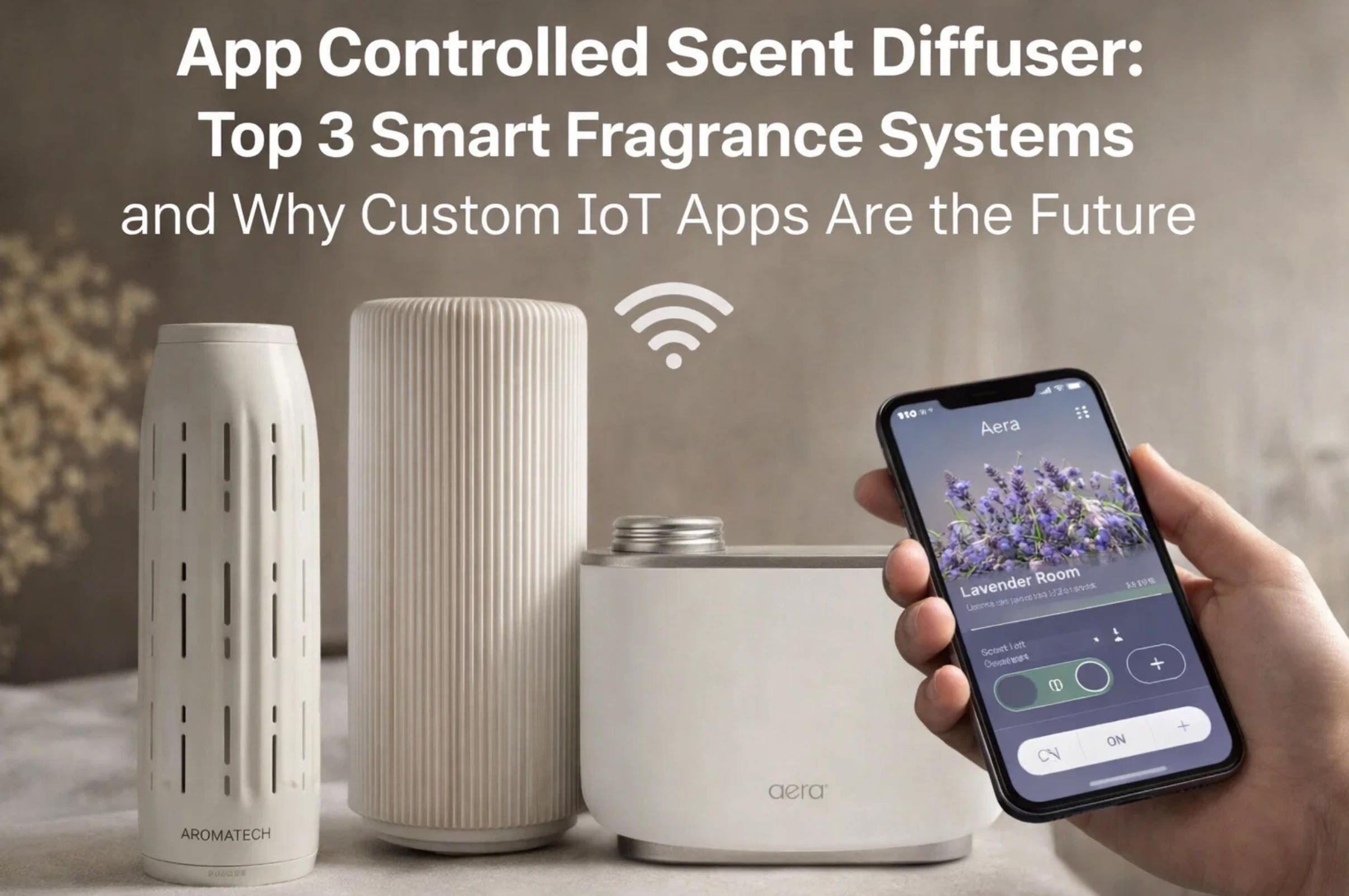
The global aromatherapy diffuser market reached approximately $1.72 billion in 2025 and is projected to grow at a 7.33% compound annual growth rate through 2031, according to Mordor Intelligence. Meanwhile, the broader home fragrance industry hit $26 billion in 2025, with Fortune Business Insights forecasting it will climb to nearly $48 billion by 2034. North America alone accounts for roughly 35% of global home fragrance revenue. If you are a manufacturer looking to enter or expand in this space, building an app controlled scent diffuser is no longer optional — it is essential.
Companies like A-Bots.com specialize in full-cycle custom software development for IoT devices, mobile applications, and connected hardware products. With over 70 completed projects and proven experience building apps that communicate between smartphones and physical devices — including their work on the Shark Clean robotic vacuum controller — A-Bots.com understands precisely what it takes to turn a simple diffuser into a smart, app-driven product.
In this article, we will break down the top three app controlled scent diffuser systems on the market today, examine what makes their companion apps work (and where they fall short), and explain why manufacturers who want to compete in this growing market need a development partner that truly understands IoT.
"The nose knows what it wants. But only an app knows when, how strong, and for how long." — A thought every scent diffuser engineer has had at least once.
What Makes an App Controlled Scent Diffuser Different from a Regular Diffuser
Before diving into specific products, it helps to understand what separates an app controlled scent diffuser from the basic models you might find at a department store. A traditional diffuser typically operates with a simple on/off button, maybe a timer knob, and a water reservoir that you fill by hand. It does one job: push scent into the air.
An app controlled scent diffuser, on the other hand, is a connected IoT device. It links to your smartphone through WiFi or Bluetooth and communicates with a dedicated mobile application. Through that app, you can do things a mechanical timer could never handle. You can set complex weekly schedules — scent running during work hours on weekdays but only in the mornings on weekends. You can adjust fragrance intensity from across the room or across the country. Some models even track how much oil remains in the cartridge and remind you to reorder before it runs out.
The technical backbone of every app controlled scent diffuser involves several layers. There is the firmware running on the device itself, typically a low-power microcontroller with a wireless radio. There is the mobile application on the user's phone, built for both iOS and Android. And in WiFi-connected models, there is often a cloud backend that allows remote access and stores user preferences. All three layers must work together seamlessly, or the user experience falls apart — something that several popular products have learned the hard way.
"A diffuser without an app is like a car without a steering wheel. It works, but you have no idea where the scent is going." — An anonymous IoT product manager with very strong opinions about aromatherapy.
This is exactly the kind of multi-layered architecture that A-Bots.com builds for clients. Their technology stack — React Native for cross-platform mobile apps, Node.js and Python/Django on the backend, plus Java, Kotlin, and Swift for native device communication — covers every piece of the app controlled scent diffuser puzzle.
Pura: The Subscription-Powered App Controlled Scent Diffuser
Overview
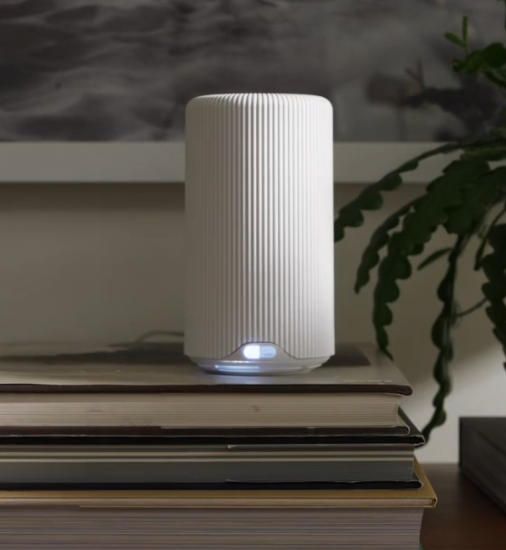
Pura is arguably the most recognized name in the consumer app controlled scent diffuser market in the United States. The company offers three main diffuser models: the Pura 4 for medium-sized rooms, the Pura Plus for larger and open-concept spaces, and the Pura Mini for small areas like bathrooms or closets. All three models connect to the Pura app via 2.4 GHz WiFi.
What sets Pura apart is its ecosystem approach. The devices use proprietary smart vials that the diffuser automatically detects upon insertion — no manual scanning or code entry required. Combined with a subscription model that delivers new scent vials on a 4, 8, or 12-week cycle, Pura has built a recurring revenue machine around its app controlled scent diffuser hardware.
App Features
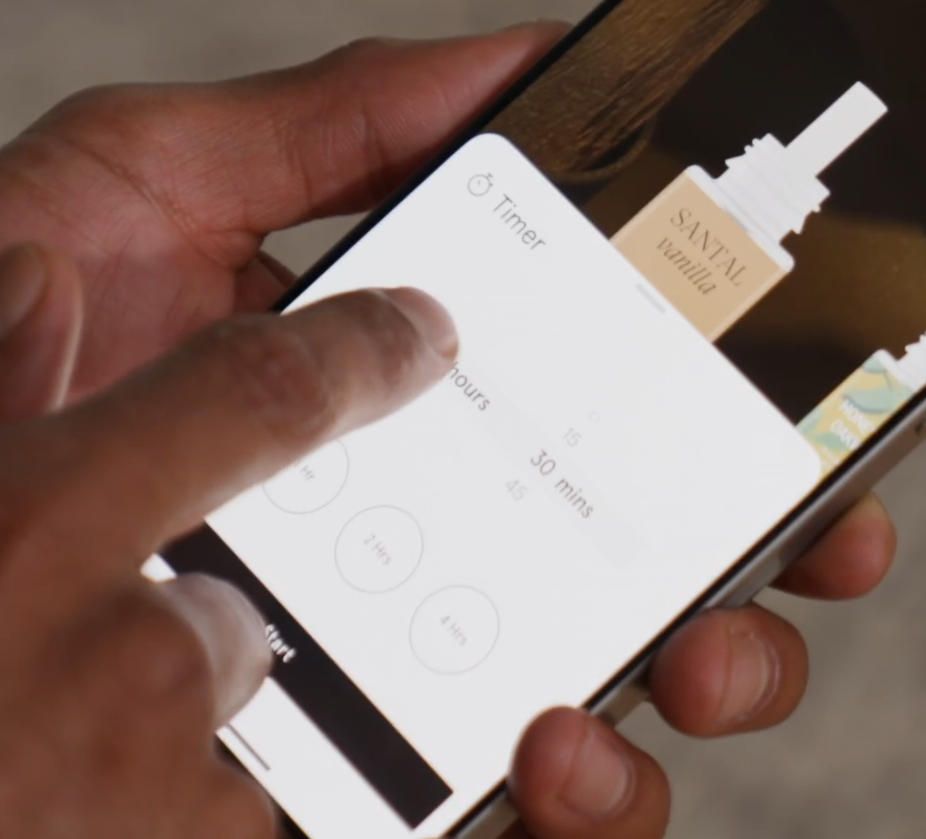
The Pura app is the command center for the entire experience. Users can set custom schedules and timers for each diffuser, adjust fragrance intensity, switch between two loaded vials, and activate an Away Mode that uses the phone's GPS to turn the diffuser off when you leave home and back on when you return. There is also a Pura Glow feature that controls an ambient LED light on the device, which can be automated to follow scent schedules.
One of Pura's more sophisticated features — and a benchmark for any modern app controlled scent diffuser — is its adaptive diffusion technology, branded as Puralast. The system reads room temperature data and adjusts scent output accordingly, aiming to deliver a consistent fragrance experience regardless of environmental conditions. Users periodically provide feedback through the app, which the system uses to further calibrate performance.
What Works and What Does Not
Pura's strengths lie in its polished user experience and tight integration between hardware and software. As an app controlled scent diffuser, the automatic vial detection and adaptive diffusion represent genuinely useful IoT features that justify the "smart" label. The marketplace of over 250 fragrances from partner brands gives users extensive choice.
However, there are trade-offs. The Pura system is a closed ecosystem. You cannot use third-party oils, which means the hardware is essentially a vehicle for ongoing vial purchases. The diffuser requires a 2.4 GHz WiFi connection and does not support 5 GHz networks, which can cause setup frustration in homes with modern dual-band routers. Some users have also reported connectivity drops and delays in app response.
For a manufacturer thinking about building their own app controlled scent diffuser, Pura demonstrates the power of combining smart hardware with a subscription business model. It also shows that app reliability and WiFi stability are areas where even well-funded companies can stumble.
Pura Diffuser Specifications at a Glance
The Pura 4 covers medium rooms, holds two scent vials lasting approximately three weeks each at medium intensity (six to eight hours daily diffusion), connects via 2.4 GHz WiFi, and retails starting at $34.99. The Pura Plus is a larger app controlled scent diffuser that covers up to 2,000 square feet, features dual internal heaters and a built-in fan for faster scent dispersal, and is designed for open-concept living spaces. The Pura Mini uses a single vial and targets compact areas.
Source: Pura official website
AromaTech: The Premium Bluetooth App Controlled Scent Diffuser
Overview
AromaTech has been in the scenting business since 2009 and is widely regarded as the go-to brand for hotel-quality home fragrance. Their product line includes several Bluetooth-enabled models: the AroMini BT Plus (covering up to 1,500 square feet), the Ambience (up to 1,000 square feet), the Ambience Mini (up to 600 square feet), and the AromaDream (up to 600 square feet with ambient LED lighting). All AromaTech devices use cold-air nebulizing technology, which disperses scent using filtered air rather than water or heat.
Unlike Pura's WiFi approach, AromaTech products connect via Bluetooth. This makes the AromaTech lineup a distinctly different kind of app controlled scent diffuser — you need to be within Bluetooth range to make app adjustments, but it also means simpler connectivity with no router configuration required.
App Features
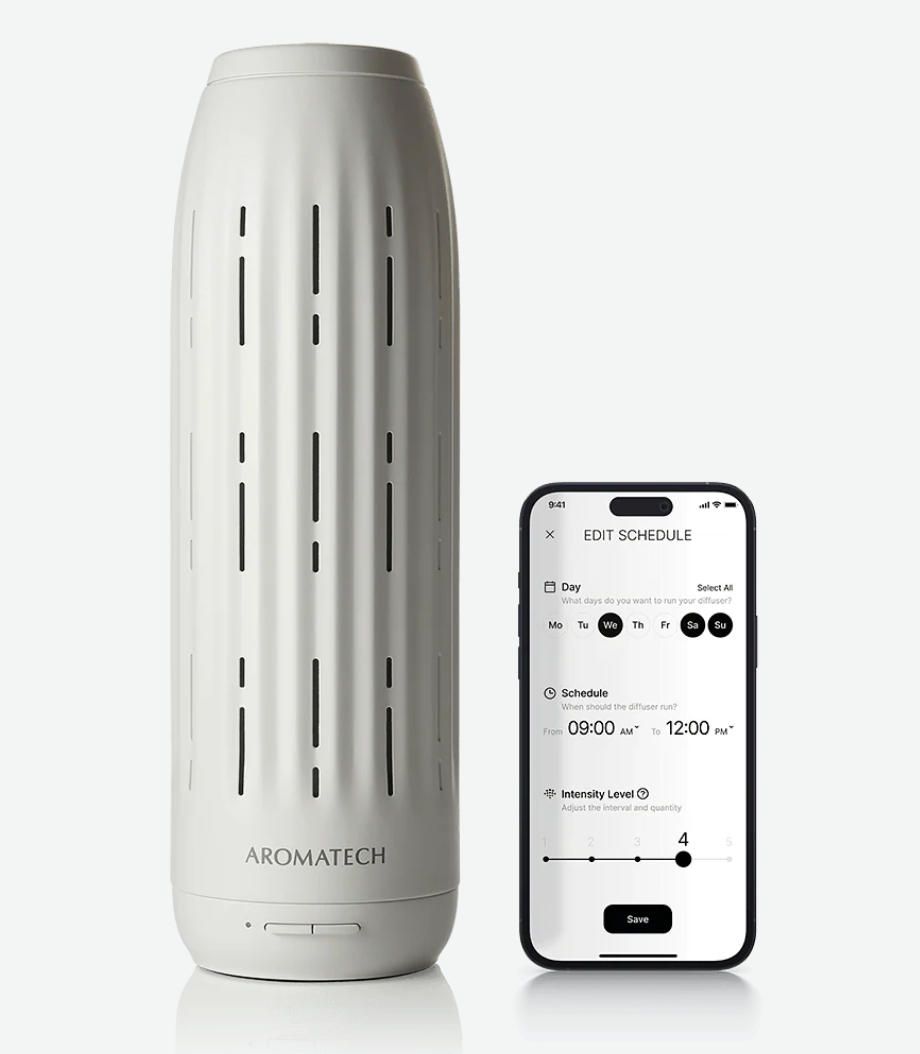
The AromaTech app (branded as "Scenting" on the App Store and Google Play) allows users to create up to five custom schedules per diffuser, adjust scent intensity, and — on the Ambience and AromaDream models — control ambient lighting color and mode. Multiple diffusers can be managed from a single app, making it possible to create different scent zones throughout a home or commercial space.
Each diffuser gets a custom name in the app, which helps when managing several units. The scheduling system lets you choose specific days and times for diffusion, accommodating different routines for weekdays versus weekends.
What Works and What Does Not
AromaTech's cold-air nebulization technology is a genuine differentiator in the app controlled scent diffuser space. Because it does not use water, there is no residue, no humidity increase, and no risk of mold. The scent particles produced are extremely fine and stay suspended in the air for hours, which delivers a more consistent fragrance experience than ultrasonic alternatives.
The app, however, has drawn criticism. The most significant complaint comes from users who had grown accustomed to the older version of the app, which allowed granular control over diffusion intervals (for example, 30 seconds on, 120 seconds off). A subsequent update removed this feature in favor of preset intensity levels from 1 to 9. Several App Store reviews specifically call out this change, noting that it led to faster oil consumption — a sore point when AromaTech's fragrance oils are premium-priced.
This is an important lesson for any company building an app controlled scent diffuser. App updates that remove user-loved features can erode trust quickly, especially in a product category where consumable costs are a major factor. Getting the app right from day one — with a thoughtful roadmap for updates — is critical.
AromaTech Diffuser Specifications at a Glance
The AroMini BT Plus covers 100 to 1,500 square feet, uses 60 ml scent bottles, connects via Bluetooth, and features cold-air nebulizing technology. The Ambience covers up to 1,000 square feet, adds ambient LED lighting, and uses a ceramic glazed shell design. The Ambience Mini covers up to 600 square feet in a compact, redesigned form factor. The AromaDream covers up to 600 square feet and features playful LED ambient lighting alongside nebulizing diffusion.
Source: AromaTech official website
Aera: The WiFi-First App Controlled Scent Diffuser with Alexa Integration
Overview
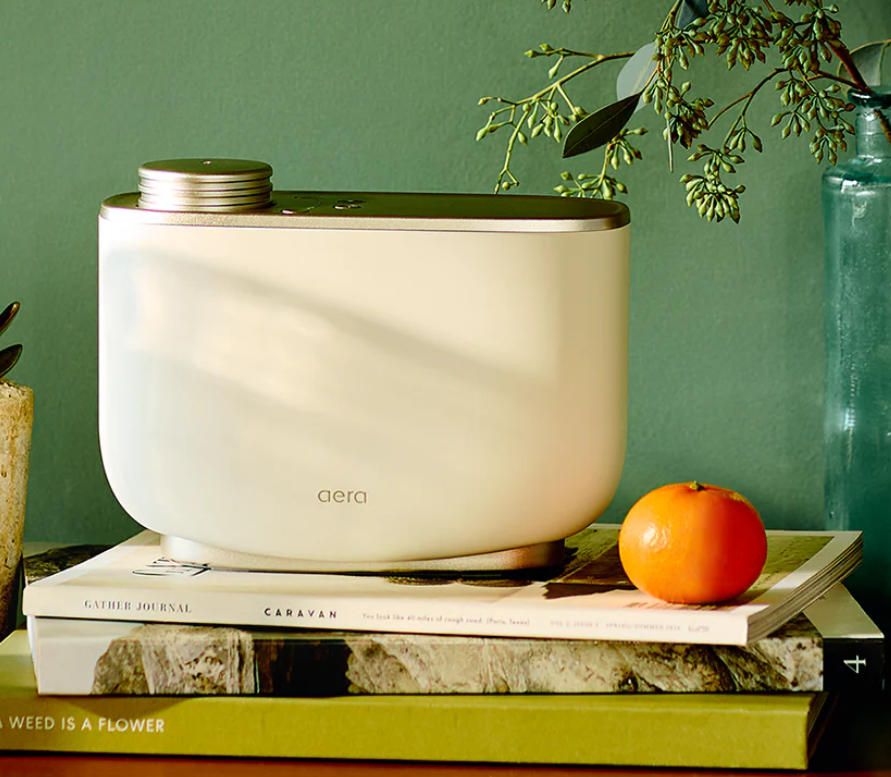
Aera positions itself as the clean, safe, and smart alternative to candles and traditional oil diffusers. As an app controlled scent diffuser brand, the company offers two main products: the Aera Smart Diffuser (covering up to 1,000 square feet, priced at $199) and the Aera Mini (covering 100 to 500 square feet). Both models use Aera's patented Microdroplet Technology, which breaks fragrance into tiny particles without heat, water, or VOCs (volatile organic compounds).
Aera's key differentiator in the app controlled scent diffuser market is its WiFi connectivity combined with Amazon Alexa integration. You can control your app controlled scent diffuser by voice command, set routines through the Alexa app, or manage everything through the dedicated AeraForHome app from anywhere in the world.
App Features
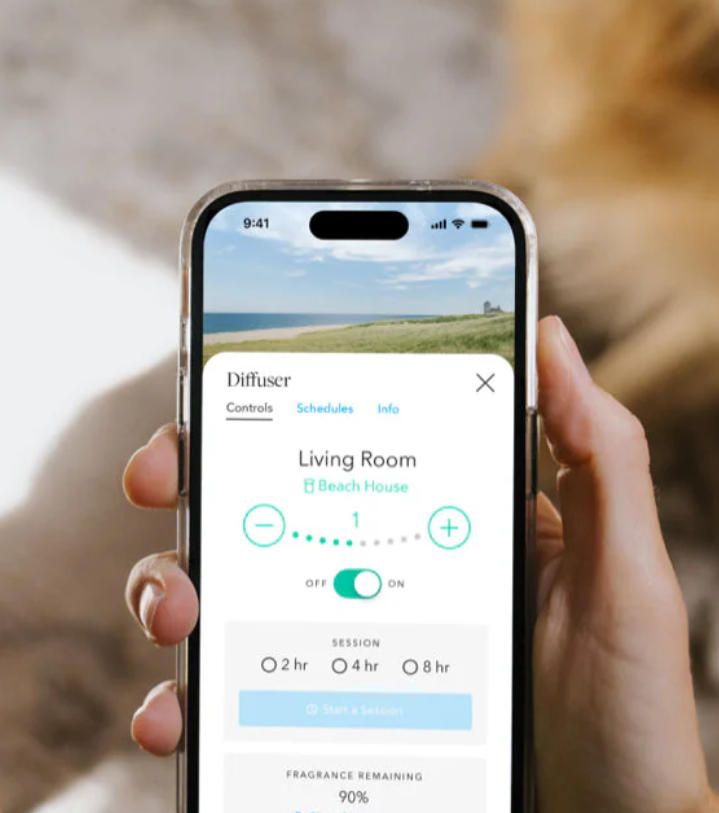
The AeraForHome app connects to Aera diffusers over WiFi, giving it a significant advantage over Bluetooth-only competitors: you can adjust settings remotely, whether you are in another room or another country. The app supports up to 20 schedules per diffuser, 10 intensity levels (on the standard Aera Smart model, 5 levels on the Mini), and fragrance level monitoring with reorder reminders. Users can add as many diffusers as they want to a single account.
An often-overlooked feature is that connecting a diffuser to the app extends the warranty from one year to three years. This is a smart incentive that encourages app adoption and gives Aera valuable usage data — a strategy that other app controlled scent diffuser manufacturers would be wise to emulate.
What Works and What Does Not
Aera's Microdroplet Technology delivers impressively even scent distribution. Reviews consistently praise the absence of "hot spots" near the device and the consistent fragrance experience throughout the covered area. The hypoallergenic formula makes it a good choice for households with children, pets, or sensitive noses.
The pain points are familiar to anyone who has worked with consumer IoT products. App Store reviews for this app controlled scent diffuser mention connectivity lag (sometimes 15 to 60 seconds between app commands and device response), status sync issues, and the need for frequent device resets. At $199 per diffuser and $55 per fragrance capsule (lasting three to four weeks), users understandably have high expectations for reliability.
"My scent diffuser's app takes so long to respond, I've started scheduling my fragrances around my patience levels." — A sentiment shared in multiple Aera user reviews.
For manufacturers developing their own app controlled scent diffuser, Aera's experience highlights the critical importance of low-latency device communication and robust state synchronization between app and hardware. These are engineering challenges that require deep IoT expertise — exactly the kind of challenge that a specialized development team like A-Bots.com is built to solve.
Aera Diffuser Specifications at a Glance
The Aera Smart Diffuser covers up to 1,000 square feet, uses patented Microdroplet Technology, offers 10 intensity levels, connects via WiFi with Alexa compatibility, and delivers up to 800 hours of fragrance per capsule (approximately 60 days at mid settings and 10 hours daily). The Aera Mini covers 100 to 500 square feet with 5 intensity levels and up to 60 days of fragrance per capsule at level 3.
Source: Aera official website
Comparing the Big Three: Where Each App Controlled Scent Diffuser Wins and Loses
Each of these three brands takes a different approach to the app controlled scent diffuser concept, and their strengths and weaknesses are instructive for anyone planning to build their own product.
Pura wins on ecosystem breadth. With over 250 fragrances, automatic vial detection, and adaptive temperature-based diffusion, it offers the most feature-rich consumer experience. Its subscription model is a masterclass in recurring revenue. But its closed system and WiFi-only connectivity create real friction points for certain users.
AromaTech wins on diffusion quality. Its cold-air nebulizing technology produces a cleaner, more consistent scent than ultrasonic or heat-based competitors. The Bluetooth-based app is simple to set up. But the limited app features and the controversial removal of granular controls have frustrated power users.
Aera wins on smart home integration. Its WiFi-first approach and Alexa compatibility make it the strongest option for users already invested in a smart home ecosystem. The warranty extension through app registration is clever product strategy. But connectivity reliability remains a challenge that undermines the premium price point.
None of these products are perfect. And that is exactly the opportunity for manufacturers who want to build a better app controlled scent diffuser with a custom-developed companion app.
Why Scent Diffuser Manufacturers Need a Custom IoT App Development Partner
The smart home market reached approximately $116.8 billion in 2025 and is growing at a CAGR of 12% to 16.9%, according to reports from Straits Research and Fortune Business Insights. Consumers now expect every device in their home to be controllable from their phone. That expectation has fully arrived in the fragrance industry.
Building an app controlled scent diffuser is not just about attaching a Bluetooth module to existing hardware. It requires coordinated expertise across multiple engineering domains: embedded firmware, wireless communication protocols, mobile app development for iOS and Android, cloud backend infrastructure, and — increasingly — integration with smart home platforms like Alexa, Google Home, and Apple HomeKit.
Consider the common problems we have seen across all three app controlled scent diffuser brands reviewed above. WiFi connectivity issues. Bluetooth range limitations. App updates that break beloved features. Slow response times between app and device. Fragrance tracking that falls out of sync. These are not hardware problems. They are software problems. And they are the kind of software problems that make or break a product's reputation.
This is where partnering with an experienced IoT development company becomes essential. A-Bots.com brings a technology stack specifically suited for app controlled scent diffuser projects. React Native enables rapid cross-platform mobile app development. Node.js and Python handle real-time device communication and cloud logic. Java, Kotlin, and Swift provide the native layer needed for reliable Bluetooth and WiFi interactions. And their experience with IoT products — including the Shark Clean robotic vacuum cleaner app — means they understand the unique challenges of building software that must reliably communicate with physical hardware.
"Building an IoT app is like teaching a dog to use a smartphone. The dog is the hardware. The smartphone is the cloud. And the leash connecting them? That is your firmware, and it better not break." — A developer who has seen too many Bluetooth disconnections.
What a Custom App Controlled Scent Diffuser App Should Include
If you are a scent diffuser manufacturer planning to develop your own connected product, here is what the market now demands from the companion app of any serious app controlled scent diffuser:
Device Pairing and Onboarding. The first experience a customer has with your app controlled scent diffuser is the setup process. If pairing takes more than two minutes or fails on the first attempt, you have already lost trust. The onboarding flow should auto-detect nearby devices, guide users through WiFi or Bluetooth configuration with clear visual instructions, and confirm successful connection with minimal steps.
Scheduling and Timer Controls. Users of any app controlled scent diffuser expect to create multiple schedules — weekday mornings, weekend evenings, specific rooms at specific times. The scheduling interface should be intuitive and flexible, supporting at minimum five to ten independent schedules per device.
Intensity Adjustment. Whether your app controlled scent diffuser offers 5 levels or 10, the app must provide real-time intensity control with responsive feedback. Users should see and feel the change within seconds, not minutes.
Fragrance Level Monitoring. Tracking oil or cartridge levels and sending push notification reminders when supplies run low is a feature that directly drives repeat purchases for any app controlled scent diffuser brand. It also improves the user experience by preventing the frustration of a diffuser running empty without warning.
Multi-Device Management. Many households will own more than one app controlled scent diffuser. The app must support managing multiple devices from a single interface, with clear labeling, individual settings, and the ability to group devices by room or zone.
Smart Home Integration. Any competitive app controlled scent diffuser must offer compatibility with Amazon Alexa, Google Assistant, and Apple HomeKit. Voice control for on/off, intensity changes, and scene activation should work reliably.
OTA Firmware Updates. The ability to update the diffuser's firmware over the air means you can fix bugs, improve performance, and add features without requiring users to return hardware. For any app controlled scent diffuser with a multi-year product lifecycle, this is critical for long-term product viability.
Usage Analytics Dashboard. For app controlled scent diffuser manufacturers, aggregated and anonymized usage data helps improve future products and understand customer behavior. For users, a simple dashboard showing diffusion hours and oil consumption adds perceived value.
Every one of these features requires careful engineering across firmware, mobile app, and cloud layers. A-Bots.com's full-cycle development approach — from strategy and product definition through mobile development, backend engineering, and QA testing — covers the entire process that brings an app controlled scent diffuser from concept to market.
The QA Factor: Why Testing Matters More Than You Think
One pattern that emerged clearly from reviewing user feedback on Pura, AromaTech, and Aera apps is that connectivity bugs and sync issues are the most common complaints. These are not obscure edge cases. They are everyday scenarios: a user opens the app and sees stale data, sends a command that takes 30 seconds to execute, or loses device connection after a router restart.
For any app controlled scent diffuser, comprehensive QA testing is not a nice-to-have — it is a necessity. This includes testing across a wide range of smartphones and operating system versions, testing Bluetooth and WiFi connectivity under various network conditions, regression testing after every app update to ensure existing features still work, and real-world user experience testing in homes with different router configurations, wall materials, and distances.
A-Bots.com provides dedicated QA and testing services as part of their development process. Their team understands that in IoT, testing is not just about the app in isolation. It is about the entire chain: device firmware, wireless communication, mobile app, cloud backend, and every handshake in between. If you already have an app controlled scent diffuser on the market that suffers from connectivity complaints or user experience issues, A-Bots.com can also audit and improve your existing product.
The Road Ahead: AI, Personalization, and the Next Generation of the App Controlled Scent Diffuser
The scent diffuser market is not standing still. Several trends are shaping the next generation of products:
AI-Driven Scent Matching. Some companies are already experimenting with algorithms that recommend fragrances based on user preferences, time of day, or even mood data. Integrating machine learning into the companion app of an app controlled scent diffuser could create highly personalized experiences that increase customer retention and lifetime value.
Subscription and E-Commerce Integration. Pura has proven that combining hardware with a subscription model can be extremely profitable. Future app controlled scent diffuser apps will likely include built-in stores for ordering refills, managing subscriptions, and discovering new fragrances — all without leaving the app.
Scent Zoning for Whole-Home Coverage. As app controlled scent diffuser hardware becomes more powerful (some models already cover 3,500 to 5,000 square feet), the software challenge shifts to managing multiple scent zones throughout a home. The companion app becomes a scent management platform, coordinating different fragrances in different rooms on different schedules.
Integration with Wellness Ecosystems. As the boundary between smart home and health tech blurs, expect app controlled scent diffuser products to integrate with sleep tracking apps, meditation platforms, and workplace wellness programs. Scent becomes data — measurable, optimizable, and tied to outcomes.
Each of these trends requires sophisticated mobile and cloud development capabilities. Manufacturers who invest in strong software partnerships now will be positioned to lead as the market matures.
Final Thoughts
The app controlled scent diffuser market is growing fast, powered by consumer demand for smart home integration and personalized fragrance experiences. The three leading products — Pura, AromaTech, and Aera — each demonstrate what is possible when you combine quality hardware with a well-designed companion app. They also demonstrate, through real user feedback, where software shortcomings can undermine an otherwise excellent product.
For scent diffuser manufacturers who want to enter or expand in this space, the message is clear: hardware alone is no longer enough. The app experience is the product. Scheduling, intensity control, device management, smart home integration, and reliable connectivity are what consumers now expect from every app controlled scent diffuser they buy.
Building that software requires a development team with deep IoT expertise, cross-platform mobile skills, and the discipline to test rigorously before launch. A-Bots.com offers exactly that: full-cycle custom software development with a proven track record in IoT applications, mobile apps, and connected hardware products. Whether you are building a new app controlled scent diffuser from scratch or need to improve the app behind your existing product, their team has the experience and technology stack to deliver a product that works — reliably, beautifully, and at scale.
"In the end, every great scent starts with a great algorithm. And every great algorithm starts with a great development team." — Something we genuinely believe at A-Bots.com.
Ready to build your next-generation app controlled scent diffuser? Visit A-Bots.com to start the conversation.
Sources
- Mordor Intelligence — Aromatherapy Diffuser Market Report
- Fortune Business Insights — Home Fragrance Market
- Straits Research — Smart Home Market
- Fortune Business Insights — U.S. Smart Home Market
- Pura Official Website
- AromaTech Official Website
- Aera Official Website
- Straits Research — Home Fragrance Market
✅ Hashtags
#AppControlledScentDiffuser
#SmartHomeDiffuser
#IoTScentDiffuser
#SmartFragranceDiffuser
#ScentDiffuserApp
#CustomIoTAppDevelopment
#SmartAromaDiffuser
#ScentDiffuserManufacturer
Other articles
Custom Branded App for Veterinary Clinic | Build and Scale Your Practice The veterinary software market is projected to exceed $3 billion by 2030, and clinics without mobile tools risk losing clients to digitally equipped competitors. This guide explains how a custom branded app for veterinary clinic operations improves client retention, reduces no-show rates by up to 65%, and opens new revenue streams through telemedicine. It covers essential features including online appointment scheduling, automated reminders, electronic medical records, secure messaging, and in-app payments. The article compares custom development against generic off-the-shelf platforms, presents market data from Grand View Research, APPA, and Mordor Intelligence, and shows how A-Bots.com builds scalable solutions for practices ranging from a single clinic to a multi-location veterinary network.
App for Window Cleaning Company | Custom Software Guide for New York 2026 Managing a window cleaning company requires coordinating field crews, tracking safety certifications, handling client relationships, and processing payments across dozens of job sites every week. This guide explores every essential feature of a purpose-built app for window cleaning company operations, from CRM and smart scheduling to OSHA compliance tracking and AI-powered route optimization. Using real market data from Fortune Business Insights and MarketsandMarkets, alongside a detailed look at how established NYC operator Big Apple Window Cleaning manages complex high-rise operations, the article demonstrates why custom software built by A-Bots.com outperforms generic off-the-shelf field service tools.
App for Dentist: Custom Dental Practice Software Guide 2026 Dental practices in 2026 face mounting operational challenges — staffing shortages, rising no-show rates, insurance claim denials, and growing patient expectations for digital convenience. A purpose-built app for dentist addresses these pain points by automating appointment scheduling, sending multi-channel reminders, streamlining billing, and integrating AI-powered diagnostics. The global dental practice management software market is projected to exceed USD 6.7 billion by 2033, reflecting rapid adoption across solo clinics, multi-provider practices, and dental support organizations. This guide covers essential features, market trends, AI capabilities, and the advantages of choosing custom development with A-Bots.com over generic off-the-shelf platforms.
How to Build a WhatsApp Clone App in 2026 and WhatsApp Clone review The instant messaging market is projected to exceed USD 70 billion by 2034, and demand for custom communication platforms continues to accelerate. This guide covers everything businesses need to know about building a WhatsApp clone app: from core features like end-to-end encryption, real-time messaging, and voice/video calling to the full technology stack powering modern messenger app development. The article reviews six emerging messenger platforms — Bitchat, Session, SimpleX Chat, Element, Threema, and Olvid — analyzing their architecture, privacy models, and market traction. It also details how A-Bots.com, a full-cycle development company with 70+ projects, handles messenger development from strategy through launch, scaling, and QA testing. Cost estimates, common mistakes, monetization strategies, and industry-specific use cases round out the guide.
Dyson WashG1 vs Tineco Floor One S7 Pro Dyson WashG1 and Tineco Floor One S7 Pro may target the same category, but they reflect two different product strategies. This article compares their cleaning hardware, usability, maintenance logic, and mobile app experience to show how premium wet floor cleaners are evolving. Beyond the buying decision, it also explores a bigger market trend: why companion software is becoming a serious competitive advantage in smart home appliances. For brands entering this segment, the comparison highlights what today’s floor washers do well - and what a custom app developed by A-Bots.com could do better.
Top stories

Copyright © Alpha Systems LTD All rights reserved.
Made with ❤️ by A-BOTS