
Home
Services
About us
Blog
Contacts
Estimate project
EN

Precision Livestock Farming Software: A Technical Review of Halter and CowManager

Precision livestock farming (PLF) is usually sold on its dashboards, but the interesting engineering sits one layer down — in the sensors strapped to, worn by, or swallowed by the animal, and in the models that turn raw motion and temperature into a usable alert. The market is large and still compounding: the global PLF market was put at roughly USD 7.94 billion in 2025 and is forecast to reach about USD 12.12 billion by 2030 at an 8.8% CAGR, with North America holding the largest share, dairy and automated milk harvesting leading by system type, and precision swine systems growing faster still at close to 13%.
precision-livestock-farming.jpg

This article does two things. The first half is a deliberately technical review of two products that sit at opposite ends of the PLF sensing spectrum: Halter, a solar GPS collar that does not just watch cattle but actively steers them, and CowManager, an ear sensor that reads individual physiology and behavior. The Halter review and the CowManager review below look past the marketing at how each system actually senses, decides, transmits, and acts — and where each breaks down. The second half goes deeper into the sensing modalities, the machine-learning problems, and the connectivity and integration constraints that decide whether any PLF deployment works, plus where custom software is the right call.

Halter Review: A Closed-Loop Control System Wearing a Collar

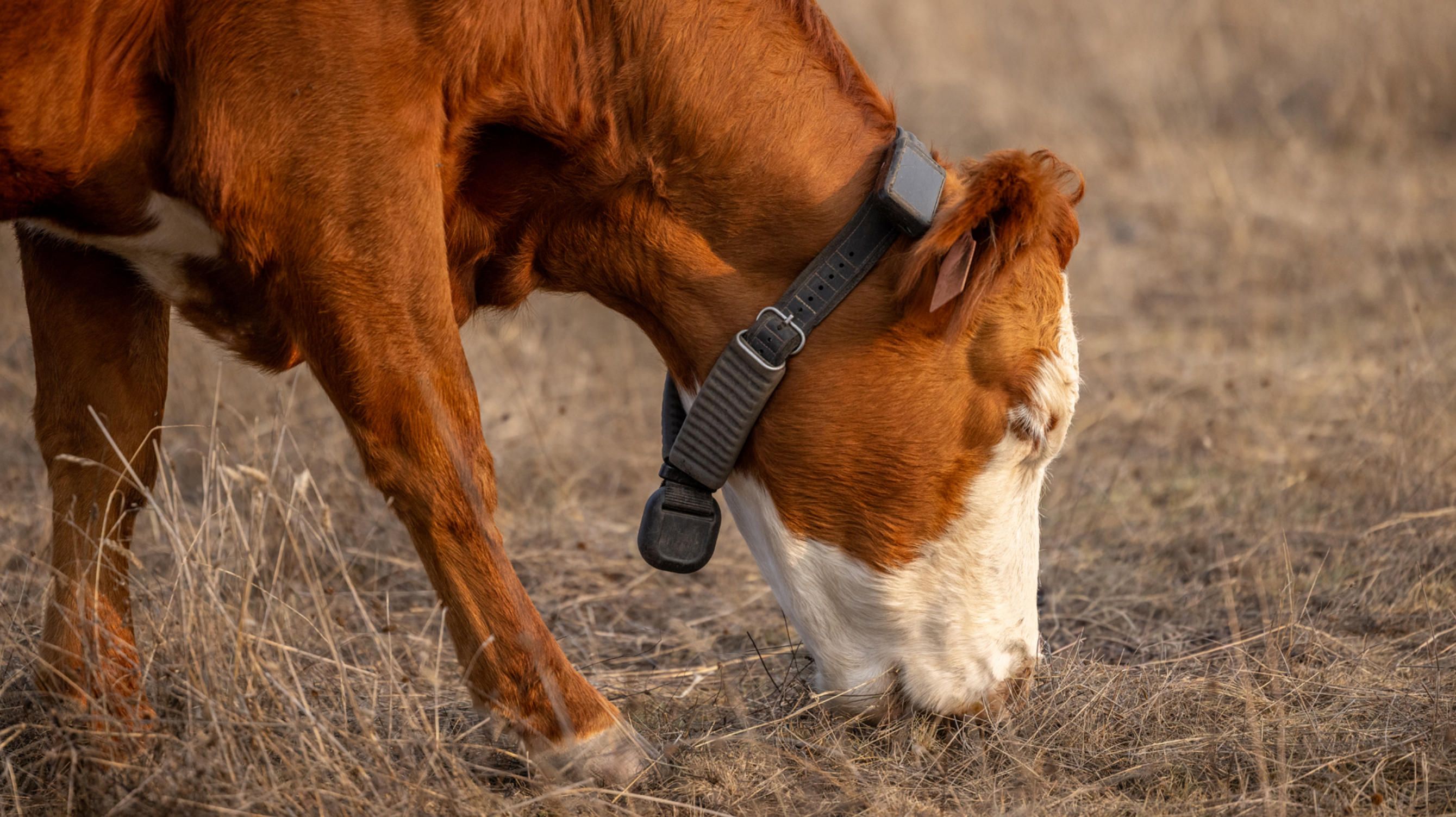
Most PLF tools observe. The reason a Halter review is worth opening with is that Halter also acts. Its solar-powered GPS collar is the visible end of a control loop that contains and moves cattle inside virtual boundaries a farmer draws on a phone — no wire, no posts, no mustering. The company reports around one million collars sold and more than 2,000 farms across New Zealand, Australia, and the United States, and raised a large Series E in early 2026 at a roughly USD 2 billion valuation, so this Halter review is examining an established system rather than a pilot.
Halter-gps-collar-pasture.jpg

The mechanism is the technically interesting part. At the center is an animal-behavior engine the company calls the Cowgorithm, which trains each animal to respond to directional sound. The Halter collar carries dual speakers that deliver distinct left and right audio cues, a vibration that confirms the direction to walk, and — only as a last resort, when an animal repeatedly ignores the primary cues — a low-energy electric pulse that the company states is markedly weaker than a conventional electric fence. A fair Halter review has to stress the ordering of that escalation, because it is what separates guidance from punishment: sound first, vibration to confirm, pulse rarely.

On the hardware and signal side, the Halter review gets more concrete. Each collar tracks position continuously, and the system openly publishes a working GPS accuracy of about 1.5 meters. Because raw GPS drifts with satellite geometry and obstructions, Halter runs filters that discard implausible position fixes, and it acknowledges that the residual error can over- or under-allocate feed by roughly that 1.5-meter margin when a virtual break is set — an honest engineering detail this Halter review credits. Connectivity originally relied on LoRaWAN towers placed on the property; the system has since added direct-to-satellite collars so that remote, leased, or seasonal country with no towers and no cell coverage can still be managed. For a monitoring-plus-actuation device running off a solar panel on a moving animal, that power and link budget is the whole game. On endurance, this Halter review notes the collar is built to run year-round on solar harvesting, holding reserve for spells of low light, because a guidance device that goes flat mid-paddock is worse than none. The Halter review also gives weight to the unglamorous engineering — multiple collar revisions for fit, weight, and durability on animals that rub, wade, and crash through brush for years. Set against a pure monitoring tag, the Halter review's defining distinction is that the same hardware that senses also acts, collapsing observation and intervention into a single loop.

Beyond fencing, the Halter review should note the passive layer: 24/7 location and behavior tracking, heat and health alerts, pasture-utilization and rest-day metrics, and a live "digital twin" of the farm. On welfare — unavoidable for any control system that can deliver a stimulus — a 2024 Journal of Dairy Science study of Halter collars in an intensive dairy setting reported effective containment and remote herding with many cows receiving no pulses once trained, and the UK's Animal Welfare Committee concluded in 2022 that virtual fencing can be used without harm given safeguards such as stimulus limits, defined training, and monitoring. Where this Halter review turns cautious is ownership: the control loop, the training model, and the data all live on the vendor's side. The honest closing point of this Halter review is the trade-off: it is unmatched where land area and mustering labor are the binding constraints, it is a closed vendor-controlled loop you do not fully own, the training-and-adaptation window is the welfare-sensitive phase, and it is built around grazing cattle rather than barn-level individual physiology. That last gap is exactly what the next review covers.

CowManager Review: Individual Physiology From the Ear

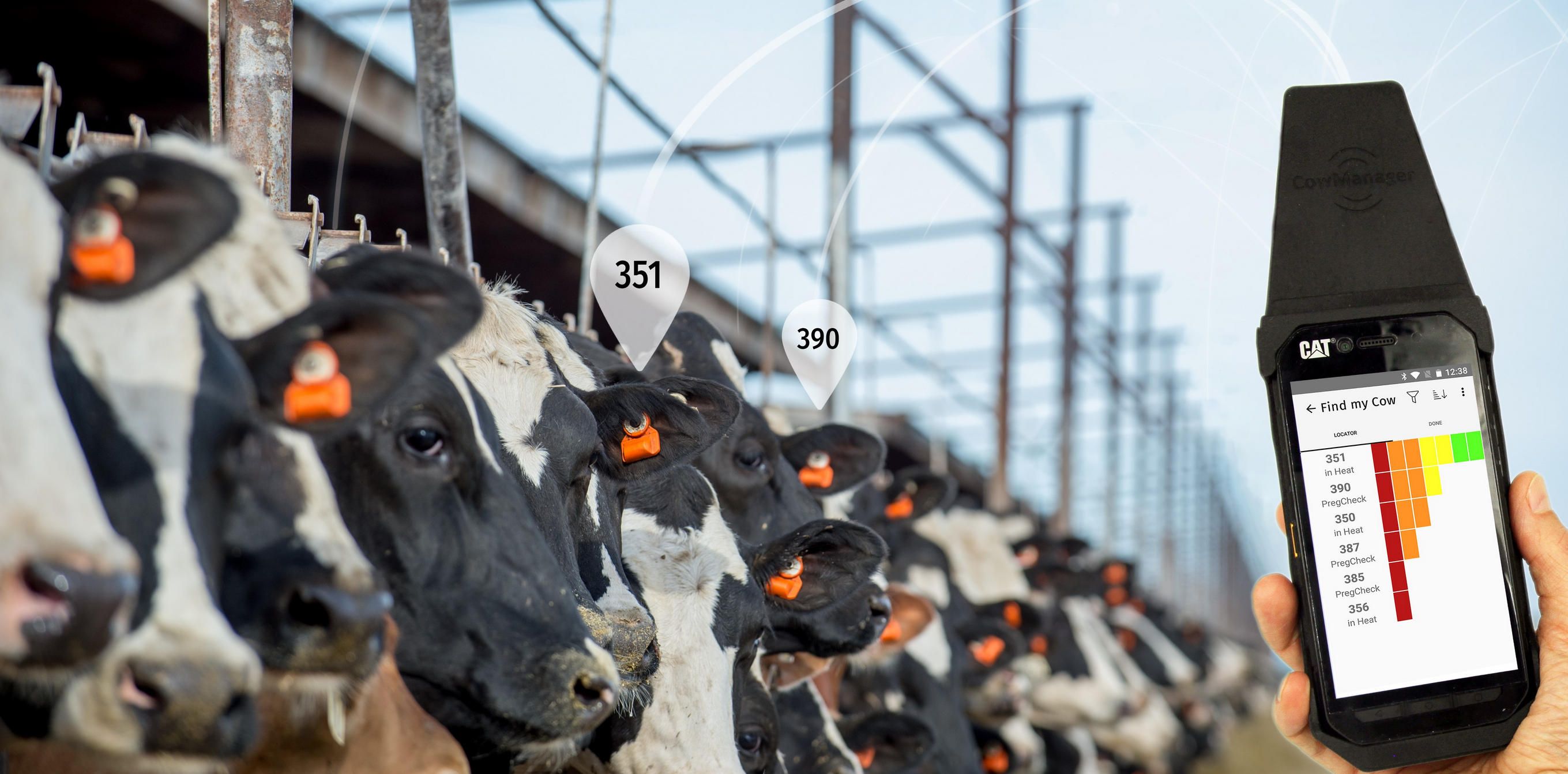
If Halter is location and actuation, the subject of this CowManager review is the opposite design choice: passive, continuous physiology read from a single point on the animal. The sensor — historically the SensOor, developed by Agis Automatisering in Harmelen, Netherlands — is a microchip that clips onto an existing EID button or a blank EID ear tag, and the EID version snaps on and off for direct identification at the parlor or sort gate. Starting a CowManager review from that detail matters, because mounting in the ear is what lets it combine accelerometer-based behavior with ear temperature in one small, low-power package.
CowManager-dairy-cow-ear-sensor-tag.jpg

The signal processing is where this CowManager review earns its "technical" label. The CowManager sensor classifies behavior into discrete states — eating, ruminating, inactive, active, and high-active — from accelerometer data, and validation studies against direct human observation have reported rumination detection with sensitivity around 99–100% and specificity in the high-80s to mid-90s percent, with a mean rumination cycle near 59 seconds. The detail that any rigorous CowManager review should pull out is this: classification accuracy depends strongly on how often the sensor streams data — continuously versus every 30 seconds materially changes performance — which is a direct trade-off between battery life, radio bandwidth, and model quality, and it is why the system caches and pre-processes on the tag rather than shipping every raw sample. That is the kind of edge-versus-cloud decision that defines the whole category.

Functionally, the CowManager review breaks into modules: Health, Fertility, and Nutrition, plus a Transition Monitor. Fusing ear temperature with behavior, the system claims illness alerts one to two days before clinical signs, heat detection precise enough to guide insemination roughly 10–22 hours after an alert, and transition-period flags that identify at-risk cows up to 50 days before calving — meaningful because a large share of adult-cow disease clusters in the first month after calving. Architecturally, this CowManager review describes a familiar PLF shape: sensor to a router/coordinator to an internet connection to a cloud program, surfaced through a customizable drag-and-drop dashboard with "multiview" sharing so a vet or nutritionist sees selected real-time data. Crucially, it integrates with 40-plus herd-management systems — DairyComp305, DeLaval, Lely, GEA, BouMatic and others — because on a working dairy it must coexist with whatever already runs the parlor.

The limitations belong in any balanced CowManager review. Ear temperature is influenced by ambient conditions and tag position, which is precisely why the platform fuses it with behavior rather than treating it as a clinical thermometer. The economics are per animal — a sensor plus subscription per cow — and the value is entirely contingent on someone acting on the alerts, so alert fatigue is a real failure mode. And as noted, reducing data cadence to save power degrades classification. On lifecycle, this CowManager review notes lightweight tags with reduced power draw, a hardware warranty tied to the subscription, and software refreshed on a roughly biweekly cadence. A newer addition the CowManager review should flag is a milk sensor that identifies each cow in the parlor and watches individual udder quarters for early mastitis signals. Against a location-and-actuation collar, the CowManager review's strength is depth per animal rather than reach across land. The verdict of this CowManager review: excellent, well-validated individual physiology and behavior sensing, delivered as a layer that must be wired into the farm's existing software and routine to pay off.

The Engineering Behind the Alerts

Read together, these two reviews map the real design space of PLF: where you sense, what you sense, how you get the data off the animal, and what you do with it. No single product owns all of that, which is why serious operations end up combining systems — and why the seams between them are where projects succeed or fail.

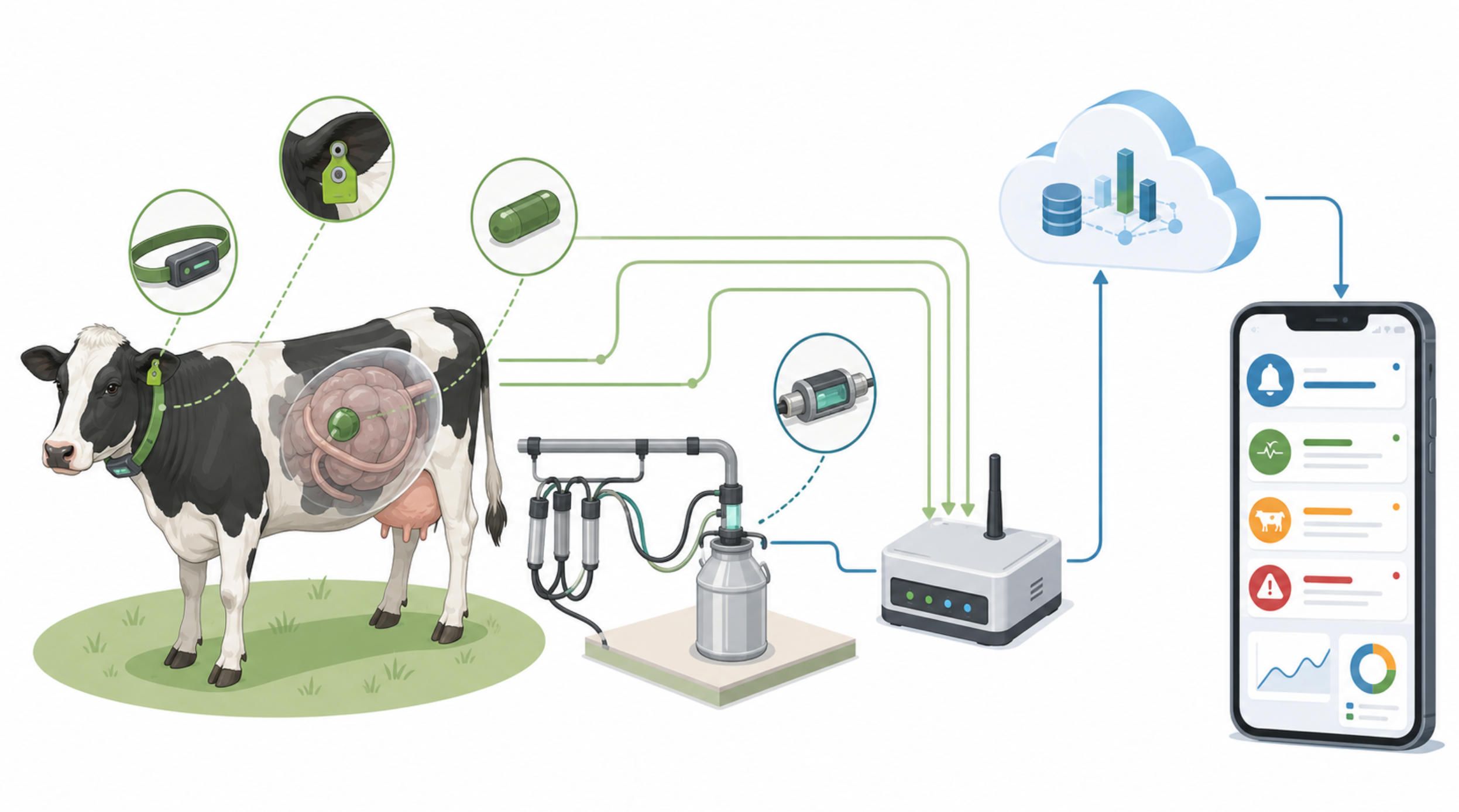
Start with sensing modality, because each one is a different physics-and-power problem. External accelerometers on the ear, neck, or leg infer behavior from motion and are cheap and non-invasive, but they read the outside of the animal. In-body boluses read the inside: the smaXtec reticulorumen bolus, for example, is a roughly 210-gram, 105-by-35-millimeter capsule administered once and left in the reticulum, measuring inner body temperature, drinking cycles and water intake, rumination via reticulum contractions, activity, and optionally pH, transmitting on the order of every ten minutes for up to a year or more on its battery. Internal data is far harder to corrupt with weather or tag position, which is why researchers use bolus pH to flag subacute ruminal acidosis and track the roughly 6.0–7.5 window where rumen methanogens are most active — but it requires an algorithm to strip out the temperature dips caused by cold drinking water before reticular temperature can stand in for core body temperature. Vision systems add body-condition scoring and lameness gait analysis without touching the animal; acoustic monitoring detects respiratory disease in swine and poultry by listening for coughs; inline milk sensors read conductivity and components per udder quarter to catch mastitis at milking. Every modality trades invasiveness, accuracy, power, and cost differently.

Then the harder half: the model. Turning an accelerometer stream into "this cow is ruminating" is a supervised classification problem whose ground truth comes from scarce, expensive human observation, and whose accuracy, as the CowManager validation work shows, moves with sampling cadence. A good system baselines each individual against herself rather than the herd, because a healthy high-activity cow and a sick average cow can look identical in absolute terms. And the metric that actually matters on-farm is positive predictive value, not raw sensitivity — calving-prediction models built on these sensors have posted respectable sensitivity but poor precision, which on a real dairy means false alarms, which means alert fatigue and ignored notifications. PLF lives or dies on specificity.

Underneath both sit two constraints engineers underestimate. The first is connectivity and power: barns are RF-hostile and pasture has no mains power, so deployments lean on LoRaWAN and other sub-GHz links, base stations, solar harvesting with tight duty cycles, and increasingly satellite — and on doing as much classification at the edge as possible to avoid transmitting raw data. The second is interoperability: the reason CowManager advertises 40-plus integrations and the industry leans on ICAR-style data standards is that every farm is already a patchwork of milking, feeding, and records systems. Data ends up siloed by vendor, and the question of who owns the herd's data and the models trained on it is rarely answered in the customer's favor.
livestock-sensing-modalities-diagram.jpg

Where Custom Development Fits — and How A-Bots.com Can Help

Off-the-shelf platforms like Halter and CowManager are the right answer for a great many operations. The case for custom software shows up at the edges that a single vendor will not serve: when an agribusiness or cooperative needs one branded app that unifies collars, ear tags, boluses, and milk sensors from several vendors instead of four logins; when per-animal subscription economics stop making sense across very large herds; when a deployment has to classify behavior and buffer data on the edge because the barn or the back paddock has no reliable link; when proprietary hardware needs its own firmware, telemetry pipeline, and alert logic; or when a company wants to own the analytics layer and the data rather than rent someone else's closed loop.

This is the work A-Bots.com does. We build custom mobile and web apps, device firmware and IoT integration, edge and cloud data pipelines, and the behavior-classification and alerting models on top — for a full product or for a single module inside an existing stack. If you already run a PLF platform, we also provide independent QA and testing: validating sensor accuracy and behavior classification against ground truth, stress-testing alert logic for false-positive rates, and checking offline sync, load, and integration with herd-management systems. Concretely, that might be a branded multi-sensor herd app, an offline-first edge gateway for barns and pasture, firmware and a connectivity layer for your own tags or boluses, integrations that let your data live alongside the systems your farm already uses, or a focused QA engagement on a product you have already shipped.

If you need software or a mobile application for precision livestock farming — a complete platform, a specific module, or thorough testing of what you already run — A-Bots.com will gladly design and build it to your requirements. Tell us what your animals, your barns, and your team need, and we will scope it with you. Reach out at info@a-bots.com.

✅ Hashtags

#PrecisionLivestockFarming
#PLF
#AgTech
#DairyTech
#LivestockMonitoring
#IoT
#VirtualFencing
#AppDevelopment

Other articles

Warehouse and Inventory Mobile ERP Apps: From Barcode Scanning to Real-Time Stock Control How warehouse and inventory mobile ERP apps connect physical stock movement with real-time ERP data. It focuses on barcode scanning, QR workflows, receiving, picking, packing, stock transfers, cycle counts, returns, damaged goods, offline synchronization, audit trails, and ERP or WMS integration. The key idea is the Inventory Truth Engine - a custom module that shows not only stock quantity, but also how trustworthy that quantity is. The article positions custom mobile app development as a practical way for companies to reduce inventory errors, improve fulfillment accuracy, protect margin, and make ERP data more reliable.

ERP Apps for Manufacturing and Equipment Companies: Production, Maintenance, Spare Parts, and After-Sales Control This article explains how manufacturing and equipment companies can use custom ERP mobile apps to connect production data, installed equipment, spare parts, maintenance, warranty, dealer networks, and after-sales revenue into one controlled lifecycle. The key concept is the Installed Base Revenue Radar - a custom module that helps manufacturers understand what each sold machine is likely to need next: maintenance, parts, warranty attention, dealer follow-up, upgrades, or service contracts. The article shows why ERP should not stop at the factory gate and how mobile apps can turn every sold unit into a managed service asset.

How to Build a Custom ERP Mobile App How to build a custom ERP mobile app as a controlled execution layer, not just a smaller ERP screen. It shows why mobile ERP architecture must protect the system of record while allowing field teams, warehouse workers, managers, dealers, and service staff to complete real workflows at the edge of the business. The article covers integration layers, offline-first synchronization, action-based security, AI governance, human-in-the-loop control, audit trails, and the Enterprise Workflow Command Center - a trigger feature that gives companies visibility into mobile transactions, sync risks, approvals, validation errors, and ERP workflow health.

Canon Printer App for Android: A Real Setup Guide Getting a printer to work from an Android phone should be simple, and with most Canon models it is: the right Canon printer app for Android finds the printer and prints on the first try. But branded printer apps still fail sometimes, as a real Xerox Phaser 3020 case shows, where the official plugin refused with "device not supported." This guide explains what the official Canon printer app for Android options are, why a universal app like NokoPrint often succeeds where the branded one stalls, and the exact manual fix, an IP address plus port 9100, that prints when nothing else will. It closes with how A-Bots.com builds reliable companion apps for connected hardware.

Precision Field Monitoring: Climate FieldView & CropX Review Reviews two leading tools for precision crop and field monitoring. The first half is a detailed, hands-on review of Climate FieldView, the Bayer data platform built around live planting maps, imagery, and variable-rate prescriptions, and CropX, the soil-intelligence system whose in-ground sensors report moisture, temperature, and conductivity by depth. It weighs features, mobile apps, pricing, and real user complaints for each. The second half maps the wider technology stack, the connectivity and integration gaps in off-the-shelf products, and where custom development or independent QA testing makes sense. It closes with how A-Bots.com builds tailored field-monitoring apps, IoT integrations, and tests existing platforms.

Top stories

  • food delivery app development

    food ordering startups

    custom food ordering app

    food delivery startups

    Food Delivery and Food Ordering Mobile App Development

    A-Bots.com offers custom food delivery and food ordering mobile app development for startups and restaurants. From UI/UX to testing, we build scalable apps with real-time tracking, secure payments, and AI personalization.

  • apple watch for seniors

    iOS app development company

    apple watch healthcare apps

    watchOS app development

    senior apple watch app

    Apple Watch for Seniors: Custom Apps and Elder-Care Solutions

    Explore how Apple Watch for seniors transforms elder care. Learn how custom watchOS and iOS app development improves safety, health, and independence.

  • unitree G1 programming

    custom software for unitree G1

    humanoid robot

    unitree G1 control

    unitree G1 SDK

    Custom Unitree G1 Programming and Unitree G1 SDK App Development

    Bespoke Unitree G1 programming, SDK integrations and app development. A-Bots.com creates custom robotics software for advanced humanoid solutions.

  • drones show app development company

    app development for swarm of drones

    software development for drones show

    IoT app development company

    Swarm of Drones and Drones Show Software Development Company

    A-Bots.com is a drones show app development company delivering app development for swarm of drones: orchestration servers, ArduPilot Mission Planner workflows, operator-grade mobile apps, safety-first timing, and scalable IoT integrations.

  • farmer app development company

    agritech app development company

    bespoke agriculture application development

    agriculture app development company

    bespoke agro apps

    Farmer App Development Company - Smart Farming Apps and Integrations

    A-Bots.com - farmer app development company for offline-first smart farming apps. We integrate John Deere, FieldView & Trimble to deliver the best farmer apps and compliant farming applications in the US, Canada and EU.

  • counter-drone software

    drone detection and tracking

    LiDAR drone tracking

    AI counter drone (C-UAV)

    Counter-Drone (C-UAV) Visual Tracking and Trajectory Prediction

    Field-ready counter-drone perception: sensors, RGB-T fusion, edge AI, tracking, and short-horizon prediction - delivered as a production stack by A-Bots.com.

  • pet care application development

    custom pet-care app

    pet health app

    veterinary app integration

    litter box analytics

    Custom Pet Care App Development

    A-Bots.com is a mobile app development company delivering custom pet care app development with consent-led identity, behavior AI, offline-first routines, and seamless integrations with vets, insurers, microchips, and shelters.

  • agriculture mobile application developmen

    ISOBUS mobile integration

    smart farming mobile app

    precision farming app

    Real-Time Agronomic Insights through IoT-Driven Mobile Analytics

    Learn how edge-AI, cloud pipelines and mobile UX transform raw farm telemetry into real-time, actionable maps—powered by A-Bots.com’s agriculture mobile application development expertise.

  • ge predix platform

    industrial iot platform

    custom iot app development

    industrial iot solutions

    industrial edge analytics

    predictive maintenance software

    GE Predix Platform and Industrial IoT App Development

    Discover how GE Predix Platform and custom apps from A-Bots.com enable real-time analytics, asset performance management, and scalable industrial IoT solutions.

  • industrial iot solutions

    industrial iot development

    industrial edge computing

    iot app development

    Industrial IoT Solutions at Scale: Secure Edge-to-Cloud with A-Bots.com

    Discover how A-Bots.com engineers secure, zero-trust industrial IoT solutions— from rugged edge gateways to cloud analytics— unlocking real-time efficiency, uptime and compliance.

  • eBike App Development Company

    custom ebike app development

    ebike IoT development

    ebike OEM app solution

    ebike mobile app

    Sensor-Fusion eBike App Development Company

    Unlock next-gen riding experiences with A-Bots.com: a sensor-centric eBike app development company delivering adaptive pedal-assist, predictive maintenance and cloud dashboards for global OEMs.

  • pet care app development company

    pet hotel CRM

    pet hotel IoT

    pet hotel app

    Pet Hotel App Development

    Discover how A-Bots.com, a leading pet care app development company, builds full-stack mobile and CRM solutions that automate booking, feeding, video, and revenue for modern pet hotels.

  • DoorDash drone delivery

    Wing drone partnership

    drone delivery service

    build drone delivery app

    drone delivery software development

    Explore Wing’s and DoorDash drone delivery

    From sub-15-minute drops to FAA-grade safety, we unpack DoorDash’s drone playbook—and show why software, not rotors, will decide who owns the sky.

  • drone mapping software

    adaptive sensor-fusion mapping

    custom drone mapping development

    edge AI drone processing

    Drone Mapping and Sensor Fusion

    Explore today’s photogrammetry - LiDAR landscape and the new Adaptive Sensor-Fusion Mapping method- see how A-Bots.com turns flight data into live, gap-free maps.

  • Otter AI transcription

    Otter voice meeting notes

    Otter audio to text

    Otter voice to text

    voice to text AI

    Otter.ai Transcription and Voice Notes

    Deep guide to Otter.ai transcription, voice meeting notes, and audio to text. Best practices, automation, integration, and how A-Bots.com can build your custom AI.

  • How to use Wiz AI

    Wiz AI voice campaign

    Wiz AI CRM integration

    Smart trigger chatbot Wiz AI

    Wiz AI Chat Bot: Hands-On Guide to Voice Automation

    Master the Wiz AI chat bot: from setup to smart triggers, multilingual flows, and human-sounding voice UX. Expert guide for CX teams and product owners.

  • Tome AI Review

    Enterprise AI

    CRM

    Tome AI Deep Dive Review

    Explore Tome AI’s architecture, workflows and EU-ready compliance. Learn how generative decks cut prep time, boost sales velocity and where A-Bots.com adds AI chatbot value.

  • Wiz.ai

    Voice Conversational AI

    Voice AI

    Inside Wiz.ai: Voice-First Conversational AI in SEA

    Explore Wiz.ai’s rise from Singapore startup to regional heavyweight, its voice-first tech stack, KPIs, and lessons shaping next-gen conversational AI.

  • TheLevel.AI

    CX-Intelligence Platforms

    Bespoke conversation-intelligence stacks

    Level AI

    Contact Center AI

    Beyond Level AI: How A-Bots.com Builds Custom CX-Intelligence Platforms

    Unlock Level AI’s secrets and see how A-Bots.com engineers bespoke conversation-intelligence stacks that slash QA costs, meet tight compliance rules, and elevate customer experience.

  • Offline AI Assistant

    AI App Development

    On Device LLM

    AI Without Internet

    Offline AI Assistant Guide - Build On-Device LLMs with A-Bots

    Discover why offline AI assistants beat cloud chatbots on privacy, latency and cost—and how A-Bots.com ships a 4 GB Llama-3 app to stores in 12 weeks.

  • Drone Mapping Software

    UAV Mapping Software

    Mapping Software For Drones

    Pix4Dmapper (Pix4D)

    DroneDeploy (DroneDeploy Inc.)

    DJI Terra (DJI Enterprise)

    Agisoft Metashape 1.9 (Agisoft)

    Bentley ContextCapture (Bentley Systems)

    Propeller Pioneer (Propeller Aero)

    Esri Site Scan (Esri)

    Drone Mapping Software (UAV Mapping Software): 2025 Guide

    Discover the definitive 2025 playbook for deploying drone mapping software & UAV mapping software at enterprise scale—covering mission planning, QA workflows, compliance and data governance.

  • App for DJI

    Custom app for Dji drones

    Mapping Solutions

    Custom Flight Control

    app development for dji drone

    App for DJI Drone: Custom Flight Control and Mapping Solutions

    Discover how a tailor‑made app for DJI drone turns Mini 4 Pro, Mavic 3 Enterprise and Matrice 350 RTK flights into automated, real‑time, BVLOS‑ready data workflows.

  • Chips Promo App

    Snacks Promo App

    Mobile App Development

    AR Marketing

    Snack‑to‑Stardom App: Gamified Promo for Chips and Snacks

    Learn how A‑Bots.com's gamified app turns snack fans into streamers with AR quests, guaranteed prizes and live engagement—boosting sales and first‑party data.

  • Mobile Apps for Baby Monitor

    Cry Detection

    Sleep Analytics

    Parent Tech

    AI Baby Monitor

    Custom Mobile Apps for AI Baby Monitors | Cry Detection, Sleep Analytics and Peace-of-Mind

    Turn your AI baby monitor into a trusted sleep-wellness platform. A-Bots.com builds custom mobile apps with real-time cry detection, sleep analytics, and HIPAA-ready cloud security—giving parents peace of mind and brands recurring revenue.

  • wine app

    Mobile App for Wine Cabinets

    custom wine fridge app

    Custom Mobile App Development for Smart Wine Cabinets: Elevate Your Connected Wine Experience

    Discover how custom mobile apps transform smart wine cabinets into premium, connected experiences for collectors, restaurants, and luxury brands.

  • agriculture mobile application

    farmers mobile app

    smart phone apps in agriculture

    Custom Agriculture App Development for Farmers

    Build a mobile app for your farm with A-Bots.com. Custom tools for crop, livestock, and equipment management — developed by and for modern farmers.

  • IoT

    Smart Home

    technology

    Internet of Things and the Smart Home

    Internet of Things (IoT) and the Smart Home: The Future is Here

  • IOT

    IIoT

    IAM

    AIoT

    AgriTech

    Today, the Internet of Things (IoT) is actively developing, and many solutions are already being used in various industries.

    Today, the Internet of Things (IoT) is actively developing, and many solutions are already being used in various industries.

  • IOT

    Smart Homes

    Industrial IoT

    Security and Privacy

    Healthcare and Medicine

    The Future of the Internet of Things (IoT)

    The Future of the Internet of Things (IoT)

  • IoT

    Future

    Internet of Things

    A Brief History IoT

    A Brief History of the Internet of Things (IoT)

  • Future Prospects

    IoT

    drones

    IoT and Modern Drones: Synergy of Technologies

    IoT and Modern Drones: Synergy of Technologies

  • Drones

    Artificial Intelligence

    technologi

    Inventions that Enabled the Creation of Modern Drones

    Inventions that Enabled the Creation of Modern Drones

  • Water Drones

    Drones

    Technological Advancements

    Water Drones: New Horizons for Researchers

    Water Drones: New Horizons for Researchers

  • IoT

    IoT in Agriculture

    Applying IoT in Agriculture: Smart Farming Systems for Increased Yield and Sustainability

    Explore the transformative impact of IoT in agriculture with our article on 'Applying IoT in Agriculture: Smart Farming Systems for Increased Yield and Sustainability.' Discover how smart farming technologies are revolutionizing resource management, enhancing crop yields, and fostering sustainable practices for a greener future.

  • Bing

    Advertising

    How to set up contextual advertising in Bing

    Unlock the secrets of effective digital marketing with our comprehensive guide on setting up contextual advertising in Bing. Learn step-by-step strategies to optimize your campaigns, reach a diverse audience, and elevate your online presence beyond traditional platforms.

  • mobile application

    app market

    What is the best way to choose a mobile application?

    Unlock the secrets to navigating the mobile app jungle with our insightful guide, "What is the Best Way to Choose a Mobile Application?" Explore expert tips on defining needs, evaluating security, and optimizing user experience to make informed choices in the ever-expanding world of mobile applications.

  • Mobile app

    Mobile app development company

    Mobile app development company in France

    Elevate your digital presence with our top-tier mobile app development services in France, where innovation meets expertise to bring your ideas to life on every mobile device.

  • Bounce Rate

    Mobile Optimization

    The Narrative of Swift Bounces

    What is bounce rate, what is a good bounce rate—and how to reduce yours

    Uncover the nuances of bounce rate, discover the benchmarks for a good rate, and learn effective strategies to trim down yours in this comprehensive guide on optimizing user engagement in the digital realm.

  • IoT

    technologies

    The Development of Internet of Things (IoT): Prospects and Achievements

    The Development of Internet of Things (IoT): Prospects and Achievements

  • Bots

    Smart Contracts

    Busines

    Bots and Smart Contracts: Revolutionizing Business

    Modern businesses constantly face challenges and opportunities presented by new technologies. Two such innovative tools that are gaining increasing attention are bots and smart contracts. Bots, or software robots, and blockchain-based smart contracts offer unique opportunities for automating business processes, optimizing operations, and improving customer interactions. In this article, we will explore how the use of bots and smart contracts can revolutionize the modern business landscape.

  • No-Code

    No-Code solutions

    IT industry

    No-Code Solutions: A Breakthrough in the IT World

    No-Code Solutions: A Breakthrough in the IT World In recent years, information technology (IT) has continued to evolve, offering new and innovative ways to create applications and software. One key trend that has gained significant popularity is the use of No-Code solutions. The No-Code approach enables individuals without technical expertise to create functional and user-friendly applications using ready-made tools and components. In this article, we will explore the modern No-Code solutions currently available in the IT field.

  • Support

    Department Assistants

    Bot

    Boosting Customer Satisfaction with Bot Support Department Assistants

    In today's fast-paced digital world, businesses strive to deliver exceptional customer support experiences. One emerging solution to streamline customer service operations and enhance user satisfaction is the use of bot support department assistants.

  • IoT

    healthcare

    transportation

    manufacturing

    Smart home

    IoT have changed our world

    The Internet of Things (IoT) is a technology that connects physical devices with smartphones, PCs, and other devices over the Internet. This allows devices to collect, process and exchange data without the need for human intervention. New technological solutions built on IoT have changed our world, making our life easier and better in various areas. One of the important changes that the IoT has brought to our world is the healthcare industry. IoT devices are used in medical devices such as heart rate monitors, insulin pumps, and other medical devices. This allows patients to take control of their health, prevent disease, and provide faster and more accurate diagnosis and treatment. Another important area where the IoT has changed our world is transportation. IoT technologies are being used in cars to improve road safety. Systems such as automatic braking and collision alert help prevent accidents. In addition, IoT is also being used to optimize the flow of traffic, manage vehicles, and create smart cities. IoT solutions are also of great importance to the industry. In the field of manufacturing, IoT is used for data collection and analysis, quality control and efficiency improvement. Thanks to the IoT, manufacturing processes have become more automated and intelligent, resulting in increased productivity, reduced costs and improved product quality. Finally, the IoT has also changed our daily lives. Smart homes equipped with IoT devices allow people to control and manage their homes using mobile apps. Devices such as smart thermostats and security systems, vacuum cleaners and others help to increase the level of comfort

  • tourism

    Mobile applications for tourism

    app

    Mobile applications in tourism

    Mobile applications have become an essential tool for travelers to plan their trips, make reservations, and explore destinations. In the tourism industry, mobile applications are increasingly being used to improve the travel experience and provide personalized services to travelers. Mobile applications for tourism offer a range of features, including destination information, booking and reservation services, interactive maps, travel guides, and reviews of hotels, restaurants, and attractions. These apps are designed to cater to the needs of different types of travelers, from budget backpackers to luxury tourists. One of the most significant benefits of mobile applications for tourism is that they enable travelers to access information and services quickly and conveniently. For example, travelers can use mobile apps to find flights, hotels, and activities that suit their preferences and budget. They can also access real-time information on weather, traffic, and local events, allowing them to plan their itinerary and make adjustments on the fly. Mobile applications for tourism also provide a more personalized experience for travelers. Many apps use algorithms to recommend activities, restaurants, and attractions based on the traveler's interests and previous activities. This feature is particularly useful for travelers who are unfamiliar with a destination and want to explore it in a way that matches their preferences. Another benefit of mobile applications for tourism is that they can help travelers save money. Many apps offer discounts, deals, and loyalty programs that allow travelers to save on flights, hotels, and activities. This feature is especially beneficial for budget travelers who are looking to get the most value for their money. Mobile applications for tourism also provide a platform for travelers to share their experiences and recommendations with others. Many apps allow travelers to write reviews, rate attractions, and share photos and videos of their trips. This user-generated content is a valuable resource for other travelers who are planning their trips and looking for recommendations. Despite the benefits of mobile applications for tourism, there are some challenges that need to be addressed. One of the most significant challenges is ensuring the security and privacy of travelers' data. Travelers need to be confident that their personal and financial information is safe when using mobile apps. In conclusion, mobile applications have become an essential tool for travelers, and their use in the tourism industry is growing rapidly. With their ability to provide personalized services, real-time information, and cost-saving options, mobile apps are changing the way travelers plan and experience their trips. As technology continues to advance, we can expect to see even more innovative and useful mobile applications for tourism in the future.

  • Mobile applications

    logistics

    logistics processes

    mobile app

    Mobile applications in logistics

    In today's world, the use of mobile applications in logistics is becoming increasingly common. Mobile applications provide companies with new opportunities to manage and optimize logistics processes, increase productivity, and improve customer service. In this article, we will discuss the benefits of mobile applications in logistics and how they can help your company. Optimizing Logistics Processes: Mobile applications allow logistics companies to manage their processes more efficiently. They can be used to track shipments, manage inventory, manage transportation, and manage orders. Mobile applications also allow on-site employees to quickly receive information about shipments and orders, improving communication between departments and reducing time spent on completing tasks. Increasing Productivity: Mobile applications can also help increase employee productivity. They can be used to automate routine tasks, such as filling out reports and checking inventory. This allows employees to focus on more important tasks, such as processing orders and serving customers. Improving Customer Service: Mobile applications can also help improve the quality of customer service. They allow customers to track the status of their orders and receive information about delivery. This improves transparency and reliability in the delivery process, leading to increased customer satisfaction and repeat business. Conclusion: Mobile applications are becoming increasingly important for logistics companies. They allow you to optimize logistics processes, increase employee productivity, and improve the quality of customer service. If you're not already using mobile applications in your logistics company, we recommend that you pay attention to them and start experimenting with their use. They have the potential to revolutionize the way you manage your logistics operations and provide better service to your customers.

  • Mobile applications

    businesses

    mobile applications in business

    mobile app

    Mobile applications on businesses

    Mobile applications have become an integral part of our lives and have an impact on businesses. They allow companies to be closer to their customers by providing them with access to information and services anytime, anywhere. One of the key applications of mobile applications in business is the implementation of mobile commerce. Applications allow customers to easily and quickly place orders, pay for goods and services, and track their delivery. This improves customer convenience and increases sales opportunities.

  • business partner

    IT company

    IT solutions

    IT companies are becoming an increasingly important business partner

    IT companies are becoming an increasingly important business partner, so it is important to know how to build an effective partnership with an IT company. 1. Define your business goals. Before starting cooperation with an IT company, it is important to define your business goals and understand how IT solutions can help you achieve them. 2. Choose a trusted partner. Finding a reliable and experienced IT partner can take a lot of time, but it is essential for a successful collaboration. Pay attention to customer reviews and projects that the company has completed. 3. Create an overall work plan. Once you have chosen an IT company, it is important to create an overall work plan to ensure effective communication and meeting deadlines.

  • Augmented reality

    AR

    visualization

    business

    Augmented Reality

    Augmented Reality (AR) can be used for various types of businesses. It can be used to improve education and training, provide better customer service, improve production and service efficiency, increase sales and marketing, and more. In particular, AR promotes information visualization, allowing users to visually see the connection between the virtual and real world and gain a deeper understanding of the situation. Augmented reality can be used to improve learning and training based on information visualization and provide a more interactive experience. For example, in medicine, AR can be used to educate students and doctors by helping them visualize and understand anatomy and disease. In business, the use of AR can improve production and service efficiency. For example, the use of AR can help instruct and educate employees in manufacturing, helping them learn new processes and solve problems faster and more efficiently. AR can also be used in marketing and sales. For example, the use of AR can help consumers visualize and experience products before purchasing them.

  • Minimum Viable Product

    MVP

    development

    mobile app

    Minimum Viable Product

    A Minimum Viable Product (MVP) is a development approach where a new product is launched with a limited set of features that are sufficient to satisfy early adopters. The MVP is used to validate the product's core assumptions and gather feedback from the market. This feedback can then be used to guide further development and make informed decisions about which features to add or remove. For a mobile app, an MVP can be a stripped-down version of the final product that includes only the most essential features. This approach allows developers to test the app's core functionality and gather feedback from users before investing a lot of time and resources into building out the full app. An MVP for a mobile app should include the core functionality that is necessary for the app to provide value to the user. This might include key features such as user registration, search functionality, or the ability to view and interact with content. It should also have a good UI/UX that are easy to understand and use. By launching an MVP, developers can quickly gauge user interest and feedback to make data-driven decisions about which features to prioritize in the full version of the app. Additionally, MVP approach can allow quicker time to market and start to gather user engagement. There are several benefits to using the MVP approach for a mobile app for a company: 1 Validate assumptions: By launching an MVP, companies can validate their assumptions about what features and functionality will be most valuable to their target market. Gathering user feedback during the MVP phase can help a company make informed decisions about which features to prioritize in the full version of the app. 2 Faster time to market: Developing an MVP allows a company to launch their app quickly and start gathering user engagement and feedback sooner, rather than spending months or even years developing a full-featured app. This can give a company a competitive advantage in the market. 3 Reduced development costs: By focusing on the most essential features, an MVP can be developed with a smaller budget and with less time than a full version of the app. This can help a company save money and resources. 4 Minimize the risk: MVP allows to test the market and customer interest before spending a large amount of resources on the app. It can help to minimize risk of a failure by testing the idea and gathering feedback before moving forward with a full-featured version. 5 Better understanding of user needs: Building MVP can also help a company to understand the customer's real needs, behaviors and preferences, with this knowledge the company can create a much more effective and efficient final product. Overall, the MVP approach can provide a cost-effective way for a company to validate their product idea, gather user feedback, and make informed decisions about the development of their mobile app.

  • IoT

    AI

    Internet of Things

    Artificial Intelligence

    IoT (Internet of Things) and AI (Artificial Intelligence)

    IoT (Internet of Things) and AI (Artificial Intelligence) are two technologies that are actively developing at present and have enormous potential. Both technologies can work together to improve the operation of various systems and devices, provide more efficient resource management and provide new opportunities for business and society. IoT allows devices to exchange data and interact with each other through the internet. This opens up a multitude of possibilities for improving efficiency and automating various systems. With IoT, it is possible to track the condition of equipment, manage energy consumption, monitor inventory levels and much more. AI, on the other hand, allows for the processing of large amounts of data and decision-making based on that data. This makes it very useful for analyzing data obtained from IoT devices. For example, AI can analyze data on the operation of equipment and predict potential failures, which can prevent unexpected downtime and reduce maintenance costs. AI can also be used to improve the efficiency of energy, transportation, healthcare and other systems. In addition, IoT and AI can be used together to create smart cities. For example, using IoT devices, data can be collected on the environment and the behavior of people in the city. This data can be analyzed using AI to optimize the operation of the city's infrastructure, improve the transportation system, increase energy efficiency, etc. IoT and AI can also be used to improve safety in the city, for example, through the use of AI-analyzed video surveillance systems. In general, IoT and AI are two technologies that can work together to improve the operation of various systems and devices, as well as create new opportunities for business and society. In the future, and especially in 2023, the use of IoT and AI is expected to increase significantly, bringing even more benefits and possibilities.

Estimate project

Keep up with the times and automate your business processes with bots.

Estimate project

Copyright © Alpha Systems LTD All rights reserved.
Made with ❤️ by A-BOTS

EN