
Home
Services
About us
Blog
Contacts
ERP Apps for Manufacturing and Equipment Companies: Production, Maintenance, Spare Parts, and After-Sales Control
Manufacturing Does Not End When the Product Leaves the Factory
For many manufacturing and equipment companies, the sale is still treated as the finish line. A machine is produced, shipped, installed, invoiced, and handed over to the customer or dealer network. The ERP system records the order, the bill of materials, the stock movement, the invoice, the warranty period, and maybe the serial number. From a production perspective, the job is done.
From a business perspective, the most valuable part may be just beginning.
Modern equipment companies do not only compete on product quality. They compete on uptime, spare parts availability, maintenance support, warranty response, service documentation, dealer performance, upgrade paths, and the ability to help customers operate assets for years. A machine, robot, HVAC unit, agricultural implement, industrial tool, medical device, cleaning robot, drone system, coffee machine, vending machine, or smart equipment platform can generate value long after the original sale.
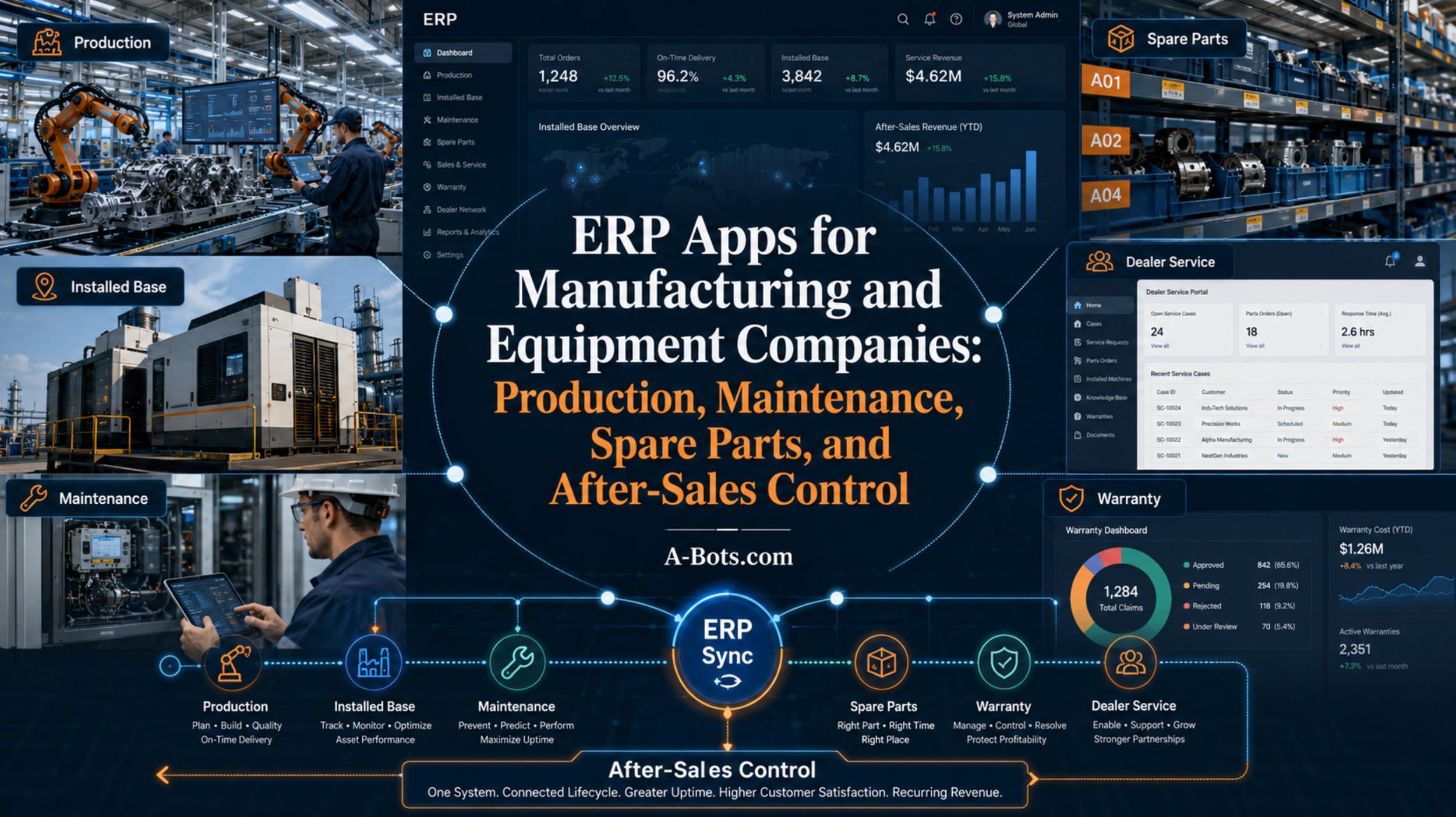
This is why manufacturers need more than ERP for production. They need mobile ERP apps that connect production records, installed equipment, maintenance events, spare parts, field service, warranty logic, dealers, and after-sales revenue into one operational system.
A classic ERP system can store product, order, inventory, and financial data. But many manufacturers still struggle to connect ERP with what happens after delivery. The installed base becomes fragmented across spreadsheets, dealer systems, service emails, warranty claims, technician notes, spare parts orders, and customer support conversations.
The result is a major blind spot: the manufacturer may know how many units it sold, but not how those units perform, when they need service, which parts they consume, which dealers respond fastest, which customers are at risk, and where future revenue will come from.
A custom ERP mobile app can close this gap.
For A-Bots.com, this is a powerful development niche because it sits exactly at the intersection of mobile apps, ERP integration, IoT, service workflows, spare parts catalogs, dealer portals, and B2B customer experience. The goal is not to replace the manufacturer’s ERP. The goal is to extend it into the real world where equipment lives, breaks, consumes parts, generates service tickets, and creates recurring revenue.
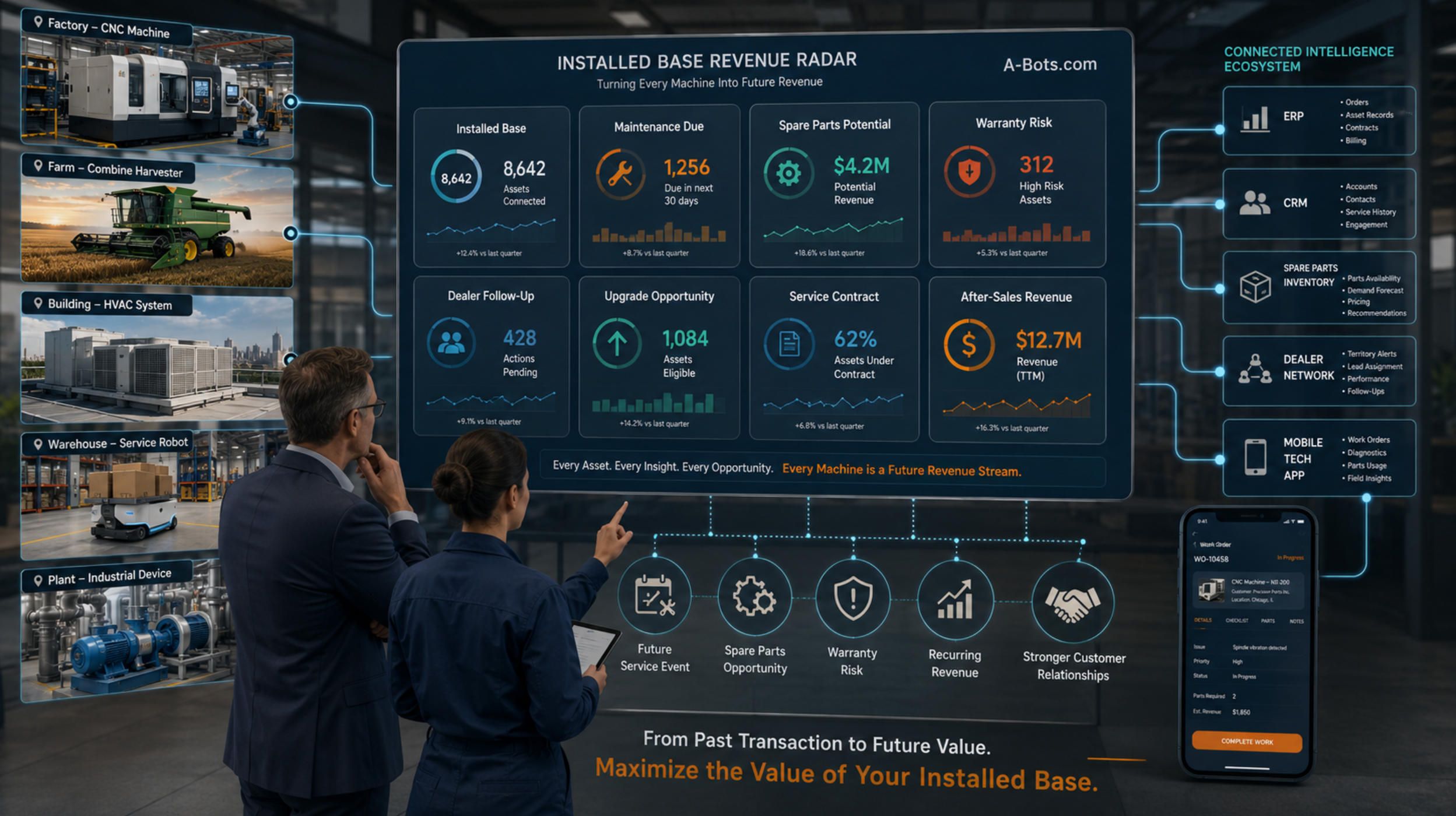
The “wow” trigger for this article is the Installed Base Revenue Radar.
It is a custom mobile and backend module that turns every sold machine or device into a monitored service asset with visible revenue potential, warranty risk, spare parts demand, maintenance timing, and dealer action.
The key idea is simple:
A manufacturer should not only know what it has sold. It should know what every sold unit is likely to need next.
Why After-Sales Is Becoming a Strategic Battleground
Equipment manufacturers are under pressure from several directions. Production costs are rising. Supply chains remain volatile. Customers expect faster service. Skilled technicians are difficult to find. Dealers want better digital tools. Spare parts must be available at the right place and time. Machines are becoming more connected, more complex, and more software-driven.
At the same time, after-sales is becoming one of the most attractive areas for growth.
Spare parts, maintenance contracts, service visits, inspections, upgrades, consumables, remote diagnostics, refurbishment, subscription features, training, and digital support can create long-term revenue streams. In many equipment categories, the lifetime value of a customer depends not only on the initial sale, but on how well the manufacturer manages the installed base.
This creates a strategic shift.
The manufacturer is no longer only a producer. It becomes an operator of an equipment ecosystem.
That ecosystem includes:
- machines and serial numbers;
- customers and asset locations;
- dealers and service partners;
- spare parts and consumables;
- warranties and service contracts;
- maintenance schedules and service history;
- IoT signals and remote diagnostics;
- mobile apps for technicians, dealers, and customers;
- ERP, CRM, warehouse, finance, and support systems.
Without software that connects these layers, after-sales remains reactive. The company waits for a breakdown, a customer complaint, a dealer request, or a warranty claim. With a proper mobile ERP app, after-sales becomes proactive. The company can see what equipment is installed, where it is, what service it needs, what parts it may require, which warranty cases are likely, and which revenue opportunities are approaching.
That is the business case for manufacturing ERP mobile apps.
The Installed Base: The Asset Most Manufacturers Underuse
The installed base is the complete population of machines, devices, or equipment units already sold and operating in the field. It is one of the most valuable datasets a manufacturer can own.
But in many companies, installed base data is incomplete, outdated, or poorly connected.
A manufacturer may know that a machine was sold to a distributor. But where is it now? Which end customer uses it? Was it installed correctly? Has it been serviced? Which components were replaced? Is it still under warranty? Which software version does it run? Which dealer supports it? Does it have recurring failures? Is the customer ready for an upgrade?
If these questions cannot be answered quickly, the manufacturer is leaving after-sales value on the table.
Installed base data should not be a passive record. It should become an active business system.
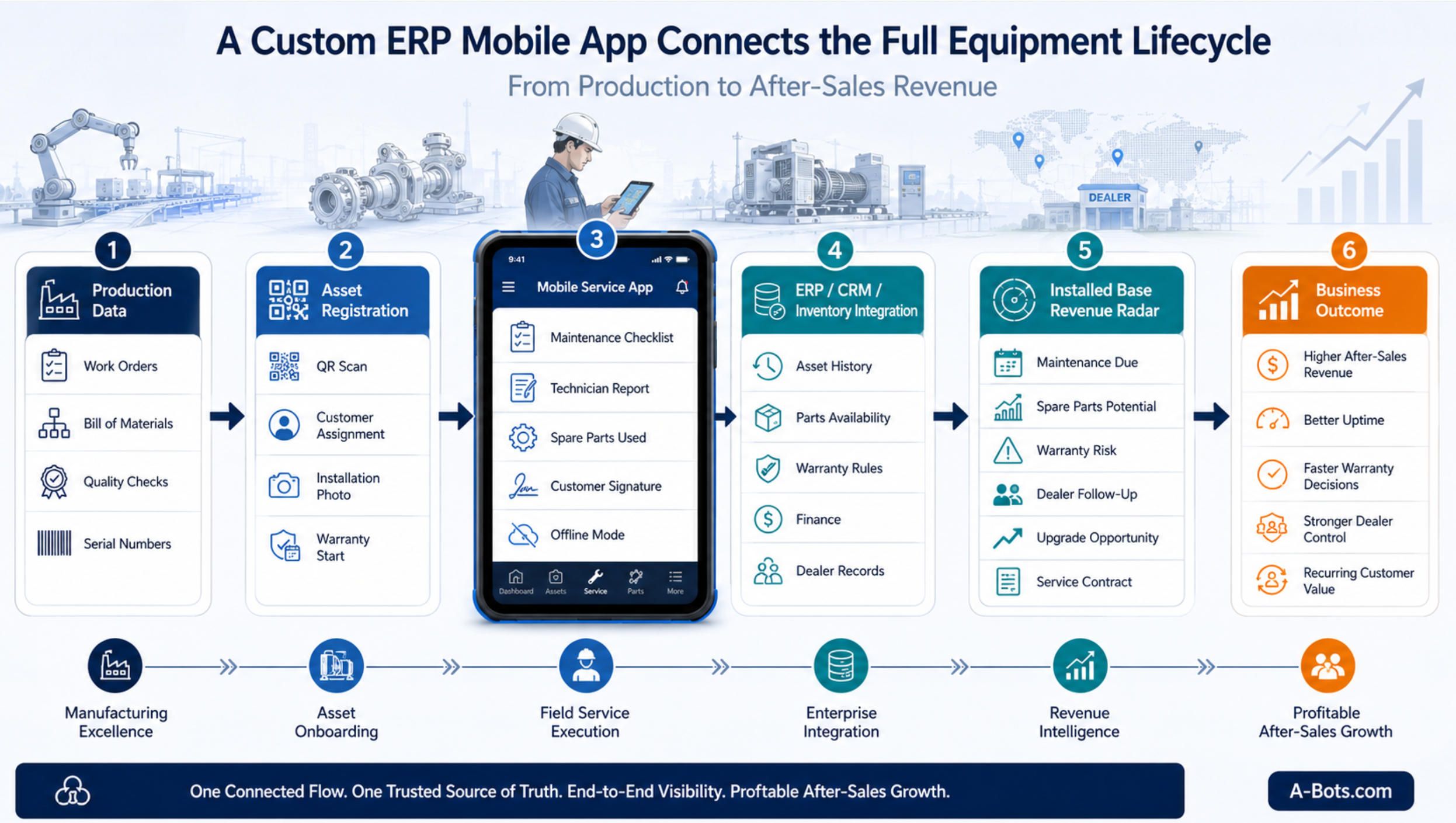
A custom ERP mobile app can help manufacturers build and maintain this system by allowing dealers, service technicians, customers, and internal teams to update asset data directly from the field.
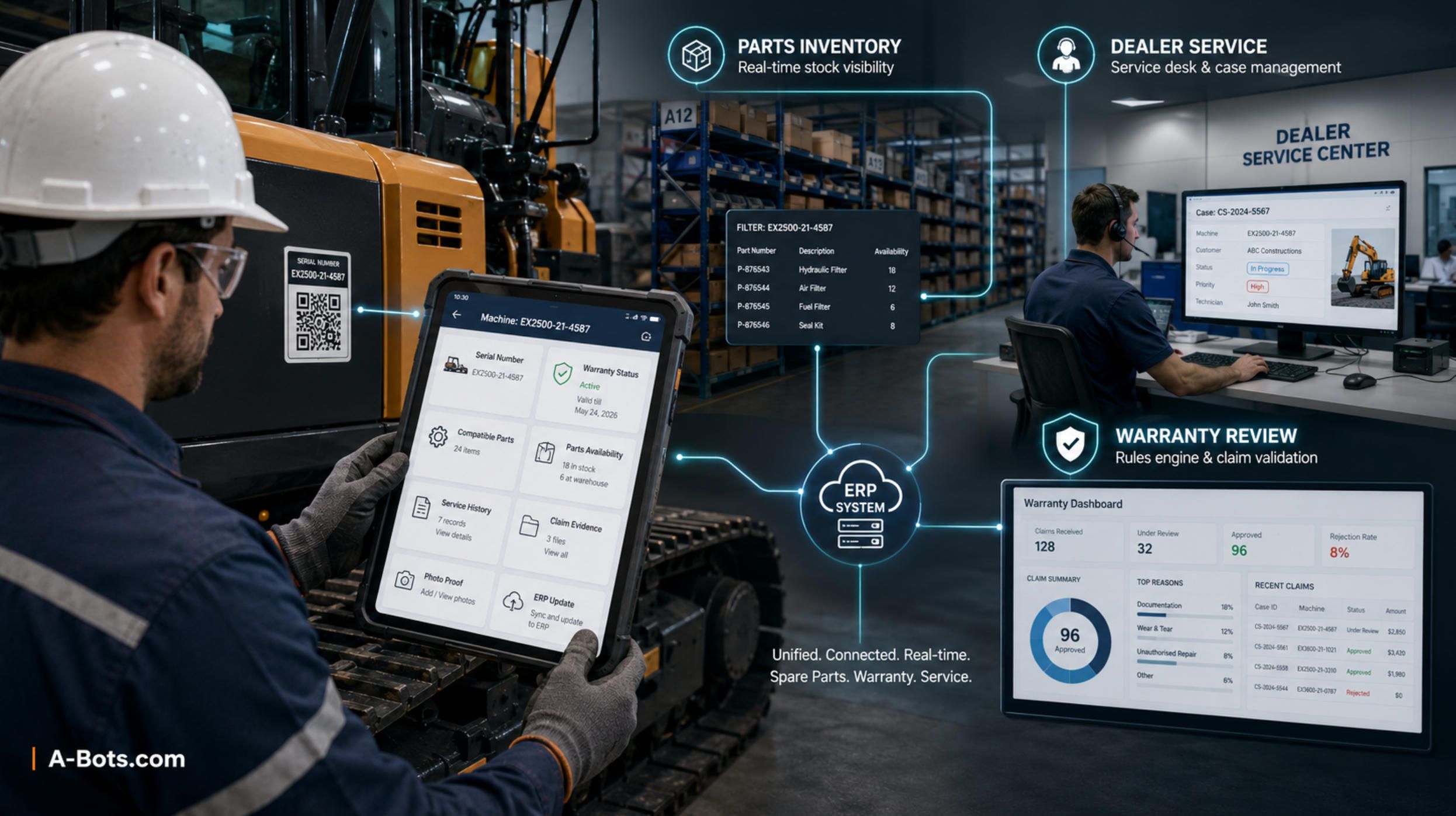
For example, a technician can scan the equipment QR code, confirm serial number, update location, upload installation photos, complete a commissioning checklist, record service actions, capture parts used, and sync everything with ERP or CRM. A dealer can register a new machine, assign it to a customer, check warranty status, request spare parts, and submit a service claim. A customer can see service history, maintenance recommendations, manuals, and parts suggestions through a controlled mobile interface.
This is how the installed base becomes alive.
The ERP stores the official business record. The mobile app captures field reality.
The Trigger Feature: Installed Base Revenue Radar
Most manufacturers track after-sales through separate reports: spare parts sales, warranty claims, service tickets, dealer orders, maintenance contracts, and customer support cases. The problem is that these reports usually look backward.
They show what already happened.
The Installed Base Revenue Radar is designed to look forward.
It is a custom module that combines ERP data, service history, spare parts usage, warranty status, asset age, operating hours, IoT signals where available, dealer activity, customer profile, and maintenance logic to show what each equipment unit is likely to need next.
The module can classify installed assets into actionable categories:
- “Maintenance due soon”
- “High spare parts potential”
- “Warranty risk”
- “Upgrade opportunity”
- “Dealer follow-up required”
- “Repeat failure detected”
- “Service contract opportunity”
- “Customer at risk”
- “Consumables reorder expected”
This is not just analytics. It is a sales, service, and operations trigger system.
A regional manager can open a dashboard and see which machines in a territory are due for maintenance. A dealer can receive a mobile task to contact customers before a service window. A spare parts manager can forecast demand based on installed equipment age and usage. A warranty team can identify models with unusual failure patterns. A sales team can see which customers are good candidates for upgrade kits, extended warranty, or service contracts.
For the customer, this creates better support. For the manufacturer, it creates revenue visibility. For the dealer, it creates structured follow-up. For service teams, it creates better preparation.
This is the feature that can make a real client think: “We have thousands of machines in the field, but we do not really control their after-sales lifecycle. We need this.”
A-Bots.com can build such a system because it requires custom integration logic, mobile UX, backend workflows, ERP connectivity, dealer roles, customer access, asset data modeling, notification rules, analytics, and possibly IoT data ingestion. It is not a generic app. It is a business-specific after-sales control layer.
Production ERP Is Not Enough Without Service Feedback
Manufacturing companies often focus ERP implementation on production planning, procurement, materials, inventory, finance, and order fulfillment. These are essential. But if production data never receives structured feedback from service, the manufacturer misses a major learning loop.
Service data can reveal product weaknesses, parts demand, installation issues, quality problems, training gaps, and design improvement opportunities.
For example, if a specific component is replaced more often than expected, engineering should know. If a machine model generates repeated service tickets in certain conditions, product teams should investigate. If installation errors cause warranty claims, training and dealer documentation should improve. If certain parts are often unavailable when technicians need them, supply planning should adjust. If customers frequently request a retrofit, the product roadmap may need to respond.
A custom mobile ERP app can capture service feedback in a structured way.
Instead of technicians writing vague notes, the app can guide them through failure codes, component selection, operating conditions, photos, measurements, parts used, customer comments, and recommended actions. That data can then flow back to ERP, PLM, CRM, quality management, or analytics systems.
This creates a closed loop:
- production creates equipment;
- equipment operates in the field;
- service captures performance evidence;
- ERP and analytics identify patterns;
- engineering improves design;
- spare parts planning improves availability;
- customers receive better uptime.
This is how a manufacturer becomes smarter over time.
Without mobile service capture, this loop is often broken. Valuable field knowledge remains in technician memory, dealer emails, or unstructured service reports.
Spare Parts: The Profit Center Hidden in Operational Complexity
Spare parts management is one of the most important after-sales functions for equipment manufacturers. It is also one of the hardest to manage well.
The challenge is not simply stocking parts. The challenge is knowing which parts are needed, where they are needed, when they are needed, which asset they belong to, whether they are covered by warranty, and how quickly they can reach the technician or customer.
A mobile ERP app can connect spare parts with actual equipment usage.
A technician should be able to scan a machine and immediately see compatible parts, exploded diagrams, replacement history, availability, alternatives, pricing rules, warranty coverage, and ordering options. A dealer should be able to request parts from a mobile interface without calling multiple departments. A customer should be able to identify consumables or approved replacement parts without confusion.
This is especially important for manufacturers with complex equipment or large catalogs.
When parts identification is difficult, customers may buy from competitors, order wrong parts, delay repairs, or overload support teams. When parts availability is unclear, technicians waste time. When parts usage is not linked back to asset history, the manufacturer loses insight.
A custom spare parts mobile module can include:
- QR code or serial number lookup;
- machine-specific parts catalog;
- visual diagrams or part groups;
- availability by warehouse, dealer, or region;
- replacement history;
- warranty and contract validation;
- recommended maintenance kits;
- dealer ordering workflow;
- technician vehicle stock;
- automatic replenishment suggestions.
This turns spare parts from a passive catalog into a connected revenue workflow.
For A-Bots.com, this is a particularly strong development area because it combines mobile usability with complex backend logic. The customer-facing interface must be simple, but the system behind it may need ERP inventory, pricing rules, part compatibility, warranty status, dealer permissions, and logistics integration.
Dealer Networks Need Better Mobile Tools
Many equipment manufacturers depend on dealers, distributors, installers, service partners, or regional representatives. These networks are essential for sales and service, but they also create data fragmentation.
A dealer may know the customer better than the manufacturer. A service partner may know the equipment condition. A distributor may control parts availability. A regional installer may handle commissioning. But if this information does not flow back into the manufacturer’s systems, the installed base becomes incomplete.
A dealer mobile app connected to ERP can solve this problem.
Dealers can register new equipment, update customer details, submit warranty claims, order parts, check availability, access manuals, complete installation checklists, upload photos, schedule service, and receive after-sales tasks.
The manufacturer can control what each dealer sees. A dealer should access only relevant customers, territories, machines, pricing, and claims. The system can support approval workflows, audit trails, document templates, and service standards.
This creates a more disciplined ecosystem.
Instead of dealer communication happening through email, phone calls, PDFs, spreadsheets, and informal messages, the mobile app becomes the shared operational channel.
The benefit is not only efficiency. It is data ownership.
The manufacturer gains better visibility into what happens after the sale, while dealers receive tools that make them faster and more professional.
Warranty Control: Where Mobile Proof Saves Money
Warranty can become a major source of leakage when it is poorly controlled.
A warranty claim may lack photos, serial number verification, installation evidence, service history, operating conditions, or proof that the failure is covered. The manufacturer may approve claims too easily to protect customer relationships. Or it may reject claims slowly, frustrating dealers and customers.
A mobile ERP app can make warranty workflows more precise.
When a technician or dealer submits a claim, the app can require structured evidence: equipment scan, serial number, purchase date, warranty status, failure code, photos, operating hours, installation checklist, parts used, customer signature, and technician notes. The app can validate whether the asset is within warranty, whether the part is covered, whether previous unauthorized repairs exist, and whether the claim requires supervisor approval.
This protects both sides.
The customer receives a faster and clearer decision. The manufacturer receives better documentation and fewer ambiguous claims. Dealers receive a more predictable process. Finance receives cleaner cost attribution. Engineering receives better failure data.
Warranty control is not only a cost defense mechanism. It is also a quality intelligence system.
If claims cluster around specific components, serial ranges, dealers, installation conditions, or operating environments, the manufacturer can detect the issue earlier.
A mobile warranty module can feed directly into the Installed Base Revenue Radar by marking assets with high warranty risk or repeat failure patterns.
Predictive Maintenance Needs Mobile Execution
Predictive maintenance is one of the most important trends in industrial equipment and smart manufacturing. Sensors, IoT devices, machine learning, and digital twins can help predict failures before they occur. But prediction alone does not fix anything.
A prediction must become an action.
That action is usually performed by a technician, dealer, maintenance team, customer operator, or service partner. This is where mobile ERP apps are essential.
If an IoT system detects vibration anomalies, temperature deviation, abnormal cycles, pressure changes, battery degradation, or error patterns, the system should create a service event. The mobile app should deliver that event to the right person with asset context, severity, recommended parts, service instructions, warranty status, customer location, and deadline.
Without mobile execution, predictive maintenance remains a dashboard.
With mobile execution, it becomes a workflow.
A predictive maintenance mobile workflow can include:
- asset alert;
- risk classification;
- technician or dealer assignment;
- recommended parts;
- maintenance checklist;
- customer notification;
- photo and measurement capture;
- completion report;
- ERP update;
- spare parts replenishment;
- future risk recalculation.
This is the practical bridge between AI, IoT, ERP, and real service operations.
A-Bots.com can help manufacturers build that bridge, especially when the company already has equipment data but lacks a mobile workflow to act on it.
Customer Apps for Equipment Owners: From Support Channel to Retention Tool
Manufacturers often think about internal ERP apps first. But customer-facing mobile apps can also become valuable in after-sales.
For equipment owners, a mobile app can provide asset registration, manuals, service history, maintenance reminders, consumables ordering, spare parts lookup, support tickets, warranty status, upgrade offers, training content, and technician visit tracking.
This is especially useful for smart devices, industrial equipment, agricultural machinery, cleaning robots, HVAC systems, coffee machines, drones, medical devices, and other products that require ongoing support.
A customer app can reduce support load because users can find correct information faster. It can reduce wrong part orders because the app filters parts by serial number or model. It can improve maintenance compliance because reminders and checklists are tied to the specific asset. It can increase after-sales revenue because customers receive timely offers for kits, consumables, service packages, or upgrades.
The app also strengthens the manufacturer’s relationship with the end user.
This matters when equipment is sold through distributors or dealers. Without a digital channel, the manufacturer may lose visibility after the sale. With a customer app, the manufacturer can maintain a direct but controlled connection to the installed base.
The goal is not to bypass dealers. The goal is to create a connected ecosystem where customer, dealer, and manufacturer work from the same asset data.
Production Floor Mobile Apps: Connecting Manufacturing Execution with ERP
Although after-sales is the main focus of this article, mobile ERP apps can also improve production workflows inside the factory.
Manufacturing employees often need to confirm tasks, request materials, report defects, document downtime, perform quality checks, scan components, update work orders, and record production progress. If these actions are delayed or entered manually later, ERP visibility suffers.
A production mobile app can help operators and supervisors capture shop floor events in real time.
This can include:
- work order status;
- material issue;
- component scanning;
- quality inspection;
- defect reporting;
- downtime reason;
- maintenance request;
- tooling status;
- shift handover;
- finished goods confirmation.
For equipment manufacturers, this internal production data becomes even more valuable when connected to after-sales data. If certain production batches, suppliers, components, or assembly steps correlate with field failures, the company can detect quality issues earlier.
This is another reason mobile ERP architecture should be designed as an ecosystem rather than isolated apps. Production, service, parts, warranty, and installed base management all belong to the same lifecycle.
Architecture: What the App Needs Behind the Screens
A manufacturing and equipment ERP mobile app may look simple to the user, but the architecture behind it can be sophisticated.
The app may need to connect with ERP, CRM, WMS, field service systems, product lifecycle management software, IoT platforms, dealer portals, e-commerce parts catalogs, accounting systems, and analytics dashboards.
A practical architecture often includes a mobile app, backend API, integration layer, role-based access system, notification service, offline storage, sync queue, audit log, asset database, and analytics module.
The app should support different user groups:
- internal production teams;
- service technicians;
- dealers;
- customers;
- warehouse teams;
- sales managers;
- warranty reviewers;
- regional managers;
- administrators.
Each group needs different permissions and workflows.
Security is critical because the app may expose customer data, equipment records, warranty claims, pricing, dealer information, spare parts availability, and service documentation. The system should use secure authentication, encrypted data, role-based permissions, audit trails, limited offline data storage, and controlled API access.
Offline mode may also be necessary. Technicians, dealers, and production teams often work in environments with unstable connectivity: factories, rural locations, basements, machine rooms, remote industrial sites, warehouses, and field installations. The app should allow critical actions to continue offline and sync safely when connection returns.
This is why custom development matters. Manufacturing and equipment workflows are rarely simple. The app must match real operational logic, not just display ERP data on a phone.
How A-Bots.com Can Build the First Version
A successful project should begin with one high-value workflow. Trying to build a full manufacturing and after-sales ecosystem in one release can make the project too large and slow.
A strong first release could focus on installed base registration and service history. Another company may start with spare parts lookup and dealer ordering. Another may start with warranty claim submission. Another may start with technician mobile work orders. Another may start with customer maintenance reminders.
For many equipment manufacturers, the best first version would include:
- asset registration by serial number or QR code;
- customer and location assignment;
- warranty status;
- service history;
- photo documentation;
- spare parts lookup;
- dealer or technician task flow;
- basic Installed Base Revenue Radar;
- ERP synchronization.
This first version already creates substantial value. It gives the manufacturer a clearer view of its installed base and establishes the digital foundation for future service revenue.
The next versions can add predictive maintenance, IoT alerts, dealer dashboards, customer portal, warranty analytics, spare parts forecasting, maintenance contracts, upgrade offers, and AI-assisted service recommendations.
A-Bots.com can support the entire lifecycle: discovery, workflow mapping, UX design, iOS and Android development, backend architecture, ERP integration, IoT connectivity, offline logic, security, testing, deployment, and continuous product improvement.
The strongest value is not only technical execution. It is the ability to turn a manufacturer’s after-sales model into a working mobile product.
The Future: Equipment as a Connected Revenue Platform
The future of manufacturing is not only smarter factories. It is smarter equipment lifecycles.
A manufacturer that sells a machine and loses visibility after delivery is leaving value to chance. A manufacturer that tracks the installed base, supports dealers, predicts service needs, controls warranty, manages spare parts, and communicates with customers through mobile apps is building a connected revenue platform.
This changes the role of ERP.
ERP is no longer just a system for production, finance, procurement, and inventory. It becomes the backbone of a lifecycle model that continues long after the product leaves the factory.
The mobile app is what makes that model usable.
It allows technicians to capture field evidence. It allows dealers to update asset data. It allows customers to request service and order correct parts. It allows managers to see after-sales opportunities. It allows warranty teams to make faster decisions. It allows spare parts teams to plan demand. It allows production and engineering teams to learn from real equipment performance.
The companies that build this mobile layer will have a better understanding of their customers, their products, and their future revenue. The companies that do not will continue to rely on incomplete installed base records, reactive service, scattered dealer communication, and missed after-sales opportunities.
The trigger is clear:
Every machine already sold is not just a past transaction. It is a future service event, spare parts opportunity, customer relationship, warranty risk, and data source.
A custom ERP mobile app can make that future visible.
For manufacturing and equipment companies, this may be the next major competitive advantage: not only producing better equipment, but controlling the entire lifecycle around it.
A-Bots.com can help build that control layer - mobile, integrated, secure, and designed around the real business logic of equipment after-sales.
✅ Hashtags
#ManufacturingERP
#EquipmentServiceApp
#AfterSalesSoftware
#SparePartsManagement
#MobileERP
#ERPIntegration
#PredictiveMaintenance
#InstalledBaseManagement
#ABotsCom
Other articles
AI Sales Agents in Mobile Apps This expert article explains how AI sales agents are transforming mobile apps into intelligent revenue platforms. It shows how custom mobile applications can qualify leads, guide buyers through product choices, personalize recommendations, prepare follow-ups, update CRM records, and support sales teams with structured customer context. The article explores practical use cases across eCommerce, field service, real estate, moving, logistics, equipment manufacturing, SaaS, and B2B services. It also explains why AI sales automation requires reliable data, CRM integration, human oversight, and custom software architecture. A-Bots.com is positioned as a development partner for companies building AI-powered mobile sales platforms.
How to Build a Custom AI Agent App How businesses can move from basic AI chatbot experiments to production-ready custom AI agent apps. It covers the architecture required for serious AI products, including mobile app UX, AI orchestration, knowledge retrieval, CRM and ERP integrations, workflow automation, data security, guardrails, observability, and human-in-the-loop control. The article shows why a business AI agent must be designed as a secure, integrated software system rather than a simple chat window. It positions A-Bots.com as a custom development partner for companies building practical AI-powered mobile apps and enterprise platforms.
Mobile ERP App Development Why traditional ERP systems often fail at the operational edge - where warehouse teams, field technicians, delivery staff, supervisors, and mobile managers actually perform the work. It explores the concept of a custom mobile ERP app as a focused operational layer over an existing ERP system. The article highlights moment-of-work data capture, offline functionality, barcode scanning, photo proof, GPS, digital signatures, approvals, security, and ERP integrations. It also shows how companies can use mobile ERP app development to reduce delays, improve data accuracy, strengthen accountability, and prepare their operations for AI-assisted workflows.
Field Service ERP Apps: Connecting Technicians, Dispatchers, and Customers How field service ERP apps turn technician visits, dispatcher decisions, spare parts usage, customer communication, and ERP records into one connected workflow. It focuses on the business value of custom mobile app development for service companies, manufacturers, facility teams, equipment providers, and field operations. The key concept is Service Profitability Control - a mobile module that helps companies see whether a visit is becoming profitable or unprofitable before the technician leaves the site. The article also covers offline mode, first-time fix rate, dispatch intelligence, ERP integration, customer proof, AI-assisted service, and secure mobile workflows.
Warehouse and Inventory Mobile ERP Apps: From Barcode Scanning to Real-Time Stock Control How warehouse and inventory mobile ERP apps connect physical stock movement with real-time ERP data. It focuses on barcode scanning, QR workflows, receiving, picking, packing, stock transfers, cycle counts, returns, damaged goods, offline synchronization, audit trails, and ERP or WMS integration. The key idea is the Inventory Truth Engine - a custom module that shows not only stock quantity, but also how trustworthy that quantity is. The article positions custom mobile app development as a practical way for companies to reduce inventory errors, improve fulfillment accuracy, protect margin, and make ERP data more reliable.
Top stories

Copyright © Alpha Systems LTD All rights reserved.
Made with ❤️ by A-BOTS