
Home
Services
About us
Blog
Contacts
Warehouse and Inventory Mobile ERP Apps: From Barcode Scanning to Real-Time Stock Control
The Warehouse Is Where ERP Data Becomes Physical Reality
ERP looks clean on a dashboard. Inventory looks structured in a report. Stock levels look precise in a database.
Then someone walks into the warehouse and discovers the truth: the item is not where the system says it is, the batch number is missing, the order was picked from the wrong zone, the returned product was never inspected, the pallet was moved but not recorded, and the last cycle count happened too late to prevent the error.
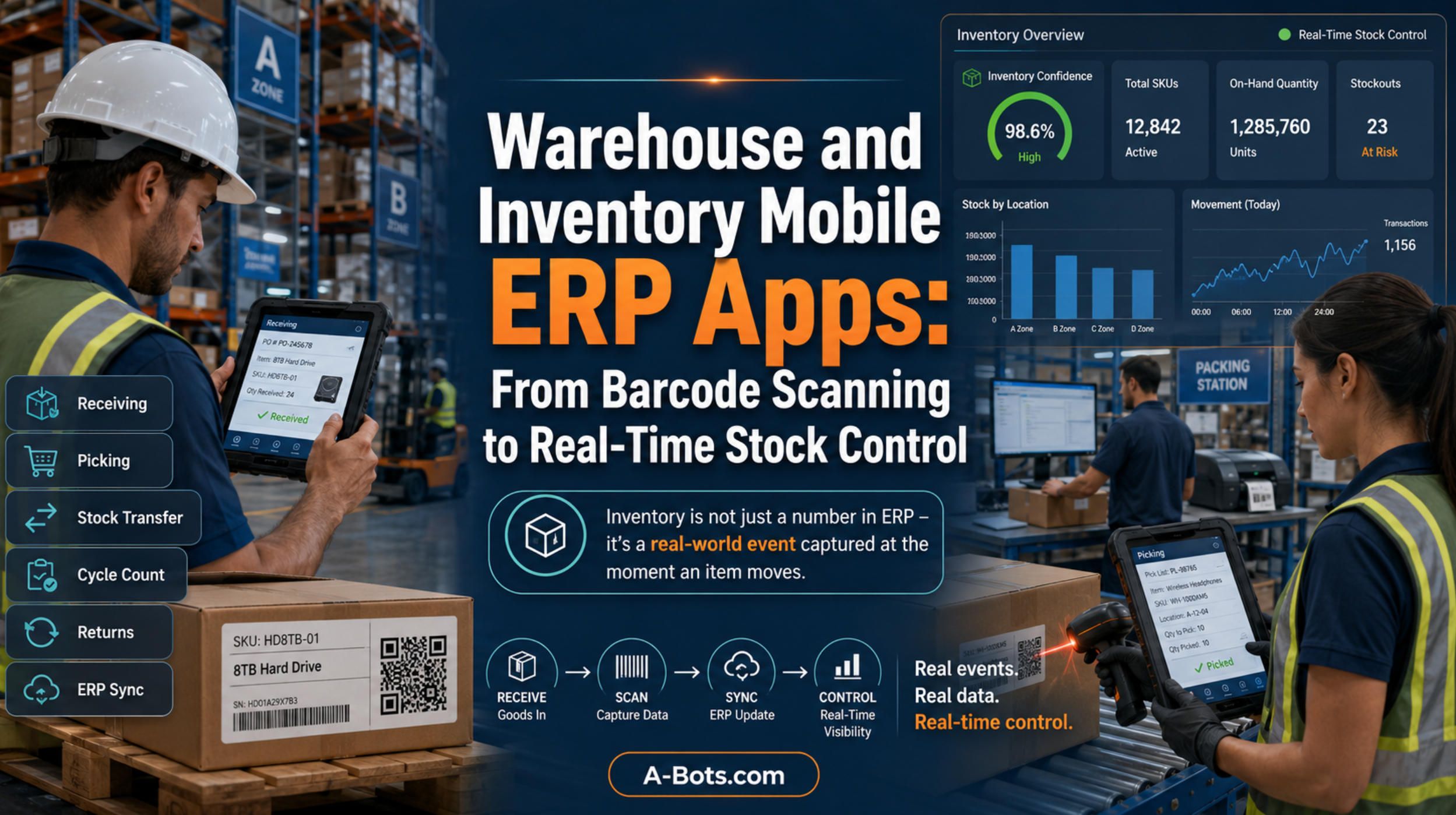
This is the warehouse problem in one sentence: inventory is not a number, it is a physical event.
Every stock record in ERP is only as good as the last real-world action behind it: receiving, scanning, moving, picking, packing, shipping, returning, counting, adjusting, reserving, or scrapping. If those actions are not captured accurately at the point of movement, ERP gradually becomes a beautiful archive of outdated assumptions.
That is why warehouse and inventory mobile ERP apps are becoming a critical part of modern operations.
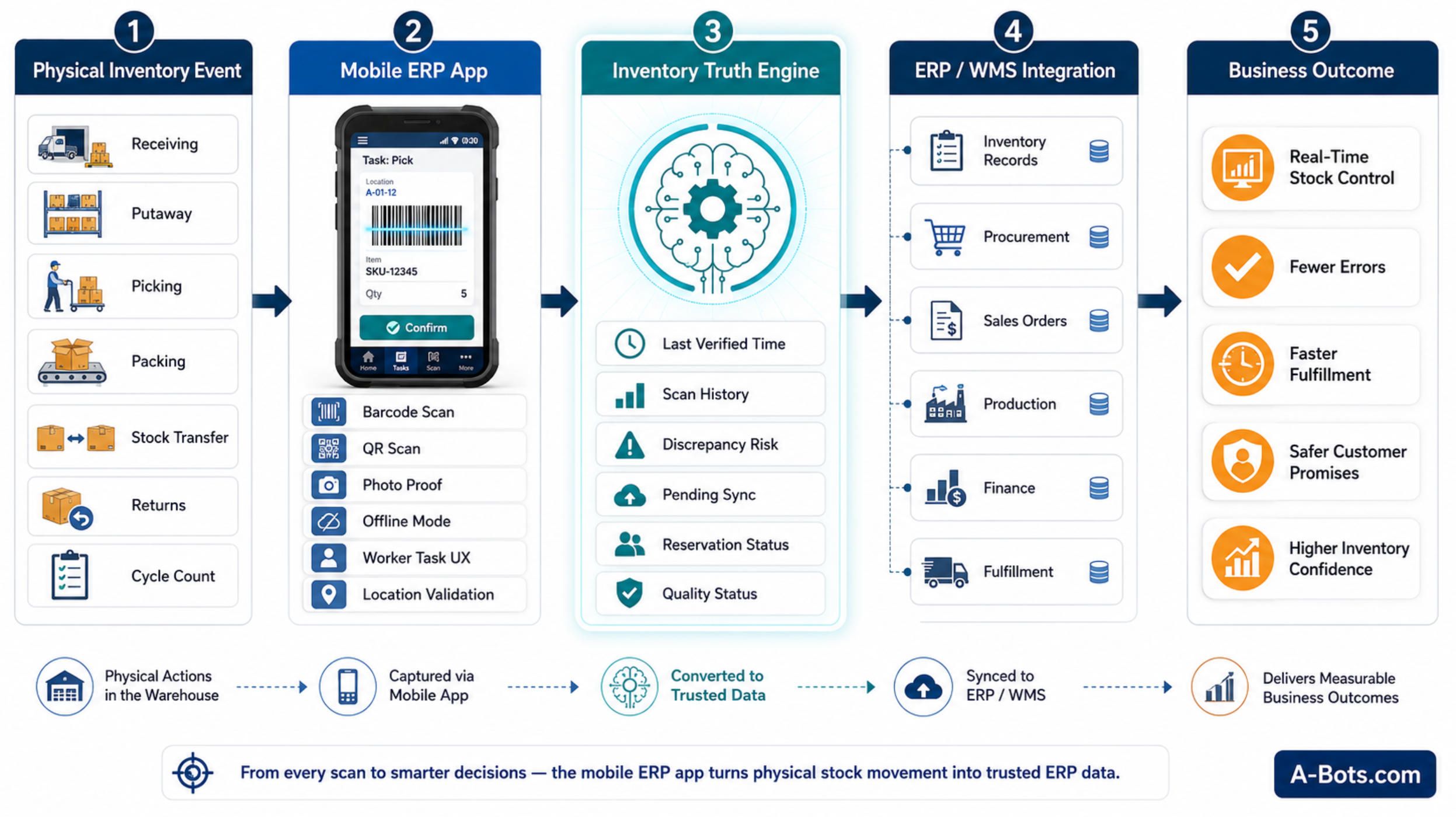
A mobile ERP inventory app is not just a barcode scanner interface. It is a mobile execution layer that connects warehouse workers, inventory managers, ERP, WMS, purchasing, sales, production, finance, and customer fulfillment. It turns physical stock movement into real-time business data.
For A-Bots.com, this is a strong and commercially practical development direction. Many companies already have ERP, but their warehouse execution still depends on paper sheets, delayed manual entry, spreadsheets, verbal confirmations, disconnected barcode devices, or warehouse software that does not fully match the company’s process. A custom mobile ERP app can close that gap.
The strongest idea is not simply “scan barcodes faster.” That is useful, but not enough.
The real trigger is this:
Your ERP should not only show stock quantity. It should show how trustworthy that quantity is.
This is the core of the article’s “wow” function: the Inventory Truth Engine.
Why Inventory Accuracy Is No Longer a Back-Office Metric
For years, inventory accuracy was treated as an internal warehouse metric. If stock records were wrong, warehouse managers had to fix them. Today, inventory accuracy affects the entire business.
It affects sales because a sales team may promise products that are not actually available. It affects e-commerce because customers expect fast and accurate fulfillment. It affects production because missing components can stop a manufacturing line. It affects field service because technicians may arrive without the right spare part. It affects finance because stock value, write-offs, shrinkage, and working capital depend on reliable inventory records. It affects customer trust because “available” should mean available.
In a modern company, inventory is not just stock. It is a promise.
A distributor promises availability. An e-commerce business promises delivery. A manufacturer promises production continuity. A service company promises repair readiness. A retailer promises shelf presence. A medical supplier promises compliance and traceability. A spare parts business promises that the right component can be found quickly.
When inventory data is wrong, those promises become fragile.
This is why inventory management software continues to grow as a market category. Companies need real-time visibility, order accuracy, multi-location control, automated replenishment, demand forecasting, barcode and RFID scanning, and integration with ERP and sales channels. But technology only works when it captures the real movement of goods.
A warehouse mobile ERP app brings the system closer to the action. Instead of waiting for someone to update ERP later, the app records the stock event when it happens.
Receiving is confirmed at the dock.
Picking is confirmed at the shelf.
Transfers are confirmed at the source and destination.
Cycle counts are performed continuously.
Damaged goods are photographed immediately.
Returns are classified before they re-enter available stock.
Low-stock alerts appear before the order fails.
This is how companies move from static inventory records to operational inventory intelligence.
The Hidden Cost of “Almost Accurate” Inventory
Many companies do not have completely chaotic inventory. They have something more dangerous: inventory that is almost accurate.
Almost accurate inventory creates confidence where caution is needed.
A manager sees 120 units available and assumes the order can ship. In reality, 20 units are damaged, 15 are in the wrong zone, 10 are reserved for another customer, and 8 have not passed quality inspection. The ERP number looks good, but the operational truth is different.
This is why inventory errors are expensive even when they are small. One incorrect stock record can create a chain reaction: delayed order, emergency purchase, overtime picking, customer complaint, lost sale, production stoppage, unnecessary replenishment, or incorrect financial reporting.
The problem is not only the error itself. The problem is that companies often discover the error too late.
A warehouse mobile ERP app changes the timing of discovery.
Instead of finding discrepancies during a monthly count, the system can detect them during receiving, transfer, picking, packing, return inspection, or cycle count. Instead of letting uncertainty accumulate, the app can flag suspicious inventory records before they create business damage.
This is where custom development can create a feature that generic software often does not provide in the exact way a company needs.
The question becomes:
Can the mobile app tell us which stock records are reliable, which are outdated, and which need verification before we make a business promise?
That is the idea behind the Inventory Truth Engine.
The Trigger Feature: Inventory Truth Engine
Most inventory systems answer one basic question: “How many units do we have?”
But operational managers need better questions:
- How confident are we in this quantity?
- When was this stock last physically verified?
- Who scanned it?
- Where was it scanned?
- Was the item moved without confirmation?
- Is the stock reserved, damaged, quarantined, expired, returned, or available?
- Does the ERP record match the latest warehouse event?
- Has this SKU caused repeated discrepancies?
- Is this quantity safe enough to promise to a customer?
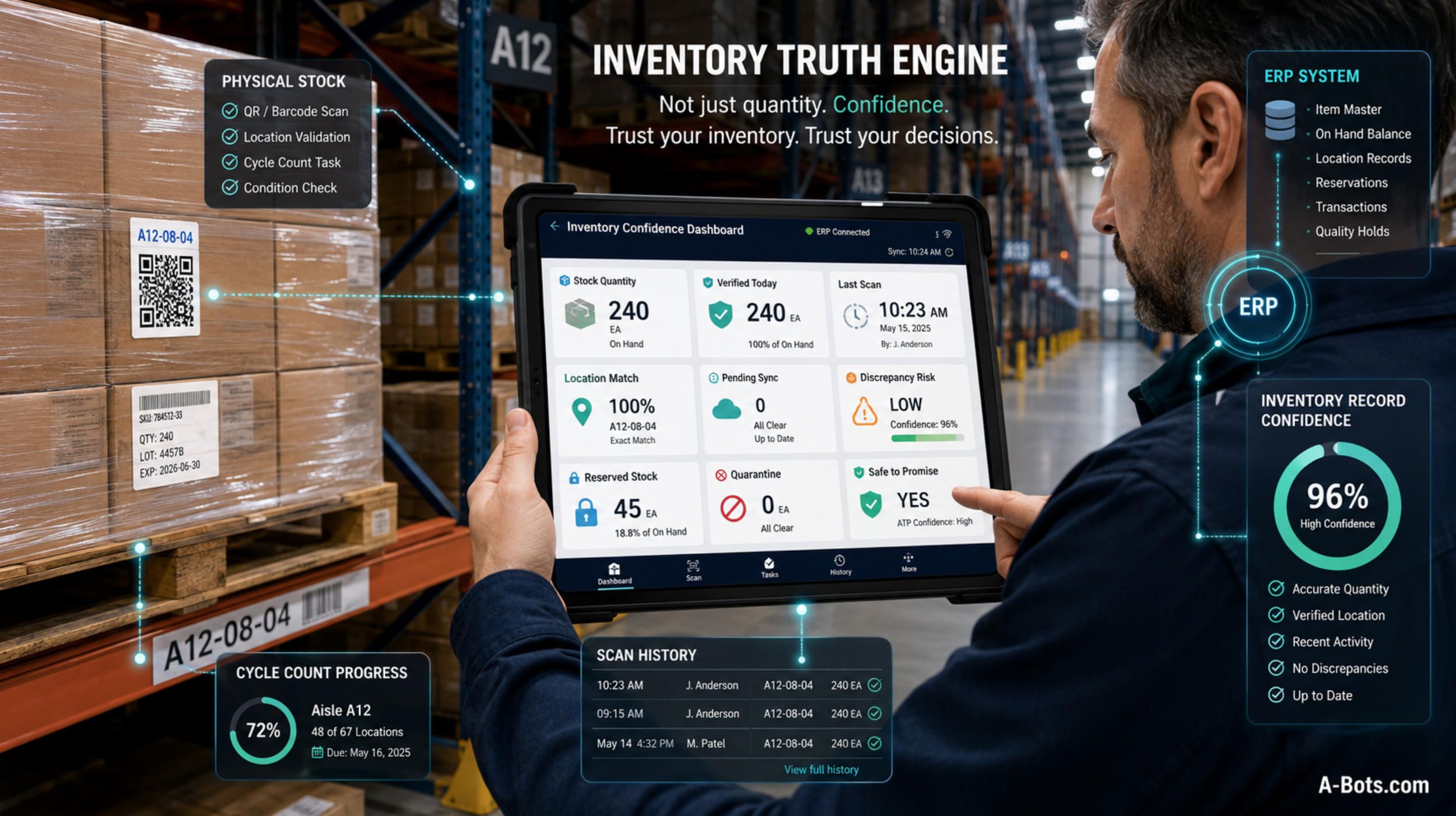
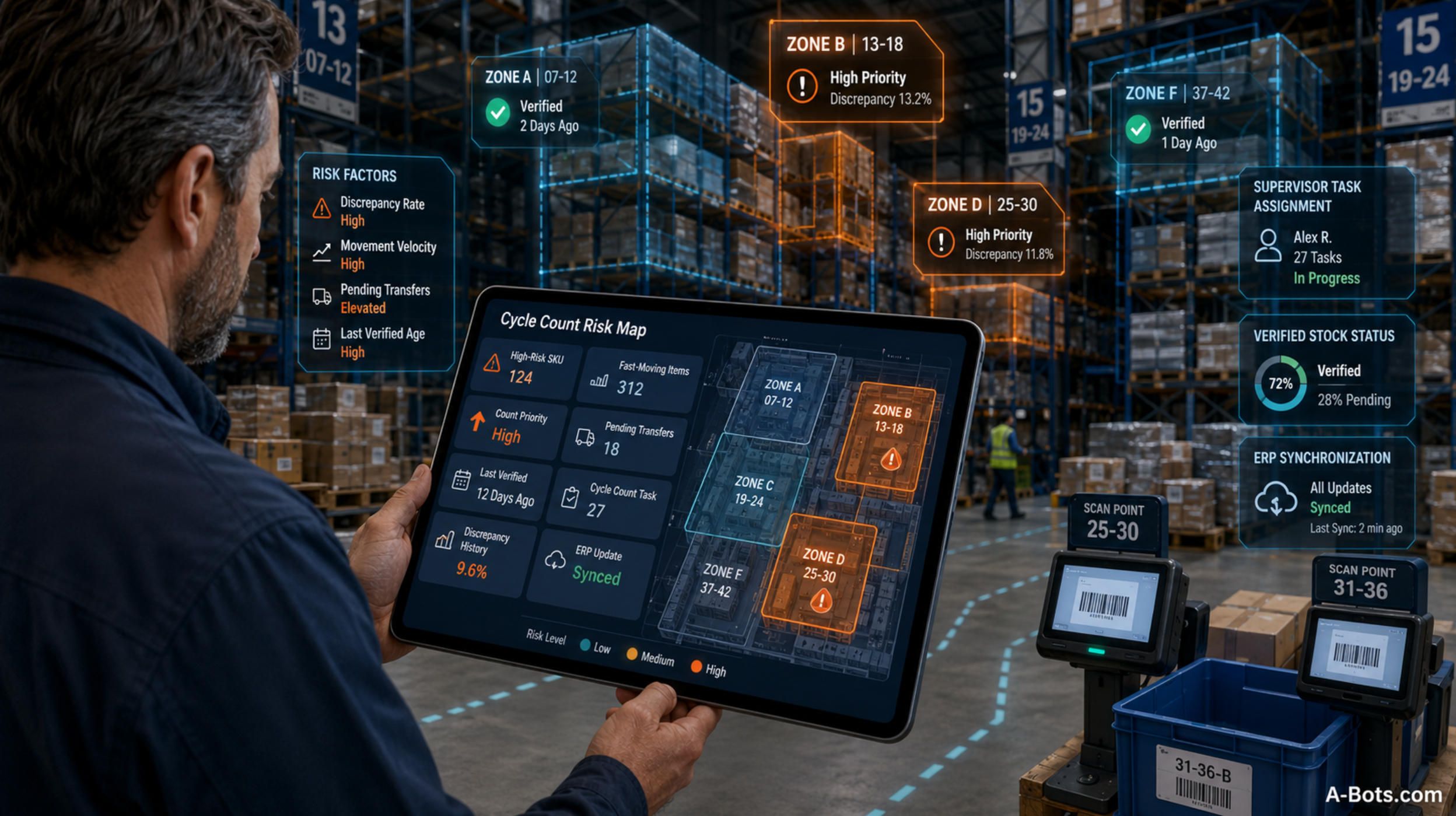
The Inventory Truth Engine is a custom module inside a warehouse mobile ERP app that assigns confidence to inventory records based on real operational evidence.
It can combine several signals:
- last scan time and location;
- last cycle count result;
- user role and scan history;
- movement frequency;
- discrepancy history;
- open reservations;
- pending transfers;
- quality status;
- batch or serial number validation;
- return status;
- damaged or quarantined stock;
- offline transactions waiting for sync.
Instead of showing stock as a flat number, the app can show stock confidence:
- “Verified today”
- “Recently moved”
- “Pending sync”
- “Needs cycle count”
- “High discrepancy risk”
- “Reserved”
- “Quarantine”
- “Do not promise”
This is a powerful function because it changes how inventory decisions are made.
A sales manager can see whether available stock is safe to promise. A warehouse supervisor can prioritize cycle counts based on risk, not habit. A purchasing manager can avoid buying more stock simply because the system looks uncertain. A production planner can see which materials require verification before scheduling. A finance team can get better confidence in inventory valuation.
This is the kind of feature that can make a real client think: “Yes, this is exactly what we need.”
It does not compete with ERP. It makes ERP more reliable.
A-Bots.com can build this type of module because it requires more than standard scanning. It requires mobile UX, ERP integration, warehouse logic, sync architecture, user roles, validation rules, analytics, and a practical understanding of how inventory errors actually appear.
From Barcode Scanning to Inventory Intelligence
Barcode scanning is often the first step in warehouse digitization. It is also one of the most misunderstood.
A barcode scanner does not automatically create inventory accuracy. It only captures a code. Accuracy depends on what the app does with that code, when it captures it, where it captures it, and how it validates the action.
A weak scanning workflow simply asks the worker to scan an item and confirm quantity.
A strong mobile ERP app understands the operational context.
During receiving, the app should know the purchase order, supplier, expected quantity, unit of measure, batch number, serial number rules, quality inspection requirement, and storage destination.
During putaway, the app should validate whether the product is placed in the correct zone, rack, bin, temperature area, or safety category.
During picking, the app should verify the order, SKU, quantity, batch, expiration date, reservation, customer priority, and substitution rules.
During stock transfer, the app should confirm source location, destination location, transfer reason, responsible user, and ERP update.
During cycle count, the app should compare physical count with system quantity, classify variance, require supervisor review when thresholds are exceeded, and update the confidence level of the inventory record.
During returns, the app should prevent returned goods from automatically becoming available stock until inspection is complete.
This is the difference between scanning and intelligence.
A custom warehouse mobile ERP app can encode the company’s actual rules into the workflow. It can reduce free-text decisions, prevent invalid actions, guide new workers, and create auditable inventory events.
The goal is not only speed. The goal is trusted stock movement.
Why Mobile ERP Matters Even When a Company Already Has WMS
Many companies already use a warehouse management system. Does that mean they do not need a custom mobile ERP app?
Not necessarily.
A WMS may be strong in core warehouse operations but weak in mobile user experience, custom workflows, multi-system integration, field inventory, spare parts movement, branch-level stock, offline work, or executive reporting. In other cases, a company uses ERP inventory functionality without a specialized WMS and needs a mobile layer to make warehouse execution practical.
The real question is not “Do we have WMS?” The real question is:
Can every critical inventory movement be captured correctly by the person who performs it, at the place where it happens, in a way that ERP can trust?
If the answer is no, a custom mobile layer may still be valuable.
A mobile ERP inventory app can connect ERP, WMS, CRM, e-commerce platforms, procurement, production, delivery systems, and accounting. It can also support workflows that sit between systems.
For example, a company may need a mobile app for technicians who carry spare parts in vehicles. That is not a classic warehouse problem, but it affects inventory. A manufacturer may need production workers to request materials from the floor. A retailer may need store staff to perform quick stock checks. A distributor may need branch employees to receive emergency transfers. A medical supplier may need batch traceability across warehouse and customer delivery.
These workflows often fall outside the neat boundaries of standard systems.
That is where custom development becomes commercially strong.
A-Bots.com can build a mobile app that fits the company’s operational edge, not just its software category.
The Warehouse Worker Experience: Accuracy Must Be Easier Than Error
Warehouse software often fails because it is designed for managers rather than workers.
A manager wants visibility. A worker needs speed, clarity, and simple instructions.
If the mobile workflow is confusing, workers will find shortcuts. They will scan later, write notes on paper, ask supervisors verbally, skip optional fields, use the wrong reason code, or delay updates until the end of the shift. Every shortcut weakens inventory accuracy.
A strong warehouse mobile ERP app must make the correct action the easiest action.
That means the interface should be role-based, fast, and context-aware. It should show the next task clearly. It should minimize typing. It should use barcode, QR, RFID, image capture, voice input, and predefined options where appropriate. It should display errors immediately. It should work on rugged handhelds, tablets, smartphones, and scanners. It should support gloves, low-light environments, noisy warehouses, and rapid task switching.
The app should not ask workers to understand ERP structure. It should guide them through warehouse actions.
For example, a picker should not search through ERP menus. The app should show the next pick, location, product image if needed, quantity, barcode validation, exception options, and route sequence.
A receiving worker should not manually reconstruct purchase order details. The app should show expected goods, supplier, discrepancies, photo capture, label printing logic, and putaway destination.
A supervisor should not wait for end-of-day reports. The app should show blocked tasks, discrepancy alerts, pending approvals, low-confidence stock records, and workers who need assistance.
Good UX is not cosmetic in warehouse software. It is an accuracy control mechanism.
Offline Mode and Sync Queues: Inventory Cannot Stop When Wi-Fi Fails
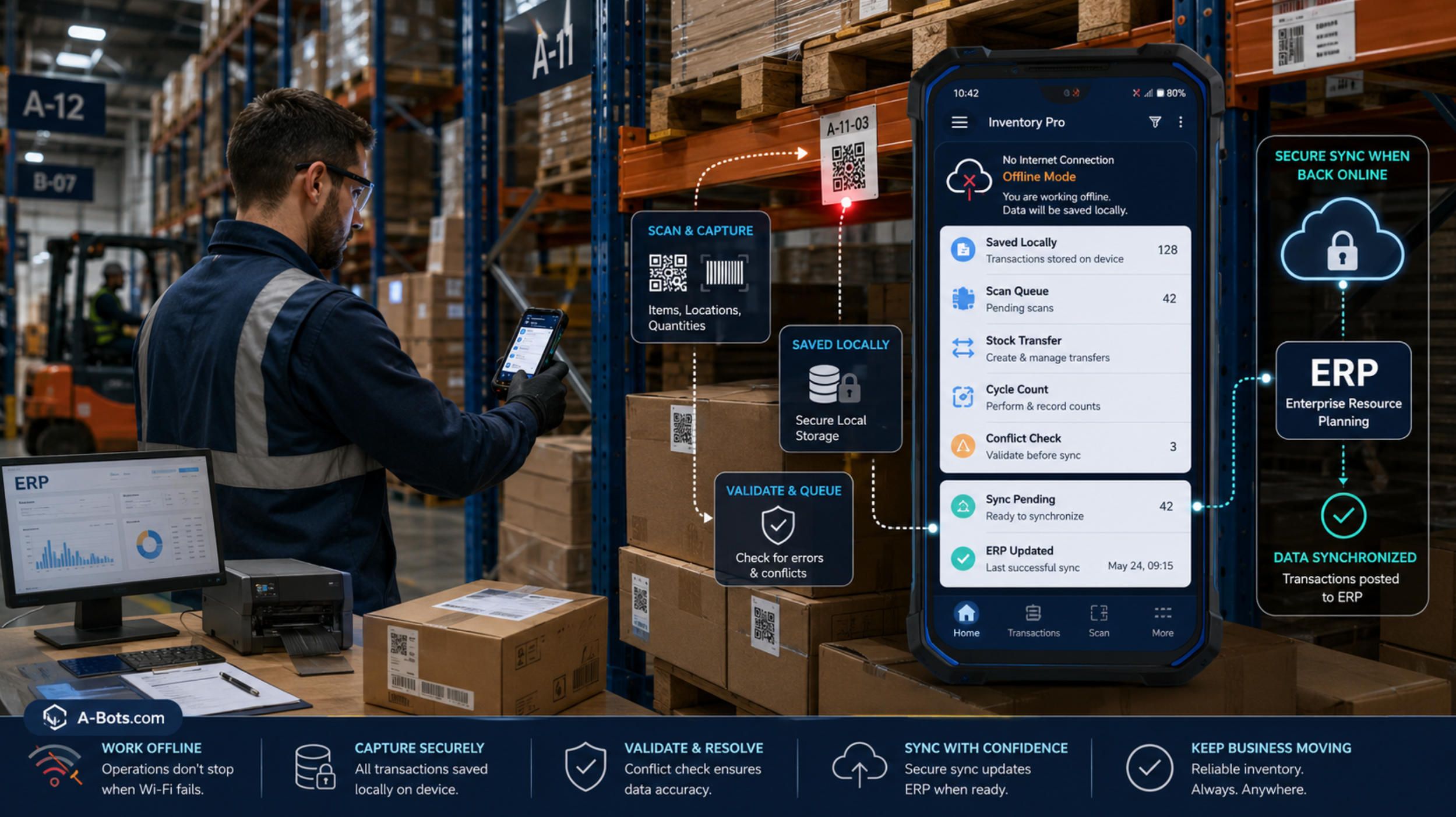
Warehouses are not always friendly to connectivity. Metal racks, cold storage, large facilities, basements, loading docks, remote yards, and industrial zones can create network gaps. If a mobile inventory app depends on perfect connection, operations will eventually break.
Offline mode is therefore not a convenience. It is part of warehouse infrastructure.
A serious warehouse mobile ERP app should allow selected actions to continue offline: scanning, picking, receiving, stock transfer, cycle count, damaged goods reporting, and photo capture. But offline inventory is technically sensitive because stock records are shared business assets. If multiple users perform offline actions on related items, the system must prevent duplication, conflict, and corrupted ERP updates.
This requires a careful sync architecture.
The app should store local transactions securely. It should assign each transaction a status. It should queue updates. It should validate them when connection returns. It should detect conflicts. It should ask for supervisor review when needed. It should never pretend that an unsynced action is already final in ERP.
The user interface must make this transparent:
- “Saved locally”
- “Sync pending”
- “ERP updated”
- “Conflict detected”
- “Supervisor review required”
This is especially important for stock transfers and picking. If a worker moves goods offline, another user should not make a wrong promise based on outdated availability. The Inventory Truth Engine can use pending sync status as one factor in confidence scoring.
That is how offline mode and inventory trust connect.
A-Bots.com can design this correctly because offline-first mobile development is not just a feature. It is a backend, database, UX, and ERP integration challenge.
Mobile Inventory Apps for Different Business Models
Warehouse mobile ERP apps are not only for large logistics companies. They are relevant across many business models.
E-commerce companies need fast picking, packing, returns, order prioritization, stock reservation, and accurate availability across channels.
Manufacturers need raw material tracking, production staging, component issue, finished goods movement, quality checks, and batch traceability.
Distributors need receiving, multi-location stock visibility, customer reservations, branch transfers, and delivery preparation.
Spare parts businesses need serial number tracking, compatibility data, bin location, vehicle stock, technician replenishment, and urgent availability checks.
Healthcare and medical suppliers need lot numbers, expiration dates, compliance records, quarantine workflows, and documented chain of custody.
Food and beverage companies need batch control, expiration logic, temperature-sensitive handling, FIFO or FEFO picking, and recall readiness.
Construction and equipment companies need tool tracking, materials issue, site inventory, returns, damage reports, and project-based stock allocation.
Retail chains need store inventory, shelf replenishment, inter-store transfers, shrinkage control, stock counts, and omnichannel availability.
The details are different, but the operational principle is the same: inventory must be captured where it moves.
This is why custom mobile app development is so effective in this category. The best solution is not one generic inventory app for every business. The best solution is a mobile workflow designed around the company’s real stock logic.
AI, RFID, Drones, and Robotics: Why Mobile Apps Still Matter
Warehouse technology is moving quickly. AI, robotics, RFID, autonomous data collection, computer vision, digital twins, and smart sensors are becoming more visible in supply chain conversations.
This does not make mobile warehouse apps less important. It makes them more important.
Automation needs accurate data. AI needs structured events. Robots need clean inventory locations. RFID needs exception handling. Drones can count stock, but someone still needs to resolve discrepancies. Digital twins need reliable updates from the physical world.
A warehouse mobile ERP app becomes the human interface to this increasingly automated environment.
It helps workers handle exceptions, verify uncertain stock, approve adjustments, resolve mismatches, document damage, classify returns, and confirm business rules that automation cannot safely decide alone.
In the near future, the best warehouse systems will not be purely manual or purely automated. They will be hybrid. Mobile apps will connect human workers, ERP, WMS, robots, scanners, sensors, and AI-assisted decision logic.
For example, AI may identify a SKU with abnormal variance. The mobile app sends a cycle count task to a supervisor. A worker scans the bin, confirms the physical quantity, captures a photo, and updates the stock confidence score. ERP receives a verified correction. Management sees the reason and audit trail.
This is practical AI in warehouse operations: not a vague prediction, but an exception workflow connected to mobile execution.
Security and Accountability in Mobile Inventory Workflows
Inventory is money. Giving mobile users access to inventory actions requires control.
A warehouse mobile ERP app must include role-based permissions, audit trails, device security, controlled offline storage, and action-level validation. Not every worker should be able to adjust stock. Not every user should see cost data. Not every device should access customer orders. Not every discrepancy should be approved automatically.
The app should separate roles clearly:
warehouse worker, picker, receiver, supervisor, inventory controller, branch manager, delivery driver, technician, finance reviewer, administrator.
Each role should have limited actions and visibility.
For accountability, every critical inventory event should have a user, timestamp, location, device, action type, previous value, new value, and reason code. For high-risk actions, the app should require supervisor approval or additional proof.
This matters not only for security. It also improves trust inside the company.
When stock errors appear, managers should not guess. They should see the movement history. They should know whether the issue came from receiving, picking, transfer, returns, damage, shrinkage, or delayed synchronization.
Good audit logic turns inventory management from blame into diagnosis.
How A-Bots.com Can Build a Warehouse Mobile ERP App
A strong warehouse mobile ERP app should begin with operational mapping, not screen design.
The first step is to identify the inventory events that matter most: receiving, putaway, picking, packing, stock transfer, cycle count, returns, damage, quarantine, replenishment, shipment, field stock, or branch transfers.
The second step is to define where the current process loses accuracy. Is the problem delayed entry, wrong location, missing scans, poor labeling, weak cycle count discipline, returns confusion, stock reservation errors, or lack of visibility across locations?
The third step is to design the mobile workflow around the most valuable first release.
For many companies, the first version can include barcode scanning, receiving, picking, stock transfer, cycle count, photo proof for discrepancies, supervisor approvals, ERP synchronization, and a basic Inventory Truth Engine.
A more advanced version can add RFID integration, label printing, warehouse heatmaps, AI exception detection, demand-based replenishment, mobile dashboards, vehicle stock, customer reservations, and integration with robots or autonomous scanning systems.
A-Bots.com can support the full development cycle: business analysis, mobile UX, iOS and Android development, backend architecture, API integration, ERP and WMS synchronization, offline-first logic, barcode and QR scanning, role-based access, audit trails, testing, deployment, and continuous improvement.
The central value is not only software development. It is translating warehouse reality into reliable digital workflows.
From Quantity to Confidence
The next generation of inventory systems will not only ask: how much stock do we have?
They will ask: how certain are we?
A quantity without confidence is risky. A warehouse record without a recent physical event is incomplete. A stock promise without location, status, reservation, and verification can damage sales, production, service, and customer trust.
This is why mobile ERP inventory apps are so important. They connect the physical movement of goods with the digital systems that run the business.
Barcode scanning is the beginning. Real-time stock control is the goal. Inventory confidence is the competitive advantage.
The companies that build this mobile layer will reduce errors, accelerate fulfillment, improve stock visibility, protect margin, support AI, and make better operational decisions. The companies that ignore it will continue to operate with a dangerous gap between what ERP says and what the warehouse can actually prove.
A custom warehouse mobile ERP app can close that gap.
It can turn receiving, picking, transfers, returns, and counts into trusted ERP events. It can help managers see not only stock levels, but stock reliability. It can help sales promise more carefully, warehouses work more accurately, finance trust valuation more confidently, and customers receive what they were promised.
For modern companies, inventory is not just a warehouse responsibility.
It is a business truth.
And the best place to capture that truth is not at the end of the day.
It is at the moment the item moves.
✅ Hashtags
#WarehouseMobileApp
#InventoryManagementApp
#MobileERP
#ERPIntegration
#WarehouseAutomation
#BarcodeScanningApp
#InventoryAccuracy
#SupplyChainTechnology
#ABotsCom
Other articles
AI Customer Service Agents How AI customer service agents are transforming business apps from simple support channels into intelligent customer interaction platforms. It explores how custom mobile apps can automate support, bookings, order tracking, service requests, warranty cases, complaint intake, technician workflows, and human escalation. The article shows why traditional chatbots are no longer enough for businesses with complex customer journeys, recurring service operations, and high expectations for speed and personalization. It also highlights the importance of data integration, governance, security, mobile UX, and human-in-the-loop control when building AI-powered customer service systems with A-Bots.com.
AI Sales Agents in Mobile Apps This expert article explains how AI sales agents are transforming mobile apps into intelligent revenue platforms. It shows how custom mobile applications can qualify leads, guide buyers through product choices, personalize recommendations, prepare follow-ups, update CRM records, and support sales teams with structured customer context. The article explores practical use cases across eCommerce, field service, real estate, moving, logistics, equipment manufacturing, SaaS, and B2B services. It also explains why AI sales automation requires reliable data, CRM integration, human oversight, and custom software architecture. A-Bots.com is positioned as a development partner for companies building AI-powered mobile sales platforms.
How to Build a Custom AI Agent App How businesses can move from basic AI chatbot experiments to production-ready custom AI agent apps. It covers the architecture required for serious AI products, including mobile app UX, AI orchestration, knowledge retrieval, CRM and ERP integrations, workflow automation, data security, guardrails, observability, and human-in-the-loop control. The article shows why a business AI agent must be designed as a secure, integrated software system rather than a simple chat window. It positions A-Bots.com as a custom development partner for companies building practical AI-powered mobile apps and enterprise platforms.
Mobile ERP App Development Why traditional ERP systems often fail at the operational edge - where warehouse teams, field technicians, delivery staff, supervisors, and mobile managers actually perform the work. It explores the concept of a custom mobile ERP app as a focused operational layer over an existing ERP system. The article highlights moment-of-work data capture, offline functionality, barcode scanning, photo proof, GPS, digital signatures, approvals, security, and ERP integrations. It also shows how companies can use mobile ERP app development to reduce delays, improve data accuracy, strengthen accountability, and prepare their operations for AI-assisted workflows.
Field Service ERP Apps: Connecting Technicians, Dispatchers, and Customers How field service ERP apps turn technician visits, dispatcher decisions, spare parts usage, customer communication, and ERP records into one connected workflow. It focuses on the business value of custom mobile app development for service companies, manufacturers, facility teams, equipment providers, and field operations. The key concept is Service Profitability Control - a mobile module that helps companies see whether a visit is becoming profitable or unprofitable before the technician leaves the site. The article also covers offline mode, first-time fix rate, dispatch intelligence, ERP integration, customer proof, AI-assisted service, and secure mobile workflows.
Top stories

Copyright © Alpha Systems LTD All rights reserved.
Made with ❤️ by A-BOTS