
Home
Services
About us
Blog
Contacts
Last-Mile Delivery App Development: Driver App, Route Dispatch, Proof of Delivery, Customer Notifications, and WMS/ERP Integration
A last-mile delivery app is not a driver tracker. It is a delivery execution layer that connects warehouse readiness, route dispatch, driver actions, customer communication, proof of delivery, and WMS/ERP synchronization into one accountable workflow.
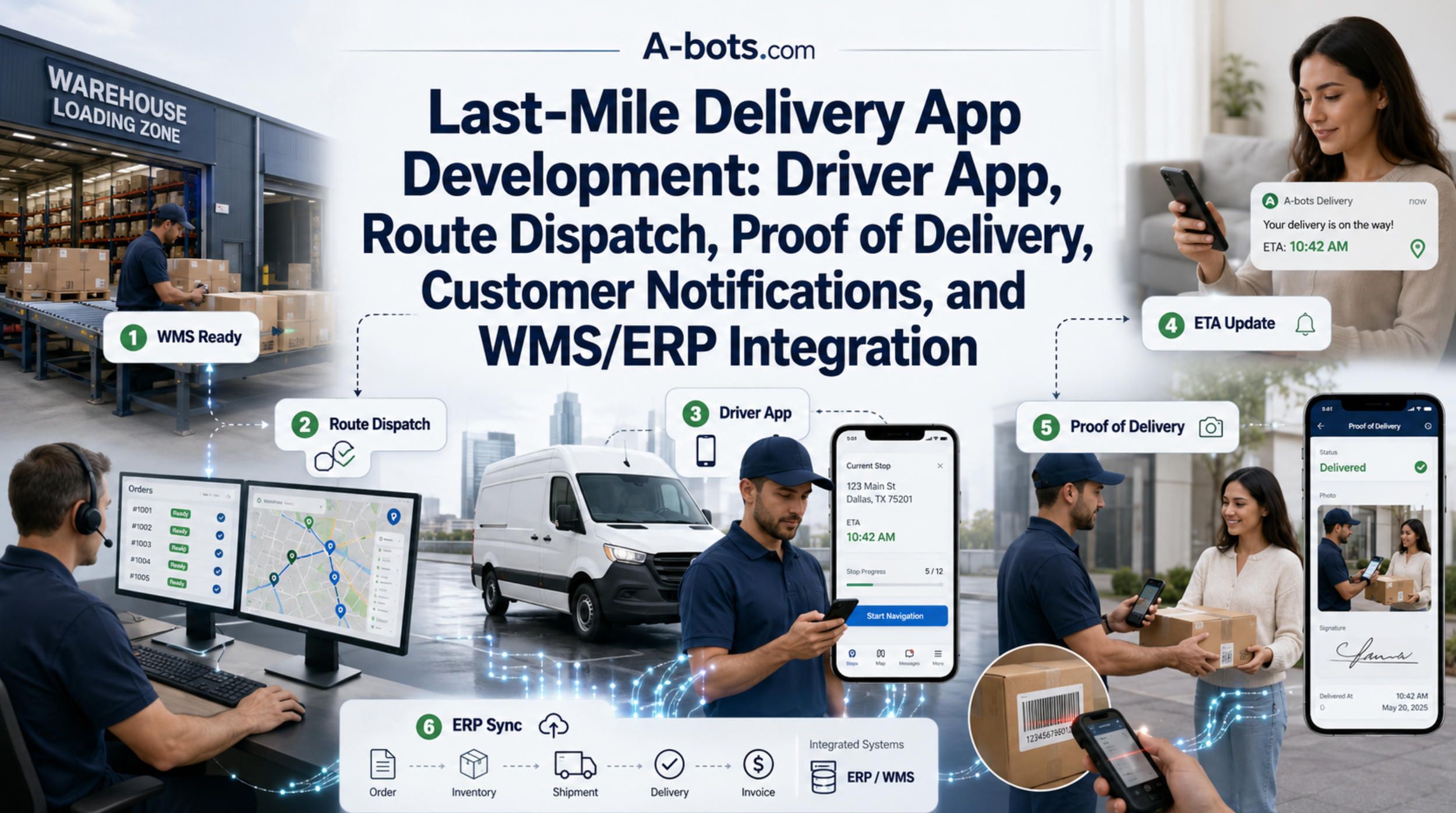
The order is picked. The label is printed. The driver has left the warehouse. The customer has already received an ETA. In the dashboard, everything appears to be moving. Yet the delivery is not truly under control.
One package is sitting in the wrong tote. One address is incomplete. One late order was added after the route had already been planned. One customer will not be home during the promised window. One driver will mark a stop as failed, but the reason will be too vague for support to act on. Another will complete a delivery with a photo that proves almost nothing. The warehouse will consider the order shipped, the customer will consider it expected, the dispatcher will consider it at risk, and the ERP will learn the truth only after several people have already spent time repairing the day.
That is the real last-mile problem.
It is tempting to describe last-mile delivery as a routing challenge. Find the shortest route, reduce mileage, improve ETA, track drivers, and the business becomes more efficient. But in most real delivery operations, the expensive failures are not created only by distance. They are created by broken handoffs between systems, people, and promises.
A route can be mathematically optimized and still operationally wrong. It can ignore warehouse readiness, vehicle capacity, customer time windows, delivery instructions, proof requirements, returns, pickups, age verification, cold-chain rules, installation tasks, or the fact that a driver knows a loading dock is impossible to access after 3 p.m. The map may look efficient, while the actual workflow is already fragile.
For retailers, pharmacies, food distributors, spare parts suppliers, furniture companies, appliance installers, courier networks, local delivery fleets, and distributors with owned vehicles, a last-mile delivery app should not be built as a decorative map. It should answer a more commercial question:
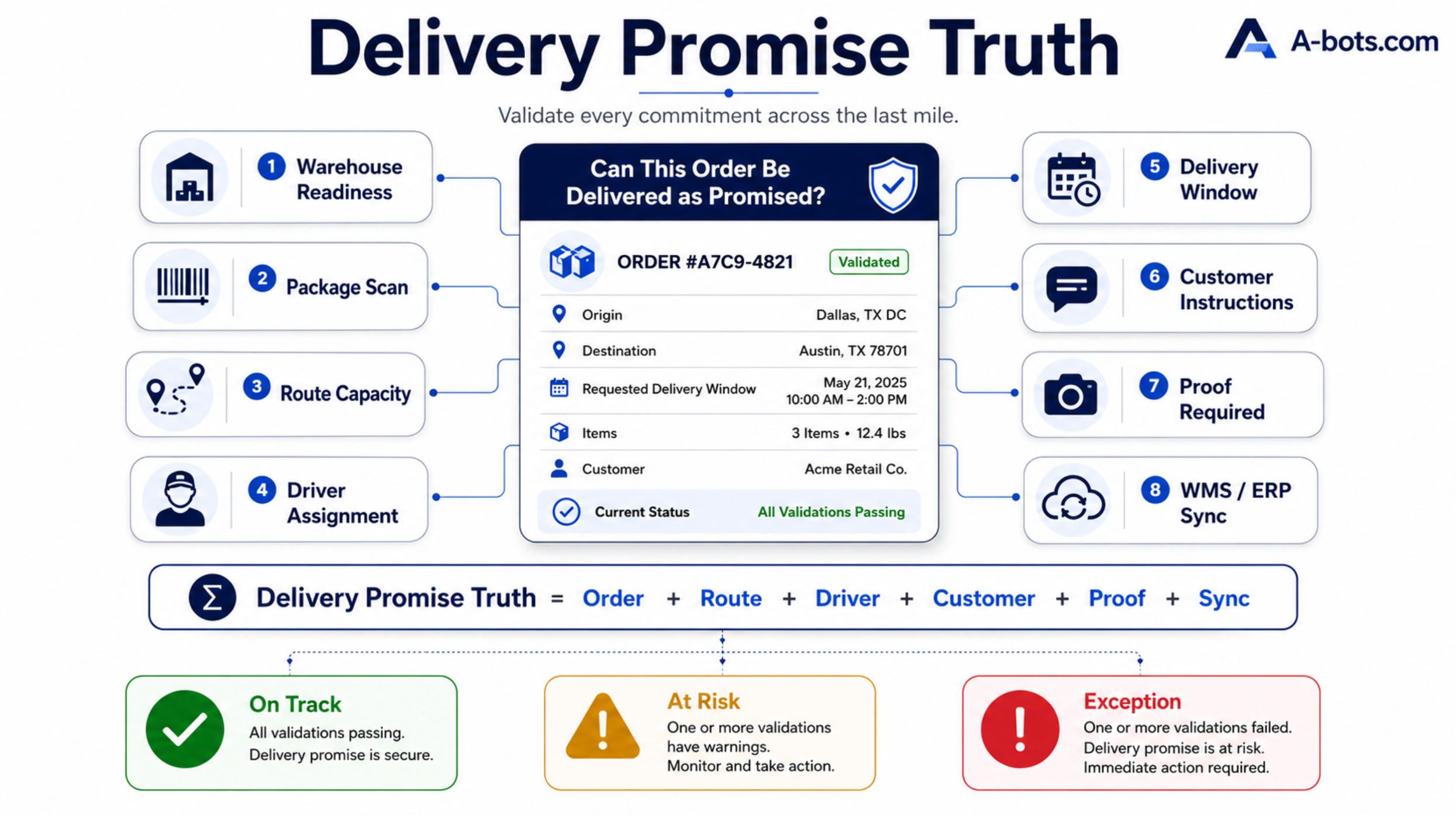
Can this order be delivered as promised, proven as delivered, and synchronized back to WMS and ERP without manual recovery work?
That question changes the product.
It moves the app away from “where is the driver?” and toward a deeper idea: Delivery Promise Truth.
The Last Mile Is Expensive Because It Is Operationally Unstable
The last mile is expensive not simply because vehicles drive through traffic. It is expensive because every order becomes an individual promise that must survive warehouse execution, routing decisions, driver behavior, customer availability, proof capture, exception handling, and system synchronization.
A pallet moving between distribution centers can be managed as a consolidated logistics event. A last-mile route is different. It may contain dozens or hundreds of individual stops, each with its own address quality, time window, customer expectation, delivery instruction, package condition, proof requirement, and risk of failure. The company is no longer moving freight in bulk. It is fulfilling many small promises under local conditions.
That is why the last mile absorbs so much operational attention. Business Insider, citing Capgemini Research Institute, describes last-mile delivery as accounting for about 41 percent of logistics costs. The exact percentage will vary by industry, geography, product type, and delivery model, but the business lesson is stable: the final leg is disproportionately expensive because it is fragmented, visible to the customer, and difficult to standardize.
The industry response has often been to invest in routing technology. That is reasonable. Dynamic routing, ETA prediction, traffic awareness, and route balancing can reduce waste. A recent Business Insider case described Net Zero Logistics reducing daily delivery routes from roughly 30–40 to 16–20 after adopting AI-powered dynamic routing while maintaining or improving capacity. FedEx’s 2026 launch of FedEx SameDay Local with OneRail points in the same direction: the market is competing on tighter delivery windows, more flexible fulfillment, and better matching between orders, drivers, and vehicles.
But routing is only one part of the execution problem.
A route plan assumes that the right orders are ready, the right packages are loaded, the address is usable, the customer can receive, the driver follows the workflow, exceptions are captured, and the final status returns to the systems that need it. If these conditions are weak, route optimization can only make the confusion move faster.
This is why a last-mile delivery app must be designed as an execution layer, not just as a route planner.
Driver Tracking Is Not Delivery Control
Many companies begin with a simple requirement: they want to see drivers on a map. This feels like control because movement becomes visible. A dispatcher can watch icons, estimate delays, and answer customer support questions more confidently.
But visibility is not the same as control.
A driver icon does not tell the company whether the correct package was loaded. It does not prove that the customer received the order. It does not explain why a stop failed. It does not confirm whether a return was collected. It does not update ERP with invoice-ready delivery confirmation. It does not tell WMS whether inventory should be released, reversed, returned, or held for investigation.
Driver tracking answers the location question. Delivery control answers the workflow question.
The distinction matters because a delivery operation can have real-time GPS and still spend hours every day on manual recovery. Dispatchers still call drivers to ask what happened. Customer support still searches for photos. Warehouse teams still investigate missing packages. Finance still waits for delivery confirmation. Managers still cannot distinguish a truly failed delivery from an attempted delivery with weak documentation.
The delivery app must therefore capture actions, not merely movement.
The driver should scan packages during loading, confirm the route manifest, see stop instructions, capture proof at the door, record failed delivery reasons, collect signatures when required, handle partial deliveries, report damage, initiate returns, and synchronize every event back to the operational stack. The dispatcher should not have to reconstruct the truth from calls, screenshots, and memory.
A good last-mile app makes the route visible. A serious last-mile app makes the delivery defensible.
Delivery Promise Truth
Delivery Promise Truth means that every delivery has a single operational reality that the business can trust:
This order, from this warehouse, on this route, with this driver, under this delivery window, with this customer instruction, has this current execution state and this proof of completion.
That may sound simple, but many companies do not have it. They have separate truths.
The WMS knows that the order was picked and staged. The route-planning tool knows that it was assigned to a vehicle. The driver app knows what happened at the stop. Customer support knows what the customer complained about. ERP knows whether the order was invoiced. The customer notification platform knows what message was sent. If these systems are not connected, each one is only partially true.
Delivery Promise Truth requires the app to manage the lifecycle of the delivery, not only the final status.
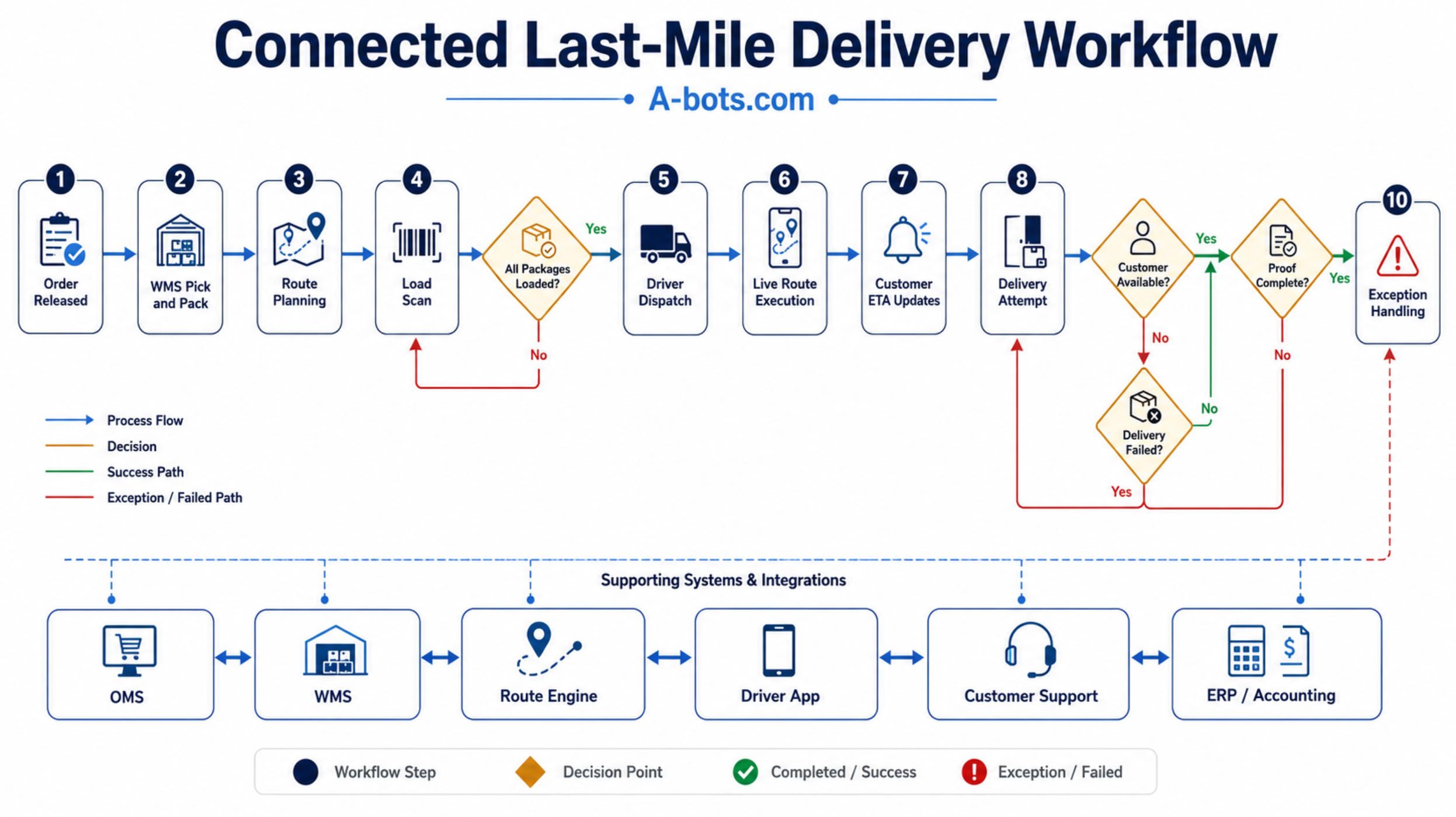
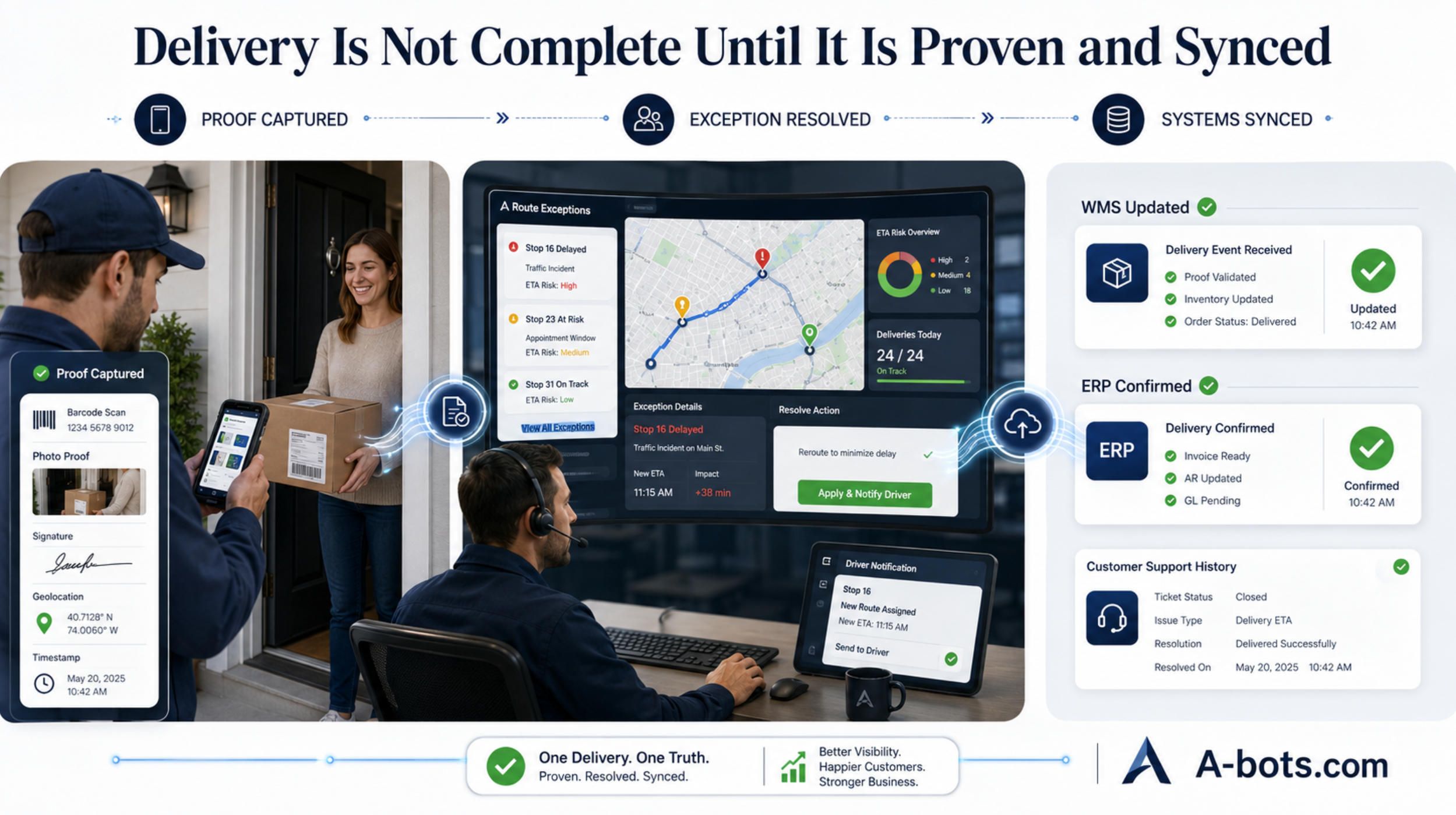
The workflow begins when an order is released from OMS or ERP and becomes eligible for fulfillment. WMS then handles pick, pack, staging, and load readiness. The routing layer builds routes based on delivery windows, capacity, geography, driver availability, service time, vehicle type, priority, and constraints. The driver app confirms loading and executes the route. Customer notifications translate real operational events into clear updates. Proof of delivery records what actually happened. Exceptions trigger recovery workflows. Final delivery events synchronize back to WMS, ERP, accounting, customer support, and analytics.
The simplified chain looks like this:
Order Released → WMS Pick and Pack → Route Planning → Load Scan → Driver Dispatch → Live Route Execution → Customer ETA Updates → Delivery Attempt → Proof of Delivery → Exception Handling → ERP/WMS Sync.
The value is not in displaying this flow. The value is in controlling the transitions.
A delivery should not become “Out for Delivery” if the required packages were not scanned into the vehicle. A stop should not become “Delivered” without the proof required for that customer, product, or regulation. A failed delivery should not be a free-text note that support cannot use. A customer notification should not be sent from a marketing schedule that ignores the actual driver route. ERP should not receive delivery confirmation before the workflow has the evidence needed to defend it.
This is how a delivery app becomes an operating system for the last mile.
Most Delivery Failures Are Created Before the Driver Reaches the Door
It is easy to blame the final failure on the final actor. The driver arrived late, the customer was unavailable, the package was missing, the proof was weak, the address was wrong. But many delivery failures are created earlier.
A warehouse releases the route before all orders are staged. A late order is added manually without rebalancing. A package is loaded into the wrong vehicle. The address is accepted despite missing apartment, gate, or dock information. The customer’s requested time window is treated as a note instead of a constraint. A delivery requiring a signature is assigned to a driver who does not see that requirement clearly. A return pickup is added by support but not inserted into the live route.
By the time the driver reaches the door, the failure may already be inevitable.
Research on last-mile routing supports this operational reality. Studies on preference-aware delivery planning and driver route behavior show that real delivery routes are influenced by more than shortest distance. Experienced drivers use local knowledge about roads, curbside conditions, building access, customer availability, and service-area patterns. That does not mean technology should simply defer to driver habits. It means route dispatch must be designed around real execution constraints, not only map geometry.
This is where custom development becomes valuable. Off-the-shelf route tools can optimize common scenarios. But many businesses have delivery rules that are specific to their model: pharmacy ID checks, grocery temperature windows, furniture room-of-choice delivery, appliance installation, spare-parts urgency, COD payment, reusable packaging return, contractor drop-offs, store-to-customer delivery, or mixed fleets of employees and contractors.
A last-mile app must understand the promises the company actually makes. Otherwise, it optimizes the wrong problem.
The Driver App Should Be Built Around Speed, Clarity, and Proof
A driver app is not a CRM on wheels. The driver is not sitting at a desk with time to navigate complex screens. The driver is moving between stops, handling packages, dealing with traffic, parking, gates, elevators, building staff, customers, weather, time pressure, and sometimes safety concerns.
The app must reduce cognitive load.
At the beginning of the route, the driver should know exactly what must be loaded, which packages belong to which stops, which items require special handling, and which exceptions must be checked before departure. During the route, the driver should see the next stop, navigation, time window, customer notes, required proof, package identifiers, and any special instruction. At the stop, the app should guide the driver through the minimum necessary actions to complete or fail the delivery correctly.
The best driver workflow feels strict in the right places and fast everywhere else.
If a package must be scanned, the app should require the scan. If a photo is mandatory, the app should not allow completion without it. If a signature is required, the app should make the signature flow obvious. If a delivery is failed, the app should ask for a structured reason, not a vague note. If the driver is offline, the app should preserve the event and sync later without losing media or duplicating statuses.
For many delivery businesses, the driver app should support load scan, stop sequence, navigation, customer instructions, package scan at stop, photo proof, recipient name, signature, geolocation, timestamp, failed delivery reason, partial delivery, damaged item report, return pickup, cash or payment confirmation where relevant, driver-dispatch chat, and sync status.
That list is not a feature wishlist. It is the operational memory of the route.
If the app does not capture these events cleanly, someone else will rebuild them later through calls and guesswork.
Dispatch Is Not a Map; It Is Exception Control
The dispatcher’s job is often misunderstood. A dispatcher is not merely placing stops on routes. In a live delivery operation, the dispatcher is protecting promises under changing conditions.
Orders are delayed in the warehouse. A driver calls in sick. A vehicle has less capacity than expected. Traffic destroys the first route plan. A customer asks to reschedule. A high-priority stop must be inserted. A failed delivery needs same-day recovery. A return pickup appears. A driver is ahead of schedule but another route is collapsing.
A map can show where vehicles are. It cannot by itself decide which promise is most at risk.
A useful dispatcher console should organize the day around exceptions and consequences. It should show route capacity, driver availability, warehouse load status, late order insertion, delivery window risk, vehicle constraints, customer priority, live ETA changes, failed stop recovery, and which statuses have not synchronized back to core systems.
The dispatcher should not have to manually “rebuild the day” every time reality changes. The system should show what changed, which customers are affected, which route can absorb a new stop, which driver can handle a pickup, which delivery is likely to miss its window, and which exception requires human approval.
This is where AI can help, but only when the workflow is structured. Dynamic route rebalancing, ETA prediction, failed-delivery risk scoring, and exception prioritization can be valuable. But AI cannot compensate for missing package scans, vague failure reasons, incomplete addresses, or disconnected WMS data. The system needs clean delivery events before intelligent optimization can be trusted.
The correct sequence is not “add AI to delivery.” The correct sequence is “make delivery events reliable, then use AI to improve decisions.”
Proof of Delivery Is Operational Memory
Proof of Delivery is often treated as a final checkbox. Delivered. Signed. Photo attached. Done.
That is too weak.
POD is the company’s operational memory. It is what customer support uses when a customer claims non-delivery. It is what finance uses before invoicing or releasing payment. It is what compliance uses when regulated goods require age verification or chain-of-custody. It is what operations uses to understand whether drivers are completing stops correctly. It is what management uses to reduce claims, refunds, and repeated disputes.
A good POD record must connect the proof to the order, package, driver, customer, stop, time, location, and required delivery conditions. A random photo on a phone does not prove much. A photo connected to the order ID, package scan, timestamp, geolocation, driver identity, route, recipient instruction, and delivery status is much stronger.
The content of POD depends on the business. A grocery delivery may need doorstep photo and temperature exception notes. A pharmacy delivery may need ID verification and chain-of-custody. A furniture delivery may need room-of-choice confirmation and damage photos. A spare-parts delivery may need recipient name and urgent time confirmation. A B2B route may need dock signature, stamp, or receiving note.
The app must adapt proof requirements to the delivery type.
Failed delivery also requires proof. A failed stop should not be a vague “customer unavailable.” It may need photo of locked gate, call attempt record, timestamp, geolocation, access issue, wrong address flag, rejected delivery reason, damaged item note, or reschedule request. Without structured failed-delivery evidence, the business cannot distinguish driver error, customer unavailability, address quality problems, warehouse mistakes, or unrealistic time windows.
POD is not only about defending against dishonest claims. It is about learning why delivery promises fail.
Customer Notifications Reduce Work Only When They Come From Real Events
Customer notifications are often discussed as a customer-experience feature. They are more than that. They reduce operational load.
A customer who receives accurate updates is less likely to call support. A customer who knows the driver is nearby is more likely to be available. A customer who can reschedule early may prevent a failed stop. A customer who receives delivery proof quickly is less likely to ask where the order is.
But notifications help only when they are connected to real events. If the customer receives an ETA that ignores route changes, the notification creates frustration. If the system says “out for delivery” before the package is actually loaded, it creates false confidence. If the customer receives “delivered” without useful proof, support still receives the call.
Customer communication should be a projection of operational truth, not a separate marketing layer.
The app should trigger messages from real workflow states: order scheduled, package loaded, driver assigned, ETA updated, driver nearby, delivery completed, delivery failed, action required, reschedule available, return collected, or claim under review. Each notification should reduce uncertainty or prompt a useful customer action.
The best notification is not the most frequent one. It is the one that arrives at the moment it can prevent manual recovery.
WMS and ERP Integration Is the Core, Not an Add-On
A last-mile app that does not integrate with WMS and ERP is just another operational silo.
WMS knows what was picked, packed, staged, loaded, shorted, returned, or damaged. ERP knows the commercial order, customer account, invoice, payment, refund, credit memo, inventory movement, and financial status. OMS or e-commerce systems know the customer promise, delivery window, contact details, and order lifecycle. Customer support needs delivery history, proof, exceptions, and reschedule actions.
The driver app knows what really happened.
If these systems do not share events, the business runs on delayed truth. A delivery may be completed in the field but not visible to finance. A failed stop may be known to the driver but not to customer support. A returned item may be physically back in the warehouse but not reflected in inventory. A customer may receive a notification that contradicts the ERP status. A manager may see route metrics that do not connect to order profitability.
Integration turns delivery from a route event into a business event.
When a driver scans a package during loading, WMS should know that the order is on the vehicle. When a delivery is completed with required proof, ERP may trigger invoicing or close fulfillment. When a delivery fails, OMS should open a recovery action and customer support should see the reason. When a return is collected, inventory and refund workflows should begin. When a claim appears, POD should be available without searching phones or chat messages.
This is where A-bots.com’s custom development approach is most relevant. The goal is not to build another generic courier tracker. The goal is to design the mobile execution layer between warehouse systems, drivers, dispatchers, customers, and the financial back office.
The strongest last-mile apps are not isolated products. They are integration products with a driver interface.
When Off-the-Shelf Delivery Platforms Are Enough
Custom development is not always the right answer. A company with a standard delivery model, simple route logic, clean integrations, and common proof requirements may be well served by existing delivery management platforms. Tools such as Onfleet, Bringg, FarEye, Locus, DispatchTrack, Routific, Tookan, and similar systems can cover route planning, driver tracking, task assignment, customer notifications, proof of delivery, and basic integrations for many operations.
The decision changes when the delivery workflow is specific enough that standard configuration creates workarounds.
That often happens when delivery is not just parcel drop-off. The company may combine delivery with installation, pickup, exchange, inspection, age verification, cold-chain handling, regulated products, payment collection, returnable packaging, service parts, store fulfillment, B2B receiving rules, or customer-specific proof requirements. It may run owned fleets, contractors, carriers, and store staff at the same time. It may depend on a legacy WMS or customized ERP. It may need delivery events to trigger complex financial, inventory, or customer support workflows.
The warning sign is not that the company lacks software. The warning sign is that employees keep building manual bridges around it.
Dispatchers still call drivers for status. Customer support still asks for photos. Warehouse staff still fixes load mistakes after departure. Finance still waits for confirmation. Managers still cannot calculate the true cost of reattempts. Customers still ask “where is my order?” because the notification does not reflect reality.
In that situation, the problem is not simply delivery visibility. The problem is that the delivery workflow is not connected to the business workflow.
A custom last-mile delivery app becomes justified when the cost of manual recovery is higher than the cost of building the missing execution layer.
A Practical MVP
A strong first version does not need to digitize every future ambition. It should target the most expensive break in the delivery chain: the gap between warehouse release, driver execution, proof capture, customer communication, and system sync.
A practical MVP can begin with order import from WMS or OMS, a dispatcher route board, a driver mobile app, load scan, delivery scan, photo and signature POD, geolocation, customer ETA notifications, structured failed-delivery reasons, an exception queue, and status synchronization back to WMS and ERP.
This is enough to answer the first serious business question:
Can the company execute deliveries with less manual recovery and stronger proof?
The second phase can add dynamic routing, AI-based ETA risk, route rebalancing, returns, customer rescheduling, courier or carrier integration, chain-of-custody, payment collection, BI dashboards, and deeper customer support workflows.
This staged approach matters because delivery operations are full of exceptions. Trying to build every exception into the first release can produce a slow, overloaded product. It is better to begin with a clean event model and expand it around the exceptions that actually cost money.
The foundation should be simple but rigorous: every delivery event has an order, package, driver, route, timestamp, location, action, evidence, and sync status.
Without that event history, optimization remains guesswork.
The Metrics That Matter
A last-mile delivery app should not be judged only by whether routes look shorter on a map. The real question is whether the system reduces the operational work required to complete and defend deliveries.
Delivery cost per stop matters, but it must be read with other metrics. A cheaper route that increases failed deliveries may not be cheaper at all. Stops per driver hour matters, but only if proof quality remains strong. ETA accuracy matters because it affects customer availability and support load. First-attempt delivery success matters because reattempts consume capacity that could have served new orders.
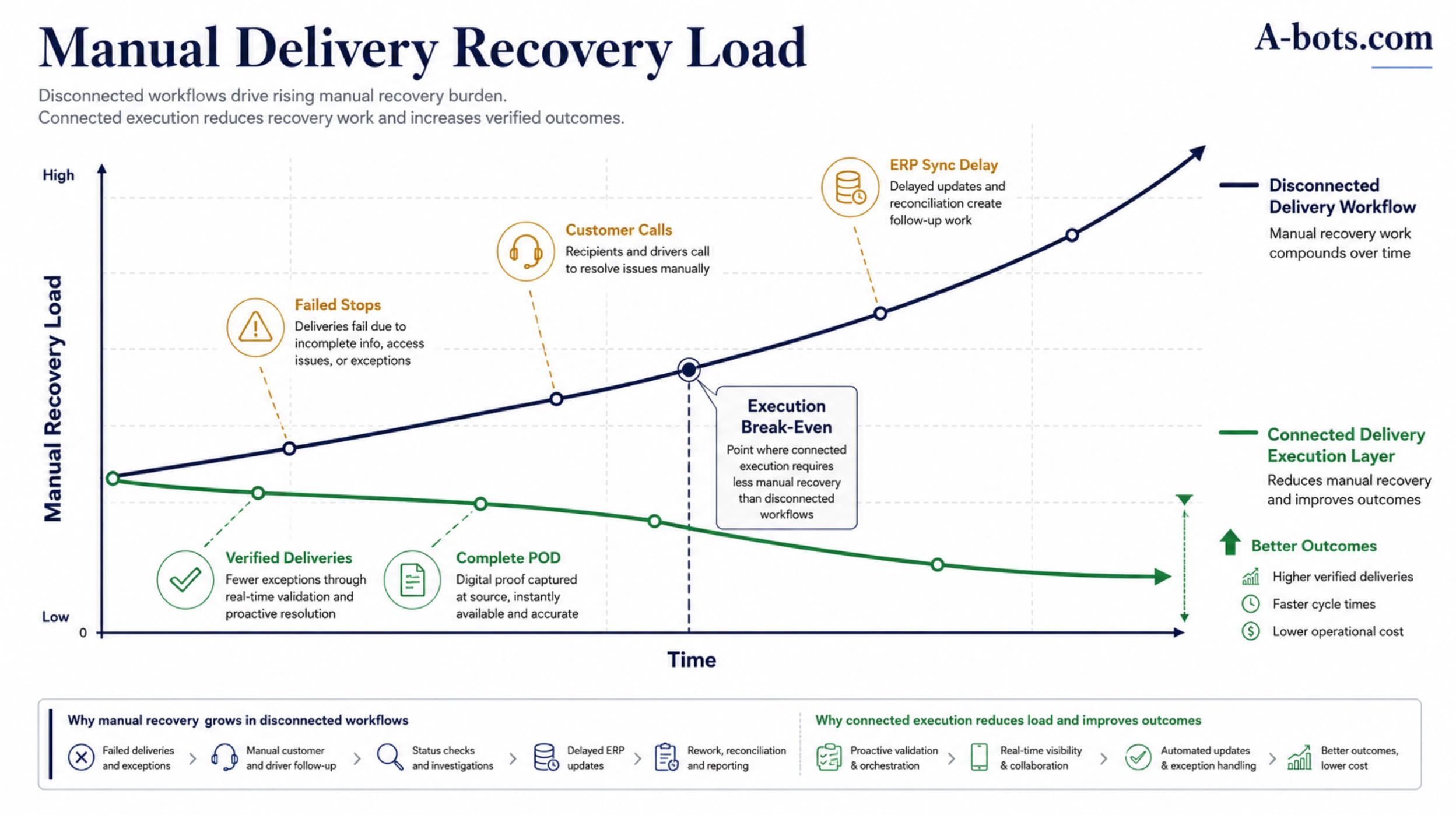
The most revealing metric is Manual Delivery Recovery Load.
This is the share of deliveries that require manual intervention after the route has already started: calling the driver, calling the customer, correcting an address, searching for proof, rebuilding a route, manually updating status, investigating a claim, arranging a reattempt, or reconciling WMS and ERP after the fact.
A delivery operation can look efficient while this recovery load remains high. Drivers may be busy, routes may be full, and dashboards may be active. But if dispatch, support, warehouse, and finance spend the afternoon reconstructing what happened, the app has not yet solved the last-mile problem.
Other useful metrics include failed delivery rate, first-attempt success, average route duration, customer support calls per 100 deliveries, POD dispute rate, claims due to “not received,” time from delivery completion to ERP/WMS update, reattempt cost, and percentage of deliveries closed with complete proof.
The purpose of measurement is not to admire dashboards. It is to discover where the delivery promise breaks.
AI Helps Only After the Delivery Workflow Is Structured
AI belongs in last-mile delivery, but it should not be the headline promise. The more practical role of AI is to improve decisions inside a controlled workflow.
AI can help predict ETA more accurately, rebalance routes dynamically, identify failed-delivery risk, detect poor address quality, recommend customer notification timing, flag unusual proof-of-delivery patterns, predict route overload, insert returns or pickups into live routes, and support claim triage. These are valuable use cases, especially when delivery volume is high and manual dispatch decisions become too complex.
But AI needs structured events. It needs package-level data, driver actions, timestamps, locations, time windows, task acceptance, task completion, customer outcomes, and exception reasons. Research datasets such as LaDe show why this matters: last-mile optimization depends on detailed package and task-event histories, not just static maps.
AI cannot reliably fix a delivery operation where packages are not scanned, failed stops are vague, address quality is poor, POD is inconsistent, and WMS/ERP sync is delayed. In that environment, AI only accelerates uncertainty.
The responsible sequence is clear: first create delivery truth, then optimize it.
The Real Product Is Delivery Confidence
A last-mile delivery app becomes valuable when the business no longer has to guess what happened between warehouse release and customer receipt.
The dispatcher can see which promises are at risk. The driver knows exactly what to do at each stop. The customer receives updates based on real events. The warehouse knows what was loaded, missed, returned, or damaged. Support sees proof and exceptions without calling three people. ERP receives the delivery status required for billing, refunds, claims, or inventory movement. Management can measure where the operation loses time, trust, and margin.
That is delivery confidence.
Not just tracking. Not just routing. Not just notifications. Not just proof of delivery. Not just a driver app.
The real product is the connected workflow that makes the delivery promise believable.
For companies that operate their own delivery fleets or coordinate local carriers, this is where custom development becomes commercially relevant. A-bots.com can help design and build last-mile delivery applications around real operational constraints: WMS readiness, route dispatch, driver execution, customer communication, proof requirements, exceptions, and ERP synchronization.
The goal is not to create another map with moving vehicles. The goal is to make every delivery event accountable.
Because the delivery is not complete when the driver taps “Delivered.”
It is complete when the company can prove what happened, update every system that depends on that truth, and move to the next order without manual recovery work.
✅ Hashtags
#LastMileDelivery
#DeliveryAppDevelopment
#DriverApp
#RouteDispatch
#ProofOfDelivery
#WMSIntegration
#ERPIntegration
#LogisticsTechnology
Other articles
Custom Field Service App Development for HVAC, Equipment Repair, and Maintenance Companies Field service companies often do not lose money because they lack software. They lose it between disconnected systems: customer requests, dispatch, technician execution, parts availability, asset history, service proof, and back-office workflows. This article explains when off-the-shelf field service management software stops fitting HVAC, equipment repair, and maintenance companies, and why a custom mobile app can become the operational layer that connects the field with ERP, CRM, inventory, accounting, and customer communication. It also explores offline-first technician workflows, dispatcher visibility, parts logic, AI-assisted service operations, and the build-vs-buy decision.
Field Service ERP Apps: Mobile Workflows for Technicians Field service companies often lose profit not during the repair itself, but between disconnected steps: dispatch, parts availability, technician notes, customer approval, invoicing, and ERP updates. This article explains how a field service ERP app becomes the mobile operational layer between office systems and real-world service execution. It explores how custom apps connect technicians, dispatchers, customers, inventory, service history, proof of work, and billing into one controlled workflow. For HVAC, equipment repair, industrial maintenance, and after-sales service teams, the goal is not more software, but better service profitability control.
Qwen Robot Suite, Qwen-RobotManip, Qwen-RobotWorld, Qwen-RobotNav Alibaba’s Qwen Robot Suite signals a major transition from conversational AI to machines that can perceive, predict, navigate, and act in physical environments. This expert analysis examines the three-model architecture behind the platform: Qwen-RobotNav for configurable spatial navigation, Qwen-RobotWorld for generating possible physical futures, and Qwen-RobotManip for generalizable robot manipulation. The article also compares Alibaba’s approach with NVIDIA Cosmos and Isaac GR00T, Google Gemini Robotics, Physical Intelligence, and Figure Helix. Beyond model benchmarks, it explores the harder questions of physical reliability, enterprise integration, safety controls, human approval, and the application infrastructure required to turn embodied intelligence into accountable business workflows.
Equipment Rental App Development: One Connected Workflow An asset shown as available in rental software may still be awaiting collection, inspection, cleaning, repair, or transfer. This article explains why equipment rental app development must connect the entire operational lifecycle rather than simply provide a booking catalogue. It examines availability forecasting, driver and yard workflows, offline inspections, damage evidence, customer self-service, telematics, maintenance, and ERP integration. The article also explores when off-the-shelf rental software is sufficient and when a custom mobile execution layer becomes justified. Its central concept—Commercial Asset Truth—helps rental companies recover rentable days, reduce disputes, expose revenue leakage, and make more reliable commitments to customers.
B2B Ordering App Development for Distributors and Manufacturers A B2B ordering app is not just a digital storefront. For distributors and manufacturers, it should act as a controlled ordering layer that connects customer-specific catalogs, negotiated pricing, inventory reality, approval rules, ERP data, and repeat purchasing workflows. This article explains why many sales teams become manual order desks, how self-service can reduce phone and email orders without weakening customer relationships, and why quick reorder, pricing accuracy, stock validation, product data, and ERP integration matter more than a beautiful catalog. It also explores when custom development makes sense and how A-bots.com can help build account-specific ordering workflows.
Top stories

Copyright © Alpha Systems LTD All rights reserved.
Made with ❤️ by A-BOTS