
Home
Services
About us
Blog
Contacts
B2B Ordering App Development for Distributors and Manufacturers: How Mobile Self-Service Cuts Phone Orders, Pricing Errors, and Manual Reordering
A B2B ordering app is not a digital storefront. It is a controlled ordering layer that turns account-specific catalogs, negotiated pricing, inventory reality, approval rules, and ERP data into a repeatable self-service workflow.
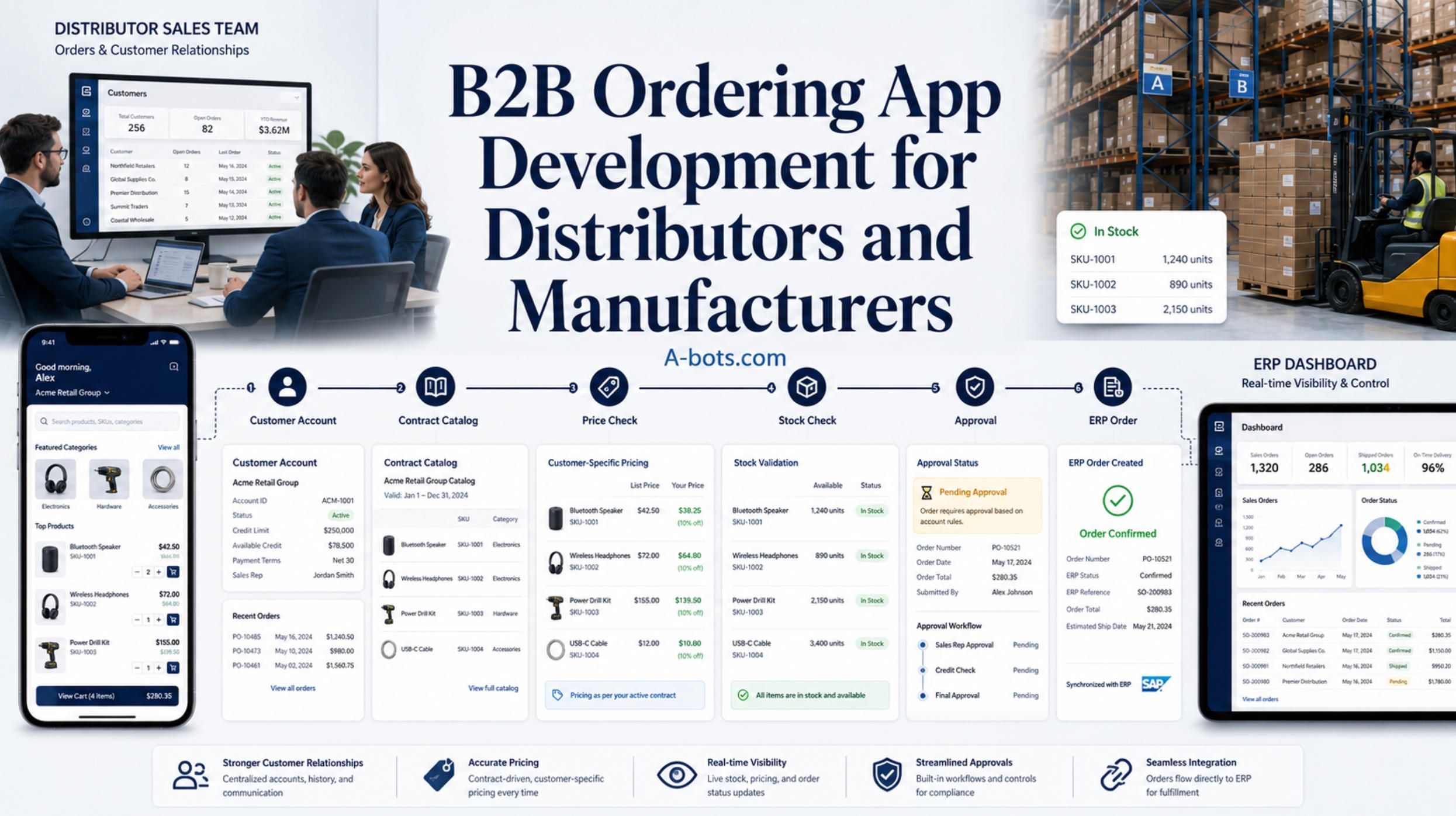
The customer does not need a sales call. He needs the same 47 SKUs he ordered last month, but with two substitutions, current stock, his contract price, a purchase order number, delivery to warehouse B, and approval from his regional manager. Nothing about this order is emotionally complicated. It is not a strategic negotiation, not a new account opportunity, not a relationship-building conversation. It is a routine replenishment task. Yet in many distribution and manufacturing businesses, this simple repeat order still travels through email, Excel, phone calls, screenshots, old PDFs, and one tired sales representative who understands the customer’s rules better than the system does.
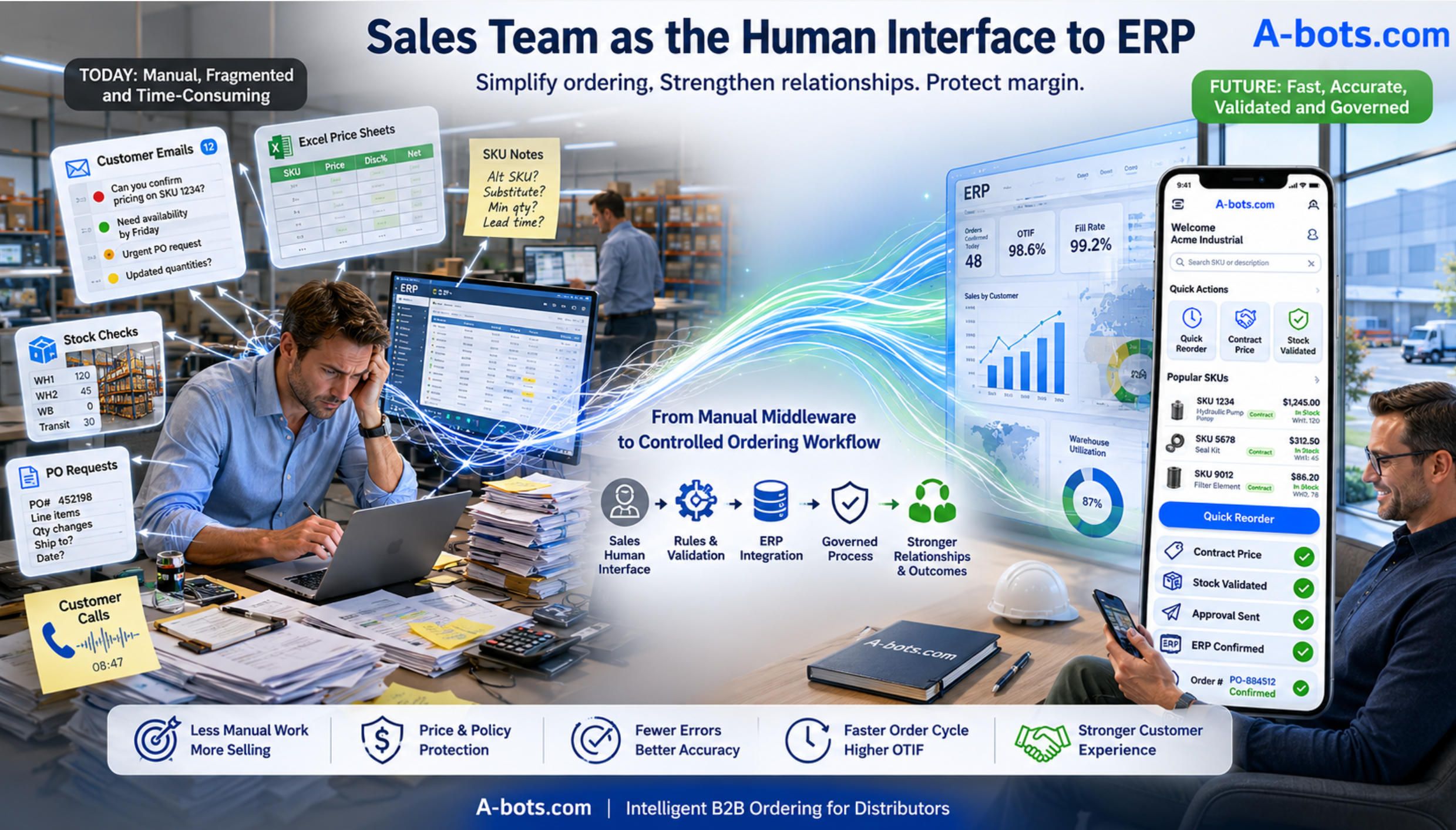
That is the quiet operational trap inside B2B sales. The company sees activity and mistakes it for selling. Customers are calling, quotes are being prepared, stock is being checked, prices are being confirmed, and orders are entering ERP. On the surface, the commercial machine is alive. But underneath, too much of the sales team’s time is being used as manual middleware between the customer and the back office. A human reads an email, translates shorthand into SKU codes, checks whether the old part number has been replaced, confirms the customer’s special price, asks the warehouse whether stock is real, verifies the purchase order requirement, enters the order into ERP, and then handles the correction when something does not match.
That may feel like customer service, especially in companies that built their reputation on personal relationships. But when the same pattern repeats hundreds or thousands of times every month, it stops being service and becomes structural waste. The relationship with the customer is still valuable. The problem is that the relationship has been forced to carry routine transactional work that software should already understand.
A serious B2B ordering app should not try to remove the relationship from the sales process. It should remove the friction hiding inside the relationship. It should protect sales representatives from being trapped in low-value order entry, protect customers from waiting for basic confirmations, and protect the business from price mistakes, stock misunderstandings, duplicate orders, incomplete purchase orders, and ERP corrections that quietly consume margin after the order has already been “won.”
For distributors, wholesalers, parts suppliers, manufacturers, food service suppliers, medical and veterinary distributors, industrial suppliers, building materials companies, and spare parts businesses, the value of a B2B ordering app is not that it makes the company look modern. The value is that it gives every customer a reliable, account-specific path from buying intent to confirmed order.
The real product is not an online catalog. The real product is Account-Specific Order Truth.
B2B Ordering Is Not B2C Checkout With Bigger Carts
Many B2B ordering projects begin with the wrong analogy. Someone looks at consumer e-commerce and says, “We need something like that, but for wholesale.” The team then imagines a product catalog, search filters, a cart, checkout, payment, order history, and perhaps a customer login. Technically, this may become an e-commerce site. Operationally, it may still fail the moment real B2B buying begins.
Consumer checkout is built around an individual buyer making a relatively simple purchase. The price is visible, the payment method is immediate, the delivery address is usually personal, and there is rarely an approval chain. B2B purchasing is different because the buyer is not merely shopping. The buyer is executing a business process on behalf of a company, branch, warehouse, project, department, or cost center. The person placing the order may not be the person approving it. The customer may have negotiated prices, credit limits, delivery rules, product restrictions, preferred substitutes, internal purchase-order requirements, and several users with different permissions.
This means the real B2B question is not “Can this product be added to a cart?” The real question is: can this company, under this contract, through this user, order these products, at these prices, in these quantities, from these warehouses, under these approval, payment, delivery, and ERP rules?
That question changes the entire architecture of the app. The app can no longer begin with an anonymous product grid. It must begin with the customer account. Only after the system understands the company, user role, contract, catalog rules, pricing logic, stock reality, and approval path can it show a trustworthy ordering experience.
This is why serious B2B commerce platforms are built around company accounts, shared catalogs, customer-specific pricing, quick order, requisition lists, purchase order approvals, permissions, quotes, and integrations. The pattern is not accidental. B2B ordering is not a public storefront problem. It is a company-account workflow problem.
Many distributors already have a website, and some even have an e-commerce platform. Yet the real ordering still happens by phone and email because the digital channel does not understand the customer’s actual purchasing reality. If the buyer cannot see the correct price, he will call. If stock availability looks vague, he will call. If he cannot repeat the last order in seconds, he will call. If the portal does not understand purchase approvals or PO numbers, he will call. If the order confirmation is not trusted because it is not synchronized with ERP, he will call again.
At that point, the company does not have digital self-service. It has a digital catalog sitting beside an analog ordering operation.
The Manual Order Desk Hidden Inside the Sales Team
In many B2B companies, sales representatives are described as revenue generators, but the daily system treats them like order processors. They are expected to grow accounts, defend margin, introduce new products, identify opportunities, and strengthen relationships. Yet a large part of their day may be spent repeating old orders, checking stock, correcting SKUs, forwarding documents, applying known discounts, chasing approvals, and entering information into ERP that the customer has already sent in an email.
The problem is not that sales representatives are inefficient. The problem is that the business has made them the human interface to systems that do not speak to the customer directly.
A customer writes, “Please repeat the same order as last month, but replace item 6182 with the newer version and send half to the north warehouse.” A good sales rep understands the message immediately because she knows the account. She knows the old SKU, the replacement, the delivery split, the customer’s usual quantities, the pricing agreement, and the internal habit of requiring a PO number after a certain amount. But the fact that she knows all this is precisely the problem. The knowledge lives in a person, not in the ordering workflow.
When this happens occasionally, it is just personal service. When it becomes the default operating model, it creates dependency. If that sales rep is on vacation, the account slows down. If the company hires a new rep, the learning curve is painful. If order volume grows, the team needs more people not because the business is selling more strategically, but because more humans are needed to translate routine purchasing into ERP-ready transactions.
Manual ordering also hides several types of loss. Time is the most obvious one, because a repeat order that should take the customer two minutes may occupy a sales rep, warehouse employee, and back-office user across several interactions. But the more dangerous losses are accuracy and trust. A wrong SKU, outdated price, incorrect unit of measure, missing PO number, unavailable quantity, or unapproved substitution may not look dramatic at the moment it happens. It becomes expensive later, when the order is delayed, the customer complains, the warehouse corrects the pick, finance adjusts the invoice, or the sales rep applies a discount to repair the relationship.
The best B2B ordering app is not the one that tells customers, “Stop talking to us.” It is the one that tells customers, “You do not need to explain the same rules again.” The app should already know the account well enough to make routine buying faster than an email, while leaving sales reps free to handle the conversations that actually deserve human judgment.
Account-Specific Order Truth
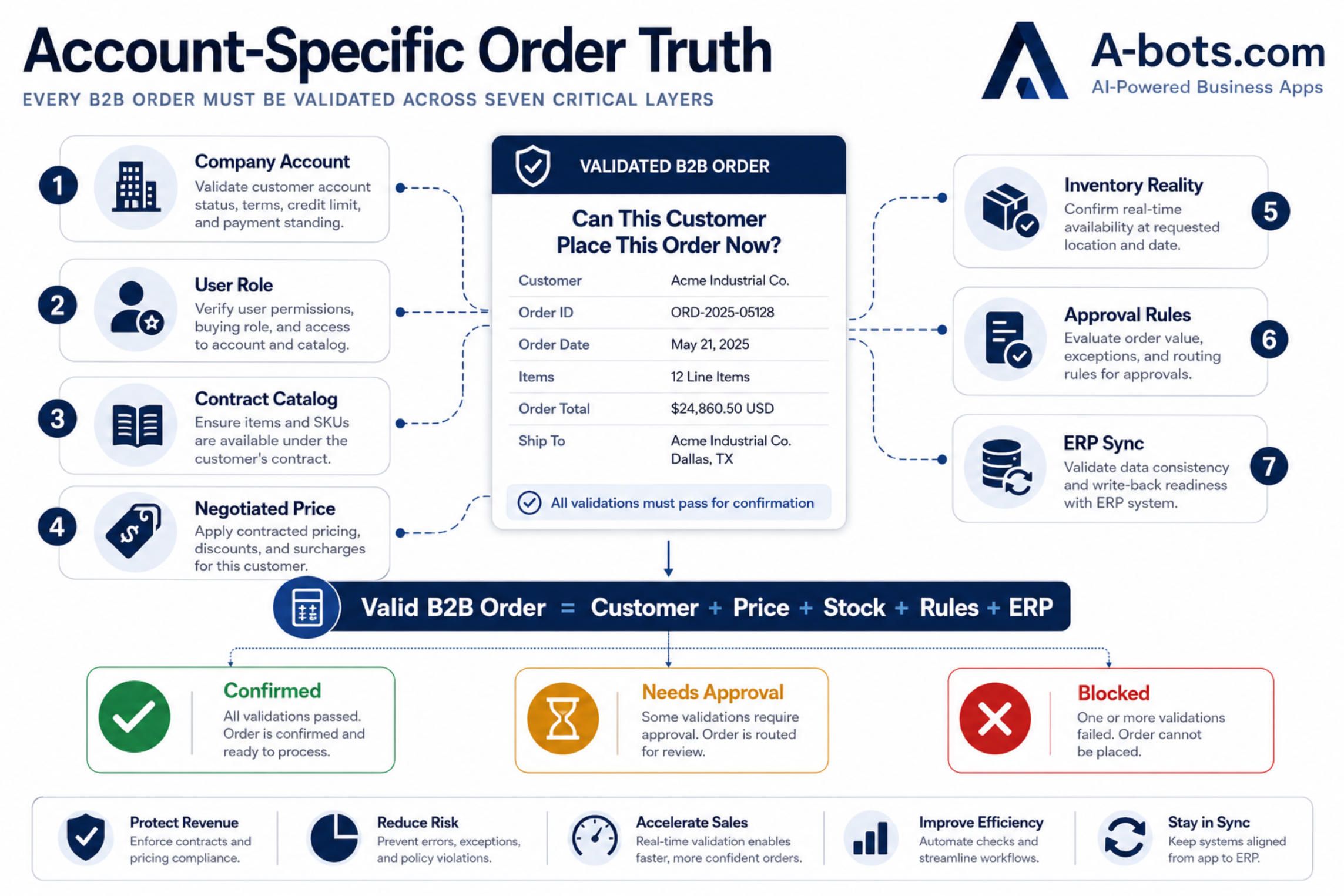
The central design principle for a B2B ordering app should be Account-Specific Order Truth. This means the app does not merely display products. It determines what is commercially, operationally, and contractually true for a specific customer at a specific moment.
The same product can have several different realities. For one customer, it is visible, discounted, available from the nearest warehouse, and orderable in pallet quantities. For another customer, it is hidden because it is not part of the approved assortment. For a third, it is available only through a substitute because the old SKU has been discontinued. For a fourth, it requires approval because the quantity is unusual or the account is near its credit limit.
A generic catalog cannot express this reality. It can show products, images, descriptions, and perhaps a base price. But it cannot answer the more important B2B question: what is this customer actually allowed and able to order now?
Account-specific order truth has several layers, and none of them can be treated as decorative. The app must know the customer company, the user, the role, the permitted ship-to locations, the product catalog assigned to that account, the correct price logic, the available stock, the quantity rules, the approval path, and the conditions under which the order can be accepted by ERP. If one of these layers is missing, the customer may still place an order, but the business has merely moved the correction downstream.
A weak ordering system accepts a messy order and leaves the back office to fix it. A strong ordering system validates the order before it becomes operational debt.
This distinction is crucial. A B2B ordering app should not be judged by how easily a user can click “Submit.” It should be judged by whether the submitted order is clean enough to move through ERP, warehouse, accounting, and delivery without manual repair. The best user experience is not just a fast checkout. It is a fast checkout that the business can actually fulfill.
Quick Reorder Is Often More Important Than Product Discovery
Consumer e-commerce is obsessed with discovery. It wants visitors to browse, compare, explore, and discover products they did not know they wanted. B2B buyers often behave differently. In many distributor and manufacturer relationships, the customer already knows what they buy. They are not shopping for inspiration. They are replenishing stock, maintaining production, preparing a jobsite, servicing equipment, or restoring inventory levels before something runs out.
That is why quick reorder can be more valuable than a beautiful homepage. A buyer who orders the same consumables every week does not want to navigate categories. A maintenance manager who buys known spare parts does not want to scroll through marketing content. A warehouse employee walking through shelves with a phone does not want to rebuild a cart from memory. They want to repeat, adjust, validate, and submit.
A good B2B ordering app should make a repeat order faster than sending an email. It should allow customers to reorder from history, save recurring lists, upload SKU files, scan barcodes, search by customer part number, and copy previous orders by branch, warehouse, project, or equipment type. The buyer should be able to start from a familiar order, change quantities, accept approved substitutes, check availability, add a PO number, route the order for approval, and receive confirmation without waiting for a sales rep.
But quick reorder must not become blind repetition. Repeating last month’s order is useful only if the app checks whether the old order is still valid today. Products may be discontinued. Prices may have changed. Stock may have moved. Packaging units may have been updated. The customer’s credit status may have changed. A substitute may now be preferred. A contract may have expired. The app should preserve the buyer’s intent while validating the current business reality.
This is where an ordering app becomes more intelligent than email. Email can repeat text. The application can repeat intent and verify whether that intent can still become a valid order.
Product Data Is the Hidden Foundation
A B2B ordering app can look excellent and still fail because the product data underneath it is weak. This is one of the most underestimated risks in distributor and manufacturer projects.
B2B catalogs are rarely simple. A distributor may manage tens of thousands or hundreds of thousands of SKUs with manufacturer part numbers, internal item codes, customer-specific item codes, old references, replacement items, substitutes, technical attributes, certificates, dimensions, weights, packaging units, minimum quantities, hazardous material rules, regional availability, and discontinued statuses. A manufacturer may need product configuration, batch information, lead times, drawings, quality documents, or compatibility logic.
When this information is fragmented, the app becomes a polished interface over confusion. A buyer searches for a manufacturer part number and finds nothing because the code is stored in a PDF. Another buyer orders a discontinued SKU because the replacement relationship was never mapped. A customer selects a unit of measure incorrectly because the product is sold in cases but displayed as individual units. A sales rep knows which substitute is acceptable, but the system does not. A warehouse sees that stock exists, but the online channel cannot show it correctly.
This is why B2B ordering projects should not begin only with screens. They should begin with product data architecture. The app needs to understand product identity, alternative identifiers, categories, attributes, customer-specific names, documents, substitutes, packaging rules, and compatibility relationships. Otherwise, the company will build a self-service channel that still requires human explanation.
Clean product data also prepares the business for the next stage of ordering automation. Natural-language search, reorder prediction, substitute recommendations, customer part-number mapping, and AI-assisted purchasing all depend on structured data. AI cannot recommend a safe replacement if the system does not understand compatibility. It cannot predict replenishment if order history is disconnected from customer identity. It cannot extract order lines from emails reliably if SKU relationships are inconsistent.
The future of B2B ordering will not be won only by companies that add AI features. It will be won by companies that make their product, account, pricing, and inventory data structured enough for automation to help without creating confident mistakes.
ERP Is the Source of Record, but Not the Buyer Experience
Most distributors and manufacturers already have ERP, and that ERP may contain the business truth: customers, item masters, price lists, stock, credit terms, invoices, tax logic, warehouses, contracts, and order history. It is natural to ask why a separate ordering app is necessary at all.
The answer is that ERP is built to run the business, not to become the customer’s buying environment. ERP screens are internal, complex, role-specific, and designed for trained employees. A B2B buyer needs a guided, account-specific, permission-aware, mobile-friendly experience that hides unnecessary complexity while still respecting the rules that make the business work.
A B2B ordering app should not replace ERP. It should make ERP usable at the edge of the customer relationship.
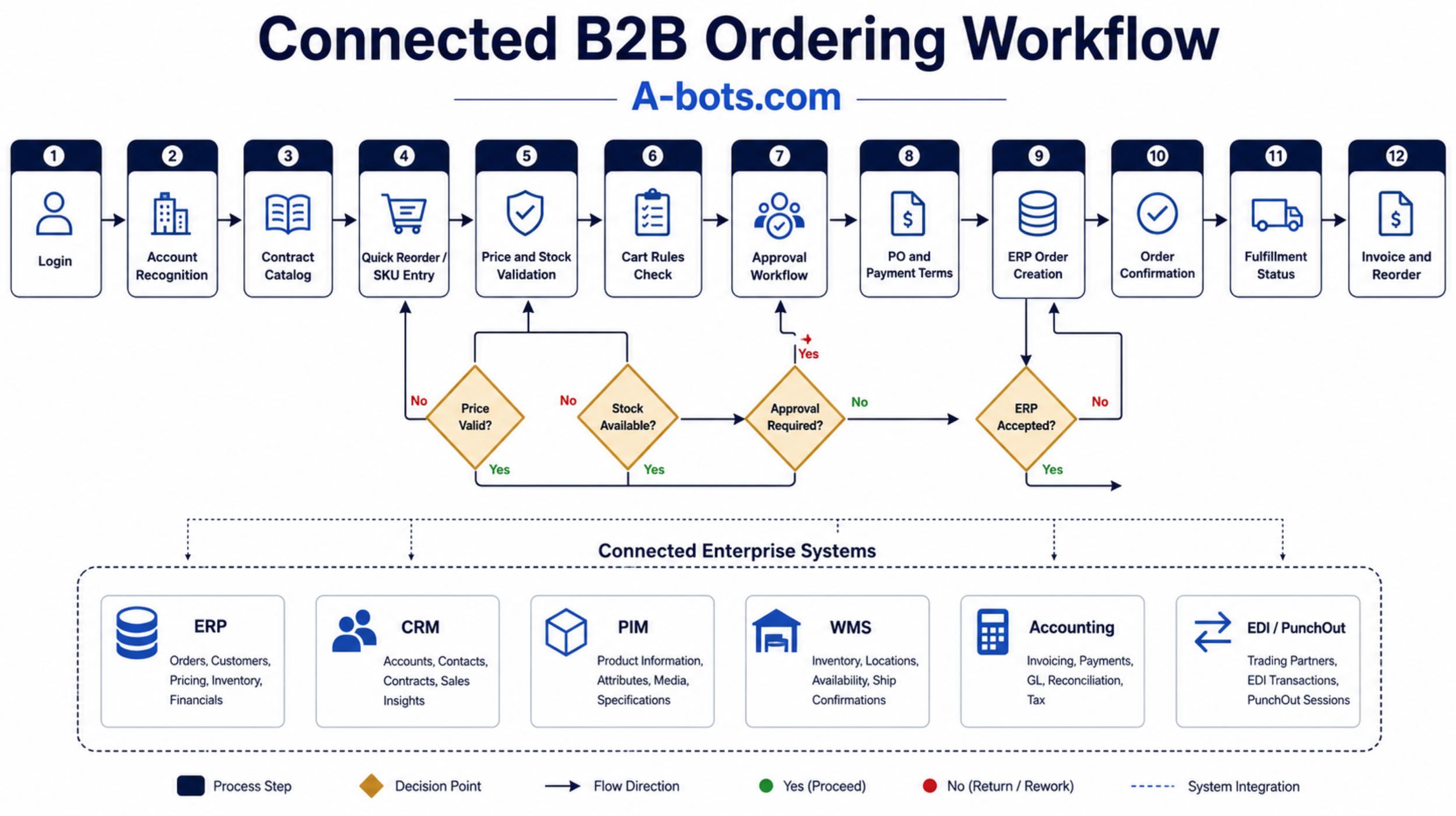
This requires more than a simple integration that sends orders after checkout. When a customer logs in, the app must identify the company and user role. When the catalog opens, it must apply product visibility and pricing rules. When the buyer checks availability, it must retrieve or calculate stock in a way the business can trust. When the buyer submits a cart, the app must validate PO requirements, credit status, quantity rules, ship-to locations, tax logic, freight constraints, approval rules, and ERP acceptance conditions. Only then should the order become a transaction.
The most dangerous ordering app is one that looks independent from ERP but creates manual reconciliation behind the scenes. If the app accepts prices ERP rejects, sales will intervene. If it shows stock that the warehouse cannot fulfill, operations will intervene. If it creates orders with missing customer references, accounting will intervene. If exceptions still need to be handled by email, customers will return to the old channel.
A successful B2B ordering app reduces manual work because it respects back-office truth instead of bypassing it.
The Ordering Execution Layer
For many companies, the right architectural idea is not “build a new e-commerce platform” or “replace the ERP.” The more practical concept is an ordering execution layer.
This layer sits between customers, sales reps, ERP, CRM, PIM, inventory, WMS, accounting, payment systems, and procurement integrations. Its purpose is to transform account-specific buying intent into clean, validated, ERP-ready orders. It can serve different customer types without fragmenting the business rules.
A small customer may use a simple self-service portal. A repeat buyer may rely on saved lists and quick order. A strategic account may need approval rules, custom pricing, and several ship-to locations. A sales rep may create an assisted order on behalf of a customer. A large enterprise buyer may require EDI, PunchOut, or cXML integration with its procurement system. These channels look different on the surface, but they should not have different truths underneath.
Without a shared ordering layer, each channel becomes its own workaround. Phone orders follow one rule set because the sales rep remembers the account. Online orders follow another because the portal has limited pricing logic. EDI orders create exceptions because product identifiers do not match cleanly. Assisted sales orders depend on personal knowledge. ERP becomes the place where all contradictions are discovered too late.
A proper ordering execution layer creates consistency. It defines who can buy, what they can buy, which price applies, what stock can be promised, which approvals are required, how the order enters ERP, and what status comes back to the customer. The channel may change, but the order truth remains governed.
This is especially important for distributors and manufacturers serving several customer tiers. The company should not force every buyer into the same checkout path. Instead, it should support different ordering maturity levels through one controlled core.
Enterprise Customers May Not Want Another Portal
A common mistake in B2B digital strategy is assuming that every customer wants to log into the supplier’s portal. Many enterprise buyers already live inside procurement systems, and they do not want another username, another cart, another approval path, and another source of order history. They want suppliers to connect into the purchasing process they already use.
This is where PunchOut, cXML, and EDI become relevant. In a PunchOut workflow, a buyer can start inside their procurement system, access a supplier catalog with the proper account context, build a cart, and return it for internal approval and purchasing. For the buyer, this preserves governance, budget control, cost-center coding, and purchase-order compliance. For the supplier, it creates a more direct path into enterprise purchasing without forcing the customer into a separate portal.
This does not make the customer portal irrelevant. It means that B2B ordering strategy must support multiple interfaces. One customer needs a simple reorder portal. Another needs a mobile app for branch buyers. Another wants sales-assisted ordering. Another sends EDI purchase orders. Another requires cXML PunchOut.
The supplier should not rebuild business logic separately for each channel. The same account-specific catalog, pricing, stock validation, substitute logic, approvals, and ERP order creation should apply regardless of how the order enters. Otherwise, the company simply moves from one manual ordering problem into several digital ordering problems.
Pricing Errors Are Trust Errors
In B2B, price is not just a number. It is a relationship artifact. A negotiated price reflects volume, history, commitment, margin strategy, competitive pressure, payment terms, freight expectations, and sometimes years of account development. When a customer sees the wrong price, the damage is not limited to one invoice. The customer begins to wonder whether the agreement is being honored.
Pricing errors usually come from fragmentation. ERP has one value, an Excel file has another, a PDF price list is outdated, the online catalog shows a default price, a promotion applies only in one region, a sales rep uses a manual discount, and finance later has to reconcile the result. Each correction may be small, but each one tells the customer that the supplier’s systems do not fully understand the relationship.
A B2B ordering app must treat pricing as a governed service, not as a product-page decoration. The right architecture depends on the company. Some businesses need real-time pricing from ERP. Others can use controlled price books with scheduled refreshes. Some need a dedicated pricing engine. Some require approval when price falls below margin thresholds. Some need contract tiers, rebates, project pricing, or volume breaks.
Whatever the architecture, the buyer experience should be simple: the customer sees the price the company is prepared to honor. If a price requires approval, that should be visible before submission. If a price has expired, it should not appear. If quantity changes the price, the buyer should see the change immediately. If a sales rep overrides the price, the action should be logged and governed.
Pricing accuracy is not only a finance concern. It is part of customer trust.
Stock Visibility Must Be More Than “In Stock”
B2B customers do not merely need to know whether a product exists somewhere in the company. They need to know whether the supplier can fulfill the business requirement.
A product may be available in one warehouse but not in the warehouse that serves the customer’s location. It may be reserved for another order. It may be physically present but blocked for quality inspection. It may be available only in partial quantity. It may require transfer. It may be orderable only in a different packaging unit. It may have a substitute that is acceptable for one customer but forbidden for another.
If the app shows simplistic stock, customers will keep calling. “In stock” is not enough when the buyer needs to know whether 120 units can ship today, whether partial delivery is possible, whether backorder is allowed, whether an approved substitute exists, and whether the delivery date is reliable.
The word reliable matters. A beautiful promise that operations cannot keep is worse than no promise at all.
For manufacturers, availability may involve production schedules, made-to-order items, batch constraints, lead times, and minimum production quantities. For distributors, it may involve multi-warehouse stock, vendor dropship, branch transfers, reserved inventory, and replenishment dates. The customer does not need to see every internal complexity, but the app must respect that complexity before it validates the cart.
A buyer does not need a warehouse management lecture. The buyer needs a confident answer.
Approval Workflows Are Not Bureaucracy; They Are How B2B Self-Service Scales
Self-service fails when it ignores governance. B2B orders often require approvals on both sides of the transaction. The buyer may need approval based on order value, product category, branch, project, budget, cost center, or user role. The seller may require approval because of credit status, margin threshold, restricted products, freight exceptions, price overrides, or unusual quantities.
If the ordering app does not understand approvals, approvals return to email. And once approvals return to email, the digital workflow loses control.
A strong ordering app should allow a purchasing assistant to build a cart, a manager to approve it, procurement to attach a PO number, and the supplier to receive a clean order only after the customer’s internal rules have been satisfied. On the seller side, the system should route exceptions to the right people instead of forcing sales reps to improvise decisions that affect margin or fulfillment.
Approval workflows may look like administrative detail, but they are what allow B2B self-service to grow without becoming risky. The company is not simply making it easier to order. It is making it easier to order correctly.
Sales Reps Should Become Account Strategists Again
The strongest argument for a B2B ordering app is not that it removes people from sales. It is that it puts people back where they create value.
A skilled sales representative should not spend the morning retyping repeat orders. She should notice that a customer’s order frequency is changing, identify a category the customer is not buying, introduce a better substitute, negotiate a contract, solve a strategic issue, or help the customer standardize purchasing across branches. When repeatable ordering becomes self-service, the sales team can move from transaction support to account development.
This matters because distributors and manufacturers are under pressure from digital-first competitors, marketplaces, and customer expectations shaped by faster purchasing experiences. Personal relationships still matter, but relationships alone are weaker when routine ordering is slow, opaque, and error-prone. A supplier that combines account knowledge with reliable digital ordering gives the customer both trust and speed.
Sales-assisted ordering should still remain part of the system. A sales rep may need to create a cart on behalf of a customer, view the account as the customer sees it, suggest substitutes, prepare a quote, apply an approved discount, or help convert a saved list into an order. But this should happen inside the same governed workflow, not in a spreadsheet outside the system.
The app should give sales reps better context: order history, reorder patterns, abandoned carts, stock issues, margin signals, customer-specific notes, and exceptions. The objective is not to automate the rep out of the relationship. It is to remove the clerical layer between the rep and the relationship.
Where Custom Development Makes Sense
Not every company needs a custom B2B ordering app. A distributor with a simple product catalog, standard pricing, one warehouse, minimal approvals, and limited integration needs may be better served by a mature B2B commerce platform. There is no value in building custom software just to recreate commodity functions.
Custom development becomes more compelling when the ordering workflow itself is specific, valuable, and difficult to express cleanly in a standard platform. This often happens when the company has a legacy ERP, complex price matrices, multiple warehouses, customer-specific catalogs, large SKU counts, compatibility rules, sales-assisted ordering, approval workflows, procurement integrations, offline sales rep needs, industry-specific documents, special credit terms, or non-standard fulfillment logic.
The warning sign is not simply that employees dislike the current system. The warning sign is that employees have built a parallel operating system around it. Sales reps calculate prices in Excel. Customers still email repeat orders because the portal is slower than calling. Stock must be confirmed manually before important orders. Online orders require correction before ERP can accept them. Enterprise customers need procurement integration, but every connection becomes a separate project.
In these cases, the problem is not the absence of software. The problem is that the existing software does not match the way orders actually become valid.
This is where A-bots.com can play a practical role: designing and developing custom mobile and web ordering workflows that connect customer accounts, product data, pricing, stock, approval rules, ERP, CRM, and warehouse systems into one controlled experience. The point is not to build “a store.” The point is to build the ordering layer the business actually needs.
A Realistic MVP
The best B2B ordering projects do not try to digitize every customer, product, approval rule, and integration on day one. They begin with a narrow but commercially meaningful workflow where friction is expensive and repeatable.
A practical MVP can focus on company accounts, contract catalog, quick reorder, price and stock validation, approval rules, and ERP order creation. This first version can serve a selected customer segment or a group of high-volume repeat buyers. It can include secure login, user roles, customer-specific catalog visibility, order history, saved lists, quick order by SKU, basic substitutes, PO fields, approval routing, order confirmation, and ERP synchronization.
This is enough to test the most important business question: can customers place repeat orders without calling sales while the back office receives cleaner orders?
The next stage can add mobile barcode scanning, sales rep assisted ordering, quote workflows, invoice access, payment terms, EDI, PunchOut, PIM enrichment, delivery tracking, and AI-assisted reorder suggestions. This sequence reduces risk because it forces the company to solve the foundation first: customer hierarchy, product data, pricing logic, inventory visibility, and ERP integration.
A beautiful app built on weak data will fail. A focused workflow built on trusted data can expand.
AI Belongs After the Ordering Truth Is Structured
AI has a real place in B2B ordering, but it should not be the first promise. It becomes useful after the company has structured the data that defines ordering truth.
AI can help predict reorders, recommend substitutes, map customer part numbers to internal SKUs, detect unusual quantities, extract order lines from emails or PDFs, improve natural-language product search, and suggest replenishment lists. A buyer could write, “I need the usual monthly filter order for the north plant, but increase the 20-inch size by 30 percent,” and the system could prepare a validated cart. A sales rep could see accounts that are likely to reorder next week or customers whose purchasing pattern is changing.
But AI is only useful when it is grounded in clean customer identity, SKU relationships, order history, pricing rules, stock data, and approval logic. Without that foundation, AI becomes another source of confident mistakes. In B2B, a wrong recommendation can delay production, send the wrong part to a jobsite, violate procurement rules, or damage a strategic account.
The responsible sequence is clear. First, build the ordering truth. Then automate around it.
The Metrics That Matter
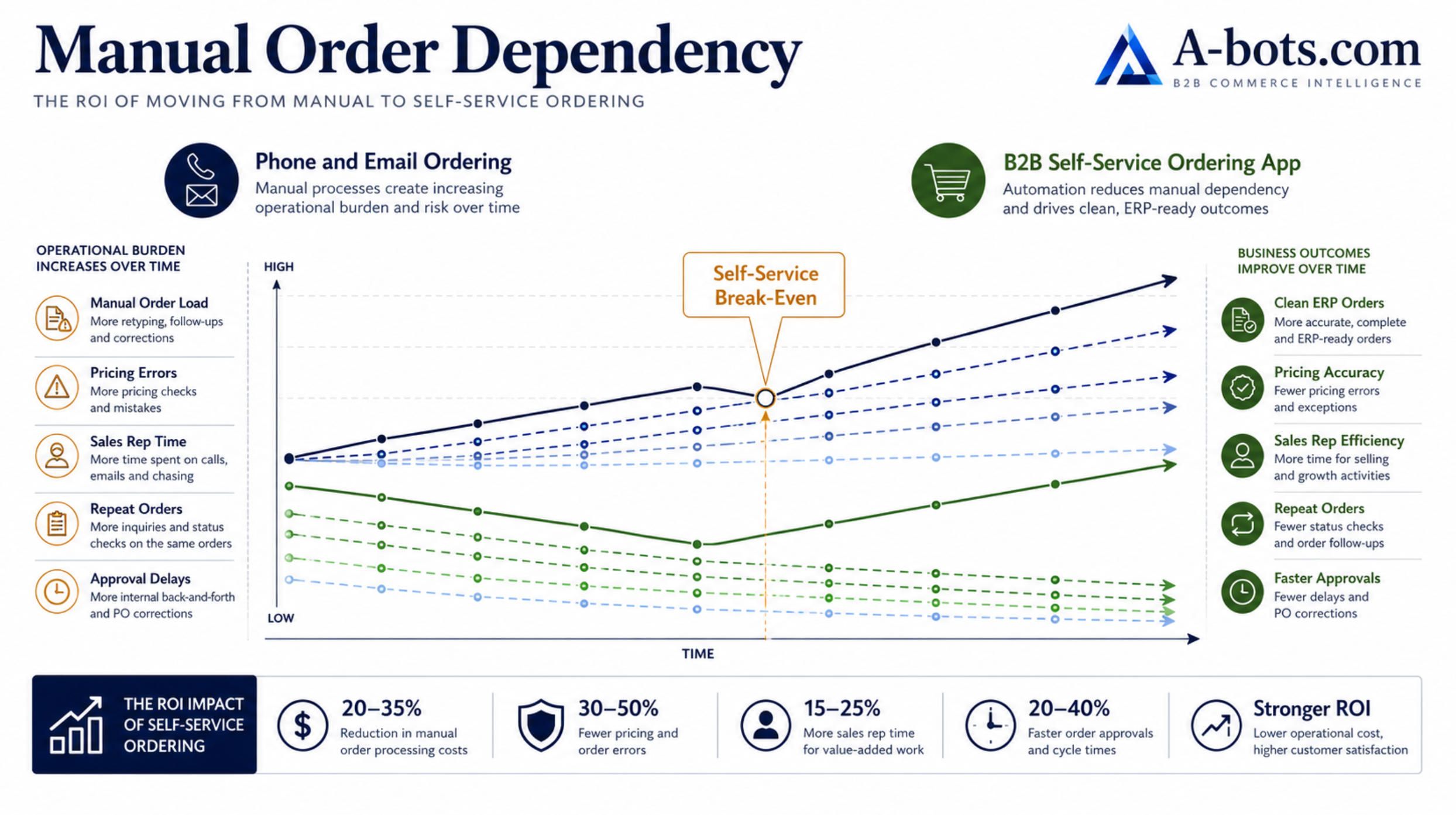
A B2B ordering app should not be judged by whether it looks modern. It should be judged by whether it reduces manual dependency and improves order quality.
The most important question is how many routine orders still require human intervention even though they are repeatable, rule-based, and predictable. That metric reveals the company’s manual order dependency. If customers still need sales reps for standard replenishment, then the digital channel has not yet solved the right problem.
Other metrics should connect directly to operations: the share of eligible orders placed through self-service, the number of phone and email orders reduced, the average time from customer intent to ERP-confirmed order, the correction rate before fulfillment, pricing error frequency, stock-related order failures, quote-to-order conversion, and sales time shifted from manual reordering to account growth.
These metrics are more meaningful than page views or generic conversion rates. B2B ordering is not impulse shopping. It is reliable purchasing with fewer exceptions, faster confirmation, and cleaner execution.
A strong ordering app should make the business easier to operate. Customers order faster. Sales reps handle fewer repetitive tasks. ERP receives cleaner orders. Warehouse teams receive fewer surprises. Finance sees fewer disputes. Management can finally see where manual dependency remains.
The Real Product Is Not the Portal
A customer portal can be useful. A mobile app can be useful. A product catalog can be useful. But none of them is the real product.
The real product is the controlled workflow that connects customer identity, product truth, contract pricing, inventory reality, approval logic, and ERP execution. That workflow is what turns B2B ordering from a human translation process into a scalable operating system.
For distributors and manufacturers, the opportunity is not to copy consumer e-commerce. The opportunity is to make buying from the company easier without making the business less controlled. A good B2B ordering app should feel simple to the buyer because the complexity has been solved behind the scenes.
The customer sees the right catalog, the right price, the right availability, the right approval path, and the right order status. The ERP receives a clean order. The warehouse receives a fulfillable request. The sales team spends less time translating and more time selling.
That is the commercial promise.
Not digital transformation as theatre. Not AI-powered commerce as a slogan. Not another storefront.
A B2B ordering app becomes valuable when it stops forcing sales representatives to act as the human interface to ERP and starts giving every customer a reliable, account-specific path from buying intent to confirmed order.
The distributor does not lose the relationship.
It finally removes the friction that was hiding inside it.
✅ Hashtags
#B2BOrdering
#B2BCommerce
#CustomAppDevelopment
#ERPIntegration
#DistributorSoftware
#ManufacturingSoftware
Other articles
Custom Agritech Development & QA Testing: Build vs Buy The capstone of a four-part agritech series. Across reviews of FieldView, CropX, Halter, CowManager, John Deere Operations Center, and Agworld, the same walls kept appearing: vendor lock-in, per-unit pricing that punishes scale, weak offline behavior, the integration tax of ISOBUS and ADAPT, and data nobody fully owns. This article turns those gaps into a build-versus-buy framework by operation scale, then shows the full stack A-Bots.com builds — device firmware, offline-first apps, interoperability layers, owned analytics — and the independent QA testing that hardens existing platforms. Custom agritech development, whole project or single module, plus testing of what you already run.
Custom Field Service App Development for HVAC, Equipment Repair, and Maintenance Companies Field service companies often do not lose money because they lack software. They lose it between disconnected systems: customer requests, dispatch, technician execution, parts availability, asset history, service proof, and back-office workflows. This article explains when off-the-shelf field service management software stops fitting HVAC, equipment repair, and maintenance companies, and why a custom mobile app can become the operational layer that connects the field with ERP, CRM, inventory, accounting, and customer communication. It also explores offline-first technician workflows, dispatcher visibility, parts logic, AI-assisted service operations, and the build-vs-buy decision.
Field Service ERP Apps: Mobile Workflows for Technicians Field service companies often lose profit not during the repair itself, but between disconnected steps: dispatch, parts availability, technician notes, customer approval, invoicing, and ERP updates. This article explains how a field service ERP app becomes the mobile operational layer between office systems and real-world service execution. It explores how custom apps connect technicians, dispatchers, customers, inventory, service history, proof of work, and billing into one controlled workflow. For HVAC, equipment repair, industrial maintenance, and after-sales service teams, the goal is not more software, but better service profitability control.
Qwen Robot Suite, Qwen-RobotManip, Qwen-RobotWorld, Qwen-RobotNav Alibaba’s Qwen Robot Suite signals a major transition from conversational AI to machines that can perceive, predict, navigate, and act in physical environments. This expert analysis examines the three-model architecture behind the platform: Qwen-RobotNav for configurable spatial navigation, Qwen-RobotWorld for generating possible physical futures, and Qwen-RobotManip for generalizable robot manipulation. The article also compares Alibaba’s approach with NVIDIA Cosmos and Isaac GR00T, Google Gemini Robotics, Physical Intelligence, and Figure Helix. Beyond model benchmarks, it explores the harder questions of physical reliability, enterprise integration, safety controls, human approval, and the application infrastructure required to turn embodied intelligence into accountable business workflows.
Equipment Rental App Development: One Connected Workflow An asset shown as available in rental software may still be awaiting collection, inspection, cleaning, repair, or transfer. This article explains why equipment rental app development must connect the entire operational lifecycle rather than simply provide a booking catalogue. It examines availability forecasting, driver and yard workflows, offline inspections, damage evidence, customer self-service, telematics, maintenance, and ERP integration. The article also explores when off-the-shelf rental software is sufficient and when a custom mobile execution layer becomes justified. Its central concept—Commercial Asset Truth—helps rental companies recover rentable days, reduce disputes, expose revenue leakage, and make more reliable commitments to customers.
Top stories

Copyright © Alpha Systems LTD All rights reserved.
Made with ❤️ by A-BOTS