
Home
Services
About us
Blog
Contacts
Corporate Event Planning and Team Building App Development: A Complete Business Blueprint and Technical Roadmap
The corporate event management landscape is experiencing unprecedented transformation. With the global event management services market projected to surge from $11.3 billion in 2024 to $42.6 billion by 2034 at a compound annual growth rate of 14.2%, organizations are recognizing event planning as a strategic business function rather than a discretionary expense. Corporate events now account for 44% of the total event market, driven by rising business activities and the critical role these gatherings play in employee engagement, talent retention, and organizational culture.
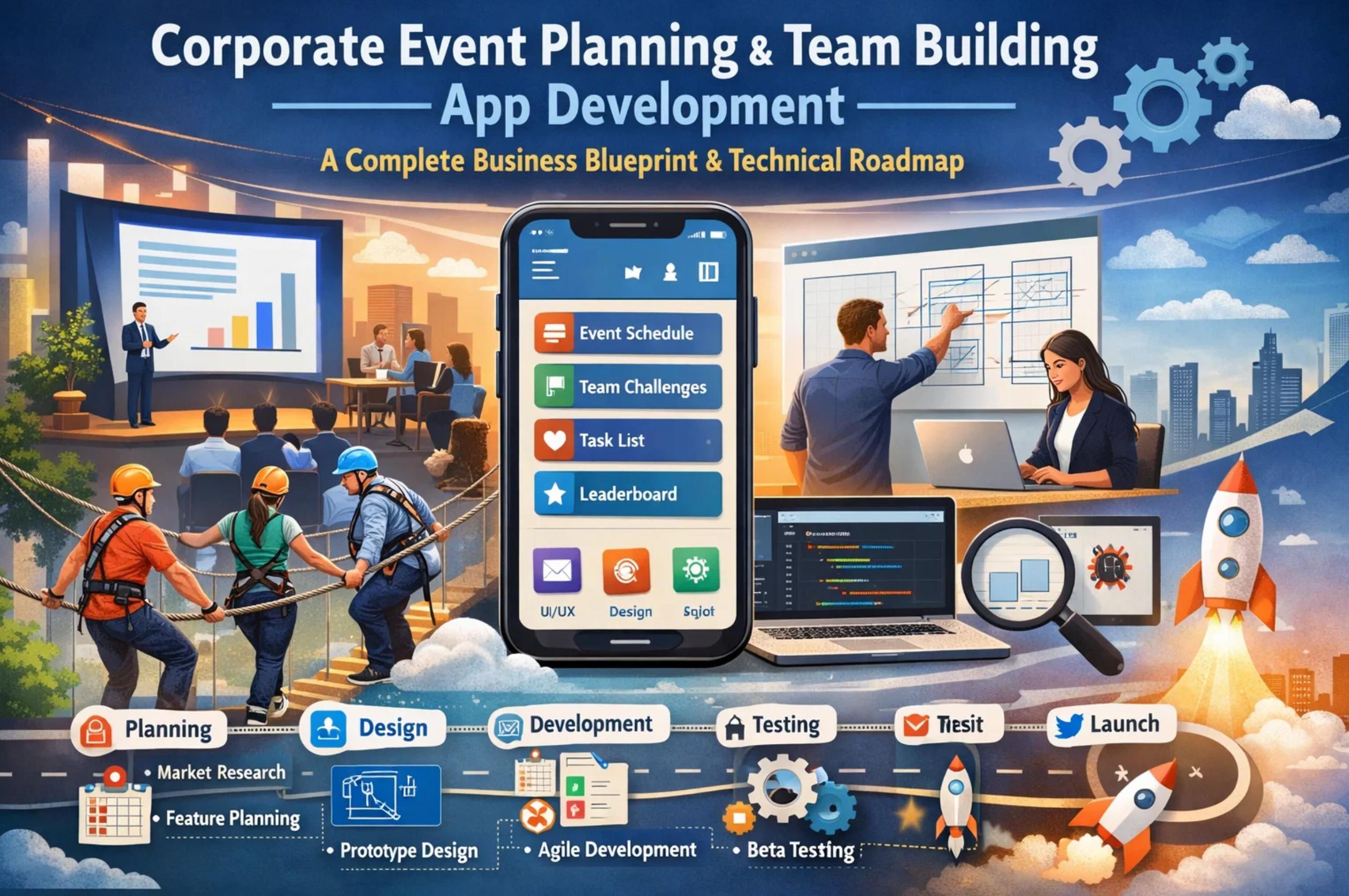
This comprehensive guide explores the development of a custom corporate event planning and team building application, presenting both the business case and technical specifications required to bring such a solution to market. Whether you are an HR director seeking to modernize event management, a CTO evaluating digital transformation initiatives, or an entrepreneur identifying market opportunities, this article provides actionable insights into creating a platform that addresses real organizational pain points while delivering measurable return on investment.
A-Bots.com brings extensive expertise in enterprise application development, with a proven track record of delivering sophisticated mobile and web solutions for corporate clients across diverse industries. Our mobile app development company has successfully completed over 70 projects, establishing long-term partnerships that span 1.5 to 5+ years with clients who trust our capabilities in custom software development and comprehensive quality assurance testing. Our team specializes in creating scalable, user-centric applications that integrate seamlessly with existing enterprise systems, ensuring that technology investments deliver tangible business outcomes.
The corporate event planning sector presents unique challenges that generic event management platforms fail to adequately address. Enterprise organizations require solutions that accommodate complex approval workflows, multi-stakeholder coordination, budget accountability, and sophisticated analytics that link event investments to business outcomes. Holiday celebrations, team building activities, and corporate retreats represent significant financial commitments, with companies spending an average of $75 to $100 per employee on annual holiday parties alone, and organizations with 100 to 500 employees allocating between $100,000 and $1 million annually for broader B2B events and corporate gatherings.
A-Bots.com understands that successful enterprise applications must balance robust functionality with intuitive user experiences. Our development methodology emphasizes stakeholder collaboration, iterative design refinement, and rigorous quality assurance testing to ensure that every feature serves a genuine business need. Whether you require a completely custom application built from the ground up or comprehensive testing services for an existing event management platform, our team delivers solutions that meet the demanding requirements of corporate environments.
The return on investment from strategic event planning extends far beyond immediate employee satisfaction. Research consistently demonstrates that teams engaged through regular team building activities experience 14% increases in productivity and 23% rises in profitability. Organizations implementing structured team development programs achieve 36% higher retention rates compared to peers without such initiatives, translating to substantial cost savings when considering that replacing a single employee costs between 50% to 200% of their annual salary. Disengaged employees cost organizations approximately $16,000 annually per person, with global lost productivity reaching $438 billion in 2024 alone. These figures underscore the strategic imperative of investing in tools that facilitate effective event planning and team engagement.
A-Bots.com recognizes that mobile applications and web platforms serve as critical infrastructure for modern enterprises. Our development services encompass the full technology stack required for enterprise-grade solutions, including native iOS and Android applications, responsive web interfaces, robust backend systems, cloud infrastructure configuration, and third-party integrations. Our quality assurance specialists employ comprehensive testing methodologies including functional testing, regression testing, performance optimization, security audits, and user acceptance testing to ensure that applications perform reliably under real-world conditions.

Market Analysis and Business Case
The corporate event management sector operates within a broader events industry experiencing explosive growth across all segments. The global events industry reached $1.35 trillion in 2025, up from $1.23 trillion in 2024, reflecting a 9.7% compound annual growth rate. Projections indicate the market will expand to $2.5 trillion by 2035, growing at a steady 6.8% annually as businesses increasingly recognize events as essential tools for relationship building, brand visibility, and employee engagement. North America represents the largest regional market, accounting for 38% of global event management services revenue with a valuation of $4.29 billion in 2024, demonstrating robust demand for organized event services across industries.
Corporate events specifically dominate the event management landscape, capturing 40% of total market revenue in specialized planning and management services. The corporate events segment is advancing at a remarkable 16.5% compound annual growth rate in the Asia-Pacific region and maintaining strong performance in North America, where 35% of market share resides. Event planning and management services represent the largest service category at 40% market share, while virtual event technology services are experiencing the fastest growth at a 21% annual rate as organizations embrace hybrid event formats that combine in-person and remote participation.
The shift toward hybrid events represents one of the most significant trends reshaping corporate event management. By 2025, 78% of event planners adopted hybrid event formats that combine in-person and virtual elements to accommodate wider audiences and provide flexibility for distributed workforces. Hybrid events now account for 45% of all team building programs in the United States, with 67% of companies offering flexible participation options that allow employees to engage according to their preferences and circumstances. This format delivers compelling economic advantages, offering cost savings of up to 60% per attendee and carbon emission reductions of up to 45%, making hybrid approaches central to future growth strategies.
Enterprise software supporting event management parallels this market expansion, with the event management software market valued at $13.80 billion in 2024 and forecast to reach $25.88 billion by 2030, advancing at a 10.27% compound annual growth rate. Strong demand for artificial intelligence-powered personalization in virtual and hybrid events, rapid transition to cloud delivery models, and rising regulatory pressure for sustainability reporting reinforce this growth momentum. Vendors are accelerating capability expansion through strategic acquisitions that bundle planning, marketing, and analytics features into unified suites, strengthening barriers to entry and consolidating market share among established players.
Corporate holiday parties and team building activities represent substantial financial commitments for organizations across all sizes. Industry surveys indicate that companies spend an average of $75 per person for holiday celebrations, meaning a 100-employee organization typically allocates $7,500 for its annual holiday party. Larger enterprises with more elaborate events report spending $100 per person or more, with some organizations in competitive talent markets investing significantly higher amounts to create memorable experiences that reinforce company culture and employee appreciation. For broader B2B events and corporate gatherings, approximately 34% of organizations maintain budgets between $100,000 and $500,000 annually, while 32% allocate $500,000 to $1 million, and nearly 18% invest between $1 million and $2 million for comprehensive event programs.
The business justification for these investments becomes clear when examining return on investment metrics. Organizations with robust team building programs can achieve extraordinary returns, with documented case studies showing 7.5x return on investment through layered programs combining nature immersion, somatic learning, and conscious communication activities. Tracked outcomes from these programs include 25% improvements in retention, 5.6% increases in productivity, 29.5% reductions in stress, and 9.5% improvements in collaboration. Companies in the top quartile for employee engagement demonstrate 21% greater profitability and 10% higher customer metrics compared to counterparts with lower engagement levels. These financially quantifiable benefits transform event planning from a discretionary expense into a strategic investment that directly impacts organizational performance.
Employee retention emerges as one of the most measurable benefits of strategic team building and corporate events. The Society for Human Resource Management estimates that replacing an employee costs 50% to 60% of their annual salary for entry-level positions and up to 200% for executive roles. Beyond direct replacement costs, organizations must account for lost productivity during transitions, training expenses, knowledge transfer gaps, and the time investment required from existing team members to onboard new personnel. Companies with strong team cultures report retention rates 12% to 15% higher than industry averages. For a mid-sized organization with 500 employees and an average salary of $70,000, improving retention by just 10% could save approximately $525,000 annually in turnover-related costs, often exceeding team building program investments by a factor of three to five.
Productivity improvements from engaged teams deliver equally compelling financial returns. Research from the Corporate Leadership Council indicates that engaged employees exert 57% more effort and perform 20% better than disengaged colleagues. A professional services firm tracking engagement and productivity metrics found that teams scoring in the top engagement quartile generated 23% more revenue per consultant than bottom-quartile teams. For a 50-person company with average revenue per employee of $200,000, a conservative 15% productivity boost translates to $1.5 million in additional annual revenue. These productivity gains stem from improved communication patterns that team building activities deliberately cultivate, with MIT's Human Dynamics Laboratory finding that productive teams share specific communication patterns including frequent, informal conversations, balanced participation, and extensive external networking.
Current pain points in corporate event management create substantial inefficiencies that custom software solutions can address. Manual coordination across multiple stakeholders consumes excessive time from HR managers and administrative staff, with event planning tasks often distributed across disconnected tools including email, spreadsheets, calendar applications, and basic project management software. This fragmentation leads to version control issues, communication gaps, duplicated efforts, and difficulty tracking real-time status. Budget management presents particular challenges, as finance departments struggle to obtain accurate, up-to-date spending information, making it difficult to enforce spending limits, compare actual expenses against budgets, or generate reports for leadership review.
Employee engagement during event planning suffers when organizations lack centralized systems for gathering preferences, managing RSVPs, communicating updates, and collecting feedback. Traditional approaches using email chains and shared documents result in low response rates, incomplete information about dietary restrictions or accessibility needs, confusion about event details, and limited ability to measure employee sentiment or satisfaction. Vendor management adds another layer of complexity, as event coordinators must manually solicit proposals, compare bids across different formats, track contract terms and deliverables, and maintain communication across multiple vendor relationships without structured workflows or centralized documentation.
The absence of robust analytics capabilities in generic tools prevents organizations from understanding the true return on investment from event spending. Without systematic data collection and analysis, companies cannot track attendance patterns across different event types and times, measure employee satisfaction trends over time, correlate event participation with retention or performance metrics, or identify opportunities to optimize spending for maximum impact. These analytical gaps make it difficult to justify event budgets to leadership or make evidence-based decisions about future planning priorities.
Business Objectives and Success Metrics
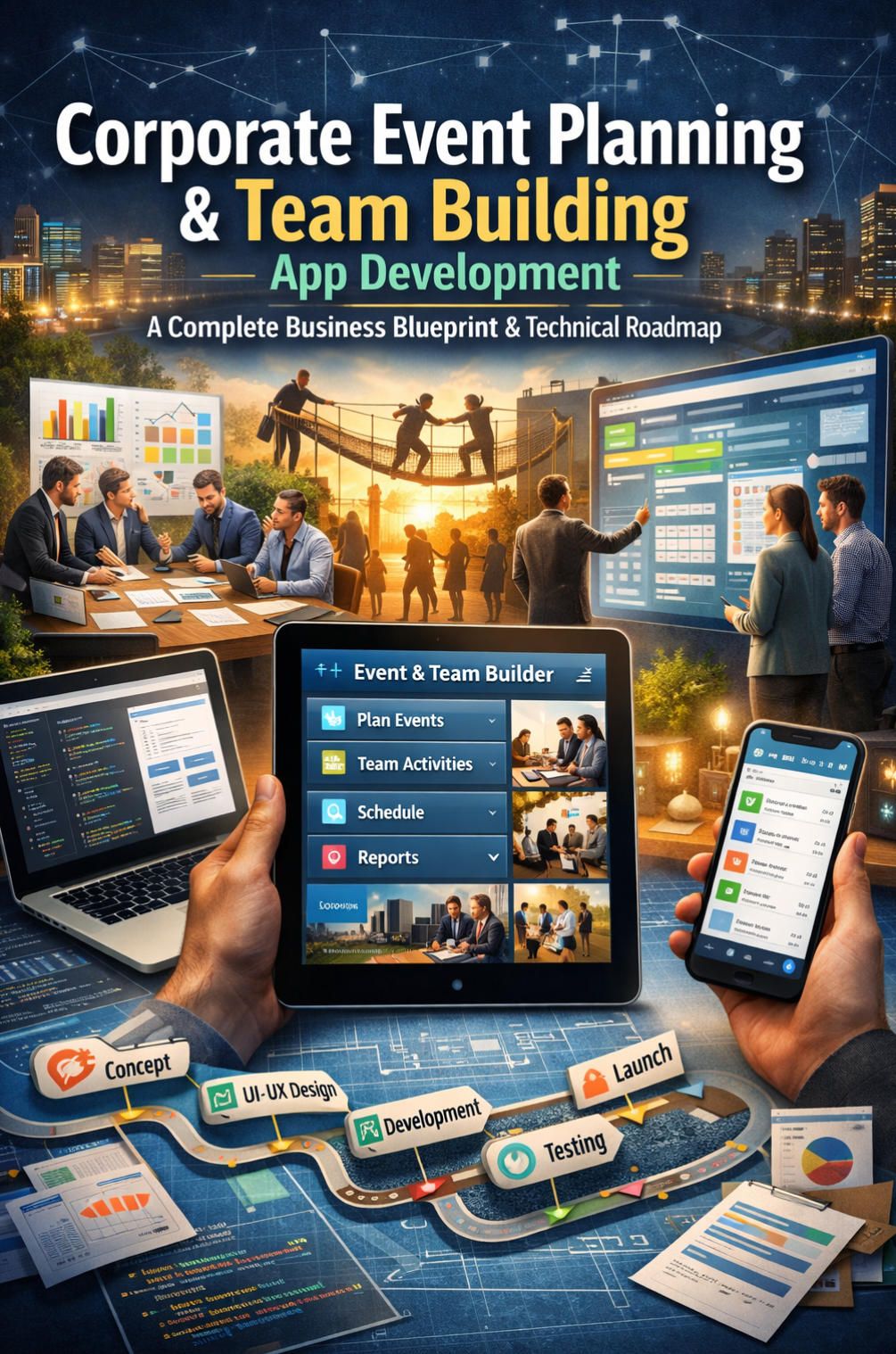
A corporate event planning and team building application must align with specific organizational objectives that extend beyond mere task automation. For HR departments, the primary goal centers on reducing administrative burden while increasing the strategic impact of employee engagement initiatives. This translates to measurable reductions in time spent coordinating events, typically targeting 40% to 60% decreases in hours invested by HR staff for comparable events. The application should enable a single HR coordinator to manage event complexity that would traditionally require multiple team members, freeing senior HR professionals to focus on strategic initiatives rather than tactical logistics.
Budget adherence and financial accountability represent critical objectives for finance departments and executive leadership. Organizations seek to eliminate budget overruns through real-time expense tracking, automated approval workflows, and predictive analytics that flag potential overspending before it occurs. Success metrics include percentage of events completed within budget parameters, typically targeting 95% adherence rates, and reduction in variance between budgeted and actual spending, aiming for tightening from typical 15-20% variances to under 5%. The application should provide granular visibility into spending categories, enabling finance teams to identify cost optimization opportunities and benchmark spending efficiency across departments or business units.
Employee participation and satisfaction directly impact the return on investment from corporate events. Key performance indicators include RSVP conversion rates measuring the percentage of invited employees who confirm attendance, typically targeting increases from baseline 60-65% rates to 80-85% with improved communication tools and user experience. Post-event satisfaction scores gathered through in-app surveys should demonstrate continuous improvement, with organizations establishing baseline measurements and targeting steady quarterly increases. Net Promoter Scores specific to corporate events provide valuable indicators of employee sentiment, with best-in-class organizations achieving scores above 50 points.
Operational efficiency metrics quantify the application's impact on event planning workflows. Time-to-organize measurements track the duration from initial planning to event execution, with successful implementations reducing timelines by 30% to 50% for comparable events. This acceleration results from streamlined communication, centralized information management, automated task tracking, and elimination of manual coordination overhead. First-time success rates for event elements, such as achieving accurate headcounts for catering, securing appropriate venue capacity, or completing vendor contracts without issues, should improve significantly, targeting reductions in planning errors or oversights from typical 10-15% rates to under 3%.
Vendor relationship management benefits from consolidated tracking and communication tools. Success metrics include reduction in time spent sourcing and evaluating vendors, typically targeting 40% decreases through centralized RFP distribution and standardized bid comparison. Vendor satisfaction scores indicate whether the platform facilitates professional, efficient collaboration, with targets above 4.5 out of 5.0 on standardized surveys. Repeat vendor engagement rates demonstrate relationship building, with organizations aiming to establish preferred vendor networks that reduce search time and improve reliability through proven partnerships.
Analytics utilization represents a forward-looking objective, measuring how effectively organizations leverage data to drive continuous improvement. Metrics include percentage of events with complete data capture across attendance, spending, satisfaction, and engagement dimensions, targeting 100% coverage. Monthly active users of analytics dashboards among HR managers and event coordinators indicate whether reporting tools deliver actionable insights. Most importantly, documentation of specific decisions informed by event analytics, such as shifting event timing based on attendance patterns or reallocating budget based on satisfaction correlations, demonstrates tangible business impact.
Long-term organizational outcomes tied to event program effectiveness include employee retention rates, with companies establishing baseline measurements and targeting improvements of 5% to 10% over 12 to 18 month periods. Engagement survey scores specifically related to company culture, sense of belonging, and appreciation should show measurable increases correlated with event participation frequency and quality. Leadership should be able to draw direct connections between event investments and business outcomes including reduced turnover costs, improved productivity metrics, and enhanced employer brand reputation in competitive talent markets.
Target Users and User Personas
Successful corporate event planning applications serve multiple distinct user groups, each with unique needs, priorities, and success criteria. Comprehensive persona development ensures that feature prioritization and user experience design address real workflows rather than assumptions.
HR Managers and Event Coordinators represent the primary power users who plan, coordinate, and execute corporate events. These professionals typically range from mid-level HR specialists to senior directors, working in organizations from 100 to 5,000+ employees. Their primary goals include reducing administrative burden, improving employee participation, demonstrating return on investment, and creating memorable experiences that strengthen company culture. Pain points center on fragmented tools requiring constant context switching, difficulty tracking real-time status across multiple events, limited visibility into budget spending before receiving final invoices, and challenge gathering and synthesizing employee feedback. Success for this persona means completing event planning in half the time compared to previous methods, achieving 85%+ RSVP rates, staying within budget on 95%+ of events, and receiving consistently positive feedback from attendees and leadership.
Finance Directors and Budget Approvers engage with the application primarily for oversight, approval workflows, and financial reporting. These users prioritize budget control, spending visibility, audit trails, and integration with accounting systems. Their pain points include delayed or incomplete expense reporting from event coordinators, difficulty comparing spending across departments or time periods, limited ability to enforce budget policies before spending occurs, and manual reconciliation between event expenses and general ledger categories. Success metrics for finance users include real-time visibility into committed versus actual spending, 100% of events requiring budget approval routed through proper workflows, automated expense categorization reducing reconciliation time by 60%+, and comprehensive reports available on-demand without manual compilation.
Executive Leadership interacts with the application primarily through dashboards and executive summaries that connect event investments to business outcomes. CEOs, COOs, and division leaders seek high-level insights about employee engagement trends, return on investment from culture-building initiatives, and strategic alignment of event programs with organizational priorities. Their pain points involve difficulty understanding whether event spending delivers tangible value, limited visibility into employee sentiment and participation patterns, and inability to compare engagement metrics across different initiatives or time periods. Leadership considers the application successful when they can quickly access executive dashboards showing trends in participation and satisfaction, identify correlations between event programs and retention or productivity metrics, and make informed decisions about event budget allocations based on data rather than anecdotes.
Employees as Event Participants interact with the application to RSVP, manage preferences, receive communications, and provide feedback. This diverse user group spans all organizational levels, age demographics, technical proficiencies, and engagement preferences. Employee goals include quickly finding information about upcoming events, easily confirming attendance and indicating dietary restrictions or accessibility needs, receiving timely reminders and updates, and providing meaningful feedback without excessive time investment. Common pain points involve missing event announcements buried in email, cumbersome RSVP processes requiring multiple steps or external tools, lack of visibility into who else is attending, and frustration when their feedback appears ignored. Employees consider the platform successful when they can RSVP in under 60 seconds via mobile or desktop, receive personalized event recommendations based on interests and past participation, access all event information in a single location, and see evidence that their feedback influences future planning.
Vendors and Service Providers including caterers, venues, entertainment companies, and other suppliers interact with the platform to receive requests, submit proposals, communicate with event coordinators, and manage contracted services. Vendor users prioritize clear specifications in requests for proposals, efficient communication channels, timely responses to questions, and straightforward contract and payment processes. Their pain points center on incomplete or ambiguous event requirements requiring multiple clarification rounds, delayed responses to proposals causing uncertainty about planning, inconsistent communication across different event coordinators within the same organization, and unclear payment terms or delayed processing. Vendors value the platform when RFPs contain comprehensive, standardized information about event requirements, they can submit proposals directly through structured forms reducing email back-and-forth, they receive timely notifications about proposal status, and invoicing and payment processes integrate smoothly with their accounting systems.
Department Managers and Team Leaders play a secondary but important role, often collaborating with HR on department-specific events or providing input on organization-wide gatherings. These users need simplified workflows that don't require extensive training, visibility into events relevant to their teams, ability to communicate event details to direct reports, and basic reporting on team participation and engagement. Success for this persona means being able to plan a department event in under 30 minutes, confirming that all team members received invitations and reminders, and accessing simple reports showing team participation rates without requiring assistance from HR or IT.
Understanding these distinct personas enables prioritization of features that serve genuine user needs. Core functionality must accommodate the event coordinator managing dozens of annual events across multiple formats, while maintaining simplicity for the department manager planning an occasional team lunch. Mobile experiences should serve the employee quickly RSVPing during their commute, while desktop dashboards provide the depth finance directors require for budget analysis. This user-centric approach, informed by actual workflows and pain points, differentiates enterprise-grade solutions from generic tools that attempt to serve all users identically.
Core Features and Functionality
The foundation of an effective corporate event planning application rests on comprehensive feature sets addressing each stage of the event lifecycle from initial concept through post-event analysis.
Event Planning and Management Module
The event planning module serves as the central hub for creating, configuring, and coordinating all aspects of corporate gatherings. Event coordinators begin by selecting from a template library containing pre-configured event types including annual holiday parties, quarterly team building activities, awards ceremonies, training workshops, client appreciation events, and corporate retreats. Each template includes suggested timelines, standard budget categories, common vendor types, and typical communication schedules, reducing setup time from hours to minutes while ensuring comprehensive planning coverage.
Calendar management functionality provides multi-tiered views spanning individual events, department schedules, and organization-wide event calendars. The system automatically identifies scheduling conflicts, flags potential attendance issues when events cluster in the same time period, and suggests optimal timing based on historical attendance patterns. Intelligent scheduling algorithms consider factors including payroll cycles when planning events with gift distributions, major business deadlines that might impact participation, and seasonal considerations affecting venue availability and pricing.
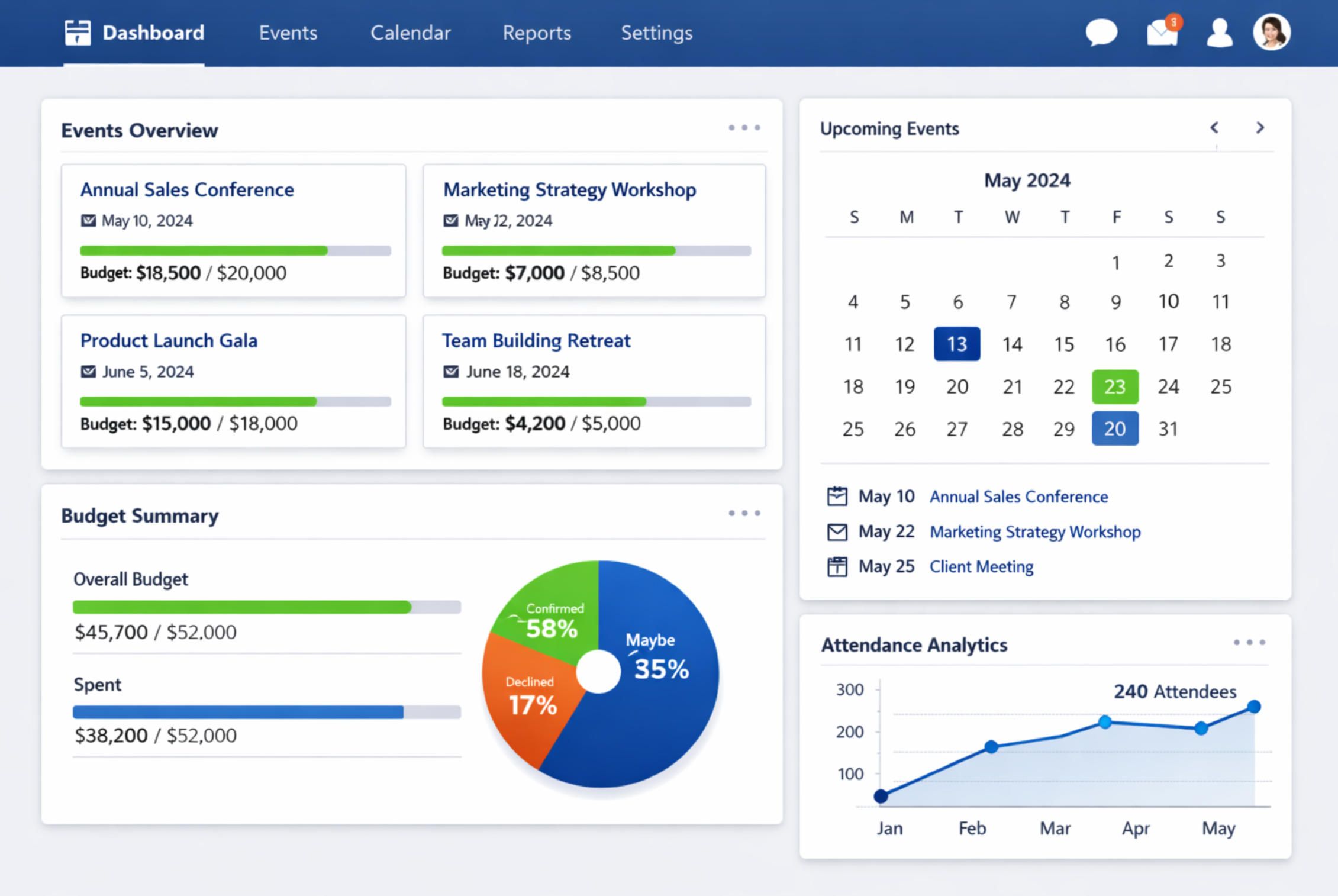
Multi-event coordination tools enable coordinators managing concurrent events across different departments or locations to maintain clear visibility and control. Dashboard views aggregate key metrics across all active events, highlighting those requiring immediate attention due to approaching deadlines, budget concerns, or low RSVP rates. Bulk operations allow applying common updates across multiple events, such as communication templates, vendor relationships, or budget adjustments, while maintaining individual event customization where needed.
Venue booking integration connects directly with venue management platforms and internal space reservation systems. For organizations with multiple office locations or access to corporate facilities, the system displays real-time availability, capacity information, included amenities, and associated costs. External venue searches incorporate filters for location, capacity, parking availability, accessibility features, and budget constraints. Shortlisted venues can be compared side-by-side with detailed scoring rubrics weighing factors that matter most for specific event types.
Timeline and milestone tracking ensures that no critical planning tasks fall through the cracks. The system automatically generates project timelines based on event type and date, assigning standard tasks with appropriate lead times. Coordinators customize timelines by adding event-specific requirements, adjusting task sequences, and delegating responsibilities to team members. Automated reminders notify responsible parties as deadlines approach, escalating to supervisors when tasks remain incomplete. Visual timeline representations help stakeholders quickly understand project status and identify potential bottlenecks requiring attention.
Recurring event functionality accommodates organizations hosting regular team building activities, monthly all-hands meetings, or quarterly celebrations. Rather than recreating similar events repeatedly, coordinators establish master templates that automatically generate new instances at specified intervals. The system carries forward vendor relationships, budget allocations, and communication schedules while allowing modifications for individual occurrences. Analytics track trends across recurring event series, identifying patterns in attendance, satisfaction, or spending that inform continuous improvement.
Budget Management and Financial Controls
Comprehensive budget management transforms event planning from a process often characterized by financial surprises into a disciplined practice with clear accountability and predictability. Event coordinators establish initial budgets by allocating funds across standard categories including venue rental, catering and beverages, entertainment and activities, decorations and supplies, transportation and parking, gifts and giveaways, technology and equipment rentals, and contingency reserves. The system maintains category templates based on organizational standards while allowing customization for unique event requirements.
Real-time expense tracking provides continuous visibility into committed and actual spending against budget allocations. As coordinators select vendors, finalize contracts, or record deposits, the system automatically updates financial dashboards showing remaining budget capacity in each category. Color-coded indicators highlight categories approaching or exceeding budget limits, enabling proactive adjustments before overspending crystallizes. The distinction between committed funds, pending invoices, and actual payments helps finance teams understand true financial positions rather than relying solely on paid amounts that lag actual obligations.
Approval workflow configuration enforces organizational policies governing spending authority and financial oversight. Administrators establish rules determining which events or expense categories require approval, approval thresholds based on total event cost or individual line items, appropriate approvers based on department, location, or budget source, and escalation procedures when approvals are delayed. The system routes requests automatically, notifies approvers via email and in-app notifications, and maintains audit trails documenting approval chains. Conditional logic accommodates complex approval requirements such as dual signatures for expenses above certain thresholds or CFO approval for events exceeding departmental budgets.
Integration with accounting software including QuickBooks, SAP, Oracle Financials, and Microsoft Dynamics ensures seamless financial data flow. The platform automatically synchronizes expense categories with general ledger codes, exports invoice information for accounts payable processing, and reconciles payment confirmations against open obligations. This integration eliminates manual data entry errors, accelerates month-end closing procedures, and provides finance teams with comprehensive visibility into event-related spending alongside other organizational expenses.
Financial reporting capabilities transform raw transaction data into actionable insights. Standard reports include budget variance analysis comparing planned versus actual spending across all categories, spending trends over time identifying seasonal patterns or year-over-year changes, cost-per-attendee metrics enabling efficiency comparisons across events, vendor spending summaries revealing concentration risks or volume discount opportunities, and department-level breakdowns showing event investment distribution. Customizable report builders allow finance directors to create specialized analyses addressing specific questions or supporting executive presentations.
Predictive budget modeling leverages historical data to improve future planning accuracy. The system analyzes previous events of similar type, size, and scope to suggest realistic budget allocations for new events. Machine learning algorithms identify factors correlating with cost variations, such as specific vendor choices, venue selection, or timing decisions, enabling coordinators to make informed trade-offs. As actual expenses are recorded, the system refines predictions, creating organizational knowledge that benefits future planning cycles.
Cost optimization recommendations highlight opportunities to reduce spending without compromising event quality. The platform identifies situations such as consistently underutilized budget categories suggesting over-allocation, vendor pricing above market rates based on RFP comparisons, scheduling events during peak periods when premium pricing applies, or opportunity costs from failing to leverage volume discounts across multiple events. These insights transform budget management from passive tracking to active financial stewardship.
Employee Engagement and Participation Tools
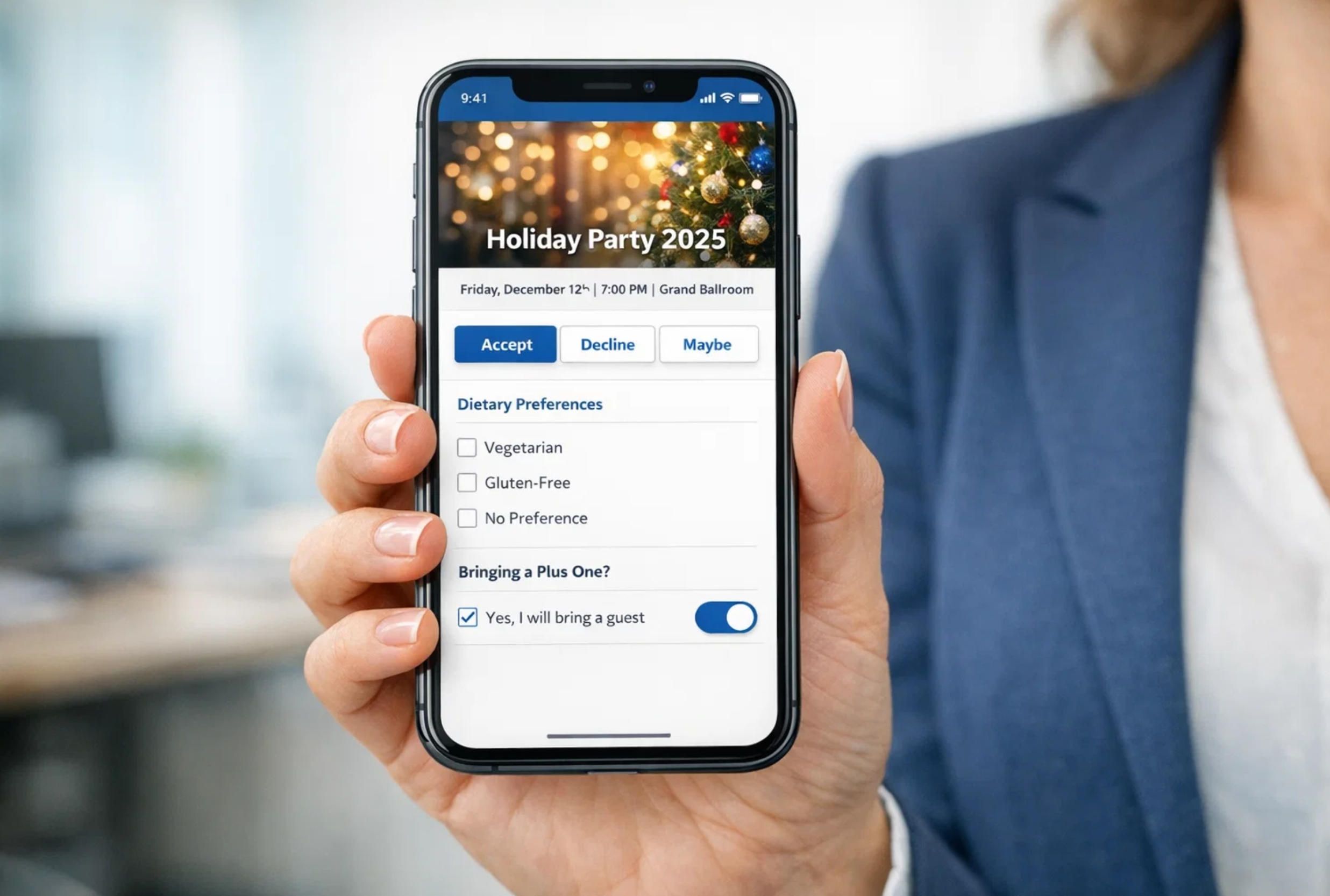
The employee-facing components of the application directly impact participation rates, satisfaction levels, and return on investment from event programs. The RSVP system must balance comprehensive information gathering with user convenience, minimizing friction while capturing essential details about attendance, dietary restrictions, accessibility needs, plus-one attendance, and session or activity preferences for multi-component events.
Intelligent invitation management ensures that the right employees receive appropriate communications at optimal times. Coordinators define target audiences using flexible criteria including department, location, role level, tenure, or custom groups such as new hire cohorts or specific project teams. The system schedules invitation delivery based on optimal timing algorithms that consider factors like typical email response patterns, organizational communication norms, and event proximity. Automated reminder sequences maintain engagement without overwhelming recipients, with customizable frequency and messaging that escalates urgency appropriately as event dates approach.
Dietary preference and restriction tracking goes beyond simple free-text fields, implementing structured options that facilitate catering coordination. The system maintains standardized categories including vegetarian, vegan, gluten-free, dairy-free, nut allergies, religious dietary requirements, and custom restrictions. Employees establish preferences in their profiles that auto-populate for new events, while retaining the ability to specify event-specific requirements. Aggregated reports provide caterers with precise headcounts for each dietary category, reducing both food waste and the risk of attendees without suitable options.
Plus-one and guest management accommodates events where spouses, partners, or family members are invited. The system tracks guest names, dietary preferences, and relationship to employees, enforcing organizational policies about which event types permit guests. Capacity management automatically adjusts as employees add or remove guests, triggering notifications when venue capacity approaches or coordinator review when guest attendance rates differ significantly from expectations.
Team formation algorithms address events incorporating breakout activities, competition teams, or small group experiences. Coordinators specify team size constraints, balancing criteria such as department diversity, role level mixing, or preserving existing team structures. The system generates optimized team assignments that maximize cross-functional interaction while respecting any hard constraints. Employees receive team assignments in advance, enabling pre-event networking and reducing onsite coordination overhead.
Gamification elements transform passive event participation into engaging experiences. Features include achievement badges for event attendance milestones, leaderboards for team-building competition results, points systems rewarding both attendance and feedback contribution, and challenge completions that unlock special recognition. These mechanisms tap into intrinsic motivators around recognition, friendly competition, and achievement, driving increased participation without requiring external rewards.
Secret Santa and gift exchange organizers automate the administrative burden of popular holiday activities. The platform collects participant sign-ups, captures budget guidelines and gift preferences, randomly assigns gift recipients with configurable exclusion rules preventing certain pairings, distributes assignments privately, and tracks gift selection or purchase completion. Integration with online retailers enables gift ordering directly through the platform, simplifying logistics while maintaining surprise elements.
Poll and voting functionality enables employees to influence event planning decisions within parameters established by coordinators. Organizations can poll employees about preferred event dates or times, venue location preferences, activity selections, or entertainment options. Results inform planning decisions while fostering sense of ownership among participants. The system prevents ballot stuffing through authentication controls while maintaining response anonymity when appropriate.
Vendor Management and Procurement Platform
Efficient vendor management reduces both the time invested in coordination and the likelihood of supplier-related issues disrupting events. The vendor management module begins with a centralized vendor directory maintaining comprehensive profiles for all potential and active suppliers. Profiles include contact information, service categories, past performance ratings, pricing history, contract terms, insurance certification, and background check documentation where required for on-site services.
Request for Proposal distribution streamlines the vendor selection process. Coordinators create RFPs containing standardized information about event specifications including date, time, and location, expected attendee count, specific service requirements, budget parameters, and submission deadlines. The platform distributes RFPs to qualified vendors based on service category, location, and capacity, while allowing manual addition of specific suppliers for comparison. Vendors receive structured forms ensuring consistent information in proposals, reducing ambiguity and facilitating apples-to-apples comparisons.
Bid comparison tools aggregate proposals in standardized formats highlighting key decision factors. Side-by-side comparisons display pricing breakdowns, service inclusions and exclusions, vendor qualifications and experience, availability and flexibility, and any value-added services or differentiators. Scoring rubrics weight factors according to organizational priorities, generating composite scores that surface the best overall value rather than simply lowest price. Coordinators document selection rationales creating audit trails for procurement compliance.
Contract management functionality centralizes all vendor agreements, purchase orders, and related documentation. The system stores executed contracts, tracks key terms including payment schedules, cancellation policies, and liability provisions, sets automatic reminders for required actions such as deposit due dates or final headcount confirmations, and maintains version control as contracts are amended. This centralization prevents situations where critical contract details are forgotten or accessible only to specific individuals.
Vendor rating and feedback systems create accountability while building institutional knowledge. After event completion, coordinators evaluate vendors across dimensions including service quality and professionalism, adherence to contracted specifications, responsiveness to questions and changes, value for money, and likelihood to recommend. Aggregated ratings inform future vendor selections, while detailed feedback helps suppliers improve performance. The platform identifies consistently high-performing vendors for preferred supplier programs and flags problematic vendors requiring additional oversight or replacement.
Communication hub functionality consolidates all vendor correspondence within the platform rather than scattering across email threads. Coordinators and vendors exchange messages, share files, and track conversation histories within the context of specific events or ongoing relationships. Automated notifications ensure timely responses, while searchable archives enable quick reference to previous discussions. This centralization improves collaboration quality while creating comprehensive documentation valuable for resolving disputes or transferring responsibility between coordinators.
Communications and Notification Engine
Effective communication determines whether events achieve their potential participation and engagement. The communications module must deliver the right information to the right people at the right time through channels that match recipient preferences and organizational norms.
Multi-channel notification delivery ensures that critical event information reaches employees regardless of communication preferences. The platform supports push notifications through mobile applications for time-sensitive updates, email integration for detailed information and formal invitations, SMS messaging for urgent last-minute changes, in-app message centers for centralized reference, and calendar integration creating appointments automatically in Outlook or Google Calendar. Coordinators configure channel selection and frequency at both the event level and for specific message types, respecting organizational communication policies and individual preferences.
Personalization capabilities transform generic mass communications into relevant, engaging messages. The system addresses employees by name, references their past event participation, highlights activities or aspects most likely to interest them based on profile information, and adjusts language and tone based on cultural or demographic factors. Segmentation enables sending different messages to various employee groups, such as emphasizing team bonding for new hires while highlighting networking opportunities for senior staff at the same event.
Automated communication workflows reduce coordinator workload while ensuring consistent, timely messaging. The platform sends save-the-date notices when events are created and published, formal invitations at coordinator-specified intervals before events, confirmation emails when employees RSVP, reminder sequences at customizable intervals, venue directions and logistics information as event dates approach, post-event thank you messages and feedback requests, and follow-up communications sharing event photos or highlights. Each message type supports template customization maintaining brand consistency while allowing event-specific modifications.
Two-way communication features enable employees to ask questions, request accommodations, or provide information directly through the platform rather than generating separate email threads. Coordinators receive and respond to inquiries within centralized message centers maintaining context and history. FAQ sections answer common questions proactively, reducing support burden. Automated responses acknowledge receipt of messages outside business hours while setting expectations for response timing.
Emergency update capabilities handle situations requiring rapid communication with attendees. When events are cancelled, postponed, or experience significant changes, coordinators trigger emergency notification workflows that simultaneously deploy messages across all channels, flag communications as high-priority, and track acknowledgment to confirm receipt. This capability proves essential for weather-related cancellations, venue emergencies, or other circumstances demanding immediate coordination.
Announcement boards provide persistent event information accessible through mobile and web interfaces. Rather than searching through email archives for details received weeks earlier, employees consult event pages containing schedule information, venue directions, parking instructions, FAQ sections, attendee lists showing colleagues attending, agenda or activity descriptions, and real-time updates about any changes. This single source of truth eliminates confusion while reducing repetitive questions to coordinators.
Analytics, Reporting, and Business Intelligence
The analytics module transforms event management from an operational function into a strategic capability by revealing patterns, measuring outcomes, and supporting data-driven decisions. Comprehensive data capture across all platform interactions creates a foundation for sophisticated analysis.
Attendance analytics track participation patterns across multiple dimensions. The system generates reports showing overall attendance rates across all events, attendance segmented by department, location, tenure, and role level, trends over time revealing whether participation is increasing or declining, correlation between invitation timing and RSVP rates, and impact of different event types or formats on attendance. These insights help coordinators understand what drives participation, enabling optimization of event planning and targeting.
Employee satisfaction measurement leverages post-event surveys deployed automatically through the platform. Standard satisfaction questions assess overall event experience, specific aspects including venue, catering, activities, and organization, likelihood to attend future events, and open-ended feedback for qualitative insights. The system calculates Net Promoter Scores tracking employees' willingness to recommend events to colleagues, a strong predictor of genuine satisfaction versus mere compliance. Trend analysis reveals whether satisfaction is improving, remaining stable, or declining, prompting investigation when patterns shift unfavorably.
Budget performance analytics connect financial data with outcomes, enabling assessment of spending efficiency. Reports calculate cost-per-attendee metrics comparable across events of different scales, identify correlations between spending levels and satisfaction scores, reveal budget category performance showing where forecasts are consistently accurate versus areas requiring adjustment, and benchmark internal spending against industry standards or peer organizations. These insights support budget justification conversations with finance leaders by demonstrating responsible stewardship and value creation.
Vendor performance tracking aggregates ratings and outcomes across multiple events to assess supplier quality systematically. Analytics identify top-performing vendors deserving preferred status, suppliers with declining performance requiring attention or replacement, pricing trends indicating market rate changes, and risk concentrations where excessive reliance on single vendors creates vulnerability. This intelligence strengthens vendor relationship management and negotiation leverage.
Engagement scoring creates composite metrics quantifying employee connection to event programs. The system weights factors including RSVP conversion rates, actual attendance, feedback submission rates, participation in optional activities, and interaction with event content through the platform. Engagement scores calculated at individual, department, and organizational levels reveal both positive patterns to reinforce and concerning trends requiring intervention. Correlation analysis explores relationships between engagement scores and other HR metrics such as performance ratings, retention rates, and employee Net Promoter Scores.
Predictive analytics leverage machine learning algorithms to forecast future outcomes and recommend optimizations. Models predict expected attendance for planned events based on historical patterns, optimal timing for specific event types based on participation data, budget requirements based on event specifications and market conditions, and satisfaction outcomes from different planning choices such as venue selection or activity options. These predictions improve planning accuracy while surfacing non-obvious insights from complex data.
Custom report builder functionality empowers users to create specialized analyses addressing specific questions. Drag-and-drop interfaces enable selection of metrics, dimensions, filters, and visualization styles without requiring technical skills or IT support. Saved reports can be scheduled for automatic delivery, ensuring stakeholders receive timely updates. Export capabilities support integration with presentation software or further analysis in Excel or business intelligence tools.
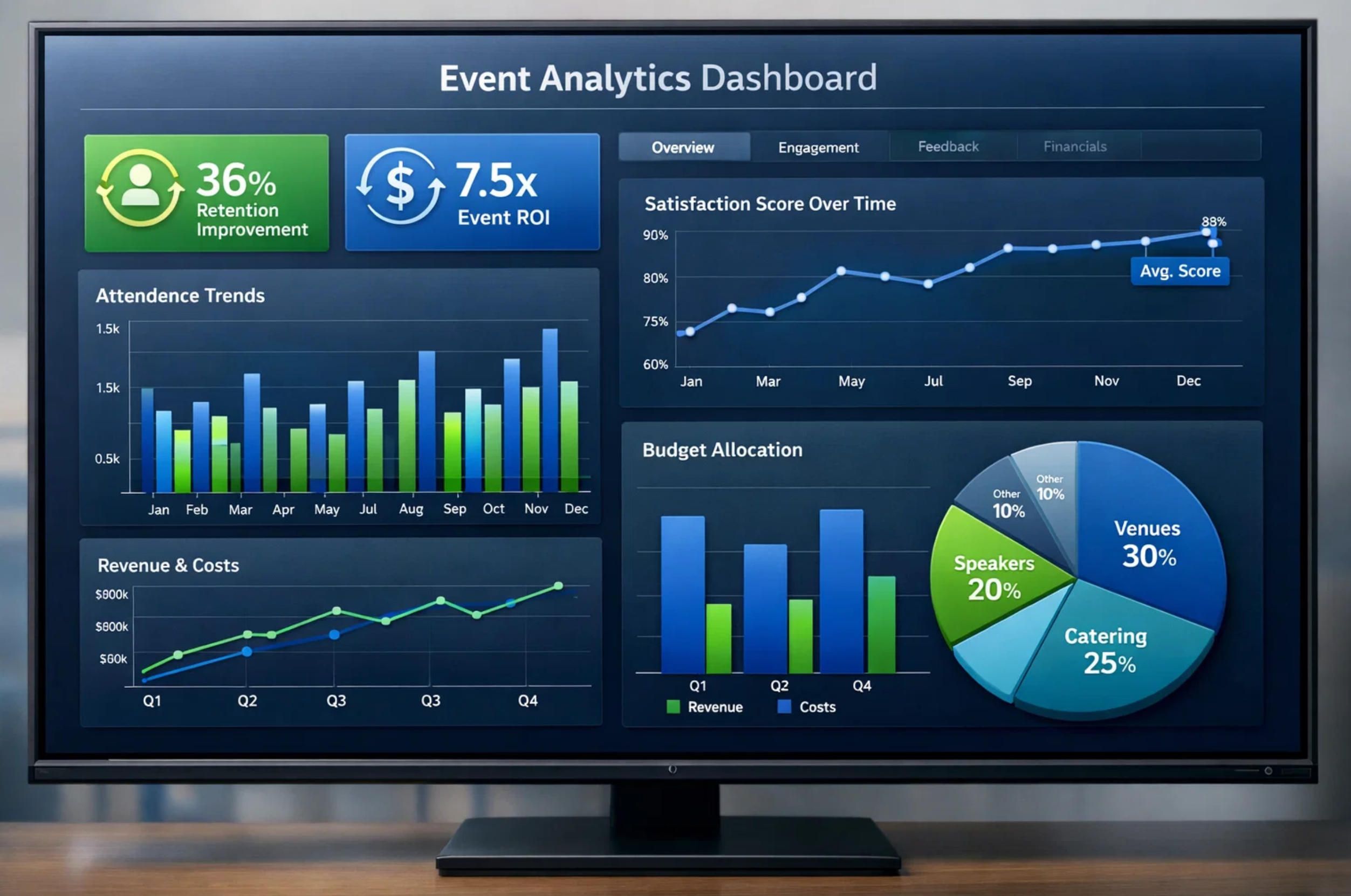
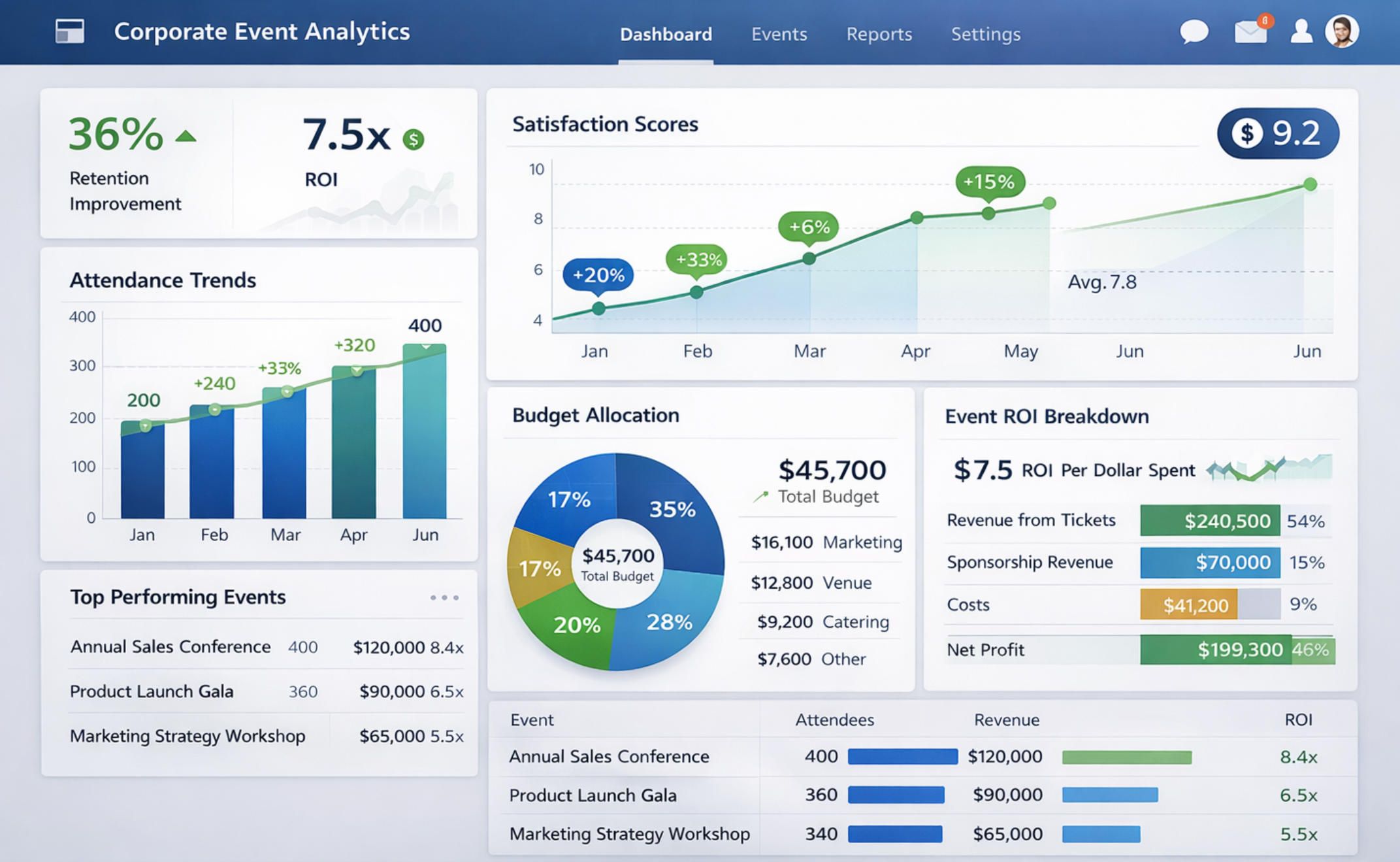
Executive dashboards provide leadership with high-level visibility into event program health and impact. Single-screen views present key performance indicators including upcoming event count and status, year-to-date spending versus budget, overall participation and satisfaction trends, and strategic metrics linking events to retention or engagement goals. Drill-down capabilities enable exploring underlying details when dashboard indicators warrant investigation.
Mobile-First Features and User Experience
Mobile functionality is no longer optional for corporate applications, as employees increasingly interact with workplace tools through smartphones. The mobile experience must deliver complete functionality, not simplified subsets relegating important capabilities to desktop browsers.
QR code check-in streamlines on-site arrival processes, eliminating paper sign-in sheets and manual attendance tracking. Employees receive unique QR codes in confirmation emails or through the mobile app, scanning them at registration tables using coordinator-operated devices. The system instantly records attendance, updates headcount information, and can trigger actions such as distributing name badges or meal tickets. For large events, multiple check-in stations operate simultaneously with real-time synchronization preventing duplicate processing.
Live event updates keep attendees informed during multi-hour or multi-day gatherings. Coordinators publish real-time announcements about schedule changes, room assignments, meal availability, transportation timing, or emergency information. Push notifications ensure that critical updates reach all attendees immediately, while in-app message feeds maintain accessible history. Interactive maps guide attendees through large venues, conference centers, or outdoor spaces, displaying locations for sessions, restrooms, food service, and emergency exits.
Photo sharing and social engagement transform events into community-building experiences extending beyond the hours attendees are physically present. The platform enables employees to share photos from activities and gatherings, comment on and like colleague contributions, tag coworkers appearing in photos, and create collective event memories. Privacy controls ensure appropriate sharing boundaries, while moderation capabilities address inappropriate content. These social features particularly benefit large organizations where employees may not regularly interact, using events to foster broader connections.
Feedback collection mechanisms must overcome the typical challenge of low survey response rates following events. The mobile app requests ratings and brief feedback immediately after events conclude, while experiences are fresh and employees are already engaged with the platform. Gamification elements reward feedback submission through recognition or small incentives. Brief, focused surveys respecting employee time increase completion rates compared to lengthy assessments.
Venue navigation integrations leverage smartphone GPS capabilities for outdoor events or large campuses. Interactive maps provide turn-by-turn directions from employees' current locations to event venues, parking areas, or specific rooms within buildings. Real-time parking availability indicators help attendees quickly locate spaces during high-volume arrival windows. These features reduce late arrivals, confusion, and frustration particularly for employees new to organizations or attending events at unfamiliar locations.
Offline functionality ensures that the application remains useful in venues with poor cellular reception or during connectivity outages. The mobile app caches critical information including event schedules, venue maps, and attendee lists, enabling reference without active internet connections. When connectivity is restored, the app synchronizes any locally captured data such as check-ins or feedback submissions, preventing information loss.
Accessibility features ensure that all employees can engage fully regardless of disabilities or limitations. The platform implements screen reader compatibility for visually impaired users, closed captioning and transcription for deaf or hard-of-hearing participants in virtual or hybrid events, keyboard navigation alternatives to touch or mouse controls, adjustable text sizes and color contrast options, and support for assistive technologies. Beyond technical accessibility, event planning workflows prompt coordinators to address physical accessibility requirements including wheelchair-accessible venues, sign language interpreters, or sensory considerations for neurodivergent participants.
Technical Architecture and Technology Stack
The technical foundation determines whether an event management platform can deliver enterprise-grade performance, security, and scalability. Architecture decisions made during initial development profoundly impact long-term success, as correcting fundamental design flaws becomes progressively expensive and disruptive.
Frontend Development Technologies
Cross-platform mobile application development using React Native enables simultaneous iOS and Android application delivery from a unified codebase, reducing development time and maintenance overhead compared to separate native applications. React Native provides near-native performance for business applications while maximizing code reuse. The framework supports platform-specific optimizations where necessary, accommodating iOS and Android design guideline differences while maintaining consistent core functionality.
Responsive web interfaces built with React.js serve desktop users and accommodate employees who prefer browser access to downloadable applications. React's component-based architecture facilitates reusability across mobile and web interfaces, with shared business logic reducing inconsistencies. The web application supports modern browsers including Chrome, Firefox, Safari, and Edge, with progressive enhancement ensuring graceful degradation for older browsers in environments with IT restrictions.
Admin panel development prioritizes functionality and workflow efficiency over consumer-facing polish. Coordinators and administrators require dense information displays, keyboard shortcuts, bulk operations, and specialized tools that would overwhelm employee-facing interfaces. The admin panel implements role-based access control exposing different functionality to event coordinators, finance users, HR leadership, and system administrators. Customizable dashboards enable each user to configure views emphasizing information most relevant to their responsibilities.
Design system implementation establishes consistent visual language, interaction patterns, and component behaviors across all interfaces. The design system encompasses color palettes reflecting corporate branding, typography hierarchies optimizing readability, iconography communicating common actions and states, spacing and layout grids creating visual harmony, and component libraries accelerating development while ensuring consistency. Design tokens enable theme customization for white-label deployments or multi-brand organizations managing events across different business units.
Backend Architecture and Data Management
Microservices architecture divides platform functionality into independent, loosely-coupled services communicating through well-defined APIs. This approach provides scalability by enabling selective scaling of high-demand services, fault isolation preventing failures in one service from cascading across the platform, technology flexibility allowing different services to use optimal languages or frameworks, and team autonomy enabling parallel development by different engineering groups. Core microservices might include authentication and authorization, event management, budget tracking, vendor coordination, communications, analytics, and admin operations.
API-first development philosophy ensures that all platform functionality is accessible through documented, versioned APIs. This approach facilitates third-party integrations, enables future development of additional client applications, and supports automation scenarios where organizations connect event platforms with other enterprise systems. RESTful API design follows industry best practices for resource modeling, HTTP method semantics, status code conventions, and error handling. GraphQL implementations provide flexible data fetching for complex client requirements while reducing over-fetching and under-fetching common with REST approaches.
Database selection balances relational and non-relational storage based on data characteristics. PostgreSQL serves as the primary relational database for structured transactional data including event definitions, user accounts, budget records, and vendor information. Its robust support for complex queries, transactions, and referential integrity makes it ideal for core business data. Redis provides high-performance caching for frequently accessed data including user sessions, upcoming events, and dashboard metrics. Caching dramatically improves response times while reducing database load during peak usage. For analytics workloads involving complex aggregations across large datasets, data warehouse solutions such as Amazon Redshift or Google BigQuery provide optimized performance.
Real-time synchronization ensures that all users see consistent, up-to-date information even as multiple coordinators and employees interact with the platform simultaneously. WebSocket connections enable server-initiated updates to client applications, immediately reflecting changes to event details, RSVP counts, or budget allocations. Optimistic UI updates provide instant visual feedback while background synchronization confirms persistence, balancing responsiveness with consistency.
Infrastructure and Deployment
Cloud infrastructure leverages leading providers including Amazon Web Services, Microsoft Azure, or Google Cloud Platform for reliability, scalability, and global reach. Cloud deployment eliminates capital expenditure for server hardware, provides flexible scaling to accommodate usage spikes during peak event seasons, offers managed services for databases, caching, and other infrastructure components reducing operational burden, and enables disaster recovery and high availability through geographic distribution.
Container orchestration using Kubernetes manages deployment, scaling, and operations of application containers across infrastructure clusters. Containerization encapsulates services with their dependencies, ensuring consistent execution across development, staging, and production environments. Kubernetes automates scaling based on demand, replaces failed containers, and manages rolling updates minimizing downtime during deployments. This orchestration capability is essential for enterprise-grade reliability and operational efficiency.
Content delivery network integration accelerates static asset delivery including images, stylesheets, and JavaScript files to users worldwide. CDN providers cache these assets at edge locations close to users, dramatically reducing latency and improving load times regardless of where events are hosted or employees are located. This performance optimization is particularly important for global organizations with distributed workforces.
Security infrastructure implements defense-in-depth strategies protecting against diverse threats. Web application firewalls filter malicious traffic before it reaches application servers, DDoS protection maintains availability during attacks, TLS encryption secures all data transmission, and intrusion detection systems monitor for suspicious activity. Regular security audits and penetration testing identify vulnerabilities before they can be exploited.
Integration and Interoperability
Calendar synchronization with Google Calendar, Microsoft Outlook, and Apple Calendar ensures that event invitations and updates appear in employees' existing calendar tools. Bidirectional synchronization enables employees to RSVP from their calendar applications with responses flowing back to the event platform. Meeting metadata including organizer information, location details, and virtual meeting links appears in calendar entries providing single-source access to all relevant information.
Payment gateway integration with providers including Stripe, PayPal, and Braintree enables ticket sales for events with registration fees, donation collection for charitable events, and vendor payment processing. PCI compliance requirements demand that sensitive payment information never touches application servers, instead flowing directly from client interfaces to payment processors through tokenization. The platform stores transaction references enabling refunds, reporting, and reconciliation without retaining sensitive card data.
HR information system integration with Workday, SAP SuccessFactors, Oracle HCM, and similar platforms synchronizes employee data enabling accurate targeting, personalization, and analytics. Integration populates the event platform with employee names, departments, locations, reporting structures, and email addresses, while respecting data privacy requirements. Incremental synchronization maintains currency as employees join, transfer, or leave the organization.
Accounting software integration with QuickBooks, Xero, NetSuite, and enterprise ERPs automates financial data flow. Event budgets and expense categories map to general ledger codes, vendor invoices export to accounts payable workflows, and spending reports reconcile with financial statements. This integration eliminates duplicate data entry while providing finance teams with consolidated visibility into event-related spending alongside other organizational expenses.
Single Sign-On implementation using SAML, OAuth, or OpenID Connect enables employees to access the event platform using corporate credentials without separate passwords. SSO integration improves security by centralizing authentication, simplifies user experience by eliminating another password to remember, enables centralized access control and audit logging, and facilitates automatic deprovisioning when employees leave the organization. Enterprise deployments often require SSO as a prerequisite for security compliance.
Data Security and Privacy Compliance
Enterprise applications handling employee information must implement comprehensive security and privacy controls addressing regulatory requirements and organizational policies.
Data encryption protects information both at rest and in transit. All data stored in databases, file systems, and backups uses strong encryption algorithms such as AES-256. TLS 1.3 secures all network communications including API calls, web browsing, and mobile app traffic. Encryption key management using hardware security modules or cloud key management services prevents unauthorized access even if storage media is compromised.
Access control and authentication enforce principle of least privilege, ensuring that users can access only information and functionality required for their legitimate roles. Role-based access control defines permissions for different user types including employees viewing their event invitations, coordinators managing events, finance users accessing budget data, and administrators performing system configuration. Multi-factor authentication adds additional security layers for administrative and sensitive operations.
GDPR compliance for organizations operating in European Union requires specific capabilities. The platform provides employees with transparent information about what personal data is collected and how it's used, mechanisms to access, correct, or delete their personal information, consent management for optional data collection, and data portability enabling export of personal information in machine-readable formats. Data processing agreements document platform operator commitments and responsibilities.
Audit logging creates comprehensive records of all data access, modifications, and security-relevant events. Logs capture user identity, timestamp, action performed, and affected data, enabling forensic investigation of security incidents, compliance verification, and troubleshooting of operational issues. Log retention policies balance investigative value against storage costs and privacy considerations. Tamper-proof logging mechanisms prevent unauthorized modification or deletion of audit records.
Disaster recovery and business continuity planning ensures that event data and functionality remain available even during infrastructure failures or catastrophic events. Regular automated backups create point-in-time snapshots stored in geographically separate locations. Recovery time objectives define acceptable downtime durations, with critical systems designed for rapid restoration. Recovery point objectives determine acceptable data loss windows, driving backup frequency. Regular disaster recovery exercises validate that recovery procedures work as designed and teams are prepared for actual incidents.
Development Roadmap and Implementation Timeline
Successful enterprise application development requires disciplined project management, clear milestones, and realistic timelines accounting for complexity and stakeholder coordination.
Phase 1: Discovery and Requirements Gathering
The discovery phase establishes the foundation for all subsequent development, making it critical to invest appropriate time and attention despite pressure to begin coding immediately. The phase typically requires two to three weeks for mid-sized implementations, extending to four to six weeks for complex enterprise deployments spanning multiple business units or geographic regions.
Stakeholder interviews engage representatives from all user groups to understand current workflows, pain points, and desired outcomes. Interviews with HR managers and event coordinators focus on day-to-day event planning processes, coordination challenges, and feature priorities. Finance stakeholders discuss budget management requirements, reporting needs, and integration expectations with existing financial systems. IT leadership addresses security requirements, infrastructure constraints, integration specifications, and operational considerations. Executive sponsors clarify strategic objectives, success metrics, and resource commitment.
Competitive analysis examines existing event management platforms, internal tools, and manual processes to identify best practices and differentiation opportunities. Analysis encompasses feature comparison across leading platforms, user experience evaluation identifying strengths and weaknesses, pricing model assessment, integration capability review, and gap analysis revealing unmet needs that custom development can address.
Requirements documentation synthesizes interview findings, competitive insights, and organizational constraints into comprehensive specifications. Functional requirements detail what the system must do, organized by user role and feature area. Non-functional requirements address performance expectations, security mandates, reliability standards, usability criteria, and compliance obligations. User stories translate requirements into concrete scenarios describing how different personas will interact with the platform to accomplish specific goals.
Technical feasibility studies validate that proposed features can be delivered within timeline and budget constraints using proven technologies. Feasibility analysis includes prototyping complex or novel features, evaluating third-party service providers and APIs, assessing team capabilities and skill gaps, and identifying technical risks requiring mitigation strategies.
Phase 2: UX/UI Design and Prototyping
The design phase transforms abstract requirements into concrete user interfaces and interaction patterns, typically requiring three to four weeks with iterations based on user feedback.
Wireframing establishes information architecture and screen layouts using low-fidelity representations that facilitate rapid iteration. Wireframes define navigation hierarchies, content organization, form structures, and interactive element placement without investing in visual polish. Stakeholder review of wireframes validates that the design addresses requirements and supports intuitive workflows before visual design begins.
User interface design applies branding, visual hierarchy, and interaction design principles to wireframes. High-fidelity mockups demonstrate final appearance including color schemes, typography, iconography, and spacing. Design systems ensure consistency while component libraries accelerate development. Interactive prototypes created with tools like Figma or Adobe XD enable stakeholders to experience navigation flows and interactions, surfacing usability issues before development begins.
Accessibility review ensures that designs accommodate users with disabilities. Designers verify color contrast ratios meeting WCAG standards, keyboard navigation support for users unable to use pointing devices, screen reader compatibility, and touch target sizing suitable for users with limited dexterity.
User testing sessions with representative users from each persona group validate design effectiveness. Testing observes participants attempting representative tasks while thinking aloud, revealing confusion, friction points, and workflow inefficiencies. Insights inform design refinements before development begins, preventing costly rework later.
Phase 3: MVP Development and Core Features
The MVP development phase delivers core functionality enabling basic event planning workflows, typically requiring ten to fourteen weeks organized into two-week sprints.
Sprint 1-2 focus on foundational capabilities including user authentication and authorization, profile management, database schema implementation, and API framework establishment. These sprints create infrastructure supporting all subsequent feature development.
Sprint 3-4 implement event creation and calendar management, enabling coordinators to define events, set dates, specify basic details, and publish to target audiences. Basic RSVP functionality allows employees to confirm attendance and indicate simple preferences.
Sprint 5-6 develop budget management capabilities including category definition, expense tracking, and basic reporting. Integration with accounting systems may begin during these sprints or be deferred based on priority.
Sprint 7-8 address vendor management features including vendor directory, RFP distribution, and basic contract tracking. Communications infrastructure supporting automated invitations and reminders is established.
Sprint 9-10 implement analytics dashboards providing coordinators and leadership with visibility into event performance, participation trends, and budget status. Admin panel development enables system configuration and user management.
Sprint 11-12 focus on mobile app development for iOS and Android platforms, ensuring that employees can interact with events through their preferred devices. QR code check-in and real-time updates enhance onsite experiences.
Sprint 13-14 constitute a hardening sprint addressing technical debt, refining user experience based on internal testing, improving performance, and preparing for quality assurance.
Phase 4: Quality Assurance and Testing
Comprehensive testing validates that the platform operates correctly across diverse scenarios, devices, and user types, typically requiring four to six weeks overlapping with final development sprints.
Functional testing verifies that all features work as specified. Test cases cover standard workflows, edge cases, error conditions, and integration points. Automated testing reduces manual effort while enabling continuous validation during ongoing development.
Performance testing ensures the platform remains responsive under realistic load. Load testing simulates hundreds or thousands of concurrent users to validate response times, identify bottlenecks, and verify that infrastructure scales appropriately. Stress testing pushes the system beyond expected capacity to understand failure modes and graceful degradation behavior.
Security testing identifies vulnerabilities before deployment. Penetration testing simulates attacker methods attempting to breach security controls. Vulnerability scanning uses automated tools to identify common security issues in code and infrastructure. Security code review examines implementation for flaws that automated tools may miss.
User acceptance testing engages actual end users to validate that the platform meets their needs and integrates effectively into real workflows. Coordinators plan and execute test events, employees RSVP and participate, finance users review budget reports, and leadership examines analytics dashboards. Feedback drives final refinements before production launch.
Phase 5: Deployment and Launch Preparation
The launch phase transitions the platform from development to production use, typically requiring two weeks for infrastructure setup, data migration, and user onboarding.
Beta release with limited user groups enables validation in production environment with real data while limiting blast radius of any undiscovered issues. Beta participants might include a single enthusiastic department, IT staff who can provide sophisticated feedback, or a geographically distributed sample representing the broader organization. Beta feedback drives rapid fixes and refinements.
Production deployment follows successful beta validation. Phased rollout begins with less critical events or business units before expanding organization-wide. Rollback procedures enable rapid return to previous systems if critical issues emerge. Deployment automation using CI/CD pipelines reduces human error and accelerates deployment velocity.
User training ensures that coordinators, administrators, and employees understand how to use new capabilities effectively. Training approaches include live training sessions for coordinators and admins, video tutorials for asynchronous learning, quick-start guides for common tasks, and in-app tooltips and help content. Train-the-trainer programs enable department champions to support colleagues.
Data migration from previous systems or manual processes seeds the platform with historical information valuable for analytics and continuity. Migration includes employee rosters and contact information, vendor directories and past performance data, historical event records for trend analysis, and budget templates and spending patterns. Migration validation ensures data accuracy and completeness.
Phase 6: Post-Launch Support and Iteration
The post-launch phase focuses on operational stability, user support, and continuous improvement based on real-world usage, continuing indefinitely.
Production monitoring tracks application health, performance metrics, error rates, and user behavior. Automated alerts notify operations teams of anomalies requiring investigation. Analytics dashboards provide visibility into platform usage, feature adoption, and user engagement informing prioritization of future enhancements.
Help desk and user support address questions, technical issues, and feature requests from users. Support channels include email support for non-urgent questions, in-app messaging for contextual assistance, knowledge base for self-service troubleshooting, and escalation procedures for critical issues. Support ticket analysis identifies common pain points driving documentation improvements or feature refinements.
Feature iteration delivers enhancements based on user feedback, usage analytics, and evolving business requirements. Regular release cycles every four to six weeks introduce new capabilities, refinements to existing features, and performance optimizations. Product roadmap prioritization balances stakeholder requests, strategic objectives, and technical considerations.
Scalability optimization addresses performance and capacity as user base grows and usage patterns evolve. Database query optimization, caching strategy refinement, infrastructure right-sizing, and architecture evolution ensure the platform continues delivering excellent performance as organizations expand event programs.
Monetization Models and Pricing Strategy
Multiple pricing approaches suit different organizational contexts and customer segments, each with distinct advantages and implications for sales cycles, customer acquisition costs, and long-term revenue stability.
Software as a Service Subscription Model
Monthly or annual subscription pricing provides predictable recurring revenue while aligning costs with ongoing value delivery. Tiered pricing accommodates organizations of different sizes and sophistication.
Small Business Tier targets organizations with 50 to 200 employees, pricing between $99 and $199 per month or $990 to $1,990 annually with discount for annual commitment. This tier includes core event management features, up to 25 events annually, basic budget tracking and reporting, employee RSVP and communication tools, mobile app access, and email support. This tier serves organizations with limited event complexity seeking to professionalize informal processes.
Mid-Market Tier addresses organizations with 200 to 1,000 employees, pricing between $499 and $799 per month or $4,990 to $7,990 annually. Additional capabilities beyond small business tier include unlimited events, advanced budget management and approval workflows, vendor management and RFP tools, comprehensive analytics and reporting, calendar and accounting system integrations, and dedicated customer success manager. This tier serves organizations with established event programs seeking operational efficiency and better data insights.
Enterprise Tier serves organizations exceeding 1,000 employees with custom pricing negotiated based on employee count, event volume, and special requirements. Enterprise features include white-label customization, single sign-on and advanced security, multi-location and business unit support, API access for custom integrations, dedicated account management and onboarding, priority support with guaranteed response times, and quarterly business reviews. Enterprise contracts typically begin at $15,000 annually, scaling based on organizational complexity.
Per-Event Pricing Model
Transaction-based pricing charges per event planned and executed through the platform. This model suits organizations with sporadic event activity or those preferring to pay for actual usage rather than ongoing subscriptions.
Pricing tiers based on event size provide fairness while simplifying selection. Small events for up to 50 attendees might price at $200 to $500 per event. Mid-sized events for 51 to 250 attendees range from $500 to $1,500 per event. Large events exceeding 250 attendees require custom quotes factoring complexity, duration, and feature requirements. Per-event pricing includes all platform features for that specific event, eliminating tiers, though organizations hosting multiple events monthly or annually typically find subscription pricing more economical.
White-Label and Agency Licensing
Corporate event planning agencies, HR consulting firms, and other service providers benefit from white-label arrangements enabling them to offer event management platforms to their clients under their own branding. Agency licensing includes customizable branding including logos, color schemes, and domain names, multi-tenant architecture supporting separate client instances, revenue sharing arrangements where agencies resell platform access, dedicated onboarding and support for agency staff, and marketing and sales support materials.
Licensing fees structure around percentage of agency revenue from platform-related services, minimum monthly guarantees ensuring predictable revenue streams, or per-client licensing fees as agencies add new customers to the platform. This model expands market reach through agency sales channels while building strategic partnerships.
Revenue Projections and Growth Trajectory
Conservative five-year revenue projections account for market penetration, customer acquisition rates, and retention patterns.
Year 1 focuses on market entry and early customer acquisition. With moderate sales and marketing investment, securing 50 to 100 small business customers at average $1,500 annual revenue, 10 to 20 mid-market customers at average $6,000 annual revenue, and 2 to 5 enterprise customers at average $25,000 annual revenue generates projected revenue between $250,000 and $450,000. First-year revenue primarily covers development costs while establishing market presence.
Year 2 accelerates growth as product improvements and case studies strengthen sales effectiveness. Expanding to 150 to 250 small business customers, 40 to 60 mid-market customers, and 10 to 15 enterprise customers projects revenue between $750,000 and $1,400,000. This growth requires expanded sales team, customer success capabilities, and product development resources.
Year 3 establishes market leadership position. Customer base expands to 400 to 600 small business, 100 to 150 mid-market, and 25 to 40 enterprise customers supporting projected revenue between $2,000,000 and $3,500,000. At this scale, the platform achieves profitability while continuing investment in product enhancements and market expansion.
Years 4-5 focus on market consolidation and potential expansion into adjacent segments or geographies. Revenue trajectories reaching $5 million to $10 million annually become achievable with disciplined execution and sustained customer acquisition.
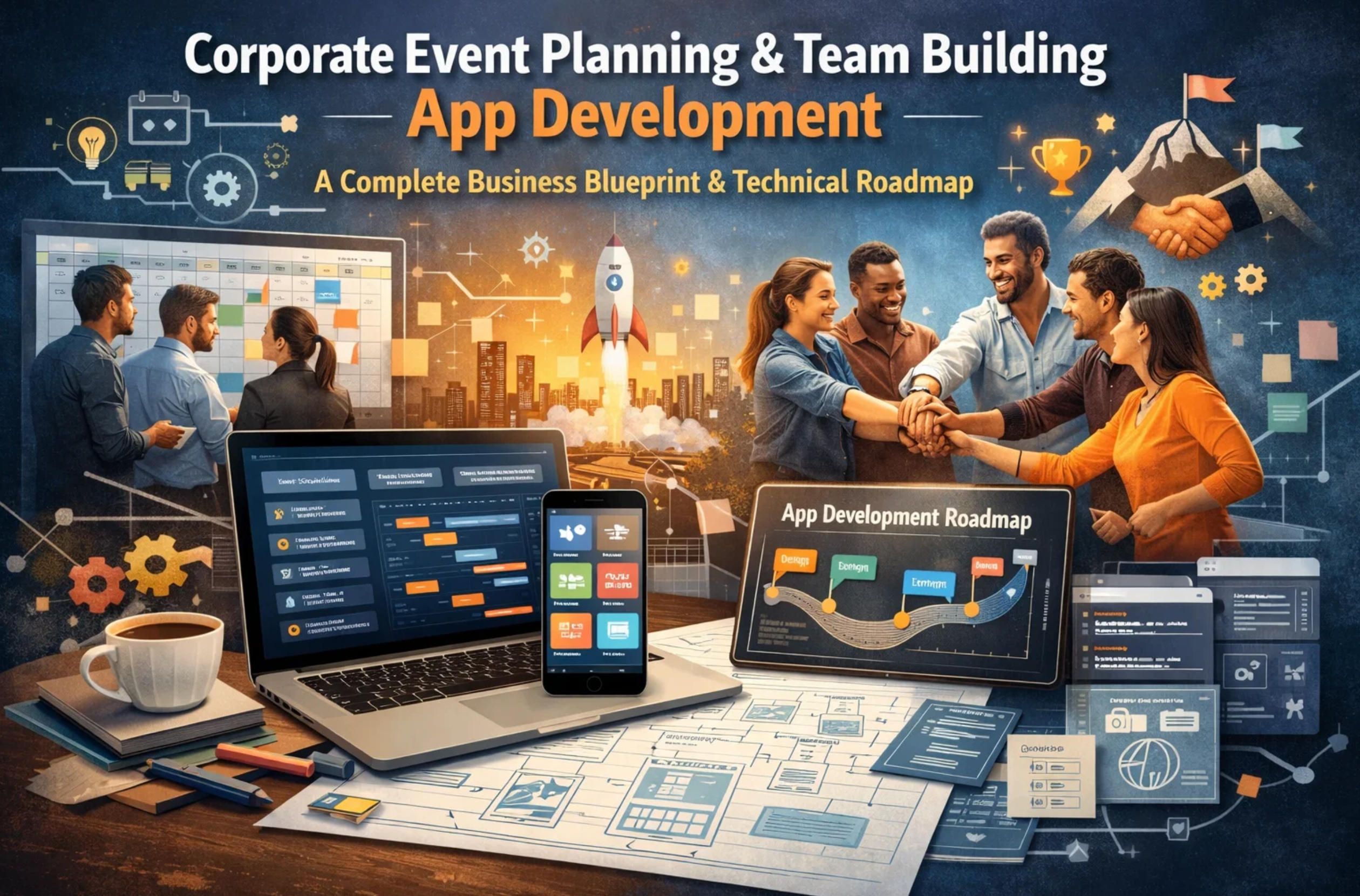
Competitive Analysis and Market Positioning
Understanding competitive landscape enables strategic differentiation and identification of sustainable competitive advantages.
Existing Event Management Platforms
Bizzabo positions as an enterprise event management platform specializing in B2B conferences and large corporate events. The platform offers sophisticated event marketing capabilities, attendee insights and analytics, networking and lead generation features, and integrations with marketing automation platforms including HubSpot, Marketo, and Salesforce. However, Bizzabo faces criticism for steep learning curves especially for smaller organizations, limited customization options constraining ability to match specific organizational workflows, high pricing that makes it inaccessible for mid-market companies, and poor attendee experience with users finding the platform difficult to navigate. These weaknesses create opportunities for solutions offering simpler onboarding, greater flexibility, more accessible pricing, and superior user experience for both coordinators and attendees.
Eventbrite dominates ticketing and registration for public events, with strong brand recognition, simple pricing models, and broad distribution reach through its event discovery marketplace. The platform serves millions of small to medium events annually. However, Eventbrite lacks enterprise features essential for corporate deployment including single sign-on, white-labeling, advanced security controls, and data privacy capabilities required for handling employee information. The platform's focus on ticket sales rather than comprehensive event management means it provides limited budget tracking, vendor management, or analytics capabilities beyond basic attendance reporting. Organizations seeking corporate event solutions quickly outgrow Eventbrite's consumer-oriented feature set.
Whova targets conferences, academic events, and professional gatherings with emphasis on attendee engagement and networking. The platform provides excellent mobile applications, AI-powered attendee matchmaking, robust agenda management, and real-time polling and interaction tools. Whova receives consistently high user ratings for ease of use and effective support. However, the platform's simplicity can limit flexibility for complex corporate events spanning multiple days, diverse activity types, or intricate approval workflows. Whova's pricing information lacks transparency, requiring custom quotes that complicate vendor evaluation. The platform emphasizes engagement over operational efficiency, potentially missing needs of organizations prioritizing budget control, vendor management, or integration with enterprise systems.
Cvent provides comprehensive event management capabilities for enterprise customers, with particular strength in venue sourcing through its extensive marketplace, sophisticated registration and attendee management, robust reporting and analytics, and deep integrations with corporate technology ecosystems. Cvent serves Fortune 500 companies and large-scale corporate events effectively. However, the platform's complexity and pricing place it beyond reach of mid-market organizations. Implementation timelines extending months and requirement for dedicated administrative resources make Cvent unsuitable for organizations seeking rapid deployment or simple solutions. The platform's breadth of features can overwhelm coordinators managing straightforward events, introducing unnecessary complexity.
Microsoft Teams and Slack provide baseline event coordination capabilities through calendar integration, group messaging, and basic RSVP tools embedded in collaboration platforms. Organizations already using these tools may initially coordinate events through familiar interfaces without additional investment. However, collaboration platforms lack purpose-built event management capabilities including budget tracking and financial controls, vendor management and RFP workflows, comprehensive analytics and reporting, employee engagement measurement, and scalability to manage dozens or hundreds of annual events efficiently. Over time, organizations coordinating significant event programs recognize limitations of general-purpose collaboration tools.
Gap Analysis and Differentiation Strategy
Market gaps present opportunities for platforms addressing unmet needs or underserved segments.
Mid-market sweet spot represents organizations with 200 to 2,000 employees who find enterprise platforms like Bizzabo and Cvent too complex and expensive while having needs exceeding what consumer-focused tools like Eventbrite provide. This segment seeks sophisticated functionality including multi-event coordination, budget management, vendor workflows, and meaningful analytics delivered through intuitive interfaces requiring minimal training. Pricing must balance comprehensive features with affordability, targeting $500 to $2,000 monthly subscription range that fits departmental budgets without requiring C-level procurement approval.
Corporate-specific workflows differentiate platforms purpose-built for internal employee events from generic tools serving public conferences or social gatherings. Corporate event coordinators require features including integration with HR systems for automatic employee roster updates, approval workflows matching organizational hierarchy and spending authorities, compliance with internal policies around event spending and vendor selection, privacy controls appropriate for employee data, and analytics connecting event investments to business outcomes like retention and productivity. Generic platforms accommodating diverse event types inevitably compromise on depth of corporate-specific capabilities.
Budget accountability and ROI measurement separate platforms treating events as strategic investments from those viewing them as administrative tasks. Organizations increasingly demand quantifiable evidence that event spending delivers business value. Platforms providing sophisticated budget management, correlation of spending with satisfaction and participation outcomes, comparative analytics across events and time periods, and executive dashboards linking events to retention and engagement metrics enable data-driven decisions about event programs. Generic tools providing basic expense tracking without analytical depth leave organizations unable to justify or optimize event investments.
Superior user experience creates competitive advantage in markets where many platforms suffer from clunky interfaces, confusing navigation, or overwhelming feature sprawl. Platforms investing in modern design, intuitive workflows, mobile-first experiences, and thoughtful default configurations reducing setup time win users frustrated with existing tools. Particular opportunity exists in attendee-facing experiences, where many platforms treat employee engagement as afterthought rather than primary objective. Delightful mobile applications, frictionless RSVP processes, engaging event communications, and easy feedback submission differentiate platforms treating employees as customers deserving excellent experiences.
Integration ecosystem determines how well event platforms fit within existing corporate technology environments. Organizations demand seamless integration with HR information systems, accounting and ERP platforms, calendar and email systems, single sign-on providers, and collaboration tools. Platforms providing pre-built integrations, well-documented APIs, and commitment to supporting custom integration requirements reduce implementation complexity and total cost of ownership. Generic tools requiring manual data export-import or lacking integration capabilities create operational friction that undermines adoption.
Quality Assurance and Testing Services
Beyond custom development, comprehensive testing services ensure that event management platforms, whether built custom or procured as commercial products, operate reliably and securely.
A-Bots.com provides specialized quality assurance and testing services for organizations implementing event management platforms, whether those platforms are custom-built, commercial off-the-shelf solutions, or hybrid implementations combining third-party software with custom extensions. Our testing team brings deep expertise in enterprise application testing methodologies, ensuring that platforms meet functional requirements, perform reliably under realistic load, maintain security against diverse threats, and deliver excellent user experiences across devices and use cases.
Functional testing validates that all platform features operate according to specifications. Test cases cover standard user workflows including event creation, employee RSVP, budget tracking, and vendor management, along with edge cases and error conditions that might surface only in unusual circumstances. Regression testing conducted after each product update ensures that new features or fixes don't break existing functionality, maintaining reliability as platforms evolve. Test automation using frameworks like Selenium, Cypress, or Appium enables continuous testing during development, catching issues earlier when they're less expensive to address.
Performance testing ensures platforms remain responsive during high-usage periods such as major event launches or end-of-year holiday party season. Load testing simulates hundreds or thousands of concurrent users, measuring response times, identifying bottlenecks in application code or infrastructure, and validating that scaling mechanisms work as designed. Stress testing pushes platforms beyond expected capacity to understand failure modes, resource limits, and graceful degradation behavior when systems become overwhelmed. These tests prevent scenarios where platforms become unusable precisely when organizations most need them.
Security testing identifies vulnerabilities before attackers can exploit them. Penetration testing employs ethical hacking methodologies attempting to breach application security, test authentication and authorization controls, and identify data exposure risks. Vulnerability scanning uses automated tools to detect common security issues like SQL injection, cross-site scripting, insecure dependencies, and configuration weaknesses. Security code review examines source code for flaws that automated scanning may miss, validating that security best practices are followed throughout implementation. For platforms handling employee personal information, security testing is not optional but rather essential for compliance and risk management.
Usability testing evaluates whether platforms deliver intuitive, efficient user experiences. Testing observes representative users from different personas attempting realistic tasks, identifying confusion, frustration, and workflow inefficiencies. This testing surfaces issues invisible to developers intimately familiar with systems, revealing how real users with varying technical sophistication and familiarity actually experience platforms. Accessibility testing specifically evaluates whether platforms accommodate users with disabilities, testing screen reader compatibility, keyboard navigation, color contrast, and other factors determining whether all employees can participate fully.
Integration testing validates connections between event platforms and surrounding enterprise systems. Test cases verify that employee data synchronizes correctly from HR systems, accounting integrations properly record transactions, calendar integrations create appointments and update them accurately, single sign-on authentication works seamlessly, and API integrations with custom tools or external services function reliably. Integration issues frequently surface only when systems are deployed in production environments, making thorough integration testing essential before launch.
Organizations implementing event management platforms often underestimate testing requirements, leading to production deployments with significant quality issues that damage user adoption and organizational credibility. A-Bots.com's testing services help organizations avoid these pitfalls through comprehensive test planning, execution, and defect management. Whether you are developing a custom event management platform or implementing a commercial solution, our quality assurance team ensures that deployment delivers the reliability and user experience your organization demands.
Implementation Timeline and Investment Requirements
Realistic timelines and budget planning prevent mid-project surprises that derail implementations or force undesirable compromises.
Development Timeline
Comprehensive custom event management platform development typically requires five to seven months from project initiation to production launch. The timeline assumes dedicated development team, effective stakeholder collaboration, and disciplined project management.
Months 1-2 encompass discovery, requirements gathering, UX/UI design, and architecture planning. This phase establishes project foundation through stakeholder interviews, competitive analysis, requirements documentation, wireframing and design, technical architecture definition, and development environment setup. Organizations sometimes pressure teams to compress this phase, viewing it as preliminaries rather than essential foundation work. However, inadequate discovery and design leads to mid-project requirement changes, user experience issues requiring expensive rework, and technical debt from architectural shortcuts.
Months 3-5 constitute core development implementing minimum viable product with essential features. Development proceeds through two-week sprints delivering progressively sophisticated capabilities. Early sprints establish authentication, data models, and API foundations. Middle sprints implement event management, budgeting, and communication features. Later sprints focus on analytics, mobile applications, and integration capabilities. Continuous integration and deployment practices enable frequent validation of work in progress.
Month 6 focuses on quality assurance and refinement. Comprehensive testing as described previously identifies issues requiring resolution before production deployment. User acceptance testing with actual coordinators and employees validates that platform meets real-world needs. Performance optimization addresses any bottlenecks discovered during load testing. Final documentation including user guides, administrator documentation, and API references supports post-launch adoption.
Month 7 manages production deployment, user training, and launch activities. Phased rollout begins with beta users providing early feedback, expanding to full organizational deployment as confidence builds. Training ensures coordinators and administrators can leverage platform capabilities effectively. Support processes establish help desk capabilities, issue escalation procedures, and continuous monitoring.
Investment Breakdown
Development costs vary based on team composition, geographic location, feature complexity, and quality standards. The following estimates reflect North American development rates and comprehensive scope.
UX/UI Design requires specialized skills translating requirements into intuitive, visually appealing interfaces. Investment typically ranges from $20,000 to $40,000 encompassing wireframing, visual design, design system development, interactive prototyping, and user testing. Organizations sometimes attempt to economize by skipping formal design processes, having developers create interfaces directly. This approach almost invariably results in poor user experience requiring expensive redesign later, making upfront design investment one of the highest-ROI components.
Application Development represents the largest investment category, typically ranging from $150,000 to $300,000 for comprehensive event management platforms. This encompasses frontend development for web and mobile applications, backend development including API implementation and business logic, database design and implementation, third-party integration development, and testing and quality assurance. Variation within this range depends on feature scope, team composition between senior and junior developers, use of offshore versus domestic development resources, and technical complexity of requirements like real-time synchronization or sophisticated analytics.
Infrastructure and Operations covers cloud hosting, third-party services, and operational tooling. Initial setup costs range from $10,000 to $20,000 including cloud infrastructure configuration, database setup and optimization, security tooling implementation, monitoring and logging infrastructure, and deployment automation. Ongoing monthly operational costs typically range from $2,000 to $5,000 depending on user count, data volume, and service level requirements. These costs cover cloud hosting fees, database and caching services, content delivery network, email delivery services, and monitoring and security tools.
Project Management and Business Analysis ensures coordinated execution and stakeholder alignment. Investment typically represents 15% to 20% of development costs, ranging from $25,000 to $60,000. This encompasses project manager coordinating team activities and stakeholder communication, business analyst gathering and documenting requirements, scrum master facilitating agile processes, and quality assurance lead directing testing efforts.
Total Investment for comprehensive custom development typically ranges from $200,000 to $400,000 for initial platform delivery. Organizations should budget additional 15% to 20% annually for ongoing maintenance, feature enhancements, infrastructure scaling, security updates, and support operations.
Return on Investment Timeframe
Event management platforms deliver quantifiable benefits justifying investment through efficiency gains, cost reductions, and improved outcomes.
Year 1 benefits primarily reflect operational efficiency for HR and event coordination staff. A coordinator managing 20 to 30 annual events might reduce time investment from 200 to 300 hours to 100 to 150 hours through platform automation and streamlined workflows. At average fully-burdened cost of $75 per hour, this represents $7,500 to $11,250 annual savings per coordinator. Organizations with multiple coordinators multiply these savings proportionally.
Years 2-3 deliver additional benefits from improved employee participation, satisfaction, and retention. Research demonstrates that even modest retention improvements generate substantial cost savings. For example, reducing turnover from 15% to 13% in a 500-person organization with average salary of $70,000 saves approximately $350,000 annually in reduced replacement costs. Platforms enabling data-driven event optimization, better employee engagement, and stronger company culture contribute materially to retention improvements.
Long-term benefits compound as organizations build event program sophistication enabled by comprehensive data and analytics. Better budget management reduces wasteful spending while improving satisfaction. Vendor relationship optimization drives costs lower while maintaining or improving quality. Most significantly, strategic rather than tactical event planning transforms employee engagement from occasional celebrations to continuous culture-building, delivering productivity and retention benefits worth millions annually for mid-sized and large organizations.
Many organizations achieve full return on platform investment within two to three years through quantifiable savings and measurable improvements in key metrics. The decision to invest in comprehensive event management capabilities represents strategic commitment to employee engagement as business priority rather than administrative function.
Risk Mitigation and Success Factors
Enterprise software implementations face common risks that disciplined planning and execution can mitigate.
Technical Risks include underestimating feature complexity, integration challenges with existing systems, performance issues at scale, and security vulnerabilities. Mitigation strategies encompass thorough technical discovery before commitment, proof-of-concept prototypes for uncertain features, experienced technical leadership, architecture reviews by independent experts, comprehensive testing as described previously, and security assessments throughout development.
Adoption Risks represent perhaps the most significant threat to ROI. Even excellent platforms fail if users don't adopt them. Mitigation requires engaging end users throughout design process, delivering intuitive user experience requiring minimal training, comprehensive change management including executive sponsorship, hands-on training and support during transition, early wins demonstrating value to skeptical users, and continuous feedback collection driving improvements.
Budget Overruns derail projects when scope creeps beyond initial estimates or unexpected complexity emerges. Prevention strategies include detailed requirements documentation before development begins, change control processes evaluating impact of scope additions, time and materials contracts for uncertain requirements rather than fixed bids assuming perfect specifications, regular budget reviews with transparent reporting, and executive sponsor commitment to providing necessary resources.
Vendor Dependency creates risk when organizations rely on single development partner or platform provider without alternatives. Mitigation includes comprehensive documentation enabling knowledge transfer, code ownership and access rather than proprietary systems, avoiding vendor-specific technologies where viable alternatives exist, and maintaining relationships with multiple service providers capable of supporting implementations.
Feature Creep threatens timelines when stakeholders continuously add requirements during development. Discipline requires prioritization frameworks distinguishing must-have from nice-to-have features, phased delivery accepting MVP functionality initially with enhancements following production validation, formal change control evaluating cost-benefit of scope additions, and stakeholder education about trade-offs between features, timeline, and budget.
Success factors consistently observed across successful implementations include executive sponsorship providing resources and removing obstacles, dedicated product owner making timely decisions, experienced development team with relevant expertise, agile methodology enabling iterative refinement, comprehensive user testing throughout development, realistic timelines without artificial pressure, and change management preparing organization for new workflows.
Conclusion and Strategic Recommendations
Corporate event planning and team building represent strategic investments in organizational culture, employee engagement, and business performance. The global event management market's rapid growth from $11.3 billion in 2024 toward projected $42.6 billion by 2034 reflects organizations' recognition that events drive measurable outcomes including employee retention improvements, productivity increases, and stronger company culture.
Generic event management platforms inadequately address corporate-specific requirements around budget accountability, multi-stakeholder workflows, employee privacy, and analytics connecting investments to business outcomes. This gap creates opportunities for custom solutions delivering functionality precisely matching organizational needs while providing superior user experience and integration with enterprise systems.
Organizations evaluating event management platform options should assess current pain points including time invested in event coordination, budget visibility and control, employee participation and satisfaction, vendor relationship management, and analytical capabilities. Quantify costs of current approaches including coordinator time, budget overruns, employee disengagement, and missed opportunities for data-driven improvement. Compare these costs against platform investment including development or procurement, implementation and training, ongoing maintenance and support, and integration with existing systems.
A-Bots.com stands ready to partner with organizations seeking to transform corporate event management from administrative burden into strategic capability. Whether you require custom application development delivering precisely tailored functionality or comprehensive quality assurance testing ensuring platform reliability, our experienced team brings proven expertise in enterprise mobile and web application development. We invite you to schedule a consultation to discuss your event management challenges, explore solution options, and develop implementation roadmap aligned with your organizational priorities and timeline.
The future of corporate event management combines sophisticated technology with human-centered experiences, using data and automation to eliminate administrative overhead while creating memorable moments that strengthen employee connections, reinforce organizational values, and drive business performance. Organizations investing in comprehensive event management capabilities position themselves to compete effectively for talent, build stronger cultures, and achieve measurable returns justifying continued investment in employee engagement as strategic priority rather than discretionary expense.
Contact A-Bots.com today to begin transforming your corporate event program into a competitive advantage driving employee retention, productivity, and organizational success.

FREQUENTLY ASKED QUESTIONS: CORPORATE EVENT PLANNING AND TEAM BUILDING APP DEVELOPMENT
1. How long does it take to develop a custom corporate event planning application?
A comprehensive corporate event management platform typically requires five to seven months from project initiation to production launch. The timeline breaks down into discovery and requirements gathering (four to six weeks), UX/UI design and prototyping (three to four weeks), MVP development of core features (ten to fourteen weeks), quality assurance and comprehensive testing (four to six weeks), and deployment with user training (two weeks). Organizations with simpler requirements focusing on essential features rather than comprehensive functionality can sometimes achieve faster delivery in three to four months. However, rushing development typically results in quality compromises, poor user experience, or missing functionality that requires expensive post-launch remediation. The most successful implementations balance urgency with disciplined execution ensuring that deployed platforms meet real organizational needs.
2. What is the typical cost to develop a corporate event planning and team building application?
Custom development investment for a comprehensive corporate event management platform typically ranges from $200,000 to $400,000 for initial delivery, with the variation reflecting feature scope, technical complexity, and development team rates. This investment encompasses UX/UI design ($20,000 to $40,000), application development for web and mobile interfaces ($150,000 to $300,000), infrastructure setup and configuration ($10,000 to $20,000), and project management and business analysis ($25,000 to $60,000). Organizations should also budget 15% to 20% annually for ongoing maintenance, feature enhancements, security updates, and infrastructure costs. While this represents significant investment, organizations typically achieve full return on investment within two to three years through quantifiable savings in coordinator time, reduced employee turnover costs, improved budget adherence, and productivity gains from higher employee engagement. Many mid-market organizations find that commercial event management platforms with enterprise-grade capabilities cost $10,000 to $50,000 annually in subscription fees, making custom development economically viable when standardized solutions inadequately address organizational requirements.
3. Can a corporate event planning app integrate with our existing HR systems and accounting software?
Yes, integration with existing enterprise systems represents a core requirement for corporate event planning applications serving mid-sized and large organizations. Modern event management platforms integrate with HR information systems including Workday, SAP SuccessFactors, Oracle HCM, BambooHR, and others to synchronize employee rosters, department structures, contact information, and organizational hierarchies. This integration enables automatic invitation targeting, accurate headcount planning, and analytics segmented by organizational dimensions. Accounting software integration with QuickBooks, Xero, NetSuite, SAP, and Oracle Financials enables seamless financial data flow, automatic expense categorization aligned with general ledger codes, accounts payable integration for vendor invoice processing, and consolidated reporting connecting event spending with broader organizational finances. Additional integrations typically include calendar systems (Google Calendar, Microsoft Outlook, Apple Calendar) for automatic appointment creation and updates, single sign-on providers (Okta, Azure AD, OneLogin) eliminating separate password management, and collaboration platforms (Slack, Microsoft Teams) for event notifications and communication. Well-designed platforms provide pre-built integrations for common enterprise systems while offering documented APIs enabling custom integration with specialized internal tools.
4. Is the event management platform GDPR compliant and suitable for handling employee personal information?
GDPR compliance and broader data privacy requirements are essential for corporate event platforms handling employee personal information. Comprehensive platforms implement privacy-by-design principles including data minimization, collecting only information necessary for event management purposes, transparent privacy notices explaining what data is collected and how it's used, consent management enabling employees to control optional data sharing, access and rectification allowing employees to view and correct their personal information, data portability supporting export of personal information in machine-readable formats, and right to erasure enabling deletion of personal data when no longer needed for legitimate purposes. Security measures protecting employee data include encryption of all data at rest using AES-256 or equivalent algorithms, TLS encryption for all data transmission, role-based access controls ensuring employees can access only appropriate information, comprehensive audit logging documenting all data access and modifications, regular security assessments including penetration testing and vulnerability scanning, and incident response procedures for handling any security breaches. Data processing agreements document platform operator commitments regarding data handling, subprocessor management, and cooperation with supervisory authorities. Organizations subject to California Consumer Privacy Act, Health Insurance Portability and Accountability Act, or other privacy regulations receive similar compliance support tailored to specific requirements.
5. Do you provide ongoing support and maintenance after the event management platform launches?
Yes, ongoing support and maintenance represent critical success factors for enterprise applications, and comprehensive service agreements ensure that platforms continue operating reliably while evolving to meet changing organizational needs. Post-launch support typically encompasses help desk services addressing user questions, technical issues, and feature requests through multiple channels including email, in-app messaging, and knowledge base for self-service troubleshooting. Proactive monitoring tracks application health, performance metrics, error rates, and user behavior, with automated alerts notifying operations teams of anomalies requiring investigation. Regular maintenance activities include security updates and patches addressing newly discovered vulnerabilities, performance optimization improving response times and resource efficiency, infrastructure scaling adjusting capacity based on growth in users or data, and bug fixes resolving issues identified through user reports or monitoring. Feature enhancements deliver new capabilities based on user feedback, industry trends, changing regulatory requirements, and strategic business objectives. Support service level agreements specify response time commitments for different severity levels, with critical production issues receiving immediate attention while lower-priority questions may have 24 to 48 hour response windows. Monthly or quarterly business reviews examine platform performance, user satisfaction, and strategic roadmap alignment. Organizations can choose between time-and-materials support arrangements providing flexibility for variable needs or fixed monthly retainers ensuring predictable budgets with defined service levels.
6. Can we white-label the event management platform for our organization or use it across multiple business units?
White-labeling and multi-tenant architecture enable organizations to customize platforms with their branding while supporting separate instances for different business units, geographic regions, or client organizations in the case of event planning agencies. White-label customization typically includes branded login pages and user interfaces displaying company logos, color schemes, and visual identity, custom domain names rather than generic platform URLs, email communications sent from organization's domain with appropriate branding, and mobile applications published under organization's name in app stores. Multi-tenant architecture provides data isolation ensuring complete separation between different business units or client organizations, shared infrastructure reducing costs compared to completely separate deployments, centralized administration enabling global configuration management, and cross-tenant reporting for organizations wanting consolidated analytics while maintaining operational separation. Configuration flexibility allows different business units to customize event types, approval workflows, budget categories, and vendor relationships while sharing core platform capabilities. This architecture particularly benefits large organizations with diverse operating companies, event planning agencies serving multiple clients, franchise organizations supporting franchisees, and holding companies managing portfolio of brands.
7. What differentiates custom event management development from commercial off-the-shelf platforms?
Custom development delivers solutions precisely matching organizational requirements, workflows, and integrations, while commercial platforms provide standardized functionality serving broad market segments. The choice between custom and commercial approaches depends on specific circumstances. Custom development advantages include exact feature fit addressing unique organizational processes without forcing workflow compromises, complete control over roadmap prioritizing enhancements based on business needs rather than vendor's market strategy, proprietary intellectual property creating competitive advantage, flexible integration architecture accommodating specialized internal systems, and unlimited customization enabling continuous refinement based on user feedback. However, custom development requires significant upfront investment, longer time to initial deployment, and ongoing technical maintenance responsibility. Commercial platforms offer lower initial costs through subscription pricing, faster deployment with immediate access to proven functionality, vendor responsibility for maintenance and enhancements, and established integration ecosystem with common enterprise systems. Disadvantages include feature limitations where platforms may lack specific capabilities required by organization, workflow compromises adapting processes to fit platform constraints, subscription costs accumulating over years potentially exceeding custom development investment, and dependency on vendor roadmap and business continuity. Many organizations adopt hybrid approaches, implementing commercial platforms with custom extensions addressing specific gaps or developing custom platforms in strategic areas while using commercial tools for commodity functions.
8. How do you measure the ROI and business impact of a corporate event management platform?
Measuring return on investment requires establishing baseline metrics before platform implementation, tracking improvements across multiple dimensions, and connecting changes to business outcomes. Operational efficiency metrics quantify time savings including hours invested by event coordinators per event, typically decreasing 40% to 60% with platform automation, administrative staff time supporting event coordination, and finance team time reconciling event expenses. Calculate savings by multiplying time reductions by fully-burdened hourly costs for affected roles. Financial performance metrics include budget adherence measured as percentage of events completed within budget parameters, with well-managed platforms achieving 95%+ compliance, spending variance reduction showing tighter alignment between budgeted and actual costs, and vendor relationship optimization delivering cost reductions through better sourcing and negotiation. Employee engagement improvements manifest in RSVP and attendance rate increases reflecting easier participation, post-event satisfaction scores showing experience quality, and correlation between event participation and employee Net Promoter Scores. Most significant financial impact comes from retention improvements, as even modest reductions in turnover generate substantial savings. For example, reducing turnover from 15% to 13% in a 500-person organization with average salary of $70,000 saves approximately $350,000 annually in replacement costs. Productivity gains from higher engagement, while harder to isolate precisely, contribute additional value with research showing 14% productivity improvements from regular team building activities. Comprehensive ROI analysis combines quantifiable savings with qualitative benefits including improved company culture, stronger leadership confidence in event investments, and enhanced employer brand reputation, typically demonstrating full investment recovery within two to three years.
9. What quality assurance and testing services does A-Bots.com provide for event management platforms?
A-Bots.com delivers comprehensive quality assurance services ensuring that corporate event management platforms, whether custom-built or commercial solutions with custom extensions, operate reliably across all scenarios. Functional testing validates that all features work according to specifications through test cases covering standard user workflows, edge cases, error conditions, and integration points with other systems. Automated testing using frameworks like Selenium, Cypress, and Appium enables continuous validation during development while regression testing after each update ensures new features don't break existing functionality. Performance testing simulates realistic usage patterns with load testing validating response times under hundreds or thousands of concurrent users, stress testing identifying system limits and graceful degradation behavior, and endurance testing confirming stability during extended operation. Security testing protects against vulnerabilities through penetration testing employing ethical hacking methodologies, vulnerability scanning detecting common security issues, and security code review examining implementation for flaws. Usability testing observes representative users from different personas attempting realistic tasks, identifying confusion, frustration, and workflow inefficiencies that impact adoption and satisfaction. Accessibility testing ensures platforms accommodate users with disabilities by verifying screen reader compatibility, keyboard navigation, color contrast, and other factors. Integration testing validates connections with HR systems, accounting platforms, calendar applications, and authentication providers. Mobile testing covers iOS and Android devices of various sizes, operating system versions, and connectivity conditions. Testing documentation provides comprehensive test plans, detailed test cases, defect reports with reproduction steps and severity classifications, and test summary reports quantifying coverage and quality metrics. Organizations implementing event management platforms often underestimate testing requirements, leading to production deployments with quality issues that damage user adoption. A-Bots.com prevents these pitfalls through disciplined test planning, execution, and defect management supporting reliable platform launches.
10. Can the platform accommodate hybrid events combining in-person and virtual participation?
Yes, hybrid event support represents an increasingly critical capability as organizations embrace flexible participation models accommodating distributed workforces, remote employees, travel restrictions, and personal preferences. Modern event management platforms enable hybrid experiences through several key features. Flexible registration allows attendees to select in-person or virtual participation during RSVP, with platform tracking different headcounts for capacity planning, catering, and technology requirements. Virtual event infrastructure integrates with video conferencing platforms including Zoom, Microsoft Teams, Google Meet, and Webex, automatically creating meeting sessions for registered virtual participants and synchronizing attendance data. Content delivery accommodates different audience segments with in-person attendees receiving venue directions and on-site information while virtual participants receive joining links and technical requirements. Engagement features maintain parity between participation modes including live polling and Q&A accessible to both in-person and virtual attendees, chat functionality enabling networking across participation modes, and session recordings available to virtual participants unable to attend live. Analytics track participation patterns across in-person and virtual attendance, satisfaction segmented by participation mode, and cost-per-attendee comparisons informing future planning decisions. Hybrid events typically deliver 60% cost savings per virtual attendee compared to fully in-person participation while achieving 45% reduction in carbon emissions, making this format strategically important for organizations balancing engagement quality, cost efficiency, and sustainability objectives. Platform capabilities enable seamless hybrid execution rather than requiring coordinators to manage in-person and virtual events as completely separate activities.
11. What are the most common challenges organizations face when implementing event management platforms?
Implementation challenges fall into several categories that proactive planning and disciplined execution can mitigate. User adoption represents the most significant risk, as even excellent platforms fail if coordinators and employees don't embrace new tools. Resistance typically stems from change fatigue particularly in organizations with frequent technology deployments, perceived complexity where users doubt that platforms justify learning effort, lack of training leaving users uncertain about how to accomplish tasks, and missing features that force continued use of legacy tools for critical workflows. Mitigation strategies include involving users throughout design process ensuring platforms address real needs, delivering intuitive interfaces requiring minimal training, comprehensive change management with executive sponsorship and clear communication, hands-on training during transition periods, and early wins demonstrating value to skeptical stakeholders. Data migration challenges occur when transitioning from manual processes or legacy systems, with incomplete or inconsistent source data, no standardized formats across departments, ownership ambiguity about who maintains what information, and privacy concerns about appropriate data collection. Solutions include dedicated data cleanup efforts before migration, establishing clear data governance policies, automating migration where possible while validating critical information manually, and using platform launch as opportunity to improve data quality. Integration complexity arises when connecting with existing enterprise systems, particularly older platforms with limited APIs, undocumented interfaces, or security restrictions. Early technical discovery identifying integration requirements, proof-of-concept testing validating connectivity before full development, involvement of IT teams managing target systems, and fallback options including manual data exchange for problematic integrations all reduce risk. Budget and timeline overruns result from underestimating scope complexity, late-stage requirement changes, inadequate testing time allocation, or unrealistic delivery pressure. Prevention requires detailed requirements documentation, change control processes, realistic timeline padding, and executive commitment to providing necessary resources.
12. How does A-Bots.com ensure that the event management platform aligns with our specific organizational workflows and culture?
A-Bots.com employs a collaborative, user-centered development methodology ensuring delivered platforms authentically reflect organizational workflows, priorities, and culture rather than forcing adaptation to generic solutions. The process begins with comprehensive discovery engaging stakeholders from all user groups through structured interviews understanding current processes, pain points, and desired outcomes, observation of existing event planning activities revealing unstated workflow nuances, review of existing tools and documentation providing context, and workshops facilitating collaborative requirements definition. Persona development creates detailed profiles of different user types including HR managers, event coordinators, finance approvers, employees, vendors, and leadership, documenting goals, workflows, pain points, technical proficiency, and success criteria for each. This persona-driven approach ensures that platform design serves genuine user needs rather than assumptions. Iterative design and validation employs wireframing to establish information architecture and workflows for stakeholder review before visual design, high-fidelity prototypes enabling stakeholders to experience navigation and interactions before development begins, and user testing sessions with representative users validating design effectiveness. Agile development methodology delivers working software in two-week sprints enabling continuous feedback and course correction rather than waiting months for comprehensive delivery. Sprint reviews demonstrate progress and gather stakeholder input informing subsequent work. Configuration flexibility allows organizations to customize event types, approval workflows, budget categories, communication templates, and analytics dashboards matching specific organizational needs rather than using rigid, one-size-fits-all defaults. Integration with existing systems respects established technology ecosystems rather than forcing replacement of working tools. Throughout development, A-Bots.com maintains transparent communication through weekly status updates, shared project management visibility, and accessible technical team members addressing questions as they arise. This collaborative approach, refined through 70+ completed projects and client relationships spanning 1.5 to 5+ years, ensures delivered platforms feel like natural extensions of organizational culture rather than foreign systems requiring adaptation.
✅ Hashtags
#CorporateEventPlanning
#TeamBuildingApp
#EmployeeEngagement
#EventManagementSoftware
#MobileAppDevelopment
#HRTechnology
#EnterpriseApps
#CustomSoftware
#EventPlanning
#WorkplaceInnovation
Other articles
Custom Beauty App Development Services: Learning from Shark Beauty's $20B Market Success Discover how Shark Beauty achieved number 1 market position in skincare devices within 11 months through strategic mobile app development. Learn why beauty technology devices require sophisticated applications for IoT connectivity, AI personalization, and AR features. A-Bots.com provides custom mobile app development services for beauty device manufacturers. With expertise in IoT integration, artificial intelligence, augmented reality, and comprehensive testing, we help beauty tech companies build complete ecosystem solutions.
Sephora Mobile App Success Story: Complete Guide to Beauty App Development in 2026 This comprehensive analysis explores the Sephora mobile app phenomenon and its implications for beauty app development. From humble French origins in 1969 to a global digital powerhouse with over 40 million loyalty members, Sephora transformed beauty retail through strategic technology investments. The article examines Virtual Artist AR capabilities, Beauty Insider program mechanics, target audience demographics, and marketing strategies that drive 80% of North American sales through app-engaged customers. Entrepreneurs and product managers will discover practical frameworks for building competitive beauty applications, including IoT integration opportunities and personalization techniques. A-Bots.com offers custom beauty app development services to bring similar visions to life.
IoT Devices Skincare Industry The beauty tech industry is experiencing unprecedented growth, with the global market projected to reach $130 billion by 2029. This comprehensive guide explores how IoT-enabled skincare devices are transforming the industry and why excellence in beauty app development has become essential for success. Using Medicube's remarkable journey from Korean startup to $6 billion powerhouse as a case study, we examine the technical architecture behind smart beauty devices, the role of companion apps in creating seamless user experiences, and practical insights for entrepreneurs entering this space. From Bluetooth connectivity and AI-powered skin analysis to viral TikTok marketing strategies, discover what it takes to build the next generation of beauty technology.
Hair Salon App Development: AR Try-On, Booking and CRM Platform This comprehensive guide explores hair salon app development for modern beauty businesses seeking digital transformation. The article covers AR-powered virtual hairstyle try-on technology that allows clients to preview cuts and colors before booking. It details three-sided platform architecture serving clients, stylists, and administrators with integrated booking, CRM, and management tools. Key market statistics reveal the $247 billion global salon industry opportunity and compare USA versus European markets. The guide addresses no-show reduction through automated reminders, multi-location scalability, security compliance, and MVP development strategies. A-Bots.com demonstrates expertise in building custom salon applications with AR integration, appointment scheduling, and comprehensive business management features.
Beauty Social Commerce App Development: Building Influencer-Driven Shopping Platforms | A-Bots.com Beauty social commerce applications have revolutionized how consumers discover and purchase cosmetics, with platforms like TikTok Shop generating billions in beauty sales through influencer-driven content. This comprehensive guide explores the technology architecture behind successful beauty social commerce platforms, including livestream video infrastructure, AI-powered recommendation algorithms, augmented reality try-on features, and creator management systems. Learn how A-Bots.com develops custom social commerce applications that integrate payment processing, affiliate commission tracking, and comprehensive analytics. The article examines market dynamics, platform strategies, and emerging trends including blockchain authentication and multi-device experiences. Essential reading for beauty brands evaluating social commerce development or seeking to understand the technical requirements of building competitive influencer shopping platforms.
Top stories

Copyright © Alpha Systems LTD All rights reserved.
Made with ❤️ by A-BOTS