
Home
Services
About us
Blog
Contacts
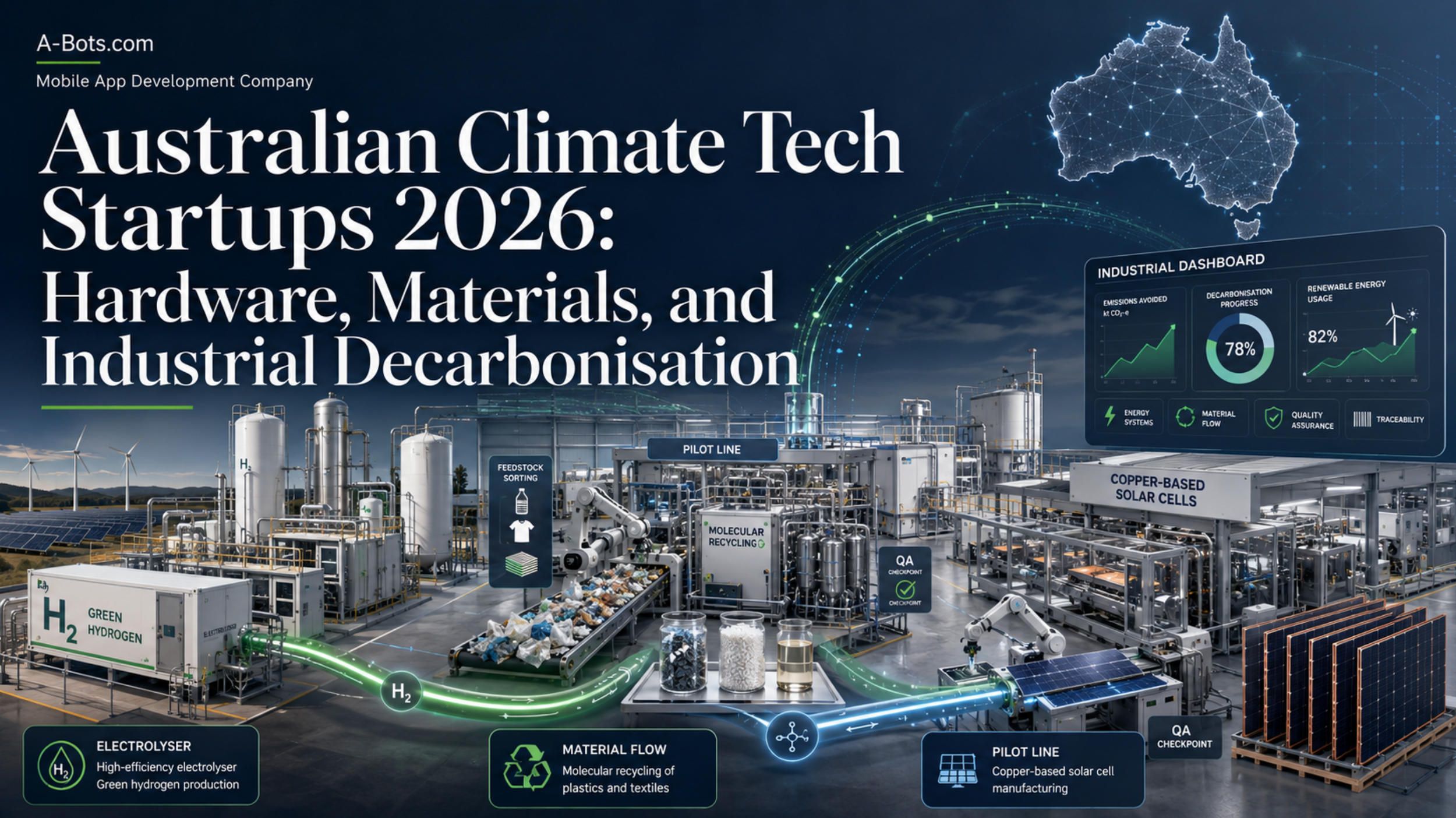
Australian Climate Tech Startups 2026: Hardware, Materials, and Industrial Decarbonisation
For several years, climate technology was often discussed through the language of software visibility. Companies needed carbon accounting. Investors wanted ESG dashboards. Governments wanted emissions reporting. Enterprises wanted better ways to measure, disclose, benchmark and explain their transition plans.
That software layer still matters. You cannot manage what you cannot measure. But measurement is not decarbonisation.
A carbon dashboard can show where emissions sit in the economy. It cannot, by itself, replace the industrial processes that create them. A reporting tool can help a company understand its footprint. It cannot make green hydrogen cheaper, turn discarded textiles back into high-quality feedstock, or remove silver dependency from solar cell manufacturing.
That is why the next phase of climate tech is harder, more physical and more industrial.
The most important climate companies of the coming decade may not look like software startups at all. They may look like electrolyser manufacturers, enzyme companies, advanced materials platforms, solar manufacturing specialists, battery chemistry firms, mineral processing innovators, industrial heat companies or circular supply-chain builders. Their work will happen in labs, pilot plants, factories, test lines and commercial deployments. Their success will depend not only on code, but on yield, efficiency, materials, uptime, quality assurance, procurement, certification, customer economics and manufacturing scale.
Australia is an especially interesting market for this shift. The country has world-class renewable resources, deep mining and materials expertise, serious industrial emissions challenges, strong research institutions, and a growing policy focus on clean energy manufacturing. It also has an uncomfortable but useful forcing function: if Australia wants to be more than an exporter of raw resources in the net-zero economy, it must turn scientific and engineering advantage into industrial capability.
That is where Hysata, Samsara Eco and SunDrive become important.
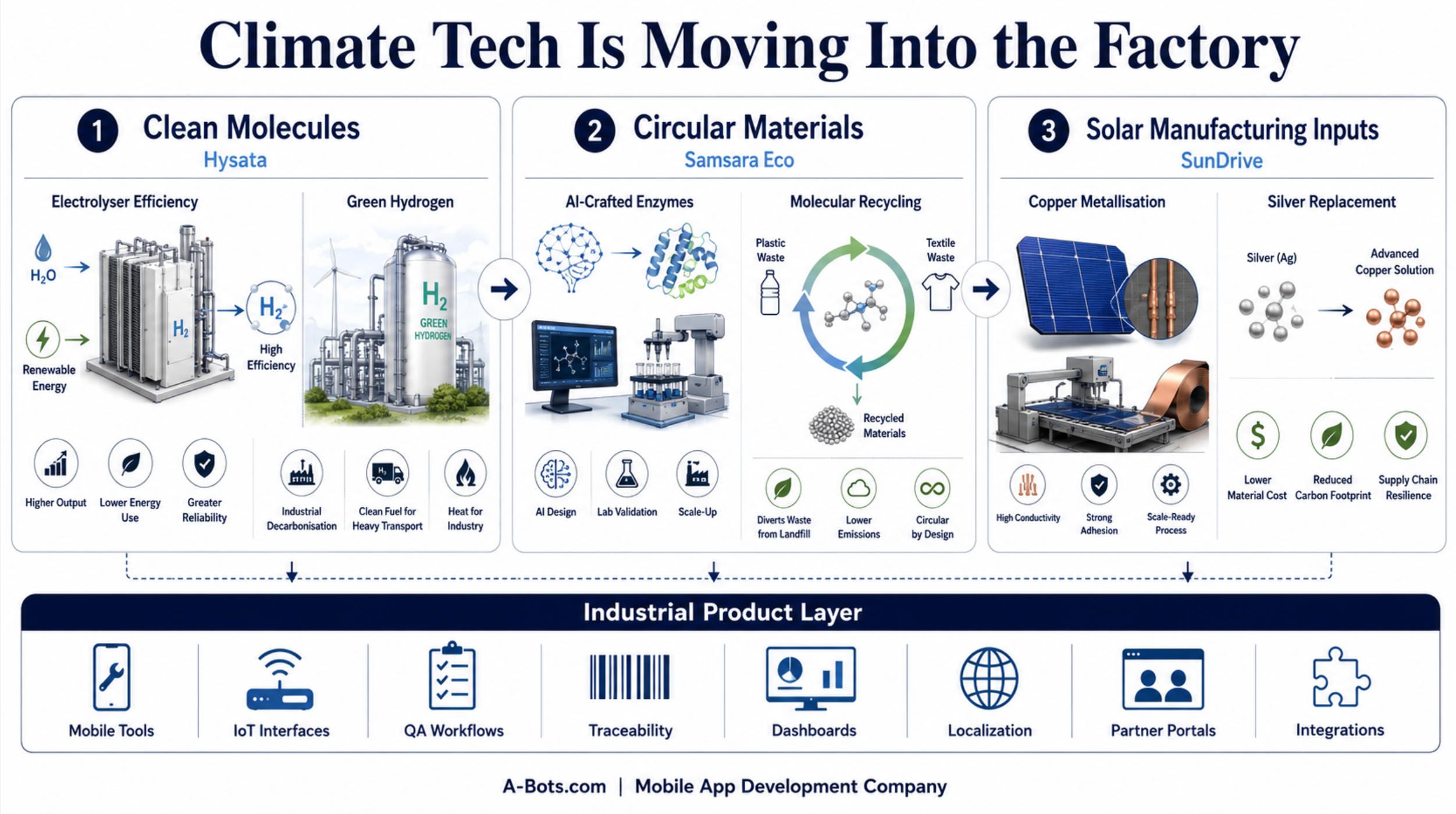
They are very different companies. Hysata is working on high-efficiency electrolysers for green hydrogen. Samsara Eco is using AI-crafted enzymes to recycle plastics and textiles back to their molecular building blocks. SunDrive is commercialising copper-based solar cell technology to reduce reliance on silver in solar manufacturing.
But together they point to the same thesis: Australian climate tech becomes most interesting when it stops looking like sustainability reporting and starts looking like industrial substitution.
Hysata attacks the cost of clean molecules. Samsara Eco attacks the waste logic of carbon-based materials. SunDrive attacks a hidden material bottleneck inside solar manufacturing.
This is not climate tech as a spreadsheet. This is climate tech as hardware, materials and industrial decarbonisation.
Climate Tech Is Entering the Factory Phase
The first climate software wave made emissions visible. The next climate technology wave must make low-carbon production physically possible and commercially credible.
That difference is crucial. Many companies can now measure more than they can change. They can identify emissions across operations, supply chains, logistics, energy use, waste streams and purchased materials. But the hardest emissions problems are often tied to physical systems that cannot be fixed by better reporting alone.
Industrial heat, steel, chemicals, aviation fuels, shipping, cement, fertilisers, plastics, mining, textiles and long-lived infrastructure all depend on deeply embedded material and energy flows. These sectors do not decarbonise because someone creates a better slide deck. They decarbonise when cleaner technologies become reliable, affordable and deployable at scale.
That is why the climate conversation is shifting from visibility to substitution.
The world needs to substitute fossil hydrogen with green hydrogen where hydrogen is truly needed. It needs to substitute linear plastics with circular materials where materials can be recovered without permanent quality loss. It needs to substitute expensive, scarce or supply-constrained inputs in clean energy manufacturing with more abundant alternatives. It needs to substitute one-off demonstration projects with repeatable deployment. It needs to substitute climate intention with industrial execution.
This is where climate tech becomes brutally practical.
A technology may be elegant in a lab but fail in a factory. It may work at pilot scale but struggle with uptime. It may produce impressive performance but depend on materials that are too expensive or too scarce. It may reduce emissions but create a cost structure that customers will not accept. It may attract capital but fail to secure offtake. It may work technically but remain hard to certify, finance, install, operate or integrate into existing industrial processes.
In other words, industrial climate tech must pass tests that normal digital software rarely faces.
The product is not only the invention. The product is the manufacturing pathway, the operating model, the customer economics and the support infrastructure around the invention.
Hysata, Samsara Eco and SunDrive are strong examples because each company is positioned at this difficult boundary between breakthrough and scale. None of them is merely saying “climate matters.” Each is attacking a physical bottleneck that has to be changed if decarbonisation is to move from ambition to production.
Hysata: Green Hydrogen Needs Better Economics, Not Better Hype
Green hydrogen has spent years moving between optimism and scepticism. Its promise is enormous, but so are its challenges.
Hydrogen can play a role in hard-to-abate sectors where direct electrification is difficult or insufficient. It can be relevant for industrial feedstocks, chemicals, fertilisers, high-temperature processes, steel pathways, heavy transport, export energy systems and long-duration storage concepts. But the economics are unforgiving. Producing hydrogen from renewable electricity requires electrolysers, water, power, infrastructure, storage, transport, offtake agreements and safety systems. If the electricity input is expensive or inefficiently used, the entire business case weakens.
That is why Hysata is such an important Australian climate tech company.
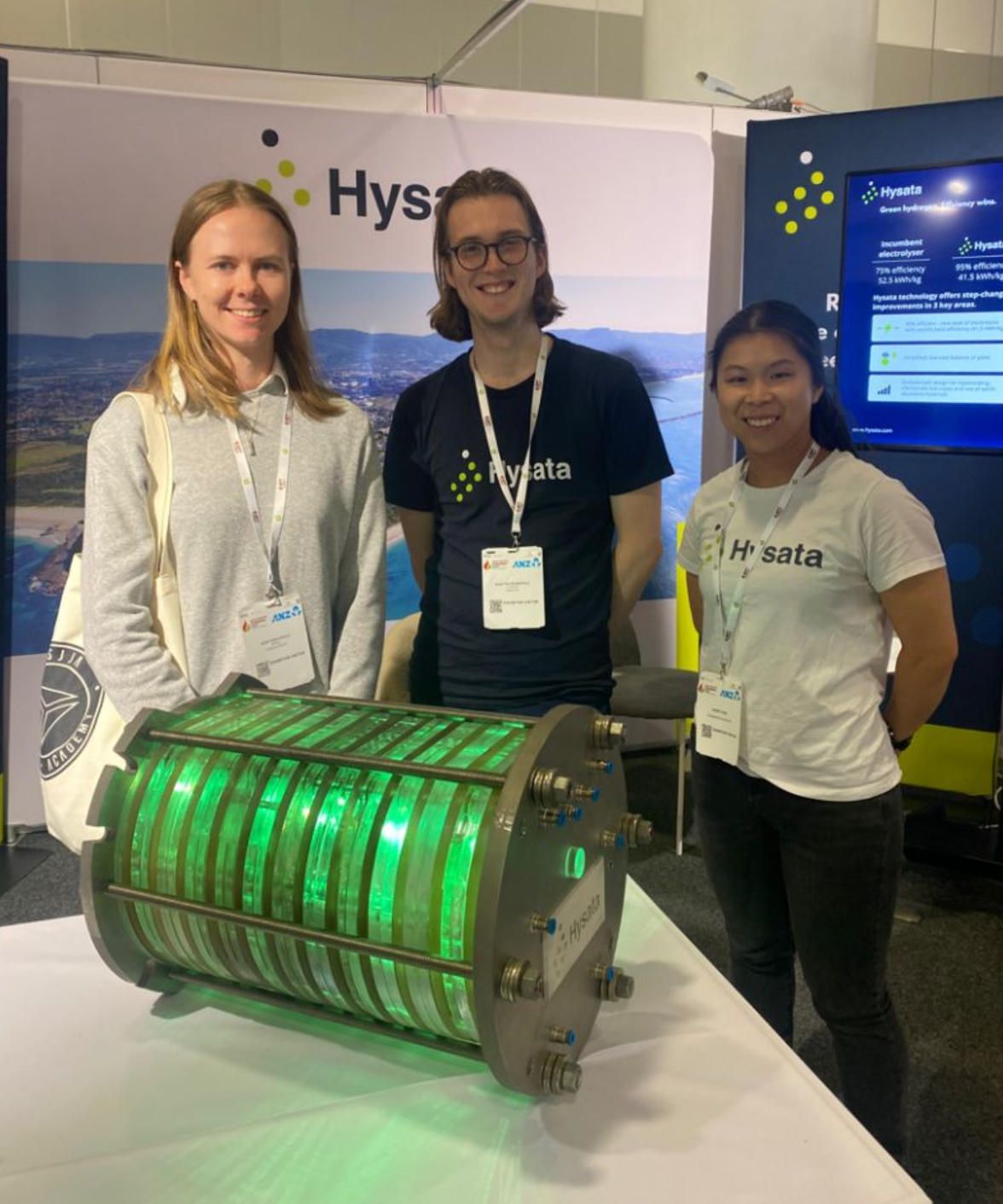
The Wollongong and Port Kembla-based electrolyser manufacturer is focused on one of the most powerful cost levers in green hydrogen: efficiency. Hysata says its capillary-fed alkaline electrolyser technology reaches 95% system efficiency, or 41.5 kWh per kilogram of hydrogen. The company’s argument is simple but consequential: electricity is the largest cost component in green hydrogen production, so wasting less electricity can change project economics.
This is not a small optimisation. If an electrolyser uses less energy to produce the same amount of hydrogen, the customer gets more output from each megawatt of renewable power. Less wasted energy can also mean less waste heat, less cooling complexity and a simpler balance of plant. In a market where many projects struggle to make the numbers work, efficiency is not a laboratory bragging point. It is a commercial weapon.
Hysata’s technology is based on capillary-fed electrolysis. The company describes the approach as combining an ultra-low resistance separator with bubble-free operation, reducing resistance inside the cell and improving efficiency. For a general business audience, the chemistry does not need to be over-explained. The important point is that Hysata is not trying to make hydrogen attractive through branding. It is trying to make hydrogen production less expensive at the system level.
That distinction matters because green hydrogen has suffered from overpromising. The sector has often been described as if demand, infrastructure and cost declines would naturally arrive together. But industrial customers do not decarbonise through enthusiasm. They need reliable equipment, bankable projects, clear offtake, predictable operating costs and technology that can be maintained in real industrial environments.
Hysata’s 2026 milestone is therefore significant. The company announced its first commercial order for a megawatt-scale electrolyser deployment, with delivery planned for the first half of 2027 to a global customer in a hard-to-abate industrial sector with secured hydrogen offtake. That type of announcement matters because it moves the company from technology validation toward commercial supply.
The difference between a pilot and a commercial order is more than a press release. It means a real customer has a real use case, a deployment timeline and enough confidence to begin adopting the technology. It also means the hard part is only beginning.
For a company like Hysata, success will depend on manufacturing scale, supplier quality, installation, commissioning, serviceability, safety systems, data monitoring, warranty confidence and customer integration. It must prove not only that the electrolyser works, but that it can become part of a repeatable industrial hydrogen production system.
That is why Hysata fits the theme of this article. It is not a climate dashboard company. It is a climate hardware company trying to change the economics of clean molecules.
The phrase “clean molecules” is important. Much of the energy transition focuses on electrons: solar, wind, batteries, transmission, grid flexibility and electrification. But many industrial processes still depend on molecules: fuels, chemicals, fertilisers, feedstocks and thermal processes. Decarbonising those sectors requires more than cheap renewable electricity. It requires technologies that can turn that electricity into usable low-carbon industrial inputs without destroying the project economics.
Hysata’s promise is not that hydrogen should be used everywhere. That would be a weak argument. The better argument is that where green hydrogen is genuinely needed, efficiency can determine whether the project becomes viable.
This is the more serious climate tech story. It does not ask whether hydrogen sounds futuristic. It asks whether an industrial customer can produce it with fewer wasted kilowatt-hours, simpler equipment and a stronger business case.
Samsara Eco: Circularity Must Return Materials to the Molecular Level
If Hysata is about clean molecules for industrial energy, Samsara Eco is about recovering molecules from waste.
Recycling is one of the most misunderstood words in climate and sustainability. For consumers, it often means putting packaging or clothing into the correct bin and hoping the material becomes useful again. For industry, the problem is much harder. Many plastics and textiles are blended, dyed, contaminated, chemically complex or mechanically degraded by conventional recycling. Even when recycling works, it often downcycles material into lower-value products with limited future life.
The deeper problem is that the modern materials economy is designed to forget.
A polyester garment, a nylon textile, a coloured bottle, a mixed plastic product or a composite material may begin life as a precise chemical formulation. But after use, the system often treats it as waste. Its molecular value is buried under colourants, additives, blends, labels, contamination, mixed streams and poor economics. The material still contains carbon and chemical structure, but the supply chain no longer knows how to use it.
Samsara Eco is trying to change that.
The company uses AI-crafted enzymes to break plastics and textiles back into their original building blocks, or monomers, so they can be recreated into new materials. Instead of treating waste as a degraded secondary input, Samsara Eco is working toward a model where waste becomes molecular feedstock for high-quality production.
This is a much stronger idea than ordinary recycling. It moves the conversation from waste management to materials manufacturing.
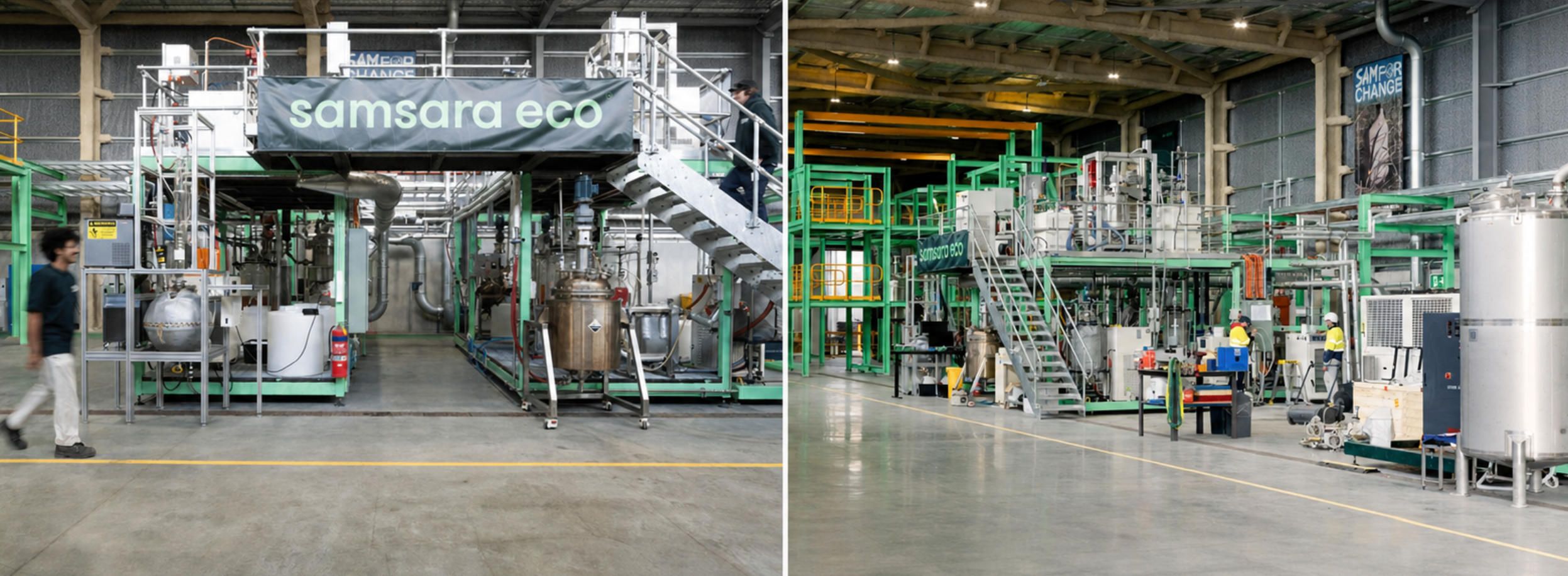
The company’s Jerrabomberra plant near Canberra is a particularly important step because it brings the technology into a more industrial setting. The plant uses AI-developed enzymes to recycle waste textiles and plastics. The process extracts nylon, polyester and PET polymers from waste textiles and plastic, then uses enzymes to break them down into monomers that can be purified and returned to polymerisation partners.
That matters because textile waste is one of the hardest visible examples of the linear economy. Fashion and apparel supply chains produce enormous volumes of synthetic fibres, often from fossil-derived inputs. Garments may contain blends, dyes and treatments that make conventional recycling difficult. Even when consumers want better circularity, the physical material system often cannot deliver it.
Samsara Eco’s work with recycled nylon and polyester shows why molecular recycling is so important. If a company can return difficult plastics to their original building blocks and create virgin-equivalent materials, it can begin to challenge the take-make-waste model at the level where it actually exists: molecules, polymers, plants, partners and supply contracts.
This is where the climate significance becomes broader than fashion.
Plastic is fossil carbon in product form. It may not be burned like fuel, but it still represents a material economy tied to fossil extraction, petrochemicals and linear consumption. If the world electrifies transport and cleans up power but continues to produce disposable carbon-based materials from virgin fossil feedstock, then a major part of the emissions and waste problem remains unresolved.
Samsara Eco’s technology is interesting because it attacks the material loop rather than the consumer guilt loop. It does not merely tell people to recycle better. It asks whether the industrial system can recover the original value of complex materials and use them again.
That is a more demanding and more useful question.
Of course, this should not be romanticised. Circular materials technologies still face difficult scale challenges. They must compete with virgin material costs, secure waste streams, manage contamination, prove process economics, build plants, partner with brands, satisfy certification requirements, and operate at industrial reliability. Enzymatic recycling is not a magic wand for every plastic category or every waste problem.
But that is exactly why Samsara Eco is a strong climate tech case. The company is operating in the hard zone where science, manufacturing, brand demand, material purity, supply-chain design and industrial economics meet.
Its use of AI is also worth understanding carefully. AI is not the climate solution by itself. The solution depends on enzymes, processes, plants and materials. AI becomes valuable because it can help design or optimise enzymes for specific plastic targets. In other words, the digital layer accelerates the biological and chemical layer.
This is an important pattern for the whole article. Climate tech in its serious phase is not “software or hardware.” It is software enabling hardware, biology, chemistry, manufacturing and operations.
Samsara Eco shows that circularity becomes real only when the material can re-enter production at quality. A recycled story is not enough. The output must be usable, consistent and economically meaningful for brands and manufacturers.
The future of circular materials will not be won by slogans about waste. It will be won by companies that can turn discarded products into reliable industrial feedstock.
SunDrive: Solar Manufacturing Has a Hidden Silver Problem
Solar power is one of the great success stories of the energy transition. Costs have fallen dramatically, deployment has accelerated globally, and solar is now central to almost every serious decarbonisation pathway.
But success creates new constraints.
As solar scales, the materials inside solar manufacturing become more important. One of those materials is silver. Silver is widely used in solar cell metallisation because it conducts electricity very well and has proven manufacturing performance. But silver is expensive, supply-constrained and increasingly exposed to demand pressure from the solar industry itself.
That creates a strange situation. One of the cheapest clean energy technologies in the world still depends on a precious metal input that may become a bottleneck as manufacturing scales.
SunDrive is attacking that problem.
The Sydney-based solar technology company is commercialising copper metallisation for solar cells, replacing silver with copper. The idea is powerful because copper is more abundant and cheaper than silver. If SunDrive can industrialise the process while maintaining or improving cell performance, the impact could be significant: lower material costs, reduced exposure to silver supply constraints, and a more scalable pathway for next-generation solar manufacturing.
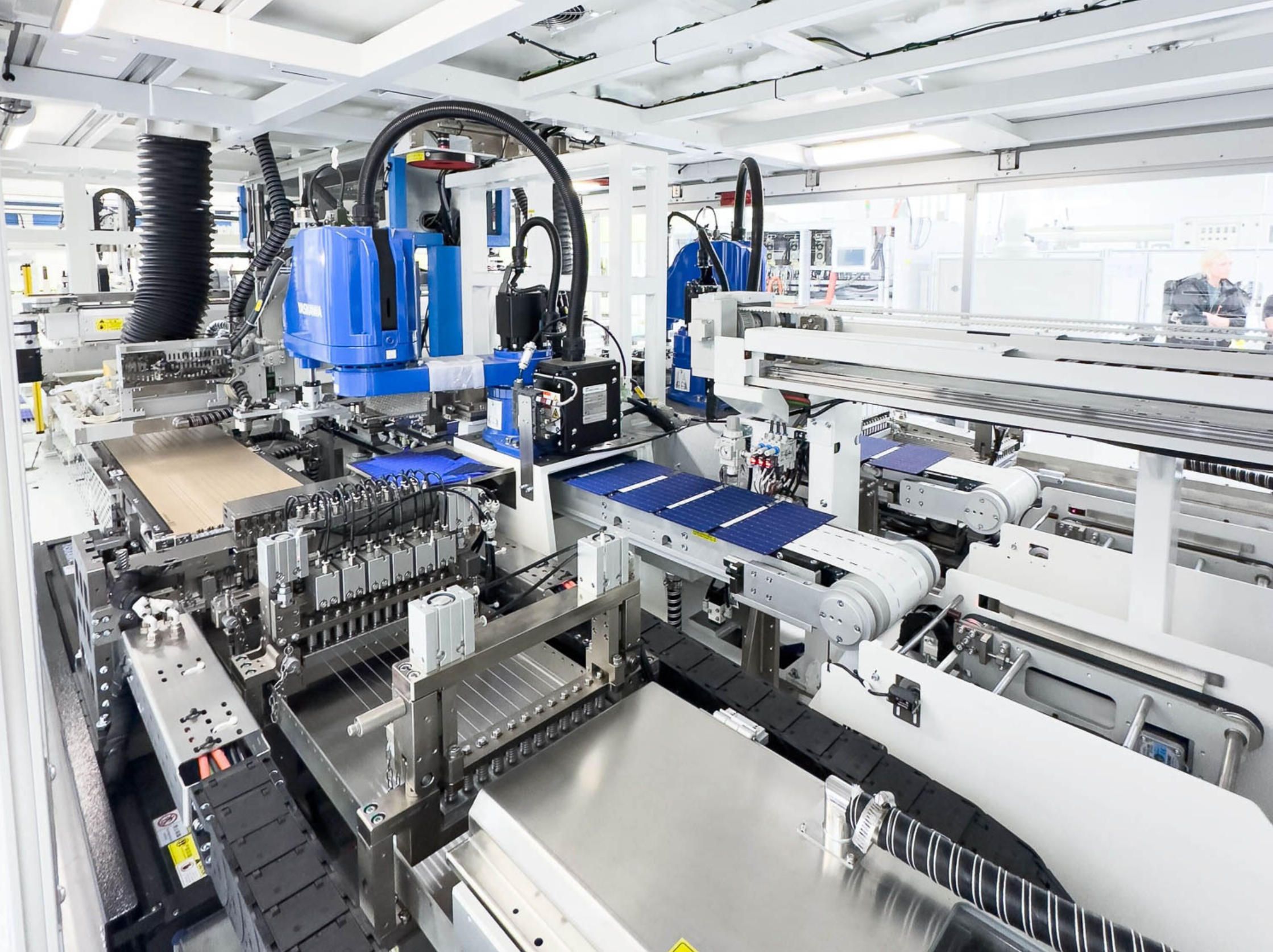
The company’s 2025 ARENA funding commitment made that industrial direction clear. ARENA committed up to A$25.3 million to support SunDrive in scaling and commercialising its copper metallisation solar cell technology. The project is intended to move from research and development at SunDrive’s Kurnell facility in New South Wales toward a 300 MW commercial-scale production tool, in collaboration with equipment manufacturing partners.
This is an important detail. The story is not simply “SunDrive has a better solar cell.” The story is that SunDrive is trying to translate breakthrough copper plating technology into industrial tools that can work in manufacturing lines.
That is the difficult middle stage where many climate technologies succeed or fail.
A solar cell efficiency record is exciting, but manufacturing adoption requires more. The process must be compatible with production equipment, quality standards, throughput requirements, yield targets, module integration, field testing, cost models and customer acceptance. A breakthrough material process must become a repeatable manufacturing process.
SunDrive’s focus on copper also reveals something broader about climate tech. Clean energy scale is not only about deploying more solar panels. It is about making the supply chain behind those panels more robust, affordable and less dependent on constrained inputs.
This is a more mature way to think about the energy transition. Early climate narratives often focused on whether clean technologies could work at all. Now the question is whether they can scale without creating new material bottlenecks. Batteries raise questions about lithium, nickel, cobalt and graphite. Wind raises questions about rare earths and steel. Solar raises questions about polysilicon, silver, manufacturing capacity and trade concentration.
SunDrive belongs in this more advanced conversation. It is not trying to prove that solar matters. That argument has already been won. It is trying to improve what solar manufacturing becomes next.
This makes the company a good example of industrial decarbonisation even though solar is often thought of as clean energy, not heavy industry. Solar panels do not appear from nowhere. They are manufactured through complex industrial processes with material inputs, equipment suppliers, production lines, QA systems, testing standards and global logistics. Reducing the cost and material constraints of those processes is part of decarbonisation.
SunDrive also fits Australia’s strategic ambitions. If Australia wants to participate more deeply in the clean energy economy, it cannot rely only on installing imported equipment or exporting raw materials. It needs technological positions in the manufacturing stack: materials, processes, equipment, IP, production know-how and international partnerships.
Copper-based solar cell technology is one possible position. It connects Australia’s research capability, clean energy ambition and industrial policy conversation in a concrete way.
Again, it is important not to overstate the case. SunDrive has not yet remade the global solar industry. It is commercialising and scaling a technology that must prove itself in industrial deployment. But that is precisely why it is relevant. The company is in the hard transition from breakthrough to manufacturing reality.
That transition is where serious climate value is created.
The Pattern: Decarbonisation Is Becoming a Materials and Manufacturing Problem
Hysata, Samsara Eco and SunDrive are not similar companies on the surface. One works on electrolysers. One works on enzymatic recycling. One works on solar cell metallisation. But they belong together because each company is trying to change the physical basis of an industrial system.
Hysata asks whether green hydrogen can become more economically credible by using electricity far more efficiently.
Samsara Eco asks whether plastics and textiles can return to their molecular building blocks instead of becoming degraded waste.
SunDrive asks whether solar manufacturing can scale with a cheaper and more abundant substitute for silver.
These are not reporting problems. They are substitution problems.
They are about replacing inefficient processes, virgin fossil feedstocks, constrained materials and fragile supply chains with better industrial alternatives. That is why this article’s central idea matters: the next climate tech frontier is not only measuring emissions, but replacing the industrial logic that produces them.
This is a more demanding climate story, but also a more useful one.
The easiest climate products to understand are often the least transformative. A dashboard is visible. A marketplace is intuitive. A consumer app is easy to explain. But the deepest emissions reductions may depend on technologies that are harder to visualise: electrolyser architecture, enzyme libraries, monomer recovery, copper plating, pilot lines, production tools, field testing, balance-of-plant simplification and supply-chain integration.
That is the nature of industrial decarbonisation. It happens inside systems most people never see.
It also explains why software still matters, even in an article focused on hardware and materials. Industrial climate tech does not eliminate the need for software. It increases it.
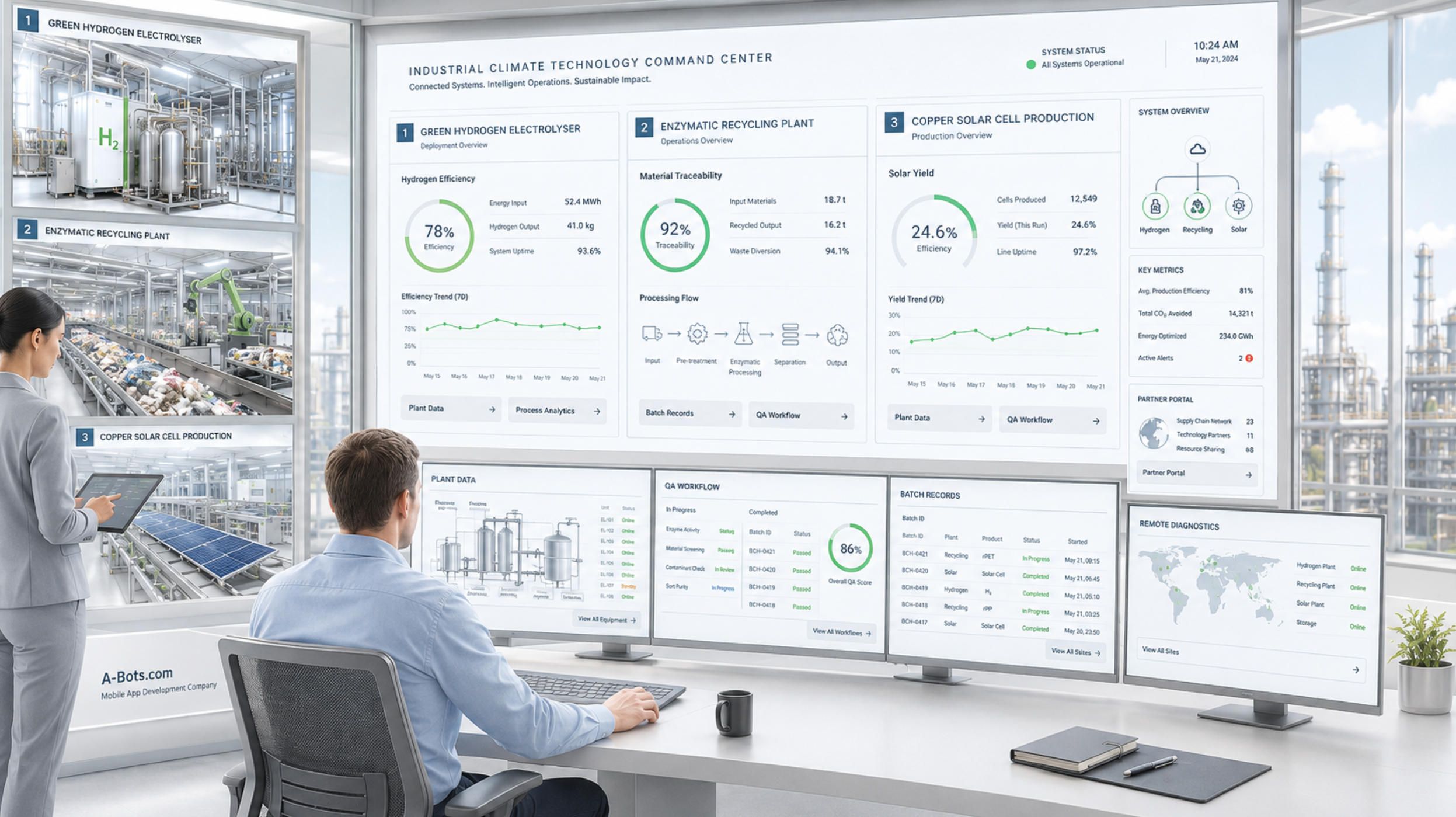
A hydrogen electrolyser deployment needs commissioning tools, performance monitoring, safety data, service workflows, remote diagnostics and customer reporting. A molecular recycling plant needs batch traceability, lab data systems, material quality records, supply-chain documentation and partner portals. A solar manufacturing technology needs equipment interfaces, yield analytics, QA workflows, production dashboards, testing records and commercial reporting.
The difference is that software is no longer the climate product by itself. It becomes the operational layer around the physical product.
That is a crucial distinction for product teams. The climate economy will need more than scientists and hardware engineers. It will need software teams that can translate complex industrial technologies into usable systems for operators, partners, customers, regulators and field teams.
The interface may not be glamorous, but it may determine adoption. A breakthrough technology that is hard to install, monitor, document, test, localise or integrate will struggle. A technology that comes with the right digital product ecosystem can move faster through pilots, customer deployments and international expansion.
In this sense, Hysata, Samsara Eco and SunDrive point toward a second software opportunity inside climate tech: the product extension layer around industrial decarbonisation.
Why Product Execution Will Decide the Next Climate Winners
Industrial climate tech does not scale like consumer software.
A consumer app can acquire users quickly, iterate weekly and test features through digital analytics. A climate hardware company must deal with procurement cycles, capex decisions, site integration, safety requirements, equipment reliability, manufacturing constraints, certification, offtake, maintenance, warranties and operational training.
This does not make climate tech less attractive. It makes product execution more important.
The winning companies will not only have clever science. They will be the companies that can convert science into deployable systems. That requires a new kind of product discipline: one that treats hardware, software, data, documentation and customer operations as parts of the same commercial system.
For Hysata, that may mean making electrolyser deployments easier to monitor, service and optimise across global industrial sites. For Samsara Eco, it may mean giving partners confidence in feedstock quality, recycled output, certification evidence and batch-level traceability. For SunDrive, it may mean connecting solar manufacturing equipment, production tools, yield data and partner workflows into a reliable industrialisation pathway.
These are not secondary details. They are part of how climate technology becomes bankable.
A customer adopting a new industrial technology needs to know not only whether it works in principle. They need to know whether it can be installed, operated, measured, maintained, audited and improved. They need data. They need interfaces. They need reports. They need QA evidence. They need training. They need service workflows. They need integration with existing systems.
That is why the software layer around industrial climate tech is not optional.
At A-Bots.com, a Mobile App Development Company, we see industrial climate tech as one of the most important product frontiers of the decade. When breakthrough technologies move from laboratory validation to factories, pilot lines and commercial deployment, they need more than core science. They need mobile tools, desktop dashboards, IoT interfaces, QA workflows, traceability systems, partner portals, localisation, documentation and integration layers.
A-Bots.com is open to collaboration with climate tech startups, industrial product teams and technology companies that need reliable engineering support to build, adapt, test or localize digital products for real operational environments.
The Australian climate tech signal in 2026 is clear. The next wave will not be defined only by who can measure emissions better. It will be defined by who can change the physical systems that create emissions in the first place.
Hysata, Samsara Eco and SunDrive show three versions of that future: cleaner molecules, circular materials and more scalable solar manufacturing.
That is where climate tech becomes serious. Not in the spreadsheet, but in the factory.
✅ Hashtags
#AustralianStartups
#ClimateTech
#ClimateTechStartups
#IndustrialDecarbonisation
#AustralianClimateTech
#Hysata
#SamsaraEco
#SunDrive
#GreenHydrogen
#CircularMaterials
#SolarManufacturing
#DeepTechStartups
#MobileAppDevelopmentCompany
Other articles
B2B Ordering App Development for Distributors and Manufacturers A B2B ordering app is not just a digital storefront. For distributors and manufacturers, it should act as a controlled ordering layer that connects customer-specific catalogs, negotiated pricing, inventory reality, approval rules, ERP data, and repeat purchasing workflows. This article explains why many sales teams become manual order desks, how self-service can reduce phone and email orders without weakening customer relationships, and why quick reorder, pricing accuracy, stock validation, product data, and ERP integration matter more than a beautiful catalog. It also explores when custom development makes sense and how A-bots.com can help build account-specific ordering workflows.
Last-Mile Delivery App Development: Driver App, POD and WMS/ERP Integration A last-mile delivery app is not just a driver tracker or route map. For retailers, distributors, pharmacies, spare parts suppliers, courier networks, and local delivery fleets, it should become a delivery execution layer that connects warehouse readiness, route dispatch, driver actions, customer notifications, proof of delivery, exceptions, and WMS/ERP synchronization. This article explains why many delivery failures are created before the driver reaches the door, how weak POD creates disputes, why customer notifications must come from real operational events, and when custom development makes more sense than forcing a standard delivery platform into a complex workflow.
Renovation Management App Development for Contractors, Site Managers, and Property Owners A custom renovation management app can turn apartment repairs, small commercial fit-outs, and property improvement projects into a transparent digital workflow. Instead of managing scope, budget, materials, approvals, photos, and rework through fragmented chats and spreadsheets, renovation teams can use one shared system for owners, site managers, and workers. This article explains how such a platform can structure trust, reduce disputes, document proof of work, control change orders, and improve project visibility. It also shows how A-bots.com can help define a detailed technical specification and develop a custom mobile and web system around real renovation operations.
Australian Breakthrough Startups 2026: Software Moves Into the Physical World Australia’s most interesting startup signal in 2026 is not another wave of ordinary SaaS. It is the rise of software built for the physical world: navigation systems that work beyond GPS, launch infrastructure for sovereign access to space, and digital twins that help utilities understand critical power networks before failure happens. This article reviews Advanced Navigation, Gilmour Space, and Neara as three breakthrough Australian startups showing how software is becoming a resilience layer for machines, infrastructure, energy systems, and high-consequence operations. For A-Bots.com, this shift opens new collaboration opportunities around mobile apps, desktop tools, IoT interfaces, QA, localization, and product adaptation.
Australian AI agent startups 2026 Australia’s AI startup scene in 2026 is not only about smarter chatbots. It is about AI agents entering real workflows where permission, compliance, auditability, privacy, and human oversight matter. This article reviews Relevance AI, Lorikeet, and Minikai as three Australian startups showing how AI is moving from conversation into governed work. Relevance AI focuses on AI workforce operations, Lorikeet brings AI concierges into complex customer support, and Minikai applies person-centred AI to disability and aged care. For A-Bots.com, this shift highlights new product opportunities around mobile apps, dashboards, QA, localization, integrations, and human-in-the-loop design.
Top stories

Copyright © Alpha Systems LTD All rights reserved.
Made with ❤️ by A-BOTS