
Home
Services
About us
Blog
Contacts
Estimate project
EN

App Controlled Outlet: TP-Link Tapo P210M vs Eve Energy Outlet — Which In-Wall Smart Outlet Wins the App Battle?

Every home has dozens of power outlets hiding in plain sight — silent, dumb, and disconnected from the digital world. But a new generation of in-wall smart outlets is quietly replacing these relics, turning ordinary wall receptacles into app controlled outlet devices that respond to your smartphone, your voice, and your daily routines. Unlike bulky smart plugs that jut out from the wall, an in-wall app controlled outlet installs flush into your existing electrical box, delivering a clean look and permanent smart functionality.
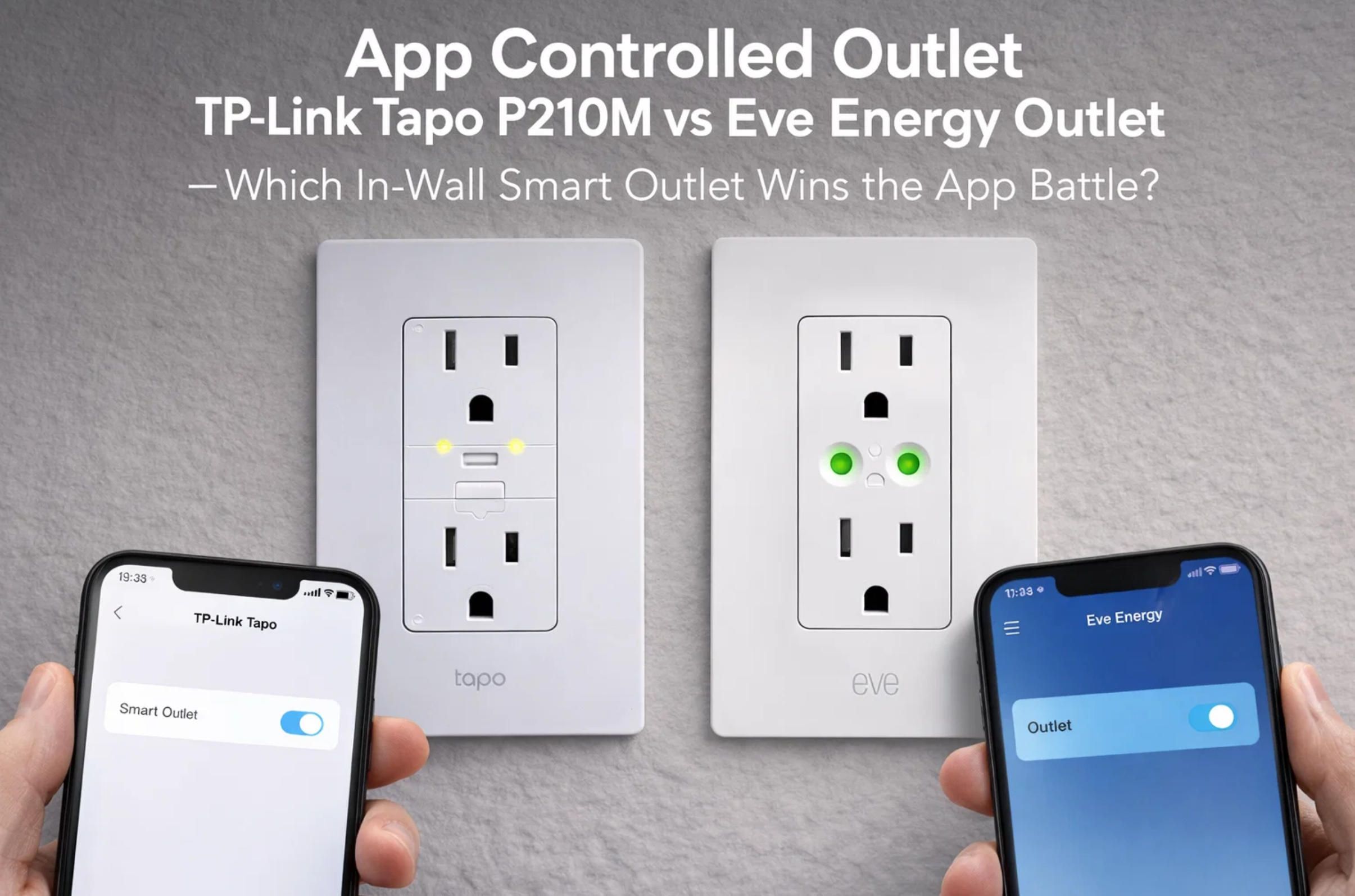
1. app controlled smart outlet.jpg

The market behind this shift is massive and accelerating. According to Consegic Business Intelligence, the global smart plug and outlet market was valued at $3.15 billion in 2024 and is projected to reach over $17 billion by 2032, growing at a compound annual growth rate of 26.4%. Mordor Intelligence forecasts the broader smart plug market to register a CAGR of 27.66% between 2025 and 2030. In the United States alone, Global Growth Insights reports that more than 29.5 million smart plug and outlet units shipped in 2024 — a number that continues to climb as homeowners demand smarter energy management tools.

At A-Bots.com, a full-cycle software development company with deep expertise in IoT mobile applications, we watch this market closely. Our team has built connected device apps using React Native, Java, Swift, Kotlin, Node.js, and Python/Django across more than 70 completed projects — including the Shark Clean robotic vacuum controller, a project that required the same real-time hardware-to-app communication that every app controlled outlet depends on. We know from experience that the companion mobile application makes or breaks the entire smart outlet experience.

This article stages a head-to-head comparison between the two most prominent in-wall app controlled outlet products available in the United States today: the TP-Link Tapo P210M and the Eve Energy Outlet. Both replace your existing wall receptacle. Both offer dual independently controlled outlets. Both support the Matter smart home standard. But they take fundamentally different approaches to connectivity, privacy, and app design — and those differences matter.

Why an In-Wall App Controlled Outlet Deserves a Closer Look

Before diving into the comparison, let us clarify what separates an in-wall app controlled outlet from a standard smart plug. A smart plug is a portable adapter that sits between your wall socket and an appliance. It works, but it adds bulk, blocks adjacent outlets, and looks distinctly like an afterthought. An in-wall app controlled outlet, on the other hand, replaces the entire outlet faceplate. It wires directly into your home's electrical system and sits flush with the wall — invisible to visitors, permanent in function, and capable of controlling two receptacles independently.

The tradeoff is installation complexity. Wiring an app controlled outlet requires turning off power at the breaker, connecting line, neutral, and ground wires, and mounting the unit into a standard electrical box. For homeowners comfortable with basic DIY or willing to hire an electrician, the result is a cleaner, more integrated smart home. As the How-To Geek review of the Tapo P210M noted, the features between in-wall outlets and smart plugs are nearly identical — the choice comes down to aesthetics, comfort with wiring, and budget.

Both contenders in our comparison are designed exclusively for the US market (120V, 15A), require a neutral wire, and carry safety certifications. Both connect to all major smart home ecosystems through Matter. And both depend heavily on their companion mobile apps for the features that transform a basic on/off switch into a genuine app controlled outlet experience.
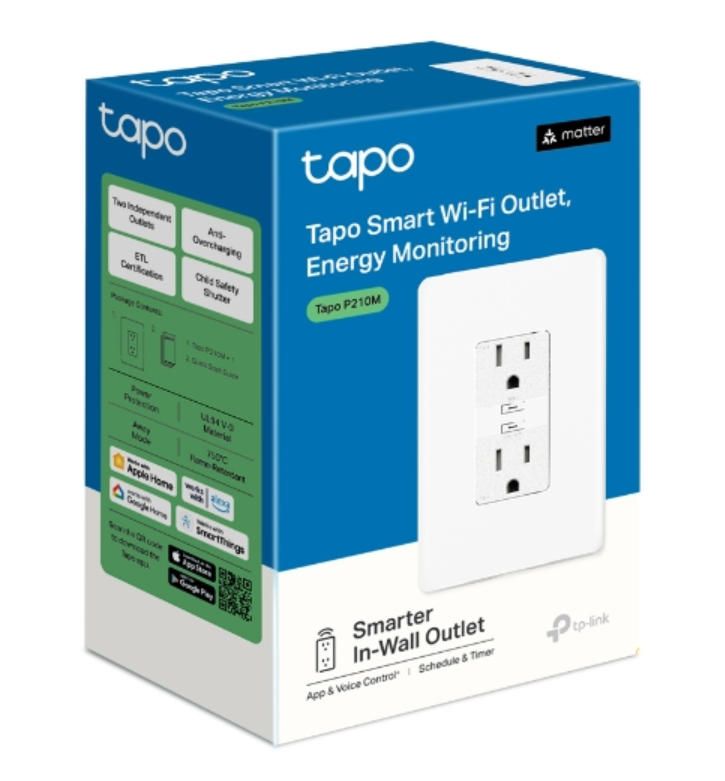
Tapo P210M smart outlet box .jpg

Contender No. 1: TP-Link Tapo P210M — The Affordable Powerhouse

The TP-Link Tapo P210M arrived in late 2024 as one of the first Matter-certified in-wall smart outlets on the market. At a retail price of $29.99 (frequently discounted to around $20), it immediately became the most affordable Matter-compatible app controlled outlet available. PCWorld, How-To Geek, and Matter Alpha all covered its launch, noting that the combination of Matter support, energy monitoring, and in-wall design at this price point had no direct competition.

Hardware at a Glance

The P210M features a standard Decora-style faceplate in white, with two independently controllable 15A receptacles. Each receptacle has its own LED-equipped button for manual on/off control directly on the device. The outlet is ETL certified and built with flame-retardant materials. TP-Link introduced a feature they call Zero-Crossing Detection technology — an industrial-grade approach to preventing relay contact welding, which the company claims extends the smart outlet's lifespan by over nine times compared to standard relays. The unit includes a screwless snap-on wall plate and requires a neutral wire for installation.
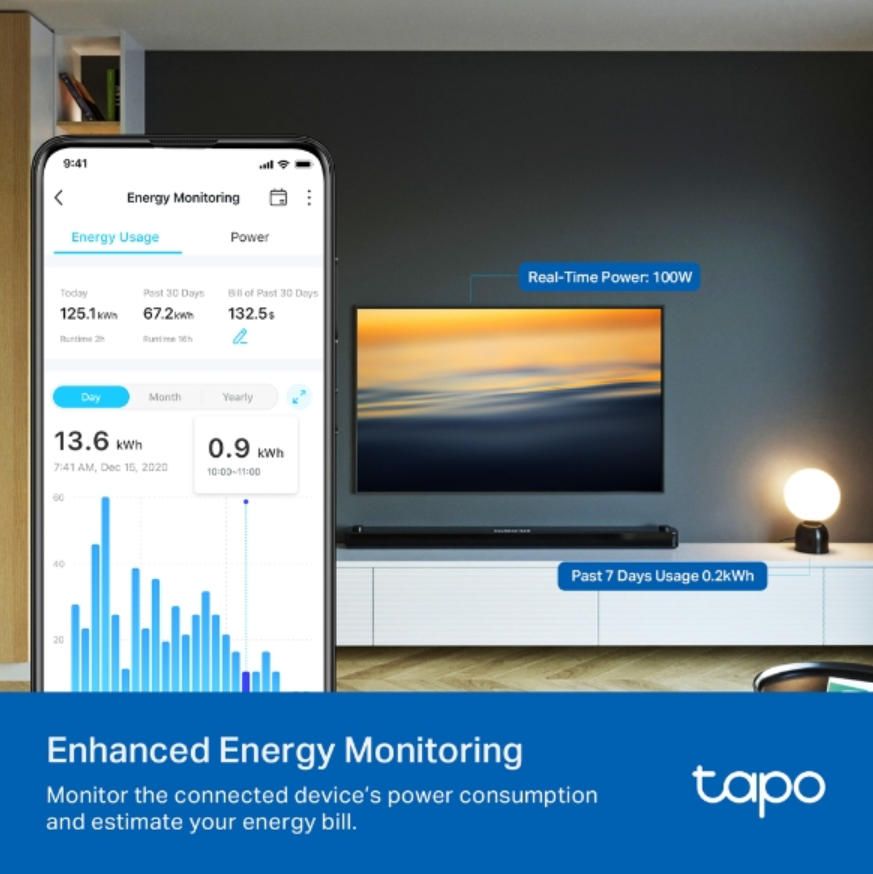
Tapo P210M App.jpg

The Tapo App: Where This App Controlled Outlet Comes Alive

The real differentiator for any app controlled outlet is its companion software, and the TP-Link Tapo app is a heavyweight in this arena. With over 34 million downloads on Android, a 4.64-star rating across 450,000 reviews, and support for 35 languages, the Tapo app is among the most widely adopted smart home platforms in the world. Tapo, the TP-Link Systems smart home brand, reports over 20 million active users globally.

Setting up the P210M through the Tapo app follows a guided workflow: after physical installation and restoring power at the breaker, you open the app, which auto-detects the new device on your local network and walks you through Wi-Fi pairing via 2.4GHz. The process can also be initiated through Matter by scanning the QR code included in the packaging. How-To Geek's reviewer noted that the Tapo app automatically detected the outlet upon opening — a convenient touch that reduces setup friction.

Once connected, the Tapo app unlocks the full feature set of this app controlled outlet. The energy monitoring dashboard displays real-time power consumption with daily, monthly, and annual charts. Users can enter their local electricity rate to generate cost estimates, helping identify power-hungry appliances. The app offers flexible billing options and recommends scheduling power-intensive devices during off-peak hours.

The scheduling engine allows users to set specific on/off times for each receptacle independently. The Away Mode randomly toggles connected devices to simulate occupancy — a security feature useful for travelers. Smart Actions chain the P210M with other Tapo devices (switches, bulbs, sensors) into automated sequences triggered by custom conditions like time of day, location, or sensor activity. The overcharge prevention feature automatically cuts power when a connected device reaches full charge — practical for phone or laptop charging stations.

Local control is another strength. Even when your home internet goes down, the Tapo app can still communicate with the P210M over your local area network, ensuring that this app controlled outlet remains functional during outages.
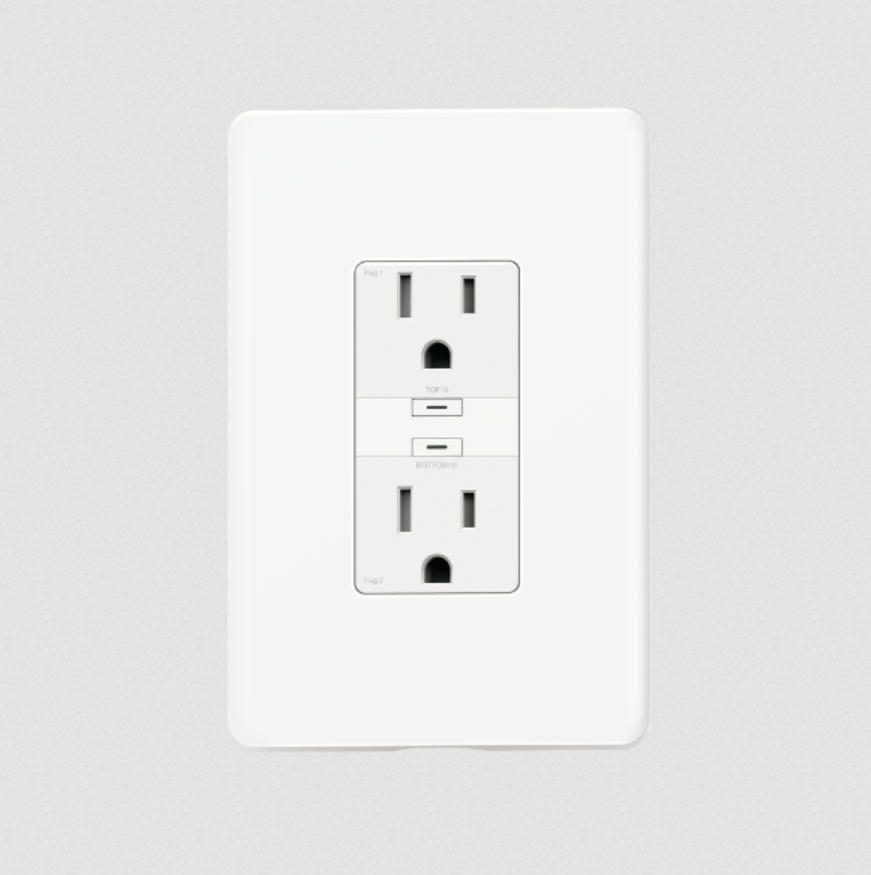
app controlled smart outlet Tapo P210M.jpg

Platform Integration

Through Matter, the P210M works with Amazon Alexa, Apple HomeKit, Google Home, and Samsung SmartThings. Basic on/off control and automation are available across all platforms. However, energy monitoring data and advanced scheduling features remain exclusive to the Tapo app — a common limitation of current Matter implementations that has not yet standardized energy reporting across ecosystems.

Where the Tapo P210M Falls Short

The P210M connects via 2.4GHz Wi-Fi, which means it adds another device to your home network — a consideration for households with many IoT devices. The app requires a TP-Link account for full functionality, introducing a cloud dependency that privacy-conscious users may not appreciate. Some users have reported that the Tapo app can feel cluttered because it manages cameras, doorbells, and other devices alongside smart outlets, creating a busy interface for those who only want their app controlled outlet features front and center.
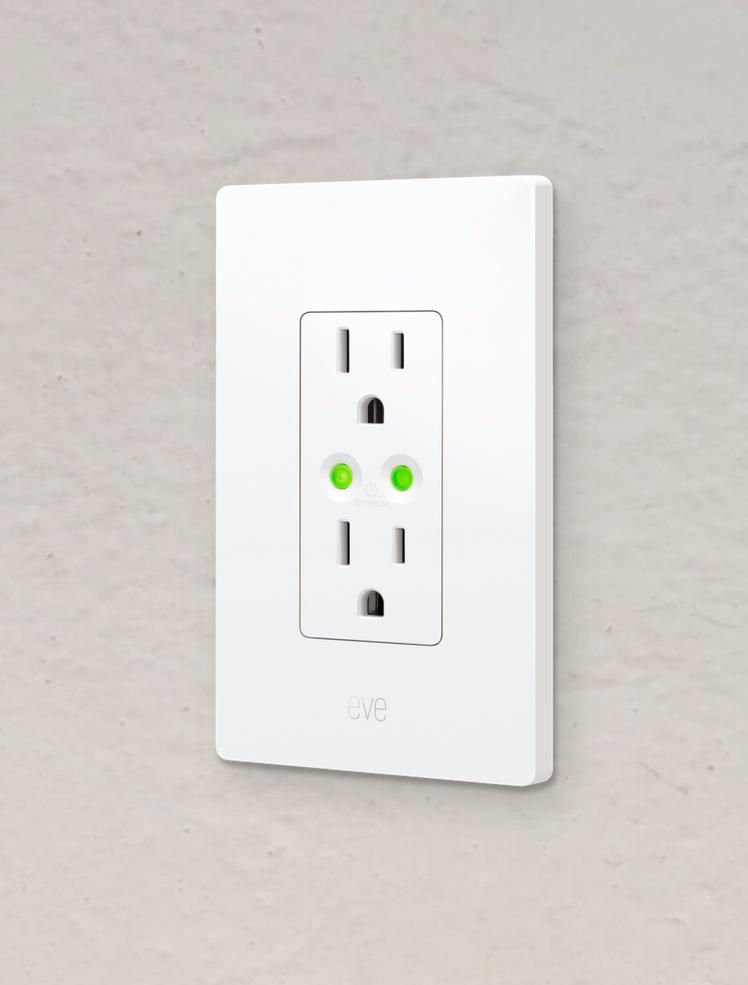
smart outlet Eve Energy.jpg

Contender No. 2: Eve Energy Outlet — The Privacy Champion

Eve Systems, a German smart home company founded in 2014 and acquired by Swiss technology conglomerate ABB in 2023, takes a radically different approach to the app controlled outlet concept. Where TP-Link optimizes for affordability and ecosystem breadth, Eve optimizes for privacy, build quality, and local-first architecture. The Eve Energy Outlet retails at $49.99 — nearly double the Tapo P210M's street price — but offers features that justify the premium for a specific type of buyer.

Hardware at a Glance

Like the P210M, the Eve Energy Outlet features a Decora-style design with two independently controllable 15A receptacles. Each outlet has a recessed LED indicator that doubles as a physical toggle button. The outlet is UL certified and measures 2.93 x 4.7 x 1.7 inches — thicker than a standard dumb outlet but designed to fit standard electrical boxes. Eve includes mounting hardware, wire nuts, a screwless wall plate, and a getting-started guide. Bob Vila's reviewer noted that installation was manageable as a DIY project even for non-electricians, with the help of a YouTube tutorial from Eve.

What sets the hardware apart is Thread connectivity. Instead of Wi-Fi, the Eve Energy Outlet communicates over Thread — a low-power mesh networking protocol designed specifically for smart home devices. Because it is hardwired and always powered, the outlet acts as a Thread router, actively strengthening the mesh network for other Thread devices in your home. More Eve outlets mean a more robust and responsive smart home network.
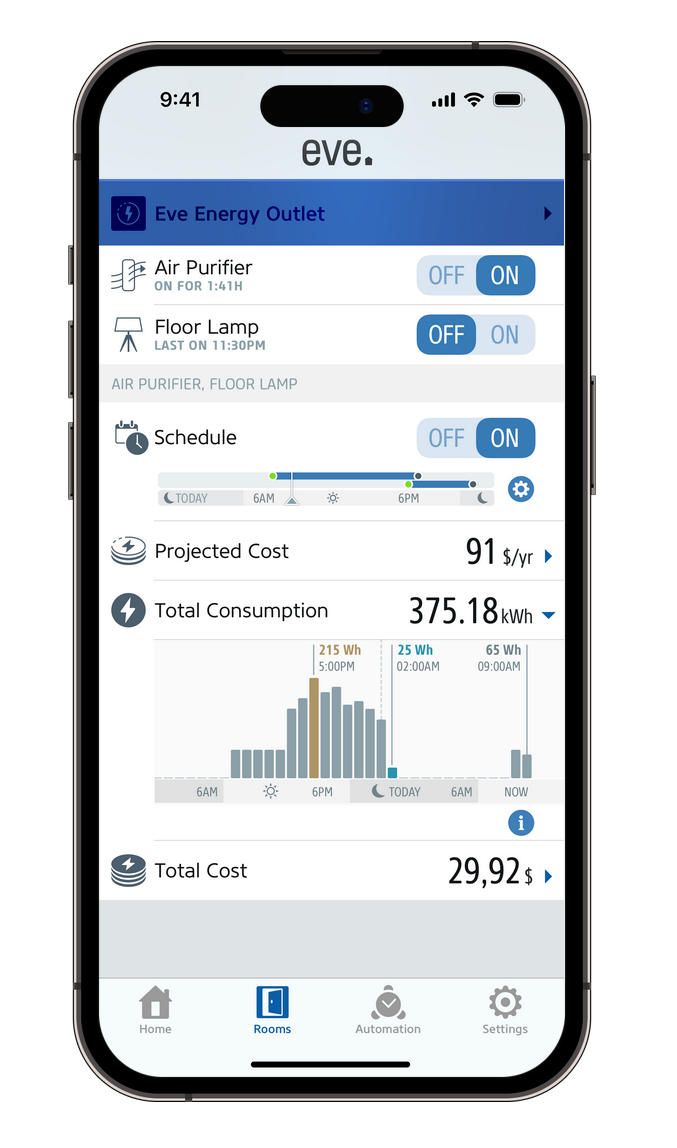
Eve app for iPhone.jpg

The Eve App: Where This App Controlled Outlet Prioritizes Privacy

The Eve app represents perhaps the most distinctive companion application in the app controlled outlet market. Its core philosophy can be summarized in three words that appear prominently on Eve's product pages: no cloud, no registration, no tracking.

Unlike the Tapo app, the Eve app does not require you to create an account. There is no Eve cloud service. All communication between the app and the outlet happens locally through your Thread network. Your energy consumption data, usage patterns, and scheduling rules never leave your home. For privacy-conscious consumers — and for the growing segment of buyers who are wary of yet another company collecting their household data — this is a powerful differentiator.

Setting up the Eve Energy Outlet is straightforward. After physical installation, you scan the Matter QR code (located inside the wall plate) using the Eve app on iOS, or through your preferred platform's app. Matter Alpha's reviewer reported that the pairing process took just minutes, and the outlet appeared immediately in Apple Home after scanning. Multi-Admin pairing with Google Home and Alexa was also successful, requiring only a copied pairing code.

The energy monitoring features in the Eve app deserve special attention. This is where the app controlled outlet truly demonstrates expert-level functionality. The app provides real-time power consumption readings, historical usage data broken down by hour, day, week, and month, cost projections based on user-entered electricity rates, and exportable usage logs for detailed analysis. Bob Vila's reviewer used the Eve Energy Outlet to monitor a high-performance desktop PC and discovered it was consuming approximately 1,700 kWh per year — translating to over $300 annually. That kind of visibility can drive real behavioral changes in energy consumption.

The Eve app also supports autonomous schedules — up to 15 programmed events per day that are stored directly on the outlet hardware. These schedules execute independently of your iPhone, your internet connection, and even your Thread border router. If everything else in your smart home goes offline, the schedules on this app controlled outlet continue running. This is a significant reliability advantage over cloud-dependent alternatives.

Additional app features include a child lock that disables the physical buttons on the device (preventing curious toddlers from toggling outlets), adjustable LED brightness (useful for bedroom installations where light pollution matters), and the ability to view Thread network diagnostics.

Platform Integration

Through Matter over Thread, the Eve Energy Outlet works with Apple Home, Amazon Alexa, Google Home, and Samsung SmartThings. Matter Alpha confirmed successful multi-admin operation across Apple Home, Google Home, and Alexa simultaneously. However, the advanced energy monitoring features are currently available only through the Eve app on iOS. Android users can control the outlet through their platform's native app, but will not have access to the detailed energy dashboards until Eve releases an Android version of their app or until Matter's energy monitoring clusters become widely adopted.

Where the Eve Energy Outlet Falls Short

Price is the most obvious barrier. At $49.99, the Eve Energy Outlet costs approximately 2.5 times more than the discounted Tapo P210M. This gap widens quickly when outfitting multiple rooms. The requirement for a Thread border router (such as a HomePod mini, Apple TV 4K, Amazon Echo 4th gen, or Google Nest Hub 2nd gen) adds an additional dependency that Wi-Fi-based outlets avoid. And while the Eve app is polished and privacy-respecting, it can sometimes be slow to respond, as some reviewers have noted.

Energy monitoring on this app controlled outlet measures the combined consumption of both receptacles rather than each one individually — a limitation that the Tapo P210M shares. Neither outlet currently supports energy-based automation triggers (such as "turn off when power consumption drops below 5 watts"), which would be transformative for monitoring washing machines, dryers, or chargers.

Head-to-Head: The App Controlled Outlet Comparison That Matters

Let us now compare these two app controlled outlet products across the dimensions that most impact everyday users.

App Ecosystem Scale

The Tapo app's 34 million downloads and 35-language support dwarf the Eve app's smaller but devoted user base. For users who want a single app to manage an entire smart home ecosystem spanning cameras, doorbells, light switches, and outlets, Tapo offers unmatched breadth. The Eve app provides a more focused, privacy-first experience that appeals to users who value data sovereignty over ecosystem scale.

Energy Monitoring Depth

Both outlets track energy consumption and project costs based on user-entered rates. When evaluating each app controlled outlet on monitoring depth, the Eve app presents this data through more detailed historical graphs and exportable logs, while the Tapo app provides cleaner daily/monthly/annual charts with built-in cost optimization recommendations. For serious energy auditing, the Eve app currently offers greater depth. For casual monitoring of an app controlled outlet, the Tapo app is more than sufficient.

Privacy Architecture

This is the starkest difference between these two app controlled outlet devices. The Eve Energy Outlet operates with zero cloud dependency — no account required, no data leaves your home, no tracking. The Tapo P210M requires a TP-Link account and communicates through TP-Link's cloud infrastructure for remote access and advanced features. For users who prioritize privacy, the Eve outlet is the clear winner. For users who prioritize convenience and do not mind cloud connectivity, the Tapo app controlled outlet performs admirably.

Network Impact

The Tapo P210M uses 2.4GHz Wi-Fi, adding to your router's device count. The Eve Energy Outlet uses Thread, which operates on a separate mesh network and actually strengthens network coverage by acting as a router node. In homes with dozens of smart devices already competing for Wi-Fi bandwidth, the Eve app controlled outlet's Thread connectivity offers a meaningful advantage.

Setup Experience

Both outlets require identical physical wiring work. For the app-based setup of each app controlled outlet, the Tapo P210M wins on accessibility: it auto-detects in the Tapo app and pairs quickly via Wi-Fi. The Eve Energy Outlet requires a Thread border router to be present and configured, adding a prerequisite that new smart home users may not have in place. Once that infrastructure exists, however, Eve's setup is equally smooth.

Value Proposition

At $20-30, the Tapo P210M is the value leader by a wide margin for any app controlled outlet buyer. It offers Matter, energy monitoring, Smart Actions, Away Mode, overcharge prevention, and local LAN control at a price point that makes whole-home deployment realistic. The Eve Energy Outlet commands nearly double the price but delivers Thread mesh networking, cloud-free privacy, autonomous on-device schedules, and premium build quality from a German engineering pedigree now backed by ABB.

What This Comparison Reveals for Outlet Manufacturers

The TP-Link Tapo P210M and Eve Energy Outlet represent two poles of app controlled outlet design philosophy. One prioritizes accessibility, price, and ecosystem scale. The other prioritizes privacy, local processing, and premium engineering. Both succeed because their companion apps deliver genuine value beyond simple on/off toggling.

For hardware manufacturers exploring the app controlled outlet space, several lessons emerge from this comparison.

The companion app is the product. Consumers do not buy an in-wall outlet for its relay switches or wiring terminals. They buy it for the scheduling, automation, energy monitoring, and voice control that the app controlled outlet delivers through its companion software. The hardware enables; the software differentiates.

Matter has become table stakes. Both leading app controlled outlet products in this comparison support Matter. Any new entrant without Matter certification faces an immediate credibility gap with informed consumers who expect cross-platform compatibility.

Energy monitoring is a retention driver. Users who see their energy consumption data develop habits around the app. They check it regularly, adjust schedules, and compare months. This engagement translates into brand loyalty and positive app store reviews.

Privacy is a premium feature. Eve proves that consumers will pay 2x more for an app controlled outlet that respects their data. As privacy regulations tighten globally and consumer awareness grows, this segment will only expand.

Setup friction kills reviews. The first five minutes a consumer spends with a new app controlled outlet determine the tone of app store reviews. Auto-detection, guided pairing, and clear visual feedback during setup are engineering investments that pay dividends in customer satisfaction.

Building the App Behind Your App Controlled Outlet

Whether you are a hardware startup designing your first app controlled outlet or an established electrical manufacturer adding smart capabilities to your product line, the companion application is the most complex and consequential piece of the puzzle.

A competitive app controlled outlet companion app in 2026 requires cross-platform mobile development for iOS and Android (using React Native for efficiency or native Swift/Kotlin for maximum performance), a scalable cloud backend or local-first architecture using Node.js or Python/Django, real-time device communication protocols optimized for low latency, Matter and Thread SDK integration for cross-ecosystem compatibility, energy monitoring dashboards with historical data visualization and cost projection, scheduling engines supporting autonomous on-device execution, comprehensive security with encrypted communication and optional zero-cloud architecture, and localization for international markets.

At A-Bots.com, we have built exactly these kinds of connected device applications across our portfolio of 70+ projects. Our experience with the Shark Clean IoT app — which demanded real-time communication between mobile devices and robotic hardware, intuitive scheduling interfaces, and reliable cloud synchronization — directly maps to the challenges of building a world-class app controlled outlet companion app. Our technology stack includes React Native, Swift, Kotlin, Java, Node.js, Python/Django, and React JS, giving us the flexibility to match the right tools to each project's requirements.

Beyond development, we offer specialized QA and testing services for IoT products. An app controlled outlet must perform reliably across hundreds of Wi-Fi router configurations, multiple Thread border routers, four major smart home platforms, and countless smartphone models. Our testing team validates across real device environments — not just simulators — because connected hardware lives in the real world, and it needs to be tested there.

The Road Ahead for the App Controlled Outlet Market

The in-wall app controlled outlet category is still in its early stages. Only a handful of Matter-certified options exist today, and the two products in this comparison represent the current state of the art. But the trajectory is clear.

AI-powered energy optimization will transform how these outlets function. Imagine an app controlled outlet that learns your appliance usage patterns and automatically shifts power-hungry devices to off-peak hours without requiring manual schedule configuration. The infrastructure for this capability is already emerging — Tata Power's 2023 partnership with AutoGrid to deploy AI-enabled smart energy management systems demonstrates that utility-level AI is moving toward the consumer edge.

Matter's evolving energy monitoring clusters (introduced in Matter 1.3) will eventually standardize how energy data flows across platforms. When this happens, the current limitation where energy monitoring is locked to vendor-specific apps will dissolve, making every app controlled outlet more useful regardless of the user's chosen ecosystem.

Thread adoption will accelerate as more border routers ship in everyday devices. Apple, Google, Amazon, and Samsung all include Thread border routers in their latest smart speakers and displays. As the installed base of border routers grows, Thread-based app controlled outlet devices like the Eve Energy Outlet will become easier to deploy and increasingly attractive compared to Wi-Fi alternatives that strain home networks.

Which App Controlled Outlet Should You Choose?

If you want the best value, broadest ecosystem support, and the easiest path to smart energy management, the TP-Link Tapo P210M is the app controlled outlet to buy. Its Tapo app delivers a feature-rich experience at a price point that makes deploying smart outlets across an entire home financially realistic.

If you prioritize privacy, premium build quality, and a network architecture that strengthens rather than strains your home infrastructure, the Eve Energy Outlet is the app controlled outlet worth its premium. Its cloud-free operation and Thread mesh networking represent the future of responsible smart home design.

Both products prove the same fundamental truth: in the app controlled outlet market, the app is the product. The wall outlet is simply the hardware that makes the app useful.

For manufacturers ready to build the next generation of app controlled outlet companion applications, the team at A-Bots.com combines deep IoT development expertise with a proven technology stack and rigorous QA methodology. From initial concept to app store launch, we help hardware companies create the software experiences that turn ordinary outlets into extraordinary products. Contact us at info@a-bots.com to start the conversation.

✅ Hashtags

#AppControlledOutlet
#SmartOutlet
#InWallSmartOutlet
#TapoP210M
#EveEnergyOutlet
#SmartHomeAutomation
#MatterSmartHome
#IoTAppDevelopment

Other articles

App for Window Cleaning Company | Custom Software Guide for New York 2026 Managing a window cleaning company requires coordinating field crews, tracking safety certifications, handling client relationships, and processing payments across dozens of job sites every week. This guide explores every essential feature of a purpose-built app for window cleaning company operations, from CRM and smart scheduling to OSHA compliance tracking and AI-powered route optimization. Using real market data from Fortune Business Insights and MarketsandMarkets, alongside a detailed look at how established NYC operator Big Apple Window Cleaning manages complex high-rise operations, the article demonstrates why custom software built by A-Bots.com outperforms generic off-the-shelf field service tools.

App for Dentist: Custom Dental Practice Software Guide 2026 Dental practices in 2026 face mounting operational challenges — staffing shortages, rising no-show rates, insurance claim denials, and growing patient expectations for digital convenience. A purpose-built app for dentist addresses these pain points by automating appointment scheduling, sending multi-channel reminders, streamlining billing, and integrating AI-powered diagnostics. The global dental practice management software market is projected to exceed USD 6.7 billion by 2033, reflecting rapid adoption across solo clinics, multi-provider practices, and dental support organizations. This guide covers essential features, market trends, AI capabilities, and the advantages of choosing custom development with A-Bots.com over generic off-the-shelf platforms.

How to Build a WhatsApp Clone App in 2026 and WhatsApp Clone review The instant messaging market is projected to exceed USD 70 billion by 2034, and demand for custom communication platforms continues to accelerate. This guide covers everything businesses need to know about building a WhatsApp clone app: from core features like end-to-end encryption, real-time messaging, and voice/video calling to the full technology stack powering modern messenger app development. The article reviews six emerging messenger platforms — Bitchat, Session, SimpleX Chat, Element, Threema, and Olvid — analyzing their architecture, privacy models, and market traction. It also details how A-Bots.com, a full-cycle development company with 70+ projects, handles messenger development from strategy through launch, scaling, and QA testing. Cost estimates, common mistakes, monetization strategies, and industry-specific use cases round out the guide.

Dyson WashG1 vs Tineco Floor One S7 Pro Dyson WashG1 and Tineco Floor One S7 Pro may target the same category, but they reflect two different product strategies. This article compares their cleaning hardware, usability, maintenance logic, and mobile app experience to show how premium wet floor cleaners are evolving. Beyond the buying decision, it also explores a bigger market trend: why companion software is becoming a serious competitive advantage in smart home appliances. For brands entering this segment, the comparison highlights what today’s floor washers do well - and what a custom app developed by A-Bots.com could do better.

App Controlled Scent Diffuser: Top 3 Reviewed Pura, AromaTech, Aera The app controlled scent diffuser market is booming, with the global aromatherapy diffuser industry valued at $1.72 billion in 2025 and growing at over 7% annually. This expert review compares the three leading smart fragrance systems — Pura, AromaTech, and Aera — analyzing their companion apps, connectivity approaches, and real user feedback. The article breaks down essential features every app controlled scent diffuser needs, from scheduling and intensity control to smart home integration and OTA firmware updates. Manufacturers looking to build or improve their own connected diffuser product will find a clear roadmap for custom IoT app development with A-Bots.com.

Top stories

  • food delivery app development

    food ordering startups

    custom food ordering app

    food delivery startups

    Food Delivery and Food Ordering Mobile App Development

    A-Bots.com offers custom food delivery and food ordering mobile app development for startups and restaurants. From UI/UX to testing, we build scalable apps with real-time tracking, secure payments, and AI personalization.

  • apple watch for seniors

    iOS app development company

    apple watch healthcare apps

    watchOS app development

    senior apple watch app

    Apple Watch for Seniors: Custom Apps and Elder-Care Solutions

    Explore how Apple Watch for seniors transforms elder care. Learn how custom watchOS and iOS app development improves safety, health, and independence.

  • unitree G1 programming

    custom software for unitree G1

    humanoid robot

    unitree G1 control

    unitree G1 SDK

    Custom Unitree G1 Programming and Unitree G1 SDK App Development

    Bespoke Unitree G1 programming, SDK integrations and app development. A-Bots.com creates custom robotics software for advanced humanoid solutions.

  • drones show app development company

    app development for swarm of drones

    software development for drones show

    IoT app development company

    Swarm of Drones and Drones Show Software Development Company

    A-Bots.com is a drones show app development company delivering app development for swarm of drones: orchestration servers, ArduPilot Mission Planner workflows, operator-grade mobile apps, safety-first timing, and scalable IoT integrations.

  • farmer app development company

    agritech app development company

    bespoke agriculture application development

    agriculture app development company

    bespoke agro apps

    Farmer App Development Company - Smart Farming Apps and Integrations

    A-Bots.com - farmer app development company for offline-first smart farming apps. We integrate John Deere, FieldView & Trimble to deliver the best farmer apps and compliant farming applications in the US, Canada and EU.

  • counter-drone software

    drone detection and tracking

    LiDAR drone tracking

    AI counter drone (C-UAV)

    Counter-Drone (C-UAV) Visual Tracking and Trajectory Prediction

    Field-ready counter-drone perception: sensors, RGB-T fusion, edge AI, tracking, and short-horizon prediction - delivered as a production stack by A-Bots.com.

  • pet care application development

    custom pet-care app

    pet health app

    veterinary app integration

    litter box analytics

    Custom Pet Care App Development

    A-Bots.com is a mobile app development company delivering custom pet care app development with consent-led identity, behavior AI, offline-first routines, and seamless integrations with vets, insurers, microchips, and shelters.

  • agriculture mobile application developmen

    ISOBUS mobile integration

    smart farming mobile app

    precision farming app

    Real-Time Agronomic Insights through IoT-Driven Mobile Analytics

    Learn how edge-AI, cloud pipelines and mobile UX transform raw farm telemetry into real-time, actionable maps—powered by A-Bots.com’s agriculture mobile application development expertise.

  • ge predix platform

    industrial iot platform

    custom iot app development

    industrial iot solutions

    industrial edge analytics

    predictive maintenance software

    GE Predix Platform and Industrial IoT App Development

    Discover how GE Predix Platform and custom apps from A-Bots.com enable real-time analytics, asset performance management, and scalable industrial IoT solutions.

  • industrial iot solutions

    industrial iot development

    industrial edge computing

    iot app development

    Industrial IoT Solutions at Scale: Secure Edge-to-Cloud with A-Bots.com

    Discover how A-Bots.com engineers secure, zero-trust industrial IoT solutions— from rugged edge gateways to cloud analytics— unlocking real-time efficiency, uptime and compliance.

  • eBike App Development Company

    custom ebike app development

    ebike IoT development

    ebike OEM app solution

    ebike mobile app

    Sensor-Fusion eBike App Development Company

    Unlock next-gen riding experiences with A-Bots.com: a sensor-centric eBike app development company delivering adaptive pedal-assist, predictive maintenance and cloud dashboards for global OEMs.

  • pet care app development company

    pet hotel CRM

    pet hotel IoT

    pet hotel app

    Pet Hotel App Development

    Discover how A-Bots.com, a leading pet care app development company, builds full-stack mobile and CRM solutions that automate booking, feeding, video, and revenue for modern pet hotels.

  • DoorDash drone delivery

    Wing drone partnership

    drone delivery service

    build drone delivery app

    drone delivery software development

    Explore Wing’s and DoorDash drone delivery

    From sub-15-minute drops to FAA-grade safety, we unpack DoorDash’s drone playbook—and show why software, not rotors, will decide who owns the sky.

  • drone mapping software

    adaptive sensor-fusion mapping

    custom drone mapping development

    edge AI drone processing

    Drone Mapping and Sensor Fusion

    Explore today’s photogrammetry - LiDAR landscape and the new Adaptive Sensor-Fusion Mapping method- see how A-Bots.com turns flight data into live, gap-free maps.

  • Otter AI transcription

    Otter voice meeting notes

    Otter audio to text

    Otter voice to text

    voice to text AI

    Otter.ai Transcription and Voice Notes

    Deep guide to Otter.ai transcription, voice meeting notes, and audio to text. Best practices, automation, integration, and how A-Bots.com can build your custom AI.

  • How to use Wiz AI

    Wiz AI voice campaign

    Wiz AI CRM integration

    Smart trigger chatbot Wiz AI

    Wiz AI Chat Bot: Hands-On Guide to Voice Automation

    Master the Wiz AI chat bot: from setup to smart triggers, multilingual flows, and human-sounding voice UX. Expert guide for CX teams and product owners.

  • Tome AI Review

    Enterprise AI

    CRM

    Tome AI Deep Dive Review

    Explore Tome AI’s architecture, workflows and EU-ready compliance. Learn how generative decks cut prep time, boost sales velocity and where A-Bots.com adds AI chatbot value.

  • Wiz.ai

    Voice Conversational AI

    Voice AI

    Inside Wiz.ai: Voice-First Conversational AI in SEA

    Explore Wiz.ai’s rise from Singapore startup to regional heavyweight, its voice-first tech stack, KPIs, and lessons shaping next-gen conversational AI.

  • TheLevel.AI

    CX-Intelligence Platforms

    Bespoke conversation-intelligence stacks

    Level AI

    Contact Center AI

    Beyond Level AI: How A-Bots.com Builds Custom CX-Intelligence Platforms

    Unlock Level AI’s secrets and see how A-Bots.com engineers bespoke conversation-intelligence stacks that slash QA costs, meet tight compliance rules, and elevate customer experience.

  • Offline AI Assistant

    AI App Development

    On Device LLM

    AI Without Internet

    Offline AI Assistant Guide - Build On-Device LLMs with A-Bots

    Discover why offline AI assistants beat cloud chatbots on privacy, latency and cost—and how A-Bots.com ships a 4 GB Llama-3 app to stores in 12 weeks.

  • Drone Mapping Software

    UAV Mapping Software

    Mapping Software For Drones

    Pix4Dmapper (Pix4D)

    DroneDeploy (DroneDeploy Inc.)

    DJI Terra (DJI Enterprise)

    Agisoft Metashape 1.9 (Agisoft)

    Bentley ContextCapture (Bentley Systems)

    Propeller Pioneer (Propeller Aero)

    Esri Site Scan (Esri)

    Drone Mapping Software (UAV Mapping Software): 2025 Guide

    Discover the definitive 2025 playbook for deploying drone mapping software & UAV mapping software at enterprise scale—covering mission planning, QA workflows, compliance and data governance.

  • App for DJI

    Custom app for Dji drones

    Mapping Solutions

    Custom Flight Control

    app development for dji drone

    App for DJI Drone: Custom Flight Control and Mapping Solutions

    Discover how a tailor‑made app for DJI drone turns Mini 4 Pro, Mavic 3 Enterprise and Matrice 350 RTK flights into automated, real‑time, BVLOS‑ready data workflows.

  • Chips Promo App

    Snacks Promo App

    Mobile App Development

    AR Marketing

    Snack‑to‑Stardom App: Gamified Promo for Chips and Snacks

    Learn how A‑Bots.com's gamified app turns snack fans into streamers with AR quests, guaranteed prizes and live engagement—boosting sales and first‑party data.

  • Mobile Apps for Baby Monitor

    Cry Detection

    Sleep Analytics

    Parent Tech

    AI Baby Monitor

    Custom Mobile Apps for AI Baby Monitors | Cry Detection, Sleep Analytics and Peace-of-Mind

    Turn your AI baby monitor into a trusted sleep-wellness platform. A-Bots.com builds custom mobile apps with real-time cry detection, sleep analytics, and HIPAA-ready cloud security—giving parents peace of mind and brands recurring revenue.

  • wine app

    Mobile App for Wine Cabinets

    custom wine fridge app

    Custom Mobile App Development for Smart Wine Cabinets: Elevate Your Connected Wine Experience

    Discover how custom mobile apps transform smart wine cabinets into premium, connected experiences for collectors, restaurants, and luxury brands.

  • agriculture mobile application

    farmers mobile app

    smart phone apps in agriculture

    Custom Agriculture App Development for Farmers

    Build a mobile app for your farm with A-Bots.com. Custom tools for crop, livestock, and equipment management — developed by and for modern farmers.

  • IoT

    Smart Home

    technology

    Internet of Things and the Smart Home

    Internet of Things (IoT) and the Smart Home: The Future is Here

  • IOT

    IIoT

    IAM

    AIoT

    AgriTech

    Today, the Internet of Things (IoT) is actively developing, and many solutions are already being used in various industries.

    Today, the Internet of Things (IoT) is actively developing, and many solutions are already being used in various industries.

  • IOT

    Smart Homes

    Industrial IoT

    Security and Privacy

    Healthcare and Medicine

    The Future of the Internet of Things (IoT)

    The Future of the Internet of Things (IoT)

  • IoT

    Future

    Internet of Things

    A Brief History IoT

    A Brief History of the Internet of Things (IoT)

  • Future Prospects

    IoT

    drones

    IoT and Modern Drones: Synergy of Technologies

    IoT and Modern Drones: Synergy of Technologies

  • Drones

    Artificial Intelligence

    technologi

    Inventions that Enabled the Creation of Modern Drones

    Inventions that Enabled the Creation of Modern Drones

  • Water Drones

    Drones

    Technological Advancements

    Water Drones: New Horizons for Researchers

    Water Drones: New Horizons for Researchers

  • IoT

    IoT in Agriculture

    Applying IoT in Agriculture: Smart Farming Systems for Increased Yield and Sustainability

    Explore the transformative impact of IoT in agriculture with our article on 'Applying IoT in Agriculture: Smart Farming Systems for Increased Yield and Sustainability.' Discover how smart farming technologies are revolutionizing resource management, enhancing crop yields, and fostering sustainable practices for a greener future.

  • Bing

    Advertising

    How to set up contextual advertising in Bing

    Unlock the secrets of effective digital marketing with our comprehensive guide on setting up contextual advertising in Bing. Learn step-by-step strategies to optimize your campaigns, reach a diverse audience, and elevate your online presence beyond traditional platforms.

  • mobile application

    app market

    What is the best way to choose a mobile application?

    Unlock the secrets to navigating the mobile app jungle with our insightful guide, "What is the Best Way to Choose a Mobile Application?" Explore expert tips on defining needs, evaluating security, and optimizing user experience to make informed choices in the ever-expanding world of mobile applications.

  • Mobile app

    Mobile app development company

    Mobile app development company in France

    Elevate your digital presence with our top-tier mobile app development services in France, where innovation meets expertise to bring your ideas to life on every mobile device.

  • Bounce Rate

    Mobile Optimization

    The Narrative of Swift Bounces

    What is bounce rate, what is a good bounce rate—and how to reduce yours

    Uncover the nuances of bounce rate, discover the benchmarks for a good rate, and learn effective strategies to trim down yours in this comprehensive guide on optimizing user engagement in the digital realm.

  • IoT

    technologies

    The Development of Internet of Things (IoT): Prospects and Achievements

    The Development of Internet of Things (IoT): Prospects and Achievements

  • Bots

    Smart Contracts

    Busines

    Bots and Smart Contracts: Revolutionizing Business

    Modern businesses constantly face challenges and opportunities presented by new technologies. Two such innovative tools that are gaining increasing attention are bots and smart contracts. Bots, or software robots, and blockchain-based smart contracts offer unique opportunities for automating business processes, optimizing operations, and improving customer interactions. In this article, we will explore how the use of bots and smart contracts can revolutionize the modern business landscape.

  • No-Code

    No-Code solutions

    IT industry

    No-Code Solutions: A Breakthrough in the IT World

    No-Code Solutions: A Breakthrough in the IT World In recent years, information technology (IT) has continued to evolve, offering new and innovative ways to create applications and software. One key trend that has gained significant popularity is the use of No-Code solutions. The No-Code approach enables individuals without technical expertise to create functional and user-friendly applications using ready-made tools and components. In this article, we will explore the modern No-Code solutions currently available in the IT field.

  • Support

    Department Assistants

    Bot

    Boosting Customer Satisfaction with Bot Support Department Assistants

    In today's fast-paced digital world, businesses strive to deliver exceptional customer support experiences. One emerging solution to streamline customer service operations and enhance user satisfaction is the use of bot support department assistants.

  • IoT

    healthcare

    transportation

    manufacturing

    Smart home

    IoT have changed our world

    The Internet of Things (IoT) is a technology that connects physical devices with smartphones, PCs, and other devices over the Internet. This allows devices to collect, process and exchange data without the need for human intervention. New technological solutions built on IoT have changed our world, making our life easier and better in various areas. One of the important changes that the IoT has brought to our world is the healthcare industry. IoT devices are used in medical devices such as heart rate monitors, insulin pumps, and other medical devices. This allows patients to take control of their health, prevent disease, and provide faster and more accurate diagnosis and treatment. Another important area where the IoT has changed our world is transportation. IoT technologies are being used in cars to improve road safety. Systems such as automatic braking and collision alert help prevent accidents. In addition, IoT is also being used to optimize the flow of traffic, manage vehicles, and create smart cities. IoT solutions are also of great importance to the industry. In the field of manufacturing, IoT is used for data collection and analysis, quality control and efficiency improvement. Thanks to the IoT, manufacturing processes have become more automated and intelligent, resulting in increased productivity, reduced costs and improved product quality. Finally, the IoT has also changed our daily lives. Smart homes equipped with IoT devices allow people to control and manage their homes using mobile apps. Devices such as smart thermostats and security systems, vacuum cleaners and others help to increase the level of comfort

  • tourism

    Mobile applications for tourism

    app

    Mobile applications in tourism

    Mobile applications have become an essential tool for travelers to plan their trips, make reservations, and explore destinations. In the tourism industry, mobile applications are increasingly being used to improve the travel experience and provide personalized services to travelers. Mobile applications for tourism offer a range of features, including destination information, booking and reservation services, interactive maps, travel guides, and reviews of hotels, restaurants, and attractions. These apps are designed to cater to the needs of different types of travelers, from budget backpackers to luxury tourists. One of the most significant benefits of mobile applications for tourism is that they enable travelers to access information and services quickly and conveniently. For example, travelers can use mobile apps to find flights, hotels, and activities that suit their preferences and budget. They can also access real-time information on weather, traffic, and local events, allowing them to plan their itinerary and make adjustments on the fly. Mobile applications for tourism also provide a more personalized experience for travelers. Many apps use algorithms to recommend activities, restaurants, and attractions based on the traveler's interests and previous activities. This feature is particularly useful for travelers who are unfamiliar with a destination and want to explore it in a way that matches their preferences. Another benefit of mobile applications for tourism is that they can help travelers save money. Many apps offer discounts, deals, and loyalty programs that allow travelers to save on flights, hotels, and activities. This feature is especially beneficial for budget travelers who are looking to get the most value for their money. Mobile applications for tourism also provide a platform for travelers to share their experiences and recommendations with others. Many apps allow travelers to write reviews, rate attractions, and share photos and videos of their trips. This user-generated content is a valuable resource for other travelers who are planning their trips and looking for recommendations. Despite the benefits of mobile applications for tourism, there are some challenges that need to be addressed. One of the most significant challenges is ensuring the security and privacy of travelers' data. Travelers need to be confident that their personal and financial information is safe when using mobile apps. In conclusion, mobile applications have become an essential tool for travelers, and their use in the tourism industry is growing rapidly. With their ability to provide personalized services, real-time information, and cost-saving options, mobile apps are changing the way travelers plan and experience their trips. As technology continues to advance, we can expect to see even more innovative and useful mobile applications for tourism in the future.

  • Mobile applications

    logistics

    logistics processes

    mobile app

    Mobile applications in logistics

    In today's world, the use of mobile applications in logistics is becoming increasingly common. Mobile applications provide companies with new opportunities to manage and optimize logistics processes, increase productivity, and improve customer service. In this article, we will discuss the benefits of mobile applications in logistics and how they can help your company. Optimizing Logistics Processes: Mobile applications allow logistics companies to manage their processes more efficiently. They can be used to track shipments, manage inventory, manage transportation, and manage orders. Mobile applications also allow on-site employees to quickly receive information about shipments and orders, improving communication between departments and reducing time spent on completing tasks. Increasing Productivity: Mobile applications can also help increase employee productivity. They can be used to automate routine tasks, such as filling out reports and checking inventory. This allows employees to focus on more important tasks, such as processing orders and serving customers. Improving Customer Service: Mobile applications can also help improve the quality of customer service. They allow customers to track the status of their orders and receive information about delivery. This improves transparency and reliability in the delivery process, leading to increased customer satisfaction and repeat business. Conclusion: Mobile applications are becoming increasingly important for logistics companies. They allow you to optimize logistics processes, increase employee productivity, and improve the quality of customer service. If you're not already using mobile applications in your logistics company, we recommend that you pay attention to them and start experimenting with their use. They have the potential to revolutionize the way you manage your logistics operations and provide better service to your customers.

  • Mobile applications

    businesses

    mobile applications in business

    mobile app

    Mobile applications on businesses

    Mobile applications have become an integral part of our lives and have an impact on businesses. They allow companies to be closer to their customers by providing them with access to information and services anytime, anywhere. One of the key applications of mobile applications in business is the implementation of mobile commerce. Applications allow customers to easily and quickly place orders, pay for goods and services, and track their delivery. This improves customer convenience and increases sales opportunities.

  • business partner

    IT company

    IT solutions

    IT companies are becoming an increasingly important business partner

    IT companies are becoming an increasingly important business partner, so it is important to know how to build an effective partnership with an IT company. 1. Define your business goals. Before starting cooperation with an IT company, it is important to define your business goals and understand how IT solutions can help you achieve them. 2. Choose a trusted partner. Finding a reliable and experienced IT partner can take a lot of time, but it is essential for a successful collaboration. Pay attention to customer reviews and projects that the company has completed. 3. Create an overall work plan. Once you have chosen an IT company, it is important to create an overall work plan to ensure effective communication and meeting deadlines.

  • Augmented reality

    AR

    visualization

    business

    Augmented Reality

    Augmented Reality (AR) can be used for various types of businesses. It can be used to improve education and training, provide better customer service, improve production and service efficiency, increase sales and marketing, and more. In particular, AR promotes information visualization, allowing users to visually see the connection between the virtual and real world and gain a deeper understanding of the situation. Augmented reality can be used to improve learning and training based on information visualization and provide a more interactive experience. For example, in medicine, AR can be used to educate students and doctors by helping them visualize and understand anatomy and disease. In business, the use of AR can improve production and service efficiency. For example, the use of AR can help instruct and educate employees in manufacturing, helping them learn new processes and solve problems faster and more efficiently. AR can also be used in marketing and sales. For example, the use of AR can help consumers visualize and experience products before purchasing them.

  • Minimum Viable Product

    MVP

    development

    mobile app

    Minimum Viable Product

    A Minimum Viable Product (MVP) is a development approach where a new product is launched with a limited set of features that are sufficient to satisfy early adopters. The MVP is used to validate the product's core assumptions and gather feedback from the market. This feedback can then be used to guide further development and make informed decisions about which features to add or remove. For a mobile app, an MVP can be a stripped-down version of the final product that includes only the most essential features. This approach allows developers to test the app's core functionality and gather feedback from users before investing a lot of time and resources into building out the full app. An MVP for a mobile app should include the core functionality that is necessary for the app to provide value to the user. This might include key features such as user registration, search functionality, or the ability to view and interact with content. It should also have a good UI/UX that are easy to understand and use. By launching an MVP, developers can quickly gauge user interest and feedback to make data-driven decisions about which features to prioritize in the full version of the app. Additionally, MVP approach can allow quicker time to market and start to gather user engagement. There are several benefits to using the MVP approach for a mobile app for a company: 1 Validate assumptions: By launching an MVP, companies can validate their assumptions about what features and functionality will be most valuable to their target market. Gathering user feedback during the MVP phase can help a company make informed decisions about which features to prioritize in the full version of the app. 2 Faster time to market: Developing an MVP allows a company to launch their app quickly and start gathering user engagement and feedback sooner, rather than spending months or even years developing a full-featured app. This can give a company a competitive advantage in the market. 3 Reduced development costs: By focusing on the most essential features, an MVP can be developed with a smaller budget and with less time than a full version of the app. This can help a company save money and resources. 4 Minimize the risk: MVP allows to test the market and customer interest before spending a large amount of resources on the app. It can help to minimize risk of a failure by testing the idea and gathering feedback before moving forward with a full-featured version. 5 Better understanding of user needs: Building MVP can also help a company to understand the customer's real needs, behaviors and preferences, with this knowledge the company can create a much more effective and efficient final product. Overall, the MVP approach can provide a cost-effective way for a company to validate their product idea, gather user feedback, and make informed decisions about the development of their mobile app.

  • IoT

    AI

    Internet of Things

    Artificial Intelligence

    IoT (Internet of Things) and AI (Artificial Intelligence)

    IoT (Internet of Things) and AI (Artificial Intelligence) are two technologies that are actively developing at present and have enormous potential. Both technologies can work together to improve the operation of various systems and devices, provide more efficient resource management and provide new opportunities for business and society. IoT allows devices to exchange data and interact with each other through the internet. This opens up a multitude of possibilities for improving efficiency and automating various systems. With IoT, it is possible to track the condition of equipment, manage energy consumption, monitor inventory levels and much more. AI, on the other hand, allows for the processing of large amounts of data and decision-making based on that data. This makes it very useful for analyzing data obtained from IoT devices. For example, AI can analyze data on the operation of equipment and predict potential failures, which can prevent unexpected downtime and reduce maintenance costs. AI can also be used to improve the efficiency of energy, transportation, healthcare and other systems. In addition, IoT and AI can be used together to create smart cities. For example, using IoT devices, data can be collected on the environment and the behavior of people in the city. This data can be analyzed using AI to optimize the operation of the city's infrastructure, improve the transportation system, increase energy efficiency, etc. IoT and AI can also be used to improve safety in the city, for example, through the use of AI-analyzed video surveillance systems. In general, IoT and AI are two technologies that can work together to improve the operation of various systems and devices, as well as create new opportunities for business and society. In the future, and especially in 2023, the use of IoT and AI is expected to increase significantly, bringing even more benefits and possibilities.

Estimate project

Keep up with the times and automate your business processes with bots.

Estimate project

Copyright © Alpha Systems LTD All rights reserved.
Made with ❤️ by A-BOTS

EN