
Home
Services
About us
Blog
Contacts
The Architecture Behind Mobile Development Equipment for Truck Drivers: A Reference Build for 2026
This article is the fifth and final entry in our series on mobile development equipment for truck drivers. The first four articles framed the category from different angles. Article one, "Mobile Development Equipment for Truck Drivers: The Complete 2026 Stack", mapped the four-layer hardware-and-software ecosystem. Article two, "App Development Equipment for Truck Drivers", worked through the off-the-shelf-versus-custom decision and the three walls that push carriers toward custom builds. Article three, "Trucking Apps", went deep on FMCSA, DVIR, IFTA, and eCMR compliance. Article four, "AI Dashcams for Truck Drivers", traced the eighty-nine-year evolution from paper logs to modern edge AI.
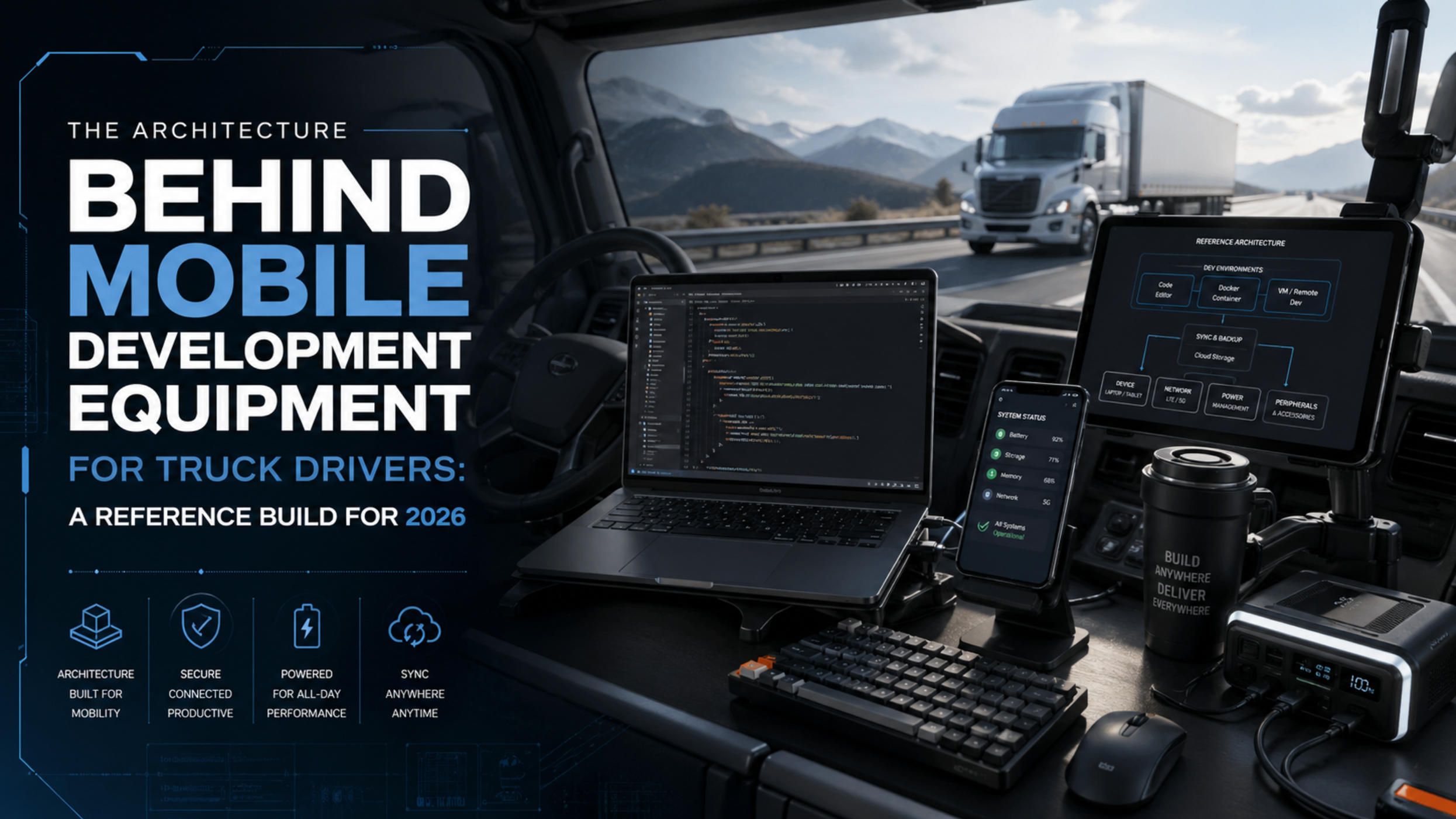
This one is the architecture article. It describes — at a level a CTO or a lead architect can plan a build from — what actually sits behind a working trucking platform in 2026. J1939 on the bus. OBD-II where appropriate. MQTT to the cloud. Fuel cards on one side, load boards on the other, compliance everywhere. Edge AI on the rugged tablet. We will walk the layers from the engine outward, and at each one we will explain not just what to build, but the specific decisions that distinguish a platform that works for ten years from one that breaks the first time a driver loses signal in a Wyoming canyon.
A junior engineer once asked a senior trucking architect what the most important design pattern in fleet platforms was. The senior thought about it for a moment and said: "The truck assumes the network is broken. That is the design pattern."
The Reference Architecture, in One Pass
Before diving into individual layers, it helps to see the whole shape on the page. A modern reference build looks roughly like this, from inside the truck outward:
The vehicle broadcasts data on the SAE J1939 bus (heavy-duty trucks) or the OBD-II port (light commercial vehicles). A gateway device plugged into the diagnostic port subscribes to specific PGNs, decodes the SPNs, and forwards normalized telemetry to the driver's rugged tablet over Bluetooth Low Energy or USB. The tablet runs the driver application — a React Native app with native Kotlin and Swift modules for the hardware-specific work — and is responsible for ELD compliance, DVIR, dispatch interaction, navigation, and any on-device AI inference. A cellular modem (in the gateway, the tablet, or both) carries data over LTE or 5G to a managed MQTT broker in the cloud. From there, an event router fans messages out to a time-series store for telemetry, a transactional database for business records, an object store for media (DVIR photos, dashcam clips, ePOD signatures), a stream processor for real-time analytics, and a business-logic API tier that talks to the dispatcher console, the customer portal, and a series of partner integrations: fuel cards (Comdata, EFS, WEX, Voyager), load boards (DAT, Truckstop), TMS and ERP systems, payment processors, and compliance reporting endpoints.
The diagram is simple. Each box hides several months of work.
Layer 1: Reading the Truck — J1939, PGNs, and SPNs
Every layer above this one depends on getting the data off the truck cleanly. For Class 3 through Class 8 commercial vehicles, the protocol that matters is SAE J1939, the higher-layer protocol built on top of CAN bus that has been the de facto standard for diesel engines, transmissions, brakes, and other vehicle subsystems since the late 1990s.
J1939 is a CAN-based protocol that uses the 29-bit extended identifier and runs at 250 kbit/s on the J1939-11 physical layer or 500 kbit/s on J1939-14. Each message is identified by an 18-bit Parameter Group Number (PGN) embedded inside that 29-bit identifier, and each data point inside the PGN is a Suspect Parameter Number (SPN). The SAE J1939-71 specification defines the standard PGNs and SPNs; the J1939 Digital Annex, published as a quarterly Excel file by SAE, contains the canonical list of roughly 1,800 PGNs and over 10,000 SPNs that a serious gateway has to be able to decode.
The first architectural decision is which PGNs to subscribe to. There are hundreds available, but a working fleet platform listens to only a subset. The ones that matter most in practice include:
PGN 61444 — Electronic Engine Controller 1 (EEC1), broadcast at engine-speed-dependent intervals. This carries SPN 190 (Engine Speed, two bytes, 0.125 rpm/bit, 0–8031.875 rpm range), SPN 513 (Actual Engine Percent Torque), SPN 512 (Driver's Demand Engine Percent Torque), and the engine torque mode. This is the highest-value single PGN on the bus.
PGN 65265 — Cruise Control / Vehicle Speed, carrying SPN 84 (Wheel-Based Vehicle Speed). Vehicle speed is the foundational signal for almost every operational use case.
PGN 65266 — Fuel Economy (LFE), carrying SPN 183 (Fuel Rate) and SPN 184 (Instantaneous Fuel Economy). These feed both IFTA reconciliation and predictive analytics.
PGN 65248 — Vehicle Distance, carrying SPN 244 (Trip Distance) and SPN 245 (Total Vehicle Distance). Engine-reported odometer is the source of truth for IFTA mileage.
PGN 65253 — Engine Hours / Revolutions, carrying SPN 247 (Total Engine Hours). For vocational and off-highway operations, hours often matter more than miles.
PGN 65262 — Engine Temperature 1, carrying SPN 110 (Engine Coolant Temperature). Critical for thermal-health monitoring.
PGN 65263 — Engine Fluid Level/Pressure 1, carrying SPN 100 (Engine Oil Pressure) and SPN 98 (Engine Oil Level).
PGN 65271 — Vehicle Electrical Power, carrying SPN 168 (Battery Potential Voltage) — a strong leading indicator for starter-motor and alternator failures.
PGN 65276 — Dash Display, carrying SPN 96 (Fuel Level 1) — needed for tank-level fraud detection on fuel cards.
PGN 65226 — Active Diagnostic Trouble Codes (DM1), the most heavily monitored PGN in modern telematics. DM1 broadcasts active fault codes with SPN, FMI (Failure Mode Identifier), and occurrence count.
PGN 65267 — Vehicle Position, carrying SPN 584 (Latitude) and SPN 585 (Longitude) where the truck broadcasts native GPS.
A gateway capable of decoding those eleven PGNs covers the data points that 90% of fleet operations actually consume. Anything beyond that is OEM-specific or use-case-specific.
The second architectural decision is how to handle the multi-frame messages. PGNs that carry more than eight bytes of payload — including DM1 when multiple faults are active — use the Transport Protocol defined in J1939-21, which fragments the message across multiple CAN frames using the BAM (broadcast announce message) or RTS/CTS (request-to-send / clear-to-send) flow control. A gateway implementation that does not properly reassemble TP frames will drop active fault codes silently, which is the kind of bug that is invisible in development and catastrophic in production.
The third architectural decision is address claiming under J1939-81. Every node on the J1939 network must claim a unique source address before transmitting. A gateway that fails to claim its address correctly can collide with another node — including the engine ECM itself — and cause real problems on the bus. Production gateways from CSS Electronics, Pyramid Solutions, and Copperhill Technologies handle this correctly out of the box; a custom firmware build needs to implement it explicitly.
For lighter commercial vehicles (Class 1–2 vans, light pickups), the protocol is OBD-II rather than J1939. OBD-II uses standard PIDs (Parameter IDs) defined in SAE J1979. The PIDs are simpler, the data is less rich, and the integration patterns are straightforward — but a fleet platform that runs across light and heavy-duty vehicles needs to abstract the source protocol behind a single normalized signal model so the rest of the architecture does not care whether the engine RPM came from PGN 61444 SPN 190 or OBD-II PID 0x0C.
Layer 2: The Cab Bridge — Tablet, Gateway, and BLE
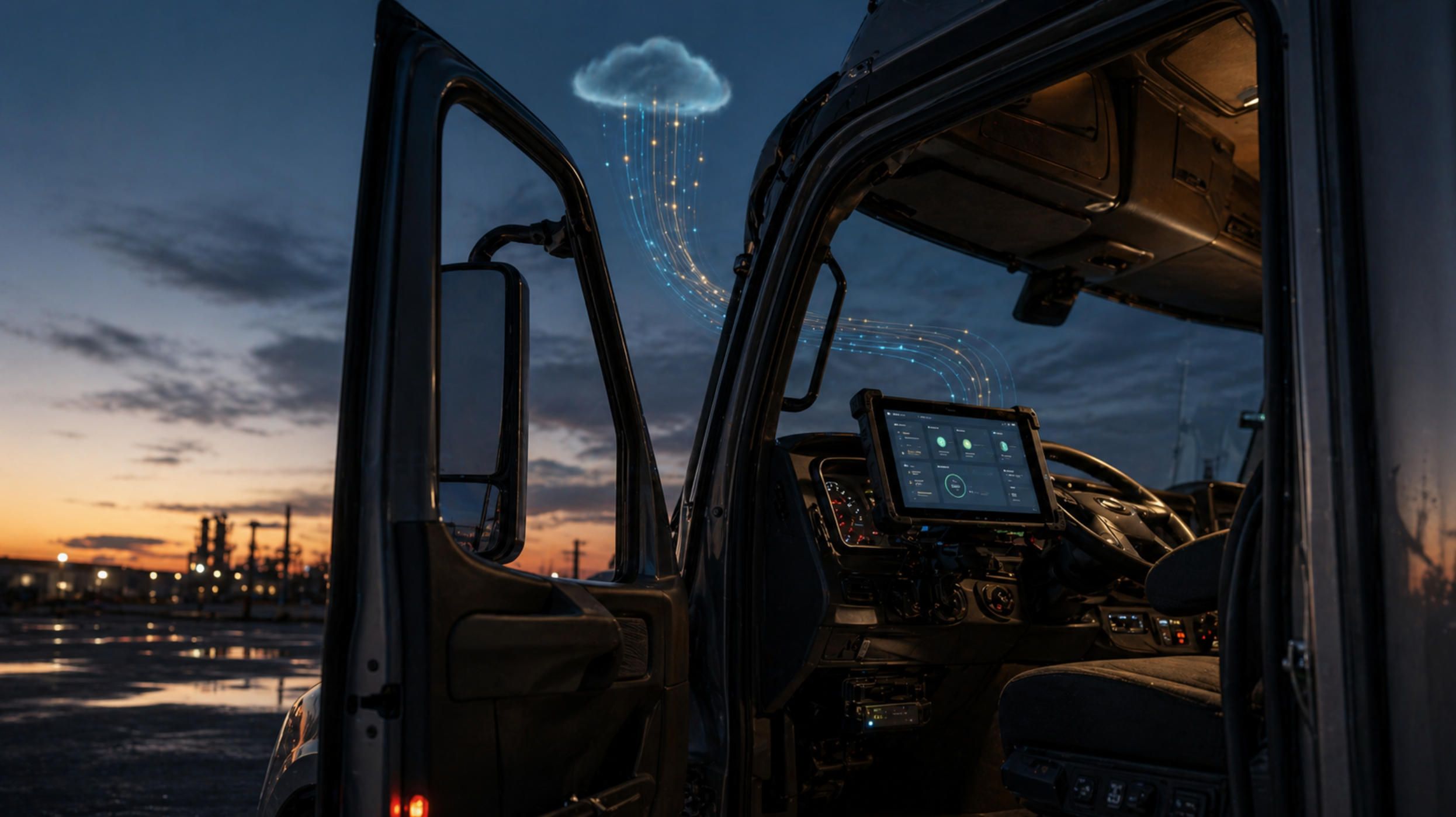
The second layer is the bridge between the gateway and the tablet, and between both of those and the cloud.
The dominant cab pattern in 2026 is a hardware split: a gateway device plugged into the truck's diagnostic port handles the J1939 bus, basic GNSS, and cellular connectivity, and a rugged tablet mounted on the dashboard handles the driver experience and any AI inference. The two communicate over Bluetooth Low Energy (BLE) — typically a custom GATT service exposing telemetry as notifications and accepting configuration writes as characteristic writes — or over USB-C when the cab supports a wired install.
The split pattern has three advantages. The gateway can be hard-wired to the truck's 12 V or 24 V supply with proper voltage regulation and stays awake to log unassigned drive time even when the tablet is off. The tablet can be replaced or upgraded independently of the gateway, which matters because tablet refresh cycles are roughly every three years while gateways often stay deployed for five-plus. And the BLE link gives the architecture a natural offline boundary: the tablet can be in the cab without LTE while the gateway continues to log, or the gateway can lose connection while the tablet caches DVIRs and HOS events, and either side can re-sync when connectivity returns.
The hardware list at this layer is well-established. Rugged tablets that ship with confidence for trucking deployments include the Samsung Galaxy Tab Active5 (MIL-STD-810H, IP68, 15-hour battery, glove touch, S Pen), Panasonic TOUGHBOOK G2 (Windows-first carriers, full Intel Core i7 with up to 16 GB RAM, 1,200-nit display, five-year warranty), Getac F110-EX (ATEX certification for hazmat, dual hot-swappable batteries, 5G, Wi-Fi 6E), Zebra XSlate R12 (Windows-based fleets, 12.5-inch display with optional vehicle dock), and the Waysion Q777 for budget-conscious owner-operator deployments. The choice depends on the carrier's operating environment, OS preference, and budget — but the abstraction layer above the tablet should not care which one is in the cab.
The gateway side is similarly mature. CSS Electronics CANedge series, Geotab GO9, Castrol BlueLink, Geometris GO devices, Stoneridge MyCadian for ELD-specific deployments, and CalAmp LMU series all expose J1939 telemetry over BLE or LTE, and a custom-firmware gateway built on AutoPi or Freematics gives full control where it matters.
Architecturally, the most important detail at this layer is clock discipline. The tablet, the gateway, and the cloud all keep their own clocks, and any drift between them shows up as ELD timing violations, IFTA jurisdiction-crossing errors, and sync-ordering bugs. The right pattern is for the gateway to act as the time authority on the truck (it has GNSS-disciplined time), the tablet to sync against the gateway over BLE on each connection, and the cloud to record both timestamps with every event so reconciliation is always possible.
Layer 3: The Wire to the Cloud — MQTT, Topics, and QoS
Once data leaves the truck, it goes into the cloud over MQTT — the Message Queuing Telemetry Transport protocol that has become the de facto standard for fleet telematics. AWS, in its own connected-vehicle reference architecture, calls MQTT "the de facto standard for connected vehicle message brokers."
The reasons MQTT won this category are specific. It is lightweight enough to run on constrained devices, which keeps cellular bills down across thousands of trucks. It uses persistent connections instead of repeated TLS handshakes, which matters for power and latency. And it is built around publish/subscribe over a hierarchical topic tree, which fits naturally to a fleet model where the cloud subscribes to thousands of trucks and individual services subscribe to specific data types.
The architectural decisions at this layer are the topic hierarchy, the QoS levels, and the broker.
Topic hierarchy. A clean hierarchy makes everything downstream simpler. A workable pattern:
fleet/<carrier_id>/vehicle/<vehicle_id>/telemetry/<signal_group> fleet/<carrier_id>/vehicle/<vehicle_id>/event/<event_type> fleet/<carrier_id>/vehicle/<vehicle_id>/command/<command_type> fleet/<carrier_id>/driver/<driver_id>/state
Telemetry topics carry continuous engine data. Event topics carry discrete things — duty-status changes, DVIR completions, harsh-braking incidents, fault codes. Command topics flow downward from the cloud to the truck — software-defined fleet campaigns, ELD configuration updates, dispatch instructions. Driver-state topics carry HOS state and assignment.
QoS levels. AWS IoT Core supports MQTT QoS 0 (fire-and-forget) and QoS 1 (at-least-once delivery). It does not support QoS 2 (exactly-once). The right pattern is QoS 0 for high-frequency telemetry (engine RPM samples ten times a second) where occasional loss is fine, and QoS 1 with idempotent event IDs for discrete events (ELD duty-status changes, DVIR submissions, POD captures) where loss is unacceptable. Idempotent event IDs handle the duplicate-delivery edge case QoS 1 can produce.
The broker. AWS IoT Core is the default for greenfield builds — fully managed, integrates natively with the rest of AWS, supports MQTT v5 since the 2023 release, scales to hundreds of millions of devices, and AWS announced a 99.99% SLA for IoT Core in 2025. EMQX is the leading self-managed alternative for fleets that want to avoid AWS lock-in or that need MQTT 5.0 features AWS does not yet expose. Either is production-grade. The decision is operational, not technical.
Persistent sessions and Last Will and Testament. A truck dropping into a tunnel or a steel-walled distribution center should not look like an offline truck to dispatch. The right pattern uses MQTT persistent sessions so the broker holds messages while the connection is down, plus a Last Will and Testament message published automatically by the broker when the connection drops ungracefully — so the dispatch console can distinguish "truck is in a tunnel" from "truck has lost its modem."
Mutual TLS. Every truck authenticates to the broker with an X.509 client certificate. Username/password is not adequate for fleet telematics in 2026. Certificate provisioning happens at gateway manufacture or at first-boot enrollment via a one-time-use bootstrap credential.
Layer 4: The Cloud Side — Stream Processing, Storage, and APIs
Once messages are landing in the broker, the cloud architecture splits the data flow by purpose.
Real-time stream processing. Telemetry messages flow from MQTT into a stream processor — typically Amazon Kinesis Data Streams plus Amazon Managed Service for Apache Flink, or Apache Kafka plus Kafka Streams in a self-managed deployment. The stream processor handles real-time analytics (live dashboards, geofence triggers, harsh-event detection) and forks output into multiple sinks.
Time-series storage. Telemetry is fundamentally time-series — engine RPM at timestamp T, fuel rate at timestamp T+100ms, GPS position at timestamp T+200ms. The natural store is a time-series database. Amazon Timestream for AWS-native deployments, InfluxDB or TimescaleDB for self-managed. Telemetry is rolled up and aggregated as it ages — second-level resolution for the last seven days, minute-level for the last 30, hour-level beyond.
Transactional storage. Business records — DVIRs, HOS logs, dispatch assignments, eCMR signatures, fuel-card transactions — go into a relational store. PostgreSQL is the default in 2026, with the ELD output file format (defined in Appendix A to 49 CFR Part 395, Subpart B) as a key constraint on the schema. The compliance retention rules from Article 3 of this series — six months for ELD, three to twelve for DVIR, four years for IFTA, statutory for eCMR — drive the partitioning and archival strategy.
Object storage. Media and binary blobs — DVIR photos, dashcam clips, ePOD signatures — go to S3 or an equivalent object store with lifecycle rules that archive older content to colder tiers.
Business-logic API. A Node.js or Python (Django) service tier exposes GraphQL or REST APIs to the dispatcher console, the customer portal, and partner integrations. The API tier owns the access control, the multi-tenant isolation (between carriers in a multi-carrier deployment), and the rate-limit envelope for downstream partners.
Caching. Redis or DynamoDB Accelerator handles the read patterns the API tier needs — current driver state, current vehicle assignment, latest telemetry — without hammering the time-series store on every dispatch refresh.
Layer 5: The Partner Integrations
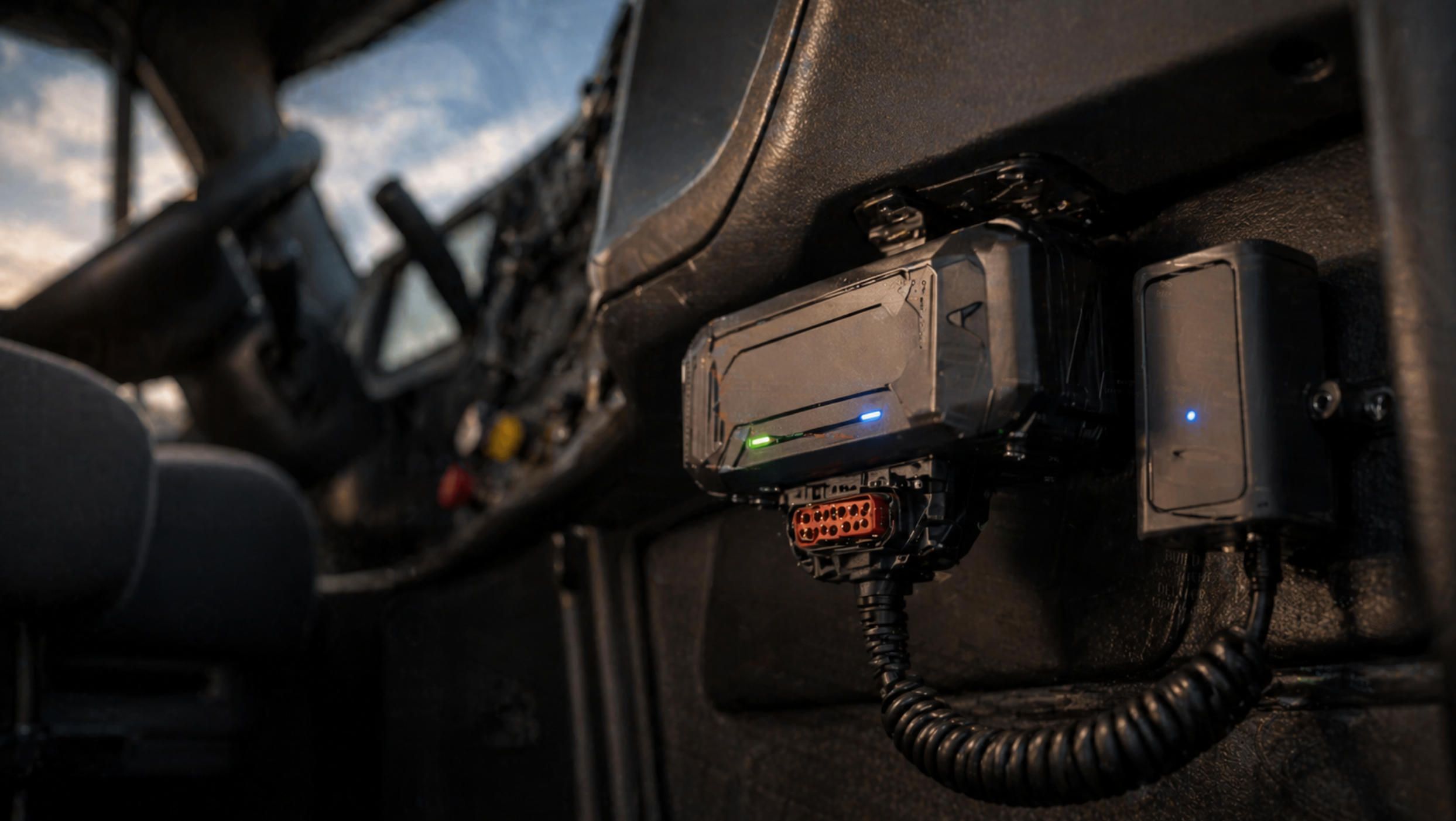
The integrations layer is where the platform stops being self-contained and starts being a real piece of operational infrastructure. The partners that matter most in 2026:
Fuel cards. Comdata (truck-stop optimized, OTR fleets), EFS (a WEX brand, 16,000+ truck-stop locations, EDGE network), WEX (universal coverage, 95% of US stations), Voyager (97% acceptance, no card fees), and the newer universal Visa cards from Coast and AtoB. Each provider exposes a transaction API — typically REST with daily or near-real-time data feeds. A fleet platform pulls transactions, matches them against the truck's GPS at purchase time (location-fraud detection), against tank level via PGN 65276 SPN 96 (volume-fraud detection), and against IFTA jurisdiction logs (audit reconciliation). WEX's API runs over XML or JSON and supports both real-time and batch modes; EFS integrates through the WEX umbrella; Comdata exposes a similar REST surface.
Load boards. DAT One and Truckstop dominate the spot market. The Truckstop Developer Portal (developer.truckstop.com) requires a signed Systems Integration Agreement before access. DAT requires partner-tier credentials enabled by a DAT account representative. Both expose load search, load posting, and rate analytics through REST APIs. A normalized adapter pattern — Shipwell's Public Load Boards API is the textbook reference — abstracts away the per-board differences in equipment-type encoding ("V" for Van on DAT, "V" for Van on Truckstop, "Van" on Trucker Tools) so the dispatch console can post once and reach multiple boards.
ELD providers (when integrating, not building). Samsara, Motive, Geotab, Verizon Connect, BigRoad, EROAD all expose REST APIs for HOS state, vehicle position, and driver-vehicle assignments. The rate-limit ceilings discussed in Article 2 of this series are real architectural constraints — Samsara's 30 requests/sec on /fleet/hos/logs, 25 requests/sec on driver-vehicle assignments — and the integration layer has to back off with exponential retries and Retry-After header awareness.
TMS and ERP. McLeod, TMW, MercuryGate, Tailwind, AscendTMS for trucking-native TMS; SAP, Oracle NetSuite, QuickBooks for general accounting. The integration is usually batch (nightly or hourly) for accounting and event-driven for dispatch.
Maps and routing. Google Maps Platform, Mapbox, HERE Technologies, and Trimble PC*MILER for truck-specific routing that respects bridge heights, weight restrictions, and hazmat corridors.
Compliance reporting. FMCSA's eRODS portal for ELD output files; state IFTA filing portals; the eFTI platforms (TransFollow, Transporeon, TESISQUARE) for European eCMR.
The integration layer is also where idempotency, retry policy, and circuit breakers earn their keep. Every outbound call has a partner on the other end whose service can have an outage. A platform that does not isolate partner failures behind circuit breakers turns one partner's bad afternoon into a fleet-wide outage.
Layer 6: Edge AI on the Tablet
The frontier layer is on-device AI inference. As Article 4 of this series traced, the AI dashcam category has moved from cloud-only to edge-native — modern Samsara, Motive, Lytx, and Nauto cameras run thirty-plus neural networks at once on dedicated edge silicon. For a custom platform, the equivalent capability runs on the rugged tablet plus a connected dashcam.
The deployment pattern in 2026 favors LiteRT (the successor to TensorFlow Lite, rebranded by Google in 2025 with a new CompiledModel API for automated hardware acceleration) for Android-first builds, and ONNX Runtime for cross-platform builds where models come from multiple training frameworks. Both run on the Galaxy Tab Active5's NPU and on TOUGHBOOK GPUs without modification.
Useful on-device models for trucking:
A driver-distraction model (face direction, eye-closure, phone detection) running on the dashcam-facing camera at 5–10 fps. Models trained against in-cab footage typically deploy at 5–20 MB after quantization.
A fatigue model that combines eye-closure rate, blink duration, head pose, and (where the hardware exists) heart-rate variability from a wearable into a fatigue index. Motive's AI Omnicam Pro shipped HRV-based fatigue scoring in November 2025; the architecture is reproducible.
A document classifier that runs on POD captures, automatically detecting whether the driver photographed a BOL, a scale ticket, a damage photo, or a fuel receipt, and routing each accordingly.
The right architectural pattern is to keep the model small enough to run in under 100 ms on the target hardware, run inference on a background thread (so the UI thread stays responsive), and stream only the inference result — not the raw frames — to the cloud unless an event triggers full-frame upload. React Native implementations typically wrap the inference engine in a native TurboModule (Kotlin on Android, Objective-C++ on iOS) so the bridge cost is amortized across many calls.
The privacy and compliance implications matter more than they used to. Driver-facing cameras and biometric inference are sensitive. Any custom build needs a documented data-governance posture: what is recorded, what is retained, what is shared with insurance partners, what the driver consents to. The Lytx-Liberty Mutual real-time DriveCam-to-actuarial-pricing integration (announced January 2026) is the most explicit version of this on the market right now — the trajectory is unmistakable.
Layer 7: The Driver App Itself
All of the above exists to support one thing: the driver's day. The driver app is where mobile development equipment for truck drivers actually meets the human operator, and it is the layer that has the lowest tolerance for engineering hubris.
Practical principles from production deployments:
Offline-first, always. Every screen the driver uses for compliance — DVIR, HOS, POD capture, eCMR signature — must work fully offline and sync deterministically when connectivity returns. Idempotent client-generated event IDs and server-side deduplication are non-negotiable. SQLite (typically through WatermelonDB or Realm in React Native) is the standard local store.
Glove-friendly UI. Tap targets minimum 48dp / 44pt, with 8dp minimum spacing. High-contrast typography (4.5:1 minimum for body text, 7:1 for safety-critical state). The driver may be wearing winter gloves and the screen may be at 1,000 nits in direct sun.
Voice and minimal screens for safety-critical workflows. Anything that happens during driving has to work without taking the driver's eyes off the road. HOS status changes, navigation prompts, and incoming dispatch should all have voice paths.
Battery and ignition awareness. The app needs to respect ACC state, drop into a low-power mode when the engine is off, and wake fast when the engine starts. It should not be the reason a truck's house battery is dead in the morning.
Plain workflows. The median professional driver is 57 years old. Workflows should be linear, single-purpose, and undoable. Multi-step wizards beat single screens with twelve fields.
The driver app is also where the four compliance streams from Article 3 — ELD per Appendix A, DVIR per §396.11, IFTA jurisdiction crossings, eCMR signatures for European deployments — get implemented in code. Each has specific UX requirements; each has audit failure modes when implemented carelessly.
What the Reference Build Costs and How Long It Takes
For a working sense of scale: a custom platform built from this reference architecture, for a 50–200-truck fleet, lands in the range of 4–8 months from kickoff to first deployed fleet, with engineering costs typically between USD 200,000 and 500,000 depending on scope. That covers driver app (React Native + native modules), dispatcher console (web), backend (Node.js or Django, MQTT broker, PostgreSQL, time-series store, S3), three to five partner integrations (one ELD, one fuel card, one load board, one TMS or accounting system, optionally one mapping provider), and FMCSA-grade compliance logic.
Adding edge AI inference, eCMR support for European operations, autonomous-handoff workflows, or deep TMS replacement extends the timeline and budget meaningfully. Subtracting hardware integration (running entirely against existing Samsara or Motive APIs) shrinks both.
These numbers compare against the off-the-shelf cost curve discussed in Article 2 of this series — a 100-truck fleet on a major ELD subscription typically pays USD 30,000–50,000 per year in software alone, plus hardware, plus the contract penalties any early termination triggers. For carriers above the breakpoints described in that article, the custom math typically pays back inside 18 months.

How A-Bots.com Builds From This Reference
A-Bots.com has been building mobile applications that sit between physical hardware and operational data layers for over a decade. The architectural pattern this article describes is the one we apply to trucking projects, with adjustments for the specific carrier's operating profile.
Our trucking stack uses React Native with native Kotlin and Swift modules for Bluetooth, background location, J1939 bridges, camera pipelines, and edge AI inference. The backend runs on Node.js, Django, GraphQL, PostgreSQL, AWS IoT Core (or self-managed EMQX), Amazon Timestream, and S3. We integrate with Samsara, Motive, Geotab, Verizon Connect on the ELD side, Comdata, EFS, WEX, Voyager on the fuel-card side, DAT, Truckstop on the load-board side, and Google Maps SDK, Mapbox, Trimble PC*MILER for routing. FMCSA Appendix A compliance logic is implemented directly when the carrier owns its own ELD certification, or bridged to commodity registered devices (Stoneridge, Garmin eLog, My20) when the carrier prefers to outsource certification. eCMR capability with eIDAS-aligned signature flows and TransFollow / Transporeon platform bridges is available for European deployments.
We work in three modes — full custom platform builds, integration-and-extension layers on top of existing telematics, and QA hardening on platforms that already exist but break in the field. Each mode draws from the same reference architecture; the scope is what differs.
A-Bots.com has completed more than 70 projects across mobile, IoT, web, chatbots, and blockchain, with offices in the United States, Ukraine, and Romania. Most clients stay with us for eighteen months or longer, and several past five years — which matches the realistic life cycle of the platforms this architecture supports.
Closing the Series
Five articles in, the picture is consistent. Mobile development equipment for truck drivers is not a single product or a single decision. It is a layered system — hardware, sensors, software, integrations, compliance, AI — that has to be designed, built, and maintained against a real cab in a real cold morning with a real driver who has been doing this job for thirty years and does not have the patience for a buggy app. The carriers that treat this stack as a strategic asset — building it, owning it, evolving it — tend to be the ones that widen their margins while the rest of the market blames the freight cycle.
If you have made it through all five articles, you have read more about the architecture and economics behind trucking mobile platforms than most vendor sales engineers know. If you are planning a build, replacing a vendor, or hardening a platform that has already started showing its age, A-Bots.com is a direct line to an engineering team that has shipped this class of system. Send the brief — current state, target state, the workflows that aren't working — to info@a-bots.com, and we will come back with a grounded technical read and a realistic plan.
The next phase of mobile development equipment for truck drivers is being built right now, on top of the reference architecture in this article. The fleets that win the next decade will be the ones who own theirs.
✅ Hashtags
#TruckingTech
#FleetArchitecture
#J1939
#MQTT
#FleetTelematics
#EdgeAI
#IoTArchitecture
#FleetManagement
#MobileAppDevelopment
#ConnectedVehicle
Other articles
App Controlled Sauna: Top 3 Models on the US Market 2026 The app controlled sauna has moved from premium novelty to baseline expectation on the US market, with IoT-enabled systems now driving 61% of buyer demand. This expert guide reviews the three models leading the category in 2026 — Harvia Fenix with its AI-adaptive MyHarvia 2 app, HUUM UKU WiFi with its cult-favorite minimalist app, and Sun Home Luminar with its full-spectrum infrared wellness ecosystem — evaluated entirely through the lens of the mobile application. Covers IoT architecture, regulatory requirements under the new ANSI/UL 60335-2-53 standard, and what sauna manufacturers should learn about multi-user access, OTA updates, door-interlock safety, and ecosystem design when building their own custom app controlled sauna platform.
Mobile Development Equipment for Truck Drivers: 2026 Stack This pillar article maps the complete 2026 stack of mobile development equipment for truck drivers across four layers: rugged in-cab hardware (Samsung Galaxy Tab Active5, Panasonic TOUGHBOOK G2, Getac F110-EX, Zebra XSlate R12), sensor electronics (FMCSA-certified ELDs, AI dashcams from Samsara, Lytx, Nauto, and Motive), driver-facing software (HOS, DVIR, IFTA, dispatch, load boards like DAT One and Truckstop Go), and integration plumbing (SAE J1939, OBD-II, MQTT, REST APIs). It also covers the operational details that separate weekend prototypes from production deployments — offline-first behavior, power management, real-device QA, and security — and explains how A-Bots.com builds, extends, and hardens custom driver platforms for trucking carriers of every size.
Off-the-Shelf ELDs vs Custom Fleet Apps: 2026 Decision Off-the-shelf ELDs from Samsara, Motive, and Geotab dominate US trucking for good reason — they work for most fleets. But specialized carriers hit three walls: workflow (drayage, hazmat, auto transport, reefer), API rate limits (Samsara caps HOS logs at 30 req/sec, driver-vehicle assignments at 25 req/sec), and contracts (3-year lock-ins with full remaining balance due on early termination). This article walks through the breakpoints where custom mobile development equipment for truck drivers pays back — fleet size, workflow specialization, integration depth, data ownership — and explains the three delivery modes A-Bots.com runs: full custom platform, integration/extension layer, and QA hardening. Second article in a five-part series.
FMCSA Compliance for Trucking Apps: 2026 Technical Guide Compliance is where trucking apps stop being clever and become legally binding. This technical guide walks through the four regulatory frames that mobile development equipment for truck drivers has to clear in 2026: FMCSA 49 CFR Part 395 (the ELD mandate, with Appendix A section-by-section), Part 396 (including the February 2026 final rule authorizing electronic DVIRs, effective March 23, 2026), IFTA quarterly fuel-tax reporting, and the accelerating eCMR framework in Europe. It maps the software-level failure modes that turn into audit findings — clock drift, engine sync, unassigned driving, offline sync, data-transfer file validity — and explains how A-Bots.com builds compliance-grade systems against Appendix A as acceptance criteria.
From Paper Logs to AI Dashcams: Trucking Tech Evolution A seven-phase arc traces 89 years of mobile development equipment for truck drivers: 1937 paper logs, 1988 AOBRDs, the 2015 ELD Final Rule, telematics platforms, AI dashcams (now a $4.8B market growing to $13.7B by 2034), predictive maintenance reaching 85-95% failure-prediction accuracy, and the 2025-2026 emergence of SAE L4 autonomous freight on public roads. The article covers VTTI dashcam testing data, the ABI Research February 2026 video telematics ranking, the January 2026 Lytx-Liberty Mutual insurance partnership, Aurora's 250,000 driverless miles, and four durable patterns shaping where the category heads next. Fourth article in a five-part series.
Top stories

Copyright © Alpha Systems LTD All rights reserved.
Made with ❤️ by A-BOTS