
Home
Services
About us
Blog
Contacts
Mobile Development Equipment for Truck Drivers: The Complete 2026 Stack
A modern Class 8 tractor is a rolling data center. Between the engine control unit, the trailer's ABS node, the ELD that reports every duty-status change, the AI dashcam tracking eye closure, and the driver's rugged tablet streaming load board updates, a single truck generates more telemetry per hour than most factories did a decade ago. The hardware and software that make all of this possible — what carriers, developers, and fleet IT architects have started calling mobile development equipment for truck drivers — is no longer a nice-to-have. It is the operating surface of the business.
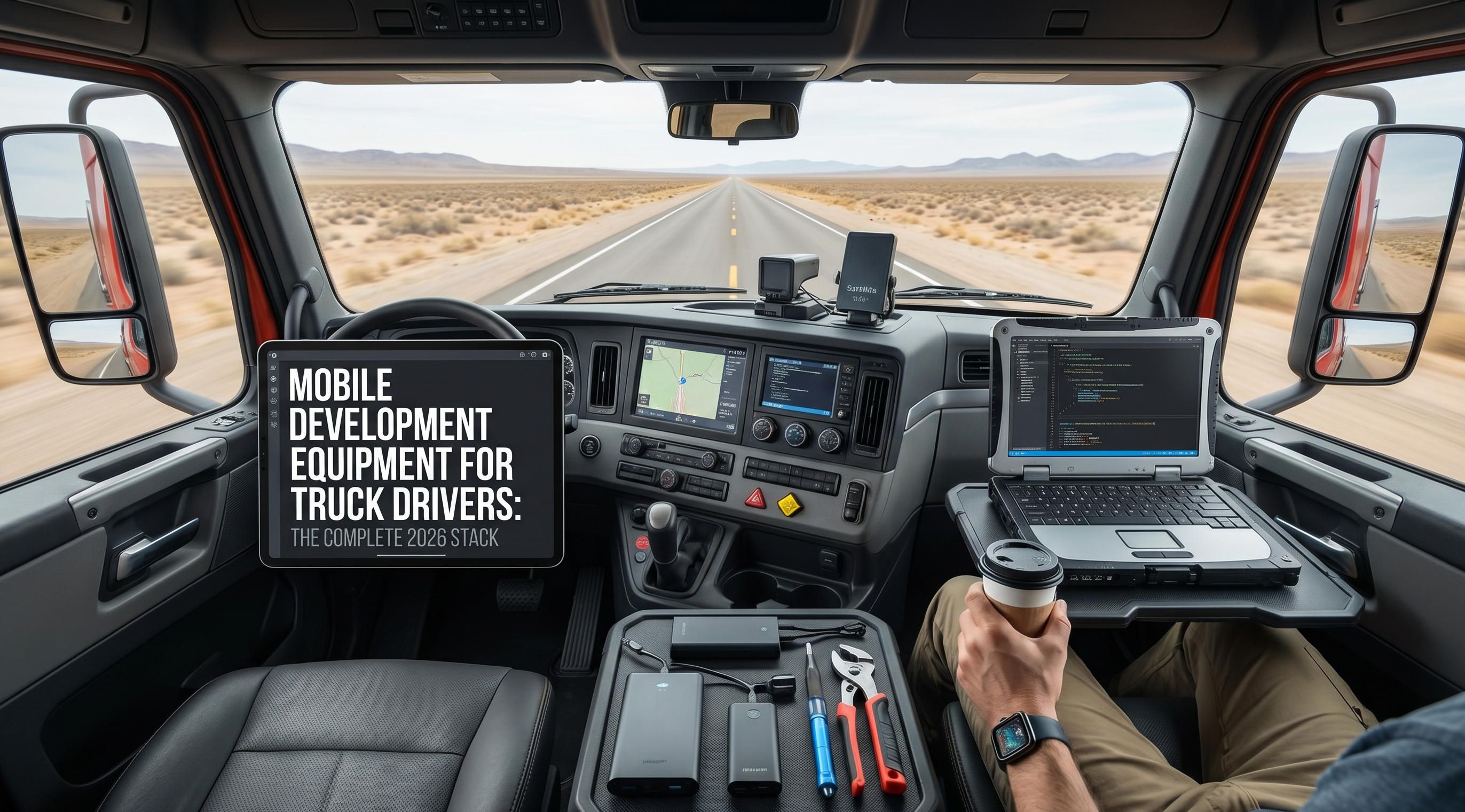
This article is the first in a five-part series on mobile development equipment for truck drivers. It is written as a map: a readable, expert-level tour of every layer in the stack, from the ruggedized tablet bolted to the dash to the backend services that turn J1939 messages into payroll. Later articles will go deep on compliance, architecture, AI safety, and the case for custom builds. This one gives you the whole picture first, so the rest makes sense.
A trucker walks into a dealership and asks for "the simplest possible setup." Three hours later he leaves with a rugged tablet, two cameras, an ELD, four cables, a 24 V hard-wire kit, and a subscription to something called the Connected Operations Cloud. Simple.
Why the Stack Matters Right Now
The numbers behind the current moment are worth stating plainly. The American Trucking Associations reports that trucks moved 11.27 billion tons of freight in 2024, generating $906 billion in revenue and employing 3.58 million professional drivers across the United States. That freight economy is running short of people: ATA's latest workforce analysis puts the 2026 driver shortage at roughly 82,000, with the median age of heavy tractor-trailer drivers sitting at 57. Meanwhile the North America fleet management solutions market is on track to grow from USD 5.51 billion in 2025 to USD 6.6 billion in 2026, and the global fleet management software market is projected to pass USD 30 billion in 2026 on its way to USD 122.3 billion by 2035 at a 16.9% CAGR (Global Market Insights).
Translated out of analyst language: fewer drivers are moving more freight, and the only lever left for most carriers is software. That is why mobile development equipment for truck drivers has moved from an IT line item to a board-level conversation. Every minute a driver spends re-entering a BOL, chasing a signal, or fighting a frozen app is a minute the carrier cannot replace by hiring.
There is also a regulatory floor. The FMCSA's ELD mandate under 49 CFR Part 395 requires almost every commercial motor vehicle operator who keeps records of duty status to log hours electronically, and penalties for non-compliance can exceed USD 16,000 per violation. Any stack built today has to clear that bar before anyone talks about features.
Layer 1: The Hardware in the Cab
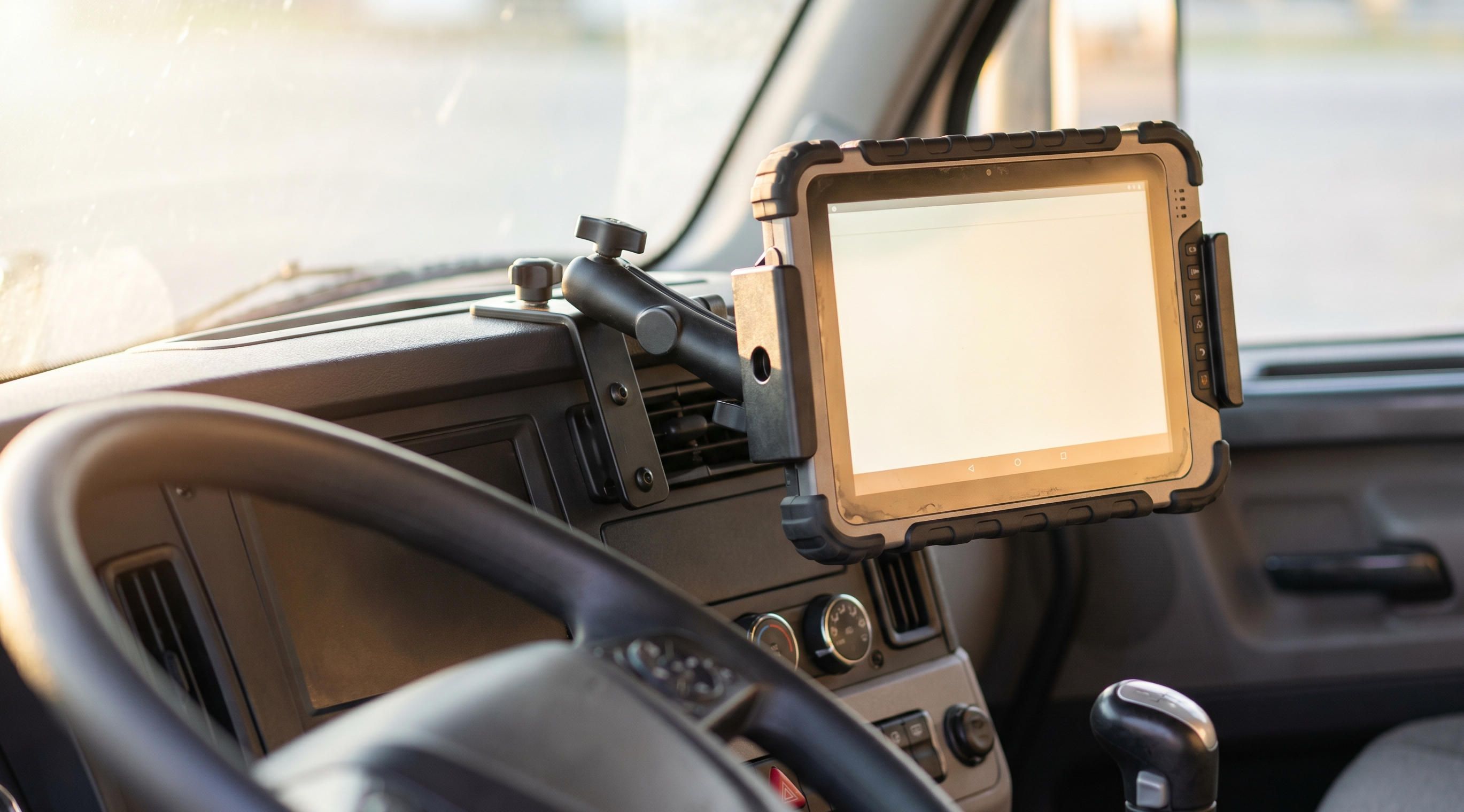
The most visible piece of mobile development equipment for truck drivers is the in-cab compute device itself. Drivers are rough on hardware by accident — sun, cold, vibration, coffee, gloves, drops onto a fuel island — and consumer tablets fail fast. The rugged tablet category has responded with devices designed specifically for commercial truck cabs.
At the enterprise end of the spectrum, the Panasonic TOUGHBOOK G2 runs full Windows 11 on an Intel Core i7 with up to 16 GB of RAM, ships with a 10.1-inch 1,200-nit glove-friendly touchscreen, and carries a five-year warranty at around USD 2,999. The Getac F110-EX pushes further into specialty work — ATEX certification for hazardous-material tankers, an 11.6-inch 1,000-nit LumiBond display, 5G, Wi-Fi 6E, and dual hot-swappable batteries at roughly USD 3,495. For Android-first fleets the Samsung Galaxy Tab Active5 has become the de facto standard: MIL-STD-810H certified, IP68 rated, 15-hour battery life, glove touch, and a bundled S Pen for digital signatures. Platform Science specifically supports it as a commercial driver device, and Samsung has partnered with fleet platforms to ship it pre-provisioned.
Below that tier, the Zebra XSlate R12 targets fleets that want a Windows workstation feel — a 12.5-inch 1080p display, IP54/MIL-STD-810G, optional keyboard and vehicle dock, Intel Core i5 with up to 16 GB of RAM. Owner-operators often end up on the Waysion Q777 at roughly USD 449 with a cradle — 7-inch 800-nit IPS, Android 14, IP65, operating range of -20 °C to 60 °C, and native CAN bus support for diagnostics.
The spec sheet matters less than the principle: mobile development equipment for truck drivers begins with a device that survives. The mounting matters almost as much. A decent RAM or AMPS mount and a 24 V hard-wire kit eliminate battery anxiety and the daily ritual of digging a charging cable out of a glove box. Multi-GNSS (GPS + GLONASS + Galileo) and integrated 5G keep dispatch, ELD, and telematics responsive even at a crowded truck stop. Everything the software layer wants to do — and every promise the vendor made in the sales deck — hinges on whether the device is still awake, bright, and connected when the driver needs it at 3 a.m. in a sleet storm.
Layer 2: Sensors and In-Cab Electronics
Above the tablet sits a layer of purpose-built sensors that produce the actual data the software layer consumes.
The first is the Electronic Logging Device (ELD). Every ELD on the road must be registered with FMCSA and meet the technical specifications in Appendix A to 49 CFR Part 395, Subpart B: it must automatically record engine power status, vehicle motion, miles driven, and duty-status changes, and it must transfer a standardized output file to a DOT inspector on demand. Samsara, Motive (formerly KeepTruckin), Geotab, Verizon Connect, BigRoad, EROAD, and J.J. Keller dominate the certified-device list. Subscription-based ELD packages from Samsara and Motive typically run USD 25–50 per truck per month, while no-subscription devices from Stoneridge, Garmin, and Rand McNally sit at USD 150–300 upfront (O Trucking).
The second is the AI dashcam, and this is where the last three years have reshaped the category. Modern units no longer passively record — they run edge AI. Samsara's AI Dash Cams analyze drowsiness with 17-plus fatigue indicators and push in-cab "nudges" before the fleet manager is ever notified. Lytx operates more than one million connected cameras globally and layers a managed-video service on top. Motive's AI Dashcam Plus reportedly runs more than 30 neural-network models simultaneously on a Qualcomm Dragonwing processor. Nauto's Predictive Fusion fuses external and internal signals — brake lights ahead, pedestrians, driver alertness, vehicle speed — and has delivered an 80% reduction in collisions with pedestrians and cyclists and a 65% overall accident reduction in its deployments (IEEE Spectrum). The operational effect is measurable: fleets deploying AI dash cams typically report 60% fewer distracted-driving events within 90 days and insurance savings of 5–20%.
The third sensor category is the vehicle gateway / telematics unit itself — the small box that plugs into the diagnostic port and listens to the truck's internal networks. Without it, a tablet is a glorified phone. With it, the tablet becomes mobile development equipment for truck drivers in the full sense of the phrase: a window into engine hours, fuel burn, coolant temperature, fault codes, odometer, and hundreds of other parameters.
Layer 3: The Software on Top
The software layer is where the stack actually produces value for the carrier, and it breaks into four families.
Compliance and HOS. Beyond the ELD itself, drivers need clean workflows for pre-trip inspections (DVIR under 49 CFR Part 396), IFTA fuel-tax reporting, Form & Manner log annotation, and Inspection Mode for roadside checks. Samsara's Driver app, Geotab Drive, and Motive's driver app all implement these flows; carriers who want something specific to their own policies build their own layer on top.
Navigation and routing. Consumer apps do not know about 13'6" bridges, weight-restricted roads, or hazmat corridors. Truck-specific routing is a hard problem: Trucker Path (600,000+ drivers, per American Truckers LLC) and Rand McNally's CoPilot Truck embed road attribute data the general mapping APIs do not expose. Apps that do not respect truck attributes cost fleets directly in detours, citations, and damaged trailers.
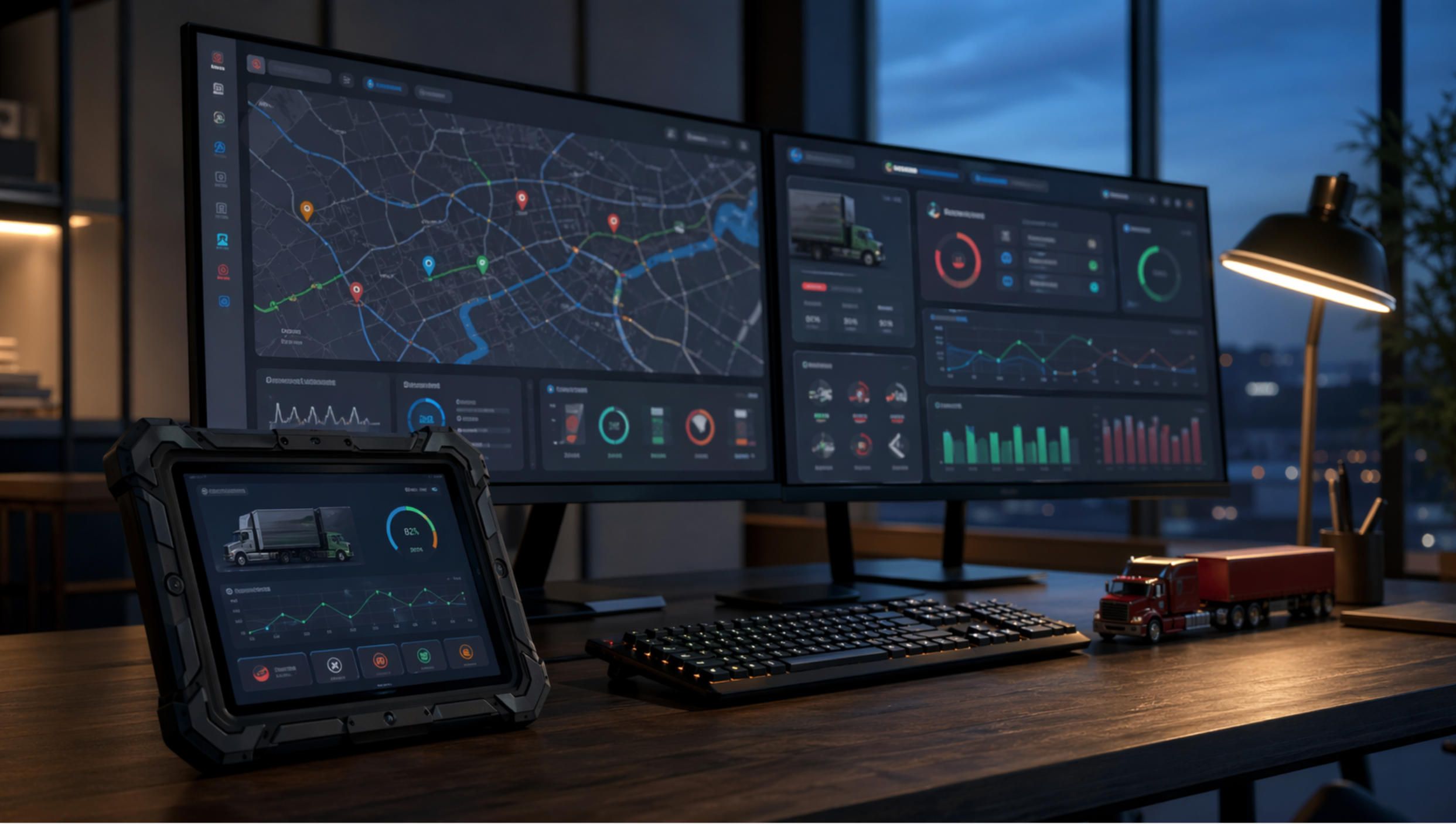
Dispatch, load boards, and back-office. DAT One posts roughly 722,500 loads every business day across the DAT Network. Truckstop Go exposes the Truckstop Load Board with Book It Now, broker ratings, and live market rates. TruckSmarter bundles a free load board, card-free fuel discounts, and AI dispatch. A dispatcher-facing TMS layer plus a driver-facing app covers the rest: load assignment, proof-of-delivery capture, document upload, settlements, and broker notifications.
Driver productivity and life-on-the-road. Fuel optimization apps (Mudflap), weigh-station bypass (Drivewyze), parking reservations, receipt scanning, and accounting are the unglamorous backbone of owner-operator economics. They also compete for screen space on the same rugged tablet, which is why fragmented app ecosystems burn real time.
Underneath all of it, modern builds lean on a consistent toolchain: React Native or native Kotlin/Swift for the driver app, Node.js with GraphQL or REST for the API tier, PostgreSQL for transactional data, MQTT or WebSocket for real-time telematics streams, Google Maps SDK or Mapbox for mapping, and AWS or GCP for the backend. It is the same architectural pattern A-Bots.com applies to IoT mobile projects like Shark Clean, where a React Native app controls physical hardware in the field with the same reliability requirements a trucker's tablet needs.
Layer 4: The Integration Plumbing
This is the layer most sales decks gloss over and where custom builds win or lose.
Heavy-duty trucks do not speak OBD-II in the way a 2008 sedan does. They speak SAE J1939, a higher-layer protocol built on top of ISO 11898 CAN with a 29-bit extended identifier and a 250 kbit/s (J1939-11) or 500 kbit/s (J1939-14) bus. Each message is identified by an 18-bit Parameter Group Number (PGN), and each data point is a Suspect Parameter Number (SPN). Engine RPM, fuel rate, coolant temperature, odometer, driver-accelerator position, diagnostic trouble codes — all of them live inside specific PGNs defined by SAE J1939-71. A reliable integration has to subscribe to the right PGNs, decode SPN values using the correct scaling and offset, handle transport-protocol messages (J1939-21) for multi-frame data, and do it all while respecting the J1939-81 network-management rules so the device does not step on another node's source address.
Alongside J1939, the mobile stack usually talks to OBD-II PIDs on lighter vehicles, Bluetooth Low Energy for wireless sensors (tire pressure, trailer locks), MQTT for moving telemetry up to the cloud, and REST/gRPC for business-layer integrations with TMS, ERP, and accounting systems. Payment hardware — Comdata, EFS, WEX, Voyager — adds another set of APIs. Load board integrations (DAT, Truckstop) add another. The quality of the integration layer is what separates a demo from production.
This is also where A-Bots.com spends a meaningful portion of its time on trucking projects. The stack behind mobile development equipment for truck drivers looks simple in a pitch; in practice it is a multi-protocol IoT system wearing a mobile-app jacket, and it has to keep working when the cab temperature hits 140 °F or the driver pulls out of a steel-sided distribution center with zero bars of LTE.
The Off-the-Shelf Trade-Off
A reasonable question at this point is whether any of this needs to be custom at all. The short version — which we will expand in Article 2 of this series — is that off-the-shelf works until the fleet has a specific advantage it wants to encode in software.
Samsara, Motive, Geotab, and Verizon Connect are genuinely good platforms. They will cover HOS, DVIR, IFTA, basic dispatch, and dashcam telematics for most fleets at predictable monthly pricing. They ship fast and they integrate with each other.
They also constrain the fleet in three specific ways. First, they own the driver experience — the workflows, the colors, the prompts, the coaching moments. Second, their APIs are often read-only or rate-limited in ways that make it hard to embed fleet-specific logic. Third, they charge per-vehicle subscriptions that scale linearly with the fleet, while a custom system amortizes.
For most carriers under fifty trucks, the calculus favors off-the-shelf. For carriers with specialized equipment (hazmat tankers, heavy haul, reefer cold-chain, auto transport), unusual workflows (intermodal drayage, yard jockeys, port operations), or integrations that simply do not exist in the vendor marketplace, custom builds pay for themselves. Platform Science's partnership with Daimler Trucks North America — where DTNA trucks ship factory-installed with a software platform that lets fleets load third-party telematics apps without aftermarket hardware — is a live example of the custom-platform direction that premium OEMs are already pursuing.
What Makes the Stack Actually Work
Spec sheets are easy. Production is hard. A functional build of mobile development equipment for truck drivers has to clear a set of unglamorous operational tests that rarely show up in demos.
Offline-first behavior. Trucks park inside warehouses. Drivers run the Dakotas with no LTE. The app has to queue DVIRs, POD photos, and HOS events locally and sync when signal returns, and it has to do it without losing data when the rugged tablet gets rebooted mid-write.
The old joke: a tablet is offline-first if, when you throw it at a concrete wall, the data survives. The driver, less so.
Battery and power behavior. Drivers turn trucks off. Drivers leave trucks on. Drivers sleep in trucks for ten hours with the ignition on accessory. A well-built mobile development equipment for truck drivers system respects ACC state, drops into deep sleep when the engine is off, and wakes fast enough that the driver does not pull out of a truck stop before the HOS screen loads.
Real-device testing. Emulators lie. A serious QA strategy for this category includes a device lab with actual rugged tablets, actual ELD gateways, actual J1939 simulators (Freematics, Kvaser, PCAN-USB), and a test matrix that covers glove touch, wet-finger touch, 1,000-nit outdoor brightness, cold starts at -20 °C, and network handoff between Wi-Fi and LTE mid-POD upload.
Security. The EU Cyber Resilience Act and FMCSA's evolving guidance on connected vehicles are both tightening what is acceptable. OWASP Mobile Top 10 compliance, certificate pinning, at-rest encryption (AES-256), secure OTA update channels, and a documented Software Bill of Materials are no longer optional for enterprise buyers.
Accessibility and plain design. The median professional driver is 57 years old. A stack that is elegant only for digital natives has missed its audience. Large tap targets, high-contrast typography, minimal screen depth, and voice input are core, not decorative.
Any one of these details can sink a project. Put together, they describe the difference between a weekend prototype and a fleet deployment that is still running five years later.
How A-Bots.com Builds Mobile Development Equipment for Truck Drivers
A-Bots.com has spent years shipping mobile apps that live on rough hardware in rough conditions. The engineering approach we bring to mobile development equipment for truck drivers is the same one we took to the Shark Clean robotic-vacuum app — a React Native application that reliably controls a physical device in a home's dead-zone corners — and to projects like LYST (cross-platform parser-to-app architecture at scale) and Scandpay (real-time retail mobile with unforgiving latency budgets). The ingredients travel well.
Our mobile stack is React Native with Kotlin and Swift native modules where the hardware demands it (Bluetooth Low Energy, camera pipelines, background location, CAN bus bridges). Our web and backend stack is Node.js, Django, GraphQL, PostgreSQL, and AWS. We build MQTT and WebSocket pipelines for live telematics, integrate Google Maps SDK and Mapbox for truck-aware routing, and we talk J1939 and OBD-II through partner gateways and custom firmware when needed.
We work in three modes on trucking projects:
Full custom build. We start from the carrier's actual workflow — dispatch to driver to POD to settlement — and design the driver app, dispatcher console, and backend services around it. Hardware selection (Galaxy Tab Active5, TOUGHBOOK G2, Zebra XSlate R12, Waysion Q777) is part of the discovery phase, not an afterthought.
Integration and extension. When a fleet is already on Samsara, Motive, or Geotab and wants to keep the ELD but layer its own logic on top, we build the layer. Webhooks, API pulls, MQTT bridges, and a custom driver app that plugs into the existing telematics stream.
QA and hardening. Sometimes the build already exists and the problem is that it breaks in the field. We run real-device QA against rugged tablets, simulate J1939 streams, stress-test offline sync, audit security against OWASP MASVS, and deliver a report the CTO can act on Monday morning.
A-Bots.com has completed more than 70 projects across mobile, IoT, web, chatbots, and blockchain, with offices in the United States, Ukraine, and Romania. Most of our clients stay with us for eighteen months or longer; several have been with us for more than five years. That retention is not an accident — it reflects the way long-horizon platforms like mobile development equipment for truck drivers actually have to be maintained.
What the Rest of the Series Covers
The four remaining articles in this series unpack the topics this pillar introduced.
Article 2 takes the off-the-shelf-versus-custom argument seriously, with specific breakpoints, cost models, and the classes of fleet where a custom driver platform pays back inside eighteen months.
Article 3 is a technical compliance deep dive: FMCSA 49 CFR Part 395 (ELD), Part 396 (DVIR), IFTA, eCMR, and how the compliance logic actually gets implemented inside mobile development equipment for truck drivers — including the failure modes that get carriers fined.
Article 4 traces the evolution from paper logs to predictive AI — Lytx's Dynamic Risk, Nauto's Predictive Fusion, Samsara's edge-AI drowsiness detection — and maps where the category is heading as computer vision and onboard compute mature.
Article 5 is the architecture article: J1939 PGNs and SPNs, OBD-II PIDs, MQTT topologies, payment-system integrations (Comdata, EFS, WEX), and load-board APIs (DAT, Truckstop). The goal is to give a CTO or a lead architect enough detail to plan a build without a vendor's sales engineer in the room.
Closing
The phrase mobile development equipment for truck drivers bundles up a surprising amount of engineering: a tablet that survives the cab, a sensor stack that sees and logs everything important, a software layer that respects FMCSA, a protocol layer that speaks J1939 cleanly, and an operational discipline that keeps all of it alive through winters and turnover. The fleets that treat this stack as a strategic asset tend to be the ones that widen their margins while everybody else is blaming the freight cycle.
If you are evaluating how to build, replace, or harden your own mobile development equipment for truck drivers, A-Bots.com is a direct line to an engineering team that has shipped this class of product. Send the brief — stack you have, stack you want, pain points you are done with — to info@a-bots.com, and we will come back with a grounded technical read and a realistic plan. The next article in the series walks through exactly when that conversation makes sense and when the off-the-shelf tool is still the right call.
✅ Hashtags
#TruckingTech
#FleetManagement
#MobileAppDevelopment
#TruckDrivers
#ELDCompliance
#FleetTelematics
#RuggedTablets
#IoTDevelopment
Other articles
Ardupilot Drone Solutions: Construction Mining SAR Construction sites, mining operations, and search-and-rescue missions share a common need for frequent, accurate aerial data delivered faster than traditional methods allow. This final article in a three-part series details three production-ready drone use cases built on ArduPilot and Mission Planner: weekly photogrammetric construction progress monitoring with automated BIM overlay and cut-fill volumetrics, mining stockpile and pit progression surveys using RTK-enabled LiDAR with slope stability tracking, and thermal search-and-rescue operations with real-time AI human detection on NVIDIA Jetson companion computers. Each case specifies hardware, firmware parameters, and custom software developed by A-Bots.com.
Bluetooth and UWB Item Trackers 2026: AirTag vs SmartTag The smart tracker market surpassed $856 million in 2025 and continues to grow rapidly as consumers and businesses adopt Bluetooth and UWB tracking solutions. This article examines the technical architecture behind modern item trackers, including BLE crowdsourced networks, Ultra-Wideband precision finding, and the DULT anti-stalking standard. It provides a detailed comparison of Apple AirTag 2, Samsung Galaxy SmartTag 2, and Tile Pro across key metrics such as range, battery life, accuracy, network size, and privacy safeguards. The article also explores practical use cases from luggage tracking to bicycle theft prevention and highlights opportunities in custom tracking app development for businesses entering this space.
GPS Trackers 2026: Tracki vs Invoxia vs LandAirSea Compared The GPS tracking device market reached $4.9 billion in 2025 and is projected to grow to $13.6 billion by 2033, driven by fleet management demand, IoT adoption, and rising vehicle theft concerns. This article examines the technical architecture behind modern cellular GPS trackers, including multi-constellation GNSS positioning, LTE-M and NB-IoT connectivity protocols, and hybrid indoor-outdoor location systems. It compares three leading long-range trackers: Tracki 4G, Invoxia GPS Tracker Pro, and LandAirSea 54 across range, battery life, accuracy, pricing, and subscription models. The article also presents NICB vehicle theft recovery data demonstrating that GPS-equipped vehicles are recovered at rates exceeding 90%, and explores custom GPS tracking app development opportunities for logistics, fleet management, and enterprise clients.
NVIDIA DGX Spark: A $4,699 Supercomputer on Your Desk - Is Personal AI Sovereignty Worth the Price? NVIDIA DGX Spark packs one petaFLOP of AI compute and 128 GB of unified memory into a 1.2 kg desktop box — enough to run 200-billion-parameter models entirely offline. But at $4,699 (now up from $3,999 after a February 2026 price hike), with monthly ownership costs rivaling a ChatGPT Pro subscription and models that still lag behind cloud frontiers, who is this actually for? This deep-dive covers real benchmark data, a full European cost-of-ownership breakdown, the NemoClaw agent stack, the global AI sovereignty trend from Gartner to Vitalik Buterin, head-to-head comparisons with AMD Strix Halo and Mac Studio, and what the next generation of home AI servers will look like.
App Controlled Sauna: Top 3 Models on the US Market 2026 The app controlled sauna has moved from premium novelty to baseline expectation on the US market, with IoT-enabled systems now driving 61% of buyer demand. This expert guide reviews the three models leading the category in 2026 — Harvia Fenix with its AI-adaptive MyHarvia 2 app, HUUM UKU WiFi with its cult-favorite minimalist app, and Sun Home Luminar with its full-spectrum infrared wellness ecosystem — evaluated entirely through the lens of the mobile application. Covers IoT architecture, regulatory requirements under the new ANSI/UL 60335-2-53 standard, and what sauna manufacturers should learn about multi-user access, OTA updates, door-interlock safety, and ecosystem design when building their own custom app controlled sauna platform.
Top stories

Copyright © Alpha Systems LTD All rights reserved.
Made with ❤️ by A-BOTS