
Home
Services
About us
Blog
Contacts
App Controlled Sauna: The Top 3 Models on the US Market in 2026
Ten years ago, "turning on the sauna" meant walking into a cold cedar-lined box, flipping a dial, and waiting. Today, "turning on the sauna" means tapping a glowing button on your phone while you are still stuck in traffic on the 405. The app controlled sauna has quietly become one of the fastest-growing sub-segments of the home wellness market — and the shift is being driven not by new heaters, but by new software.
According to Deep Market Insights, the global home saunas market grew from $3.45B in 2024 to $3.75B in 2025 and is projected to hit $5.9B by 2030 at an 8.6% CAGR, with IoT-enabled smart sauna systems cited as a primary growth driver. Business Research Insights reports that 61% of sauna buyers now explicitly demand IoT-enabled solutions, and 44% name smart sauna systems as a top purchase criterion. In North America — which holds roughly 34.6% of the global sauna and spa market, or about $4.1B in 2025 according to DataIntelo — the app controlled sauna has moved from novelty to baseline expectation in the premium residential segment. Mordor Intelligence puts household installation growth at 8.61% CAGR, with the steepest curve in smart-connected units.
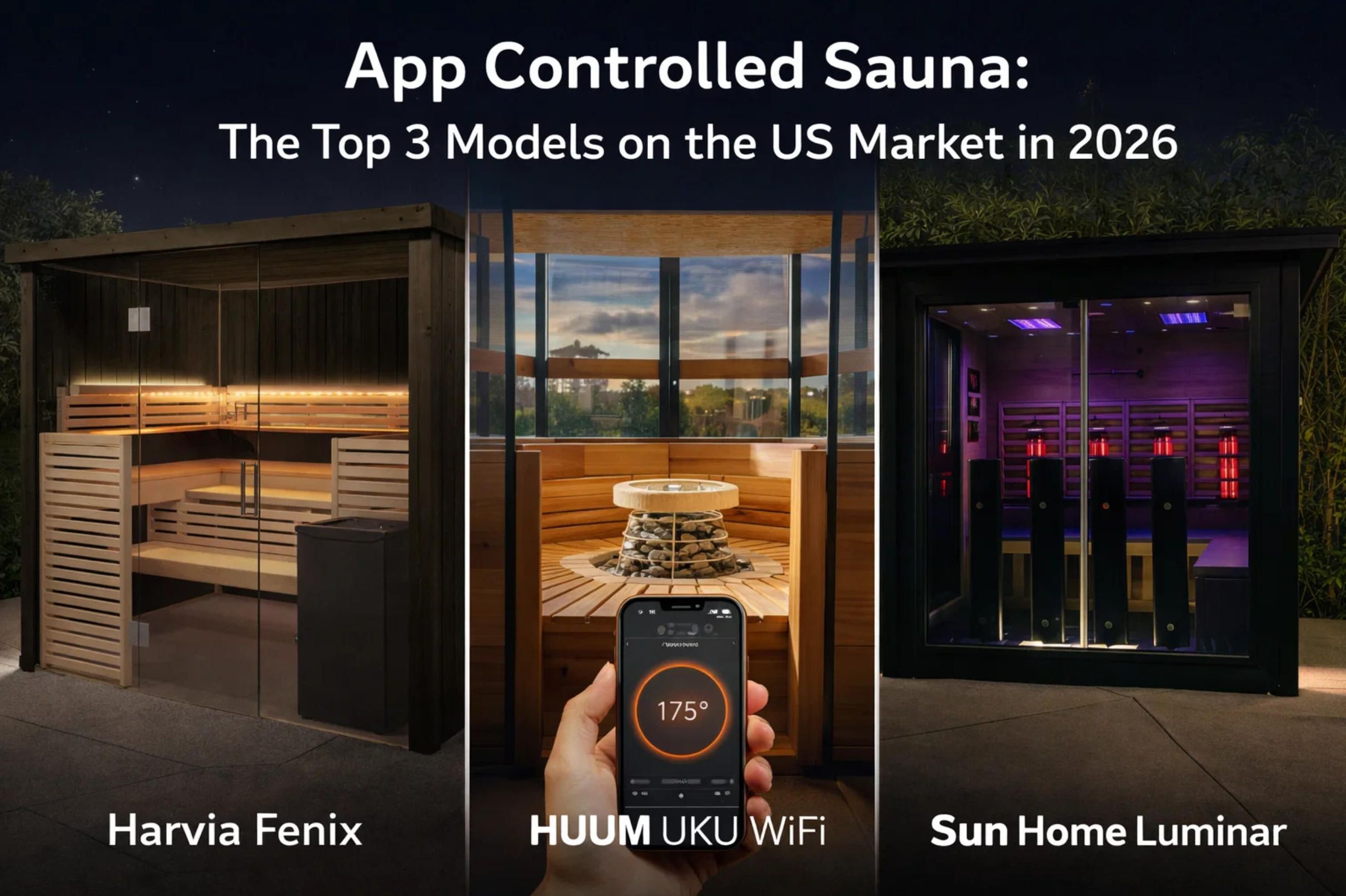
This guide looks at the three app controlled sauna models that actually deliver on the promise in the United States in 2026: Harvia's Fenix + MyHarvia 2, HUUM's UKU WiFi + HUUM app, and Sun Home's Luminar + Sun Home app. We review each app controlled sauna through the lens of the mobile application — because a well-built app controlled sauna is, fundamentally, a software product with a wooden box attached.
What Actually Turns a Sauna Into an App Controlled Sauna
Before we compare models, it helps to demystify the architecture. Every app controlled sauna on the US market today is built on roughly the same five-layer stack:
- The heater itself — electric (Harvia, HUUM, Finnleo, Saunum) or infrared panels (Sun Home, HigherDOSE, Clearlight, Peak Saunas).
- A smart controller with a CPU, temperature sensors, and a relay board that can open and close the power circuit to the heater.
- A WiFi module that either sits on the controller board directly (Harvia Fenix, Sun Home Luminar) or communicates with it over a local protocol (HUUM UKU).
- A cloud backend that brokers commands between the user's phone and the controller, stores session history, pushes firmware updates, and handles authentication.
- The mobile app — the part the user actually sees. It is where all the engineering of the other four layers either shines or falls apart.
A properly designed app controlled sauna handles three jobs without fuss: it heats to a target temperature at a scheduled time, it refuses to do anything unsafe, and it tells you what is happening in real time. Everything else — chromotherapy lighting, guided breathwork, usage analytics, voice control, multi-user household access — is gravy. But the gravy is increasingly what separates a premium app controlled sauna from a commodity one. That is where custom software teams like A-Bots.com come in, and we will get to that.
If your sauna app makes the user think about software, the software has failed. A good app controlled sauna feels like the cedar heated itself.
The other thing to understand about an app controlled sauna is that the "app" is not a peripheral convenience. Under the current regulatory framework (more on that later), the mobile application is a certified safety-critical component. Every app controlled sauna that supports remote start must enforce a door-interlock state before any heating command can be issued. A bug in that state machine is not a UX issue — it is a certification issue.
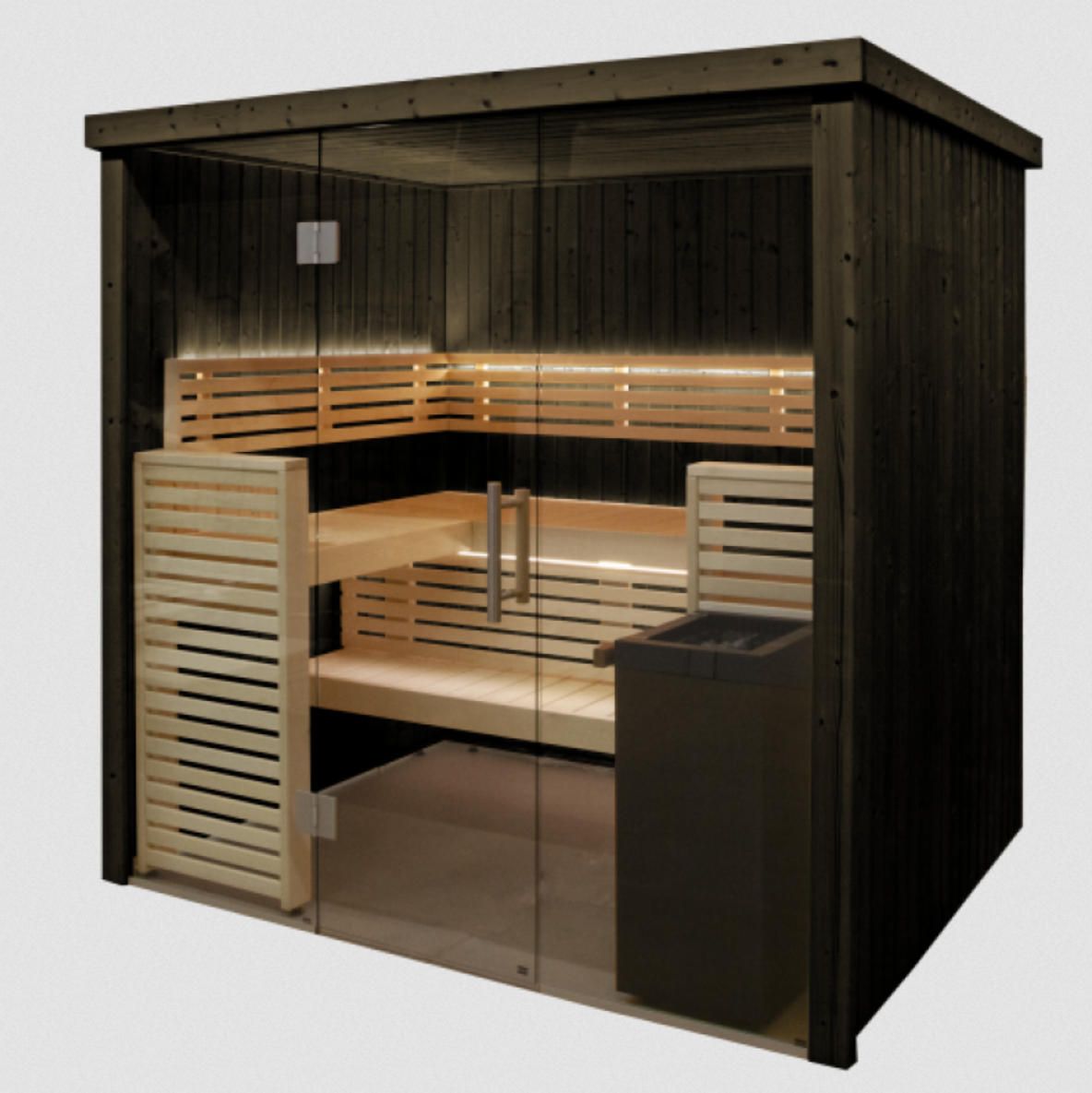
Number 1 — Harvia Fenix + MyHarvia 2 App (Finland)
Harvia is the world's largest sauna heater manufacturer by revenue — €175.2M in 2024, with roughly 700 employees across Finland, the United States, Germany, Romania, Austria, Italy, Estonia, Sweden, and China, per Harvia Group's 2024 financial report. When Harvia launched Fenix in September 2025, the company framed it as a full architectural reset of its app controlled sauna platform. It is, at the time of writing, the most technically ambitious app controlled sauna controller shipping at scale.
The hardware the app talks to
Fenix is a 4.3-inch glossy glass touchscreen that can be installed recessed, surface-mounted, or — unusually — inside the sauna itself, thanks to its heat-resistant build. Built-in WiFi comes standard on every Fenix unit. There are no add-on modules, no dongles, no "WiFi kit sold separately" footnotes. The controller is compatible with Harvia's Club, Spirit, Cilindro, and Virta heater series and has been UL-certified for the US market from day one. Any owner of an older Harvia XE or XW heater can upgrade to a Fenix-powered app controlled sauna by swapping the control panel alone — the RJ10-RJ10 data cable is reused.
What MyHarvia 2 actually does
MyHarvia 2 is not a remote-start toggle. The app pairs via QR code (a small but telling onboarding upgrade), then exposes:
- Target temperature between 104°F and 194°F (40°C–90°C).
- Humidity control from 20% to 80% RH on Combi heaters.
- Three preset heating profiles — Mild, Cozy, and Hot — each fully customizable.
- Timed start, week timer, and a delayed-start window.
- Lighting, ventilation, and steamer management from a single screen.
- Usage statistics, maintenance notifications, and over-the-air firmware updates.
- A dedicated Guest Mode for public or shared installations — vacation rentals, hotels, spas — that simplifies the UI for one-off users.
The headline feature of this app controlled sauna is AI-assisted adaptive heating. Fenix continuously learns how your specific heater performs in your specific sauna room — room volume, insulation quality, ambient temperature, heater age — and optimizes start times accordingly. You tell it "I want the sauna ready at 7:00 PM," and it calculates the ideal moment to begin heating. The older Xenio controller, which Fenix replaces for most buyers, does not do this. Harvia has stated that more Fenix-compatible products will be introduced throughout 2026, expanding the connected app controlled sauna experience across its portfolio.
There is one additional business-model wrinkle worth mentioning. Fenix ships with a free "MyHarvia Core" license that allows remote monitoring, notifications, and usage history, but not remote start. Remote start of the heater requires the paid "MyHarvia Control" license, purchased directly in the app. New Fenix buyers get a three-month Control trial. This is the first time a major sauna manufacturer has moved to a tiered software subscription on an app controlled sauna — and it is a trend US manufacturers watching the category should pay attention to.
Where this app controlled sauna falls short
App Store reviews consistently flag a few pain points. The 60-minute safety timer cannot be extended from inside the app — you have to physically reach the control panel and restart the heater. The time-remaining counter is small and only becomes useful after the target temperature is reached. Siri Shortcuts support is missing, which limits Apple smart-home integration. Multi-device pairing remains finicky per user reviews. These are exactly the kind of issues a custom-built app controlled sauna platform would iterate away in a single sprint.
Harvia built a heater that learns. Now it just needs an app whose timer is readable from more than six inches away.
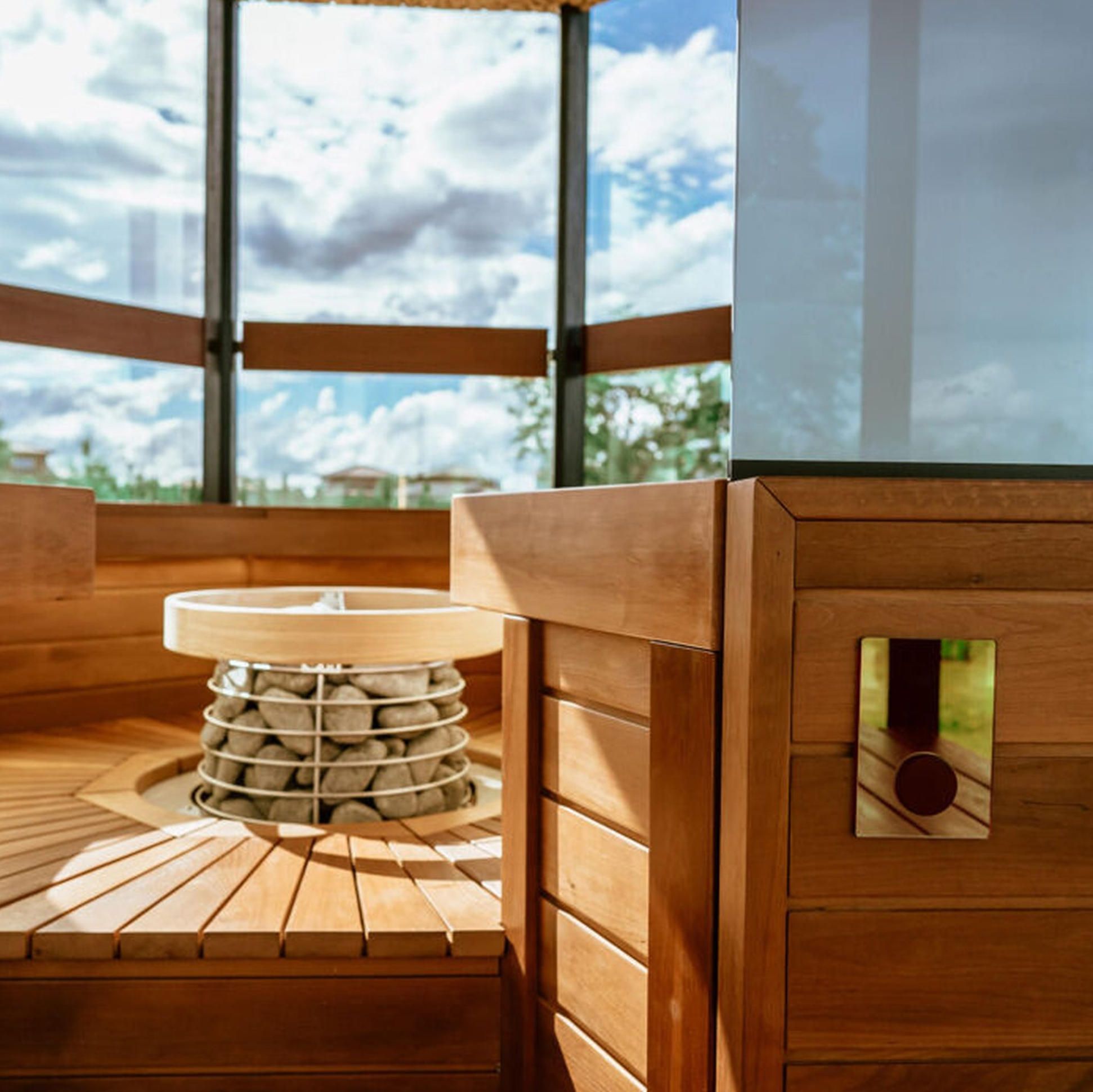
Number 2 — HUUM UKU WiFi + HUUM App (Estonia)
If Harvia is the scale player, HUUM is the cult favorite. Based in Tallinn, HUUM placed the first smartphone-compatible sauna controller on the market back in 2014, per the company's own product history — a full decade before "IoT sauna" became a marketing term. The UKU line is the standard by which serious US sauna enthusiasts measure every other app controlled sauna controller, and it is available on Amazon, at Nordica Sauna, Steam Sauna Supply, and every specialty retailer worth the name.
The hardware the app talks to
UKU WiFi consists of a small control panel (4.1" × 2.2" × 0.9" / 105 × 55 × 22 mm) and a main module that sits outside the hot room. The panel won a Red Dot Design Award and comes in Classic, Glass, and Wood casings to match different sauna interiors. UKU works with heaters from most manufacturers — not just HUUM's own stainless-steel stoves — as long as the heater supports remote control and has a temperature sensor. For heaters between 12 kW and 18 kW, a HUUM Extension Box is required. A door sensor ships in every box, because HUUM's approach to an app controlled sauna is that it simply will not heat if the sauna door is open.
What the HUUM app actually does
The HUUM app is deliberately minimalist — and after using MyHarvia 2, some owners find the restraint refreshing. Core functions:
- Target temperature between 104°F and 230°F (40°C–110°C). Yes, the upper end is higher than Harvia's — HUUM is built for traditional Finnish löyly.
- Heating periods of 3, 6, 12, or 18 hours.
- Delayed start scheduling up to 48 hours in advance.
- Real-time temperature readout and a push notification when the sauna is ready.
- Separate control of lighting, ventilation, and steamer, once wired to the main module.
- Multi-user access: anyone with the controller ID can install the HUUM app and operate the app controlled sauna, so a whole family — or an Airbnb guest — can fire up the heat.
- Eight app languages: English, Estonian, German, Finnish, Russian, Polish, Italian, and French.
- Built-in safety suite: overheating protection, child lock, and the door sensor.
- Upgradeable: if you buy the local-only UKU and later want an app controlled sauna, you can pay to unlock WiFi remotely through the app — no electrician visit required.
HUUM has a real user story that illustrates the hospitality use case. Adam Rang of Estonian Saunas gives each short-stay guest in Tallinn the controller login, and guests pre-heat the sauna remotely during their day of sightseeing. That is an app controlled sauna doing more than replacing a dial — it is creating a new category of hospitality amenity. US vacation-rental operators have started to catch on: a HUUM-equipped app controlled sauna in a Vermont cabin or Colorado cottage is now a demonstrable rate uplift on Airbnb and VRBO.
Where this app controlled sauna falls short
HUUM does not do AI-assisted heat-up optimization. It does not offer programmable thermal profiles the way Saunum's AirIQ app does. It still requires 2.4 GHz WiFi, which is a stumbling block in mesh-network homes pushing most traffic to 5 GHz, and the UKU WiFi is confirmed incompatible with ASUS Lyra amplifiers per Haven of Heat's 2026 sauna apps review. There is no native Alexa, Google Home, or Siri integration — though some Home Assistant enthusiasts have built their own IFTTT bridges. For a manufacturer evaluating what software to ship with its own app controlled sauna, HUUM is the "do the fundamentals beautifully" template.
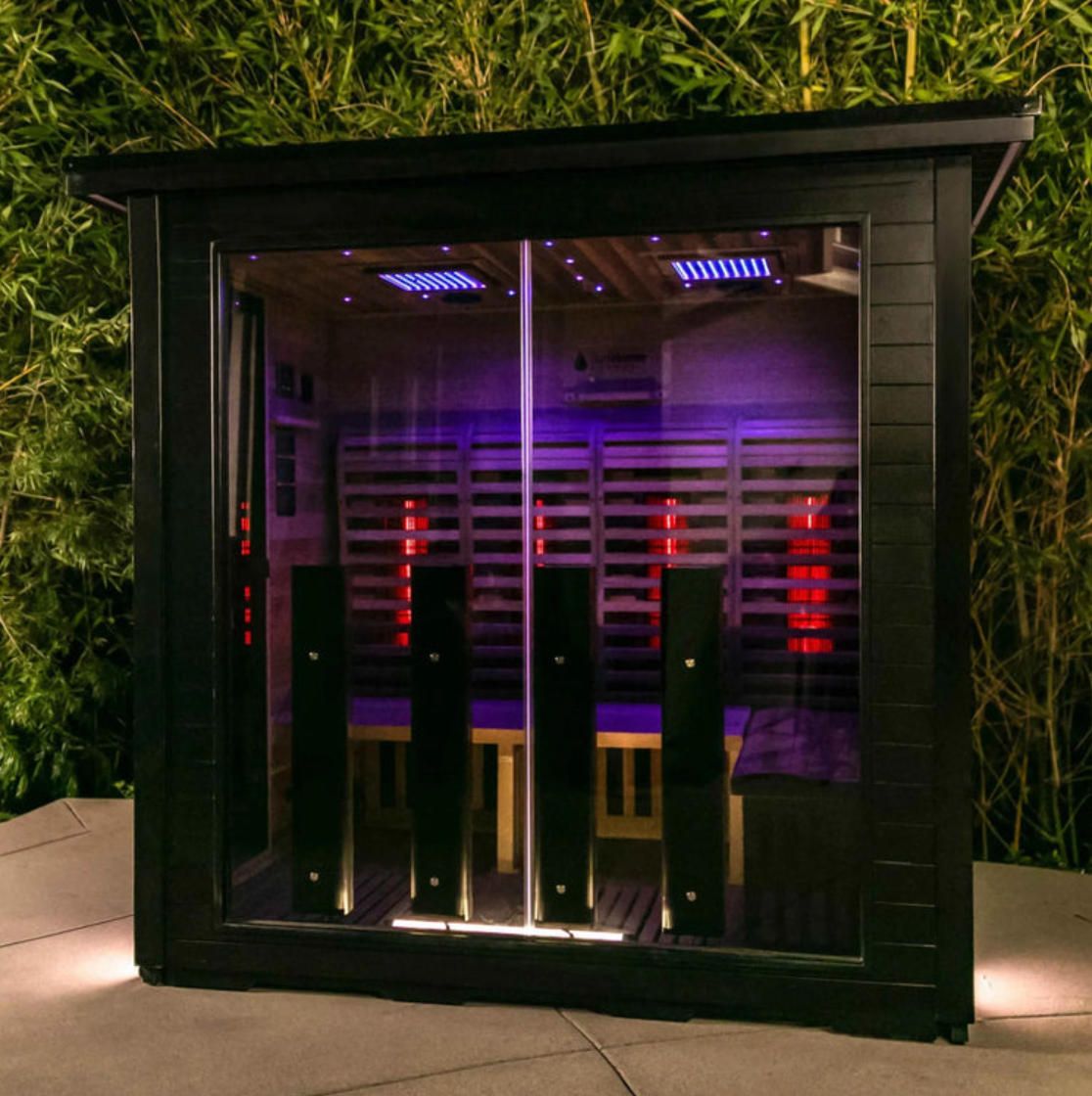
Number 3 — Sun Home Luminar + Sun Home App (USA)
Sun Home Saunas is the US-native entry on this list and the one most explicitly designed as a wellness ecosystem rather than a heater accessory. The Luminar — available in 2-person indoor, 2-person outdoor, and 5-person outdoor configurations — has been named best outdoor sauna in the world by the New York Post and Sports Illustrated, tested positively by Family Handyman and Popular Science, and routinely cited in Forbes' home wellness buying guides. The company positions itself as the #1 fastest-growing consumer services company in America and is 100% US-owned and staffed.
The hardware the app talks to
The Luminar is a full-spectrum infrared app controlled sauna, not a traditional Finnish unit. The 5-person outdoor model ships with 15 heaters — 10 full-spectrum (near, mid, far) and 5 FIR — distributed across walls, back, bench, and floor for 3D heat coverage. Temperature ceiling is 170°F (infrared saunas target skin directly, so ambient temperature runs lower than traditional 200°F+ sessions). Construction uses aerospace-grade aluminum exterior with carbonized red cedar interior and double-pane black glass throughout for insulation. Every Luminar requires a dedicated 20A circuit — not a standard household outlet — which is a real consideration for US homeowners: your app controlled sauna needs an electrician before it needs WiFi.
What the Sun Home app actually does
This is where Sun Home differentiates. Beyond standard remote temperature and session controls, the Sun Home app integrates:
- A library of guided breathwork courses playable over the sauna's built-in Bluetooth surround sound — confirmed in Popular Science's Eclipse review from February 2026.
- Medical-grade chromotherapy lighting control — multiple colors plus customizable fade patterns.
- Oxygen ionizer toggles — the Luminar includes a built-in ionizer that purifies sauna air to reduce pollen and dander during a session.
- Interior and exterior LED accent programming.
- Full audio control over the Bluetooth premium surround sound system.
- A physical remote with holder as a backup channel, plus an interior wall panel — meaning the Sun Home app controlled sauna offers three parallel control surfaces (app, remote, panel).
The Luminar is a 2026-era vision of what a premium infrared app controlled sauna looks like: the app is not a utility, it is a front door to a wellness ecosystem that also includes Sun Home cold plunges, red light therapy add-ons, and infrared blankets. The mobile app controlled sauna experience is bundled with cold-plunge session scheduling and contrast-therapy routines that recommend sauna-then-plunge timing. For US manufacturers watching the premium end of the market, this is the direction of travel.
Where this app controlled sauna falls short
At $11,499 for the 2-person outdoor Luminar and $14,599 for the 5-person, per Family Handyman's 2026 review, Sun Home is not cheap — and the app controlled sauna ecosystem it offers is deep but proprietary. You cannot swap in a third-party controller the way you can with HUUM. And unlike Harvia Fenix, Sun Home has not publicly rolled out AI-adaptive heating. The differentiation is in the content library, not the thermal intelligence — for now.
What These Three Apps Teach Sauna Manufacturers
Looking across all three, a clear playbook emerges for any hardware company thinking about shipping its own app controlled sauna.
Safety architecture is non-negotiable. Every serious app controlled sauna uses a door sensor that blocks remote start if the sauna door is open. This is not a nice-to-have — it is a regulatory requirement under IEC/EN 60335-2-53 and the new ANSI/UL 60335-2-53. Your app has to handle the "door open" state gracefully, not just throw an error. The entire heating state machine of any app controlled sauna needs to treat the door sensor as a first-class citizen, not an afterthought.
Onboarding via QR code beats Bluetooth pairing. MyHarvia 2 moved to QR pairing for a reason: it cuts dozens of support tickets per thousand units sold. Any app controlled sauna shipping today with typed-in Wi-Fi credentials as its primary onboarding path is bleeding CSAT.
Multi-device, multi-user access is table stakes. HUUM allows unlimited users per controller ID; Finnleo's SaunaLogic2 supports admin-created "Families" with sub-accounts. If your app controlled sauna limits a household to one phone, you will get one-star reviews — especially from the US premium buyer who expects the same household-sharing UX they get from Nest, Ring, or Apple HomeKit.
Over-the-air firmware updates are mandatory. Fenix ships OTA on day one; this is the only sustainable way to patch bugs and roll new features once units are in the field. An app controlled sauna without OTA is a device that ships with whatever bugs it had on shipment day for the next fifteen years.
Notifications matter more than dashboards. The single most-used feature across all three apps is the "sauna is hot" push notification. Users check the dashboard once; they receive the notification every session. The entire information architecture of a well-designed app controlled sauna should be organized around that one moment.
The app controlled sauna is becoming an ecosystem, not a remote. Sun Home's breathwork library, HUUM's vacation-rental use case, and Harvia's usage analytics and tiered licensing all point to the same trend: software is where margin expansion happens in the next decade of this industry. The next generation of app controlled sauna products will compete on content, contrast therapy integration, HRV data, and session coaching — not on kilowatts.
Every app controlled sauna that ships without a door-interlock state machine is a warranty claim waiting to happen — and possibly a subpoena.
The Regulatory Reality: UL 60335-2-53 and Why It Matters to Your App
Any manufacturer building an app controlled sauna for the US market now has a clear standard to design against: ANSI/UL 60335-2-53, First Edition, published by Underwriters Laboratories on June 27, 2025. It is a direct adoption of IEC 60335-2-53 Edition 4.2 (2021), which means US and European app controlled sauna products now operate under harmonized rules for the first time. The new standard replaces the previous US-specific UL 875 and aligns American safety expectations with the international norm that Harvia, HUUM, and every European manufacturer has been designing to for years.
A few requirements bear directly on the mobile app side of an app controlled sauna:
- Electric sauna heating appliances up to 20 kW at 250V single-phase (or 480V for other configurations) fall in scope — covering essentially every residential app controlled sauna on the US market.
- Any heater that supports a "stand-by mode for remote operation" must be paired with a door interlock. If the door is opened while stand-by is active, the stand-by mode must be disabled. The app must reflect this state and prevent start commands that violate it.
- Sauna rooms must be visually inspected before remote start is permitted on public or commercial units — meaning a commercial-grade app controlled sauna app needs an attested-inspection step, not just a "tap to heat" button.
- Thermostat and thermal cut-out contacts must operate independently, and the app must never be the sole fail-safe.
- The 2021 revision expanded scope to explicitly include infrared cabins, which is why the Sun Home app controlled sauna falls under the same regime as Harvia's traditional Finnish heaters.
For a manufacturer, the takeaway is that the app is not a peripheral — it is a certified safety component. A bug in your state machine is a certification issue, not just a user-experience issue. That is why most serious sauna brands either license a tested third-party platform (Harvia, HUUM) or outsource their app controlled sauna software development to IoT-focused teams who have built against UL and IEC standards before.
If You Manufacture Saunas: A-Bots.com Builds Custom IoT Apps For Hardware Brands
If you are a sauna manufacturer — electric or infrared, residential or commercial — evaluating whether to build your own app controlled sauna platform rather than licensing someone else's, the software side is what will make or break the product. That is exactly what A-Bots.com builds.
A-Bots.com is a full-cycle software development company with offices in the USA, Ukraine, and Romania, and a portfolio of 70+ completed projects. Our core stack includes React Native, Swift, Kotlin, and Java on the mobile side; Node.js, Python, Django, and React on the backend and web side; plus Solidity and C++ where the project needs them. That is the exact stack a modern app controlled sauna platform requires: cross-platform iOS and Android clients, a cloud backend handling device telemetry and scheduling, firmware OTA tooling, and optionally a web dashboard for commercial spa operators and dealers.
Our most directly relevant reference is the Shark Clean project — we built the IoT mobile application for Shark's connected robotic vacuums. That app handles exactly the problem a sauna manufacturer faces: pairing a smart appliance to a home WiFi network, exposing granular device control without overwhelming the user, streaming real-time state, scheduling sessions, and doing all of that across iOS and Android while integrating with a cloud backend. Swap the vacuum for a heater and you have the skeleton of a production-grade app controlled sauna platform.
We also have direct experience with the adjacent problems: Scandpay (BLE and Wi-Fi commerce flows in retail environments), LYST (high-throughput API aggregation across 12,000+ brand catalogs), and BSSAuto (telematics-style dashboards with Telegram integration for real-time push alerts). All of these translate to sauna IoT: BLE onboarding, WiFi provisioning, cloud sync, real-time notifications, multi-user households, dealer admin portals.
What we typically deliver for a sauna brand building an app controlled sauna platform includes:
- Cross-platform mobile app for iOS and Android (React Native or native Swift + Kotlin, depending on performance budget).
- Secure cloud backend with device telemetry, scheduling, authentication, and OTA firmware pipelines.
- Admin and dealer portal for your sales and support teams.
- A safety-interlock state machine designed against UL 60335-2-53 and IEC 60335-2-53 requirements.
- Integration with Alexa, Google Home, and Siri Shortcuts — the absence of which is the most common complaint in every major sauna app review.
- Optional guided-content library for breathwork, meditation, contrast therapy, and music — the "ecosystem" layer that elevates an app controlled sauna above a commodity controller.
- Usage analytics, session history, and maintenance notifications.
- A go-to-market design system that matches your brand — not a templated white-label look that screams "we bought this from a supplier."
Most of our clients have been with us for at least 1.5 years, and some for more than five. For a hardware product that will be on the market for a decade, that continuity matters more than any feature checklist. An app controlled sauna is not a one-and-done delivery — it is a platform that needs iterative improvement for as long as the heaters are under warranty.
If you already ship an app controlled sauna and are unhappy with its quality, we also do QA testing engagements — functional, compatibility, security, and load — to give you an independent read on where the weak points are before they surface in App Store reviews.
Build Your App Controlled Sauna With A-Bots.com
The app controlled sauna market is moving from "remote-start toggle" to "full wellness ecosystem" faster than most hardware brands can keep up. If you manufacture saunas and want a mobile app that matches the quality of your cedar, contact us. The best app controlled sauna of 2030 will be defined by software — make sure yours is ready.
A-Bots.com — Custom Mobile, IoT, and Web Development 📧 info@a-bots.com 🌐 a-bots.com
Whether you need a ground-up custom app controlled sauna platform, a QA and testing pass on an existing app controlled sauna release, or strategic consultation on IoT architecture for your next model line, our team can scope and deliver.
✅ Hashtags
#AppControlledSauna
#SmartSauna
#SaunaApp
#IoTSauna
#SaunaTechnology
#HomeSauna
#WellnessTech
#CustomAppDevelopment
Other articles
Drone Solutions for Energy Infrastructure Energy infrastructure inspection is shifting from helicopter patrols and climbing crews to automated drone workflows. This article details three production-ready use cases built on ArduPilot firmware and Mission Planner: radiometric thermal inspection of utility-scale solar farms with IEC 62446-3 compliance and AI-powered defect classification, LiDAR-based power line corridor mapping with vegetation clearance analysis and digital twin generation, and BVLOS pipeline surveillance with onboard optical gas imaging and real-time methane leak alerting. Each case specifies hardware architecture, ArduPilot parameters, Mission Planner configuration, and custom software modules developed by A-Bots.com for seamless integration with existing CMMS and regulatory reporting systems.
Ardupilot Drone Solutions: Construction Mining SAR Construction sites, mining operations, and search-and-rescue missions share a common need for frequent, accurate aerial data delivered faster than traditional methods allow. This final article in a three-part series details three production-ready drone use cases built on ArduPilot and Mission Planner: weekly photogrammetric construction progress monitoring with automated BIM overlay and cut-fill volumetrics, mining stockpile and pit progression surveys using RTK-enabled LiDAR with slope stability tracking, and thermal search-and-rescue operations with real-time AI human detection on NVIDIA Jetson companion computers. Each case specifies hardware, firmware parameters, and custom software developed by A-Bots.com.
Bluetooth and UWB Item Trackers 2026: AirTag vs SmartTag The smart tracker market surpassed $856 million in 2025 and continues to grow rapidly as consumers and businesses adopt Bluetooth and UWB tracking solutions. This article examines the technical architecture behind modern item trackers, including BLE crowdsourced networks, Ultra-Wideband precision finding, and the DULT anti-stalking standard. It provides a detailed comparison of Apple AirTag 2, Samsung Galaxy SmartTag 2, and Tile Pro across key metrics such as range, battery life, accuracy, network size, and privacy safeguards. The article also explores practical use cases from luggage tracking to bicycle theft prevention and highlights opportunities in custom tracking app development for businesses entering this space.
GPS Trackers 2026: Tracki vs Invoxia vs LandAirSea Compared The GPS tracking device market reached $4.9 billion in 2025 and is projected to grow to $13.6 billion by 2033, driven by fleet management demand, IoT adoption, and rising vehicle theft concerns. This article examines the technical architecture behind modern cellular GPS trackers, including multi-constellation GNSS positioning, LTE-M and NB-IoT connectivity protocols, and hybrid indoor-outdoor location systems. It compares three leading long-range trackers: Tracki 4G, Invoxia GPS Tracker Pro, and LandAirSea 54 across range, battery life, accuracy, pricing, and subscription models. The article also presents NICB vehicle theft recovery data demonstrating that GPS-equipped vehicles are recovered at rates exceeding 90%, and explores custom GPS tracking app development opportunities for logistics, fleet management, and enterprise clients.
NVIDIA DGX Spark: A $4,699 Supercomputer on Your Desk - Is Personal AI Sovereignty Worth the Price? NVIDIA DGX Spark packs one petaFLOP of AI compute and 128 GB of unified memory into a 1.2 kg desktop box — enough to run 200-billion-parameter models entirely offline. But at $4,699 (now up from $3,999 after a February 2026 price hike), with monthly ownership costs rivaling a ChatGPT Pro subscription and models that still lag behind cloud frontiers, who is this actually for? This deep-dive covers real benchmark data, a full European cost-of-ownership breakdown, the NemoClaw agent stack, the global AI sovereignty trend from Gartner to Vitalik Buterin, head-to-head comparisons with AMD Strix Halo and Mac Studio, and what the next generation of home AI servers will look like.
Top stories

Copyright © Alpha Systems LTD All rights reserved.
Made with ❤️ by A-BOTS