
Home
Services
About us
Blog
Contacts
Mobile Development Equipment for Truck Drivers and Compliance: A 2026 Technical Guide to FMCSA, DVIR, IFTA, and eCMR
Compliance is where trucking software stops being clever and starts being legally binding. A dispatcher can forgive a buggy route optimizer. A driver can work around a slow POD upload. A carrier cannot explain to FMCSA why 2,400 drivers across the fleet had their duty-status logs drift by three minutes because the ELD app's clock sync was wrong. That is the $16,000-per-violation conversation, multiplied by the CSA score damage, multiplied by the insurance premium hike. Compliance is the layer where getting it wrong costs the business directly.
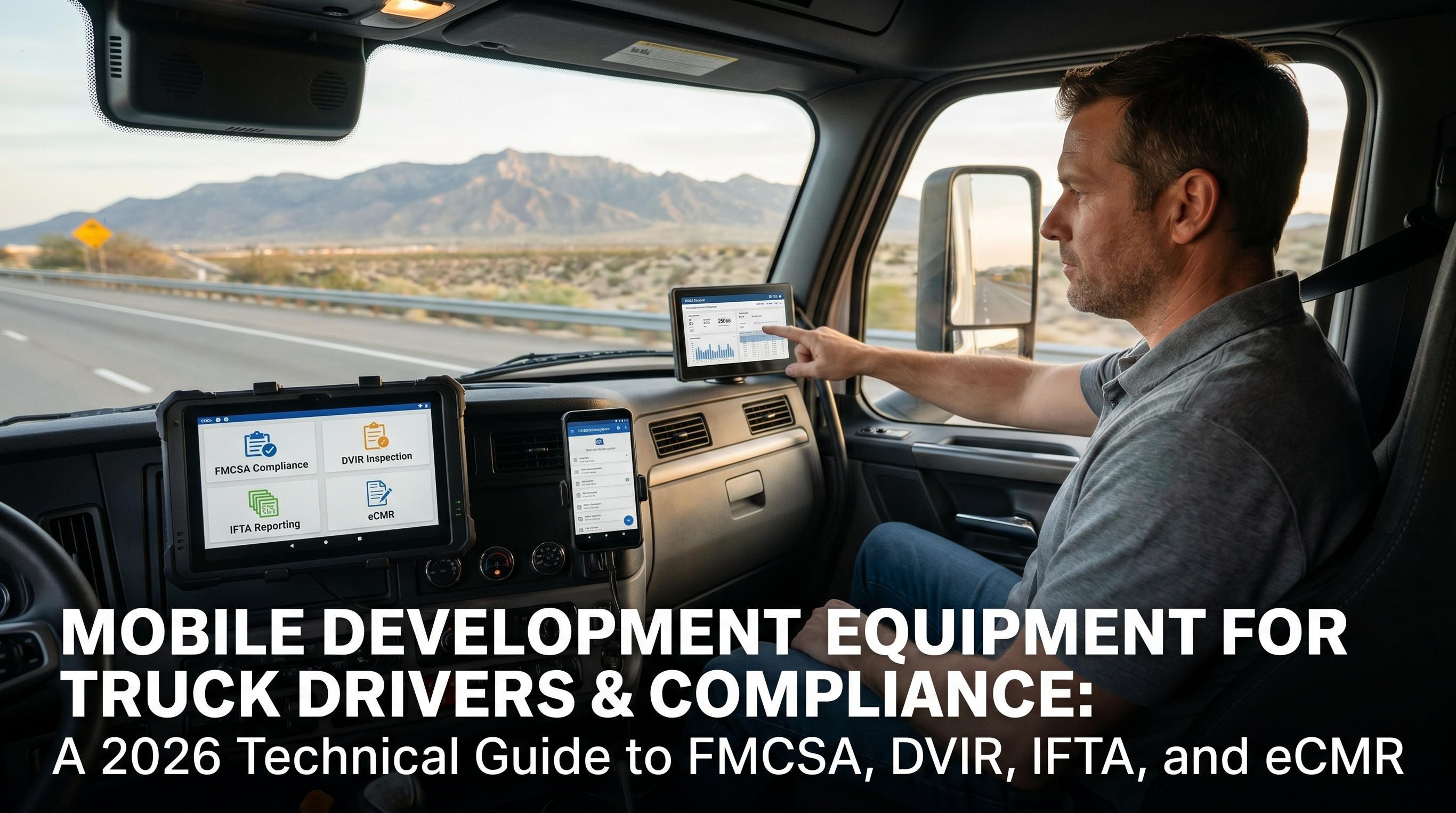
This is article three in a five-part series on mobile development equipment for truck drivers. Part one, ”Mobile Development Equipment for Truck Drivers: The Complete 2026 Stack”, mapped the whole hardware-plus-software ecosystem. Part two, ”App Development Equipment for Truck Drivers”, walked through when off-the-shelf ELDs hit their walls and when custom builds take over. This article goes into the regulatory plumbing — 49 CFR Part 395 (the ELD mandate), Part 396 (driver vehicle inspection reports), IFTA quarterly fuel-tax reporting, and the emerging eCMR framework for European operations — and looks specifically at the failure modes that live inside mobile development equipment for truck drivers, below the vendor dashboards, where a custom build either gets it right or doesn't.
A dispatcher calls the developer: "The ELD is showing fifteen minutes of unassigned drive time every morning." The developer asks when the drivers log in. "About fifteen minutes after the engine powers up." The developer nods slowly.
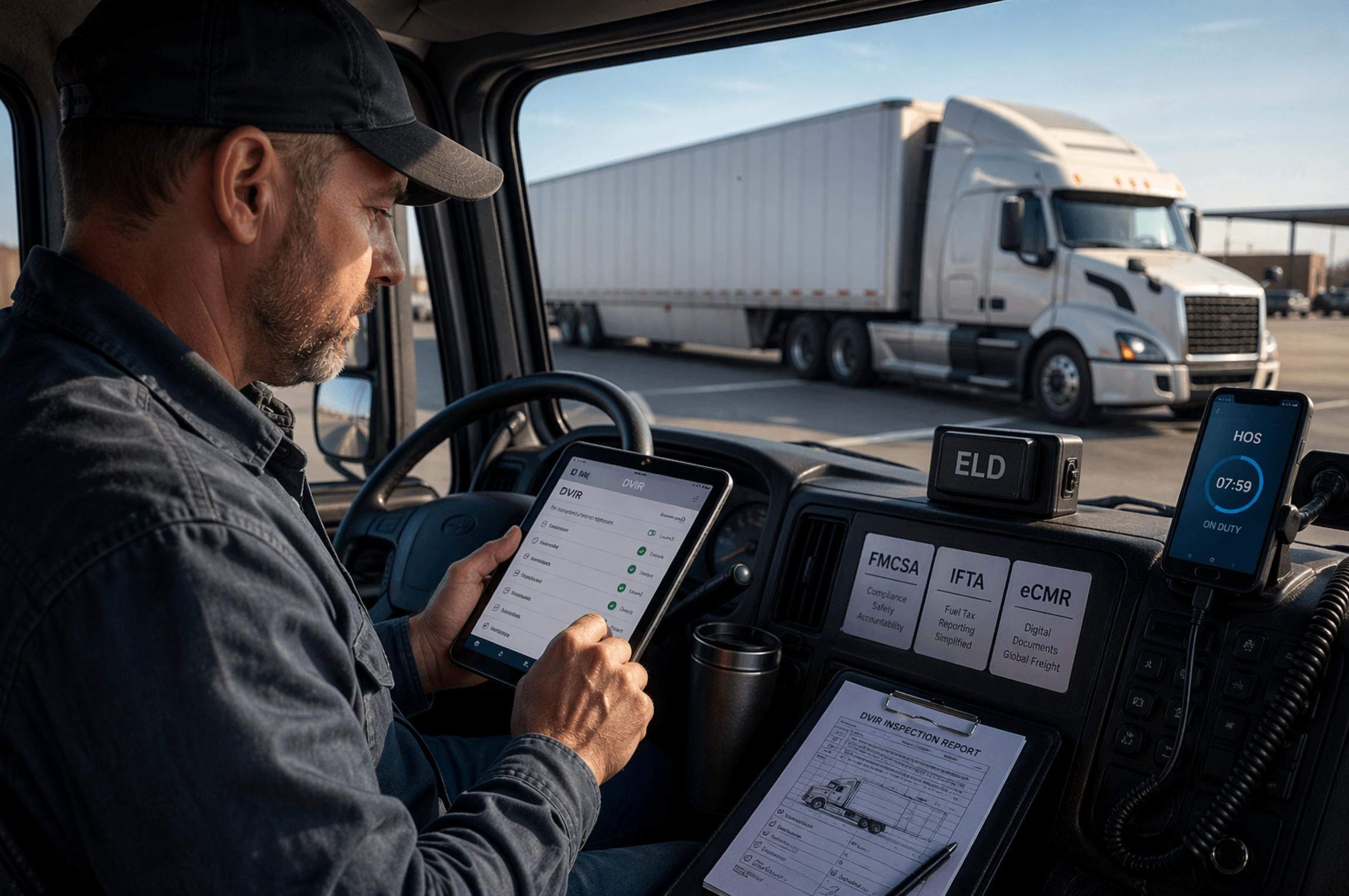
The ELD Mandate: 49 CFR Part 395, in Working Detail
The legal foundation for every ELD on the US road is 49 CFR Part 395, Subpart B, with the full technical specification in Appendix A to that subpart. FMCSA's final rule took effect in December 2017, and by 2026 the mandate is fully in force with no remaining AOBRD (Automatic Onboard Recorder) grandfather.
The high-level requirement is simple. A motor carrier whose drivers keep records of duty status must use a registered ELD — an ELD listed on FMCSA's registered-devices list at fmcsa.dot.gov/devices. The ELD has to connect to the vehicle's engine ECM, automatically record driving time when the vehicle is in motion, record GPS locations at duty-status changes and at 60-minute intervals during driving, support driver identification, provide at least two standardized data-transfer methods for roadside inspection, indicate malfunctions visibly, and be tamper-resistant for original driving data. The carrier has to retain ELD records and back-up data for six months on a device separate from the primary storage.
That is the 50,000-foot view. Below it, Appendix A spells out the specifications that actually matter when someone is writing the code. A few of the ones that bite hardest:
Engine synchronization. Per §4.2, engine synchronization means monitoring engine power status, vehicle motion, miles driven, and engine hours. Per §4.3.1.1, the ELD must be powered and fully functional within one minute of the vehicle's engine receiving power. Per §4.5.1.6, the ELD has one minute to establish the ECM link and record the power-up event. If the ELD cannot acquire values for the required parameters within five seconds of needing them after that one-minute window, §4.6.1.2 requires an engine-synchronization diagnostic event to be recorded. This is the failure mode the intro joke points to — drivers logging in fifteen minutes after engine start produce unassigned drive time, and if the software layer does not handle the reconciliation correctly, the carrier inherits phantom violations.
Location accuracy. Per §4.3.1.5 and the 2015 rule preamble, ELDs record location with accuracy of approximately a 1-mile radius during on-duty driving. FMCSA does not require real-time tracking and does not require precise GPS coordinates — but it does require consistency and the ability to confirm jurisdictional position for HOS enforcement.
Duty status categories and configurability. Per §4.3.3.1.1, an ELD must allow a motor carrier to configure the availability of the three optional duty-status categories (Personal Use of CMV, Yard Moves, and Driver Intermediate Log) on a per-driver basis. By default, none of these are available to a new driver account. The carrier has to proactively enable them. A custom app that ships with Personal Use on by default is already out of compliance.
Malfunction and diagnostic indicators. Per §4.6.1 and the malfunction table in Table 4 of Appendix A, the ELD must monitor its own compliance for a specified list of detectable malfunctions — power, engine synchronization, timing, positioning, data recording, data transfer, and unidentified driving records. A visual malfunction indicator must be clearly illuminated when there is an active malfunction, and the indicator must be visible from the normal driving position. When a malfunction occurs, the driver has eight days to have it repaired or the ELD replaced, and the carrier must begin the reconstruction of paper RODS within 24 hours of notification.
Data transfer methods. Per §4.9, an ELD must support at least two of the following transfer methods: telematics (web services and/or email) or local (USB 2.0 and/or Bluetooth). The output file itself is a standardized CSV format defined in Appendix A. A roadside officer requests a transfer; the ELD produces the file; the officer's software parses it. If the file fails validation — wrong field order, wrong character encoding, missing required elements — the carrier is functionally operating without a compliant ELD.

Why Device Revocation Has Become the 2026 Story
The stakes changed in late 2025. On December 30, 2025, FMCSA issued a revocation notice for three ELD devices. On January 13, 2026, four more. By February 12, 2026, a total of nine ELD products had been pulled from the registered-devices list within a roughly ten-week window. Motor carriers using the revoked devices had a 60-day grace period — deadlines ranging from February 7, 2026 to April 14, 2026 — to replace them with compliant devices or revert to paper logs.
After the grace period, under §395.8(a)(1), using a revoked ELD is treated identically to using no ELD at all. That means an out-of-service order under CVSA criteria (minimum 10-hour shutdown), civil penalties of $1,000 to $16,000+ depending on circumstances, CSA score damage in the HOS Compliance BASIC, and, for carriers who cannot produce compliant RODS, a cascade of follow-on violations from the same inspection.
The practical implication for anyone building mobile development equipment for truck drivers is unambiguous: vendor lock-in is now a compliance risk, not just a commercial one. A carrier running a custom driver app on top of a third-party gateway needs a roadmap for swapping gateway providers within 60 days if FMCSA pulls the certification. A carrier running fully custom ELD logic — implementing Appendix A directly in the app — carries that certification responsibility itself, through initial registration and ongoing self-monitoring per §395.23.
The Violations That Actually Cost Money
The ELD enforcement data from 2025 and early 2026 is consistent on which failure modes show up most often in audits and at roadside inspections. In rough order of frequency and penalty severity: failing to provide supporting documents that corroborate RODS (severity weight 7 out of 10); failing to certify daily logs; unassigned driving time not resolved within 13 days; ELD data-transfer failures at roadside; and operating without a registered ELD (which now includes operating a revoked one). Maximum fines for the worst of these have climbed to $19,246 per violation after the May 30, 2025 Federal Register adjustment. Average fine for missing ELD records runs around $2,867. The total business impact of a single serious violation — fine plus $264-per-driver-per-day out-of-service revenue loss plus towing costs averaging $344 per 40-mile tow plus CSA damage plus insurance consequences — typically lands between $5,000 and $20,000.
49 CFR Part 396 and the Electronic DVIR
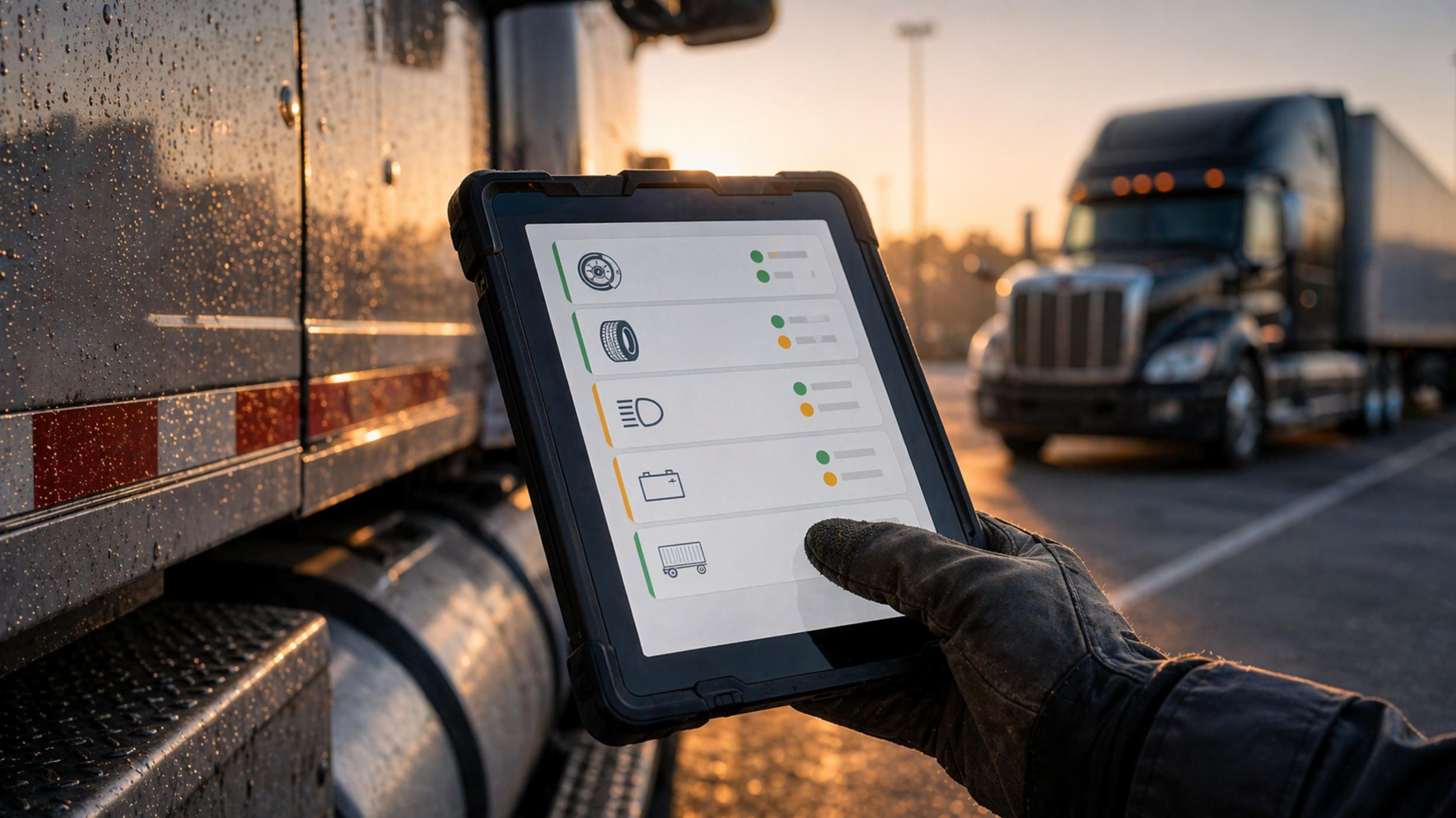
If Part 395 is the glamorous compliance layer, Part 396 is the one carriers actually fail audits on. The Driver Vehicle Inspection Report sits at the heart of Part 396 — specifically §396.11 (driver-written DVIRs at end of day) and §396.13 (next-driver review before operation). Per FMCSA's own audit data, 93% of carriers fail DOT audits with at least one violation, and DVIR deficiencies are routinely in the top three causes.
The regulatory text is short but demanding. §396.11 requires that every motor carrier mandate its drivers to prepare a written report at the completion of each day's work on each vehicle operated. The report must identify the vehicle and list any defect or deficiency discovered by or reported to the driver that would affect the safety of operation or result in mechanical breakdown. If a driver operates more than one vehicle during the day, a separate report is required for each vehicle. Since 2014, drivers of property-carrying CMVs are not required to file a DVIR if no defects were found — but any carrier with a serious compliance posture still requires a daily DVIR as internal policy, because the absence of a DVIR makes it impossible to prove the inspection was performed.
The report must cover at minimum eleven components specified in §396.11(a)(1): service brakes (including trailer brake connections), parking brake, steering mechanism, lighting devices and reflectors, tires, horn, windshield wipers, rear-vision mirrors, coupling devices, wheels and rims, and emergency equipment.
On February 19, 2026, FMCSA published a final rule (Docket FMCSA-2025-0115, RIN 2126-AC89) that amends §396.11 and §396.13 to explicitly authorize electronic DVIRs. The rule took effect March 23, 2026. Electronic DVIRs had already been permissible under 49 CFR 390.32 since 2018, but the 2026 clarification removed the last ambiguity. The rule also confirmed FMCSA's position on not reinstating no-defect DVIRs for property-carrying CMVs, which was the subject of the underlying National Tank Truck Carriers petition.
What Electronic DVIR Logic Actually Has to Do
Building compliant electronic DVIR into mobile development equipment for truck drivers is more subtle than it looks. The regulation demands a chain of custody: driver reports → carrier or mechanic certifies repair → next driver reviews and signs acknowledging the repair status. The app has to enforce all three.
A compliant electronic DVIR implementation typically includes: a customizable 11-item (or longer, for company-specific checklists) inspection flow with the FMCSA minimum categories hardcoded as required; photo capture with GPS and timestamp metadata preserved in EXIF for defect evidence; digital signature capture under 49 CFR 390.32 rules (which require, at minimum, unique signatory identification — not just a scribble on glass); a three-signature chain (driver, repair-certifying authority, next-operator) that blocks dispatch if incomplete; retention under the carrier's record-retention rules (minimum three months under §396.11(c)(2), though most carriers hold for twelve months to match the CSA rolling window); audit-mode export in a format that satisfies roadside officers and auditors.
The economic case is non-trivial. Published operational data shows paper DVIR completion rates running 55–65% while digital DVIR systems consistently reach 94–98% within 30 days of deployment. That gap — driven by paper forms that never reach anyone who can act on them — maps directly onto the carrier's CSA Vehicle Maintenance scores, which as of the 2026 CSA overhaul include a separate "Vehicle Maintenance: Driver Observed" category that directly reflects DVIR thoroughness.
For carriers building custom mobile development equipment for truck drivers, the specific implementation detail that matters most is often the simplest: the app cannot allow a driver to start a trip if the previous DVIR chain is incomplete. That one interlock — enforced in code rather than hoped for in policy — is what separates a compliant fleet from an audit finding.
IFTA: Turning Mileage into Quarterly Tax Returns
The International Fuel Tax Agreement unifies fuel-tax reporting across 48 US states and 10 Canadian provinces. A qualified motor vehicle — two axles with gross vehicle weight above 26,000 pounds, three or more axles regardless of weight, or a combination with combined gross weight above 26,000 pounds — operating across two or more IFTA jurisdictions must file quarterly returns with its base jurisdiction. IFTA filing deadlines are the last day of the month following each quarter: April 30, July 31, October 31, and January 31.
The reports are straightforward in concept and brutal in practice. Every quarter, for every qualified vehicle, the carrier has to calculate: total miles driven (taxable and non-taxable) per jurisdiction; fuel purchased per jurisdiction; tax-paid gallons per jurisdiction; and the net tax liability owed to or owed from each jurisdiction, with the base jurisdiction handling redistribution. Late filing triggers penalties of $50 or 10% of net tax liability, whichever is greater, plus 1% monthly interest on delinquent taxes. An IFTA audit — triggered by late filing, anomalous fuel-consumption ratios, or inconsistent returns — can claw back three years of returns.
The common failure pattern is entirely predictable. Drivers maintain paper trip sheets. Fuel-card data lives in a separate system. State-line crossings are estimated from paper logs. Manual reconciliation introduces errors. The return is filed. An audit triggers. The jurisdiction mileage records do not survive scrutiny. The penalty is assessed on three years of returns.
This is solved in software — or, more precisely, it is solved when the mobile development equipment for truck drivers actually does the work instead of leaving it to a spreadsheet. The correct architecture uses GPS telematics with state-line detection that logs every border crossing automatically, timestamped, with coordinates and odometer reading; fuel-card API integration (Comdata, EFS, WEX, Voyager, TCS) that pulls purchase records daily; ELD mileage data as a corroborating source; and a reconciliation layer that matches ECU fuel-consumption readings against fuel-card purchases per jurisdiction to flag anomalies before filing.
Platforms that implement this well turn three-day quarterly ordeals into 20-minute reviews. Published user case data from OxMaint's integrations with Samsara, Geotab, and Verizon Connect shows carriers reducing quarterly IFTA preparation from three days to under thirty minutes per quarter after integration. The engineering is not difficult. The discipline is.
One subtle trap worth calling out: IFTA auditors accept GPS and ELD data for mileage, but they still require fuel-purchase receipts (fuel-card records or physical receipts) as the source of truth on gallons purchased. OBD ECU consumption data is a cross-check, not a substitute. A custom IFTA module that silently replaces purchase receipts with ECU estimates will fail audit the moment it is reviewed.
eCMR: The European Parallel That Is Arriving Faster Than Expected
For carriers running any European freight — or for US carriers building platforms that might be sold into European fleets — the eCMR framework is the next regulatory layer to understand. It is moving faster than most teams realize.
eCMR is the electronic version of the CMR consignment note, the international road-freight document established by the 1956 Geneva Convention. The 2008 Additional Protocol to the CMR Convention, which took force in 2011, gave eCMR the same legal and evidential value as paper CMR — provided the system authenticates parties, preserves document integrity, and provides full traceability of modifications. As of 2026, 38 countries have ratified the eCMR Protocol.
The pace changed in 2025–2026. The EU's eFTI Regulation (EU 2020/1056) requires national authorities to accept freight documentation in electronic form via certified eFTI platforms from July 9, 2027. By mid-2026, EU Member States are expected to have national systems capable of connecting to the European digital logistics environment. Spain is leading adoption, with digital freight documentation becoming mandatory in 2026 and cross-border implications for any carrier stopping in Spanish territory. Industry expectations, per Polish legal counsel Małgorzata Wieleba-Walicka at TLP, project implementation into national law through 2026 with mandatory application by 2029.
The International Road Transport Union estimates the switch to eCMR could save 75–102 million working hours annually across Europe and eliminate approximately 160 million sheets of paper per year.
What eCMR Adds to the Mobile Stack
Building eCMR capability into mobile development equipment for truck drivers requires several specific additions beyond standard POD capture:
Qualified digital signatures with identity binding. Sign-on-glass alone does not satisfy eCMR. The protocol requires a signature logically linked to the person who signs — either via authenticated username/password, a QR code with two-factor PIN, eIDAS-aligned electronic signatures, or biometric passport verification for non-EU drivers. The cross-border identity problem is real: the European Digital Identity wallet covers EU citizens only, so platforms serving Turkish, Ukrainian, Serbian, or other non-EU drivers need independent identity verification.
Interoperability with certified eFTI platforms. From July 2027, freight data must be accessible through approved eFTI platforms. Custom mobile development equipment for truck drivers operating in Europe has to either implement eFTI integration directly or federate with a partner platform (TransFollow, Transporeon, TESISQUARE, TransFollow Messenger).
Real-time multi-party visibility. Unlike paper CMR, which lives in a driver's pocket until delivery, eCMR updates in real time and is visible to shipper, carrier, and recipient simultaneously. The architecture implication is a multi-tenant data model with field-level access control — not every party sees every field.
Offline capture with post-sync reconciliation. EU highways still include dead zones. eCMR signatures have to be captured offline and synced on reconnection, with the signature's cryptographic integrity preserved through the sync.
Document retention and immutability. Many eCMR platforms use append-only storage (blockchain-based or cryptographically timestamped) to satisfy the Additional Protocol's requirement that modifications be traceable. For a US-based team building European capability, this is often the least familiar piece of the architecture.
Even for purely US carriers, the eCMR direction is instructive. The same patterns — identity-bound signatures, offline-first capture, certified interoperability platforms, immutable audit trails — are where FMCSA's own regulatory direction has been trending. A platform architected for eCMR is, in practice, architected for whatever the next generation of US compliance requires.
Where the Software Layer Actually Fails
Across all four regulatory frames — ELD, DVIR, IFTA, eCMR — the software-level failure modes tend to cluster in the same places. For teams building or commissioning mobile development equipment for truck drivers, these are the ones worth designing against from day one.
Clock synchronization. ELD logs, DVIR timestamps, IFTA jurisdiction-crossing records, and eCMR signature timestamps all depend on a trusted clock. A tablet that drifts by even a few minutes produces records that fail audit. Implementations should use NTP synchronization with fallback, and every record should include both the captured timestamp and the clock source.
Engine power-cycle handling. The one-minute ELD sync window in Appendix A §4.3.1.1 is not optional. If the app does not wake within a minute of engine power-on, does not establish the ECM link within that window, and does not record the power-up event correctly, the resulting unassigned drive time becomes the carrier's problem.
Unassigned driving reconciliation. §395.32 requires motor carriers to review unassigned driving time and assign it to the appropriate driver within 13 days. A pattern of unresolved unassigned driving is a top audit red flag. The app and backend have to enforce a workflow that surfaces unassigned events to the carrier support personnel and closes them on time.
Offline sync determinism. DVIRs completed in a warehouse with no signal, HOS events queued during a dead zone, IFTA jurisdiction crossings logged while the cellular link is down — all of these have to sync deterministically on reconnection without duplication, loss, or out-of-order reordering. Idempotent event IDs, sequence numbers, and server-side deduplication are the minimum architecture.
Data-transfer file validity. The FMCSA ELD Output File format is defined in Appendix A §4.8.2. A single missing required field, a wrong delimiter, a wrong character encoding produces a file that roadside software cannot parse. The carrier is then treated as operating without a compliant ELD.
Malfunction and diagnostic code coverage. The monitoring list in Table 4 of Appendix A includes power diagnostic events, engine synchronization, timing compliance, positioning compliance, data recording compliance, data transfer compliance, and unidentified driving records. Each has specific trigger conditions and logging requirements. Half-implementing this list is worse than leaving it off — because the carrier assumes the ELD is self-monitoring, when it isn't.
Retention and immutability. ELD records at six months. DVIRs at three to twelve months. IFTA records at four years. eCMR records for the statutory period of the shipment contract. A storage layer that silently overwrites or allows edits on records after the fact is the single fastest path to a failed audit.
Each of these is the kind of detail that is easy to skip in a prototype and catastrophic to skip in production.
How A-Bots.com Builds Compliance-Grade Mobile Development Equipment for Truck Drivers
A-Bots.com has built mobile applications that sit between real-world hardware and real-world regulatory environments for years. The engineering patterns are consistent: offline-first capture, cryptographically integrity-checked event streams, deterministic sync, and test harnesses that simulate the failure modes before the fleet encounters them in production.
For trucking clients, our compliance stack is structured around Appendix A first and vendor integrations second. The driver app — built with React Native and native Kotlin/Swift modules where needed for Bluetooth, CAN bus bridges, and background location — implements ELD logic directly against Appendix A where the client chooses to own the certification, or bridges to a commodity FMCSA-registered gateway (Stoneridge, Garmin eLog, My20) where the client prefers to outsource device registration. DVIR logic enforces the §396.11 chain-of-custody rules in code. IFTA jurisdiction-crossing detection runs on-device against a cached state-line geofence database, with fuel-card API integration on the backend. eCMR capability is available for European deployments, with eIDAS-aligned signature capture and eFTI platform bridges.
Our QA discipline on trucking projects specifically includes failure-mode testing against the software-level compliance hazards listed above: clock-drift injection, engine-cycle simulation using Freematics or PCAN-USB gateways, network-outage sync stress tests, and roadside-inspection file-validation harnesses. We treat the Appendix A technical specification as acceptance criteria, not aspiration.
A-Bots.com has completed more than 70 projects across mobile, IoT, web, chatbots, and blockchain, with offices in the United States, Ukraine, and Romania. Most clients stay with us for eighteen months or more, with several retention relationships past five years — which is the minimum horizon any serious compliance stack has to be maintained across.
What the Next Article Covers
Article 4 of this series traces the evolution of mobile development equipment for truck drivers from paper logs through modern AI. It covers the arc from 1930s paper RODS through AOBRDs through the 2015 ELD final rule through the current generation of edge-AI dashcams (Lytx, Nauto, Samsara AI, Motive) — and then it looks at where the category is heading as onboard compute, computer vision, and predictive models mature. Regulation is a slow-moving force, but AI safety in the cab is moving fast, and the two are colliding.
Closing
Compliance does not announce itself in a demo. It announces itself at 3:17 a.m. at a Nebraska weigh station when a driver cannot produce a data-transfer file, or three months later when an IFTA auditor looks at a quarter of jurisdiction mileage records that do not reconcile with fuel-card data, or in a DVIR chain that lacks the second signature the regulation requires. Every one of those moments is a software failure expressed as a legal liability.
Building or hardening mobile development equipment for truck drivers against FMCSA 49 CFR Part 395 and 396, IFTA, and eCMR is specific work, with specific failure modes and specific acceptance criteria. If you are evaluating whether your current stack clears that bar — or planning a build that needs to — send the brief, current state, and pain points to info@a-bots.com. We will come back with a grounded technical read, a plan that starts from the regulatory text, and a realistic timeline for getting it right.
✅ Hashtags
#FMCSA
#ELDCompliance
#TruckingCompliance
#DVIR
#IFTA
#eCMR
#FleetManagement
#TruckingTech
#MobileAppDevelopment
Other articles
GPS Trackers 2026: Tracki vs Invoxia vs LandAirSea Compared The GPS tracking device market reached $4.9 billion in 2025 and is projected to grow to $13.6 billion by 2033, driven by fleet management demand, IoT adoption, and rising vehicle theft concerns. This article examines the technical architecture behind modern cellular GPS trackers, including multi-constellation GNSS positioning, LTE-M and NB-IoT connectivity protocols, and hybrid indoor-outdoor location systems. It compares three leading long-range trackers: Tracki 4G, Invoxia GPS Tracker Pro, and LandAirSea 54 across range, battery life, accuracy, pricing, and subscription models. The article also presents NICB vehicle theft recovery data demonstrating that GPS-equipped vehicles are recovered at rates exceeding 90%, and explores custom GPS tracking app development opportunities for logistics, fleet management, and enterprise clients.
NVIDIA DGX Spark: A $4,699 Supercomputer on Your Desk - Is Personal AI Sovereignty Worth the Price? NVIDIA DGX Spark packs one petaFLOP of AI compute and 128 GB of unified memory into a 1.2 kg desktop box — enough to run 200-billion-parameter models entirely offline. But at $4,699 (now up from $3,999 after a February 2026 price hike), with monthly ownership costs rivaling a ChatGPT Pro subscription and models that still lag behind cloud frontiers, who is this actually for? This deep-dive covers real benchmark data, a full European cost-of-ownership breakdown, the NemoClaw agent stack, the global AI sovereignty trend from Gartner to Vitalik Buterin, head-to-head comparisons with AMD Strix Halo and Mac Studio, and what the next generation of home AI servers will look like.
App Controlled Sauna: Top 3 Models on the US Market 2026 The app controlled sauna has moved from premium novelty to baseline expectation on the US market, with IoT-enabled systems now driving 61% of buyer demand. This expert guide reviews the three models leading the category in 2026 — Harvia Fenix with its AI-adaptive MyHarvia 2 app, HUUM UKU WiFi with its cult-favorite minimalist app, and Sun Home Luminar with its full-spectrum infrared wellness ecosystem — evaluated entirely through the lens of the mobile application. Covers IoT architecture, regulatory requirements under the new ANSI/UL 60335-2-53 standard, and what sauna manufacturers should learn about multi-user access, OTA updates, door-interlock safety, and ecosystem design when building their own custom app controlled sauna platform.
Mobile Development Equipment for Truck Drivers: 2026 Stack This pillar article maps the complete 2026 stack of mobile development equipment for truck drivers across four layers: rugged in-cab hardware (Samsung Galaxy Tab Active5, Panasonic TOUGHBOOK G2, Getac F110-EX, Zebra XSlate R12), sensor electronics (FMCSA-certified ELDs, AI dashcams from Samsara, Lytx, Nauto, and Motive), driver-facing software (HOS, DVIR, IFTA, dispatch, load boards like DAT One and Truckstop Go), and integration plumbing (SAE J1939, OBD-II, MQTT, REST APIs). It also covers the operational details that separate weekend prototypes from production deployments — offline-first behavior, power management, real-device QA, and security — and explains how A-Bots.com builds, extends, and hardens custom driver platforms for trucking carriers of every size.
Off-the-Shelf ELDs vs Custom Fleet Apps: 2026 Decision Off-the-shelf ELDs from Samsara, Motive, and Geotab dominate US trucking for good reason — they work for most fleets. But specialized carriers hit three walls: workflow (drayage, hazmat, auto transport, reefer), API rate limits (Samsara caps HOS logs at 30 req/sec, driver-vehicle assignments at 25 req/sec), and contracts (3-year lock-ins with full remaining balance due on early termination). This article walks through the breakpoints where custom mobile development equipment for truck drivers pays back — fleet size, workflow specialization, integration depth, data ownership — and explains the three delivery modes A-Bots.com runs: full custom platform, integration/extension layer, and QA hardening. Second article in a five-part series.
Top stories

Copyright © Alpha Systems LTD All rights reserved.
Made with ❤️ by A-BOTS