Home
Services
About us
Blog
Contacts
Why Off-the-Shelf ELDs Aren't Enough: The Case for Custom Mobile Development Equipment for Truck Drivers
Most carriers do not start with custom software. They start with Samsara, Motive, Geotab, or Verizon Connect. That is the right choice — until it is not. The inflection point, when it arrives, usually arrives quietly: a dispatcher spending forty minutes a day re-entering data from the ELD portal into the TMS; a driver losing a $3,200 chassis audit because the workflow the vendor shipped does not match the port the truck runs; a CFO staring at a three-year renewal quote that has grown 34% since the last one.
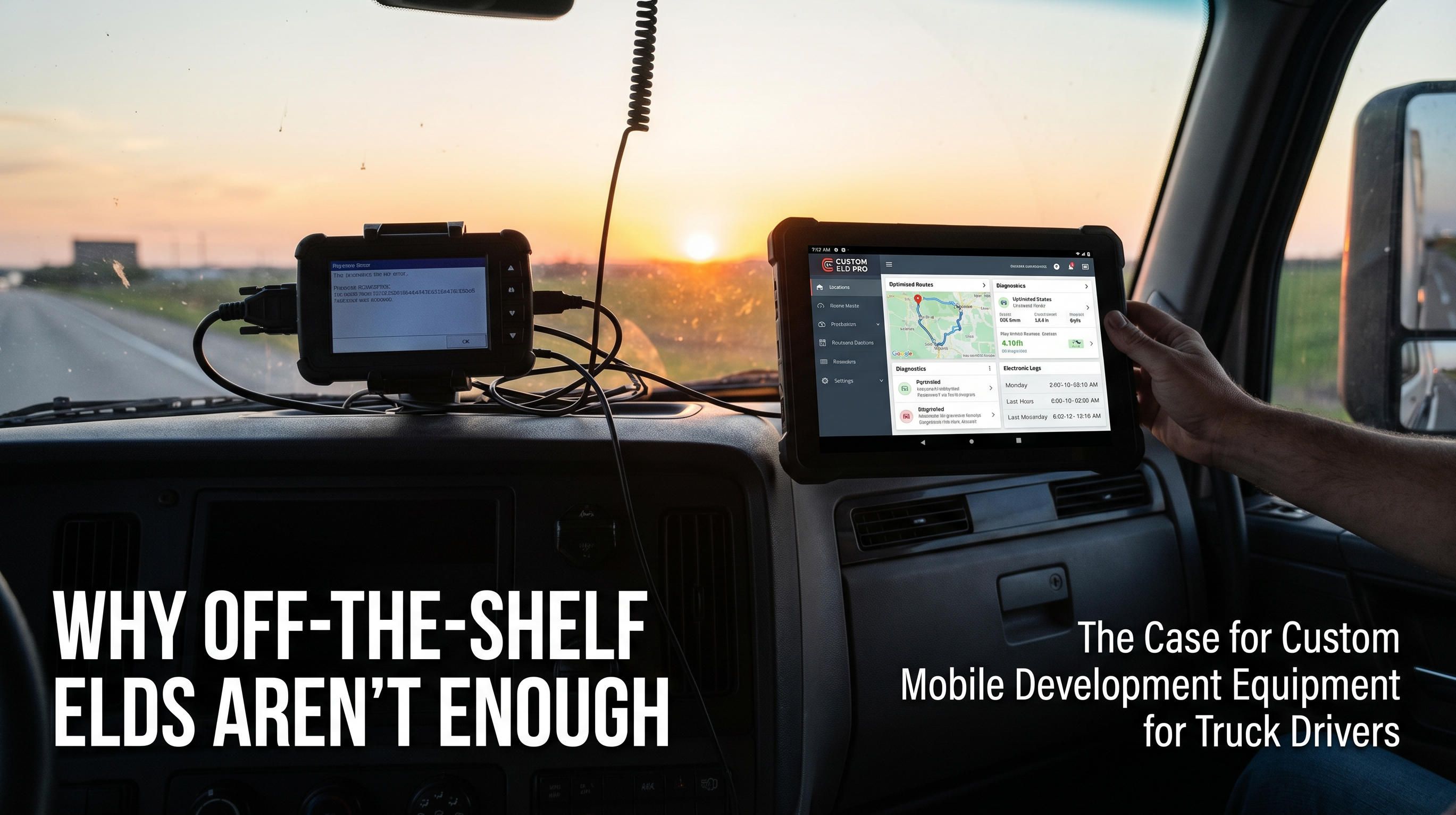
This article is the second in a five-part series on mobile development equipment for truck drivers. Article 1 mapped the full 2026 stack. This one takes on the question every operations director, CTO, and owner-operator eventually has to answer: off-the-shelf or custom? The short version is that both are right, in different places. The long version is worth the read, because the wrong answer on this question is the single most expensive mistake in fleet IT.
A carrier asked a vendor whether the platform could handle chassis splits for their drayage operation. The salesperson said "absolutely." Ten months later, the fleet still tracked chassis splits in a shared Google Sheet.
The "Good Enough" Era Is Real
The reason off-the-shelf dominates is not marketing. It is that for the majority of American carriers — single-digit and low-double-digit fleets running generic dry van — the packaged platforms genuinely solve the problem.
Samsara runs at roughly $27–33 per vehicle per month for core telematics and climbs to $40–60 with dual-facing AI dashcams (third-party data, March 2026; Samsara does not publish list pricing). Motive sits at roughly $25–35. Geotab works through resellers at roughly $30–40 per vehicle per month on bundled hardware-plus-software deals. For a ten-truck fleet, that is the cost of two tanks of diesel — in exchange for FMCSA-registered ELDs, HOS, DVIR, IFTA reporting, GPS tracking, and driver coaching.
The value is real. Industry data suggests comprehensive fleet management software delivers an average 30% operational cost reduction, 25% fuel savings, and up to 60% reduction in maintenance-related downtime. A published Zubie case study with Alliance Leasing reported a 257% ROI and $1,029 in annual savings per vehicle from driver-behavior improvements and insurance reductions alone — with simple OBD-II hardware that installs in under ten minutes.
This is why "mobile development equipment for truck drivers" rarely starts as a custom build. The off-the-shelf stack gets a small fleet to compliance and basic visibility in a week. For most carriers under fifty trucks running generic freight on generic lanes, it stays the right answer indefinitely.
Then comes the wall.

Wall One: The Workflow Wall
The first wall a carrier hits with off-the-shelf is the workflow wall. Packaged platforms are built for the median case — a driver, a truck, a trailer, a point-to-point lane. The moment operations deviate from that pattern, the platform starts fighting the business.
Drayage and intermodal are the classic example. A container move is not a single trip; it is a sequence — empty pickup, chassis split, pre-pull, live unload, street turn, empty drop — each with its own billing rules, per-diem tracking, last-free-day windows, and terminal-specific appointment systems. DrayMate's own research found that 76% of container transport companies have problems with inaccurate data entry and costly container track-and-trace mistakes. Off-the-shelf fleet platforms were not designed for chassis audits. They were designed for "did the driver arrive." Specialized drayage TMS products like Trinium TMS, TruckerZoom, PortPro, and DrayMate exist specifically because the general-purpose vendors could not cover these workflows.
Auto transport runs into a similar wall with per-vehicle VIN capture, damage photos, and carrier-specific paperwork. Heavy haul needs permit routing and pilot-car coordination. Hazmat tankers need ATEX-certified hardware, placarding logic, and emergency-response integration. Cold chain needs reefer-temperature logging with audit trails that satisfy FDA and customer SLAs. Yard jockeys need workflows that off-the-shelf platforms barely acknowledge exist.
When the workflow wall arrives, the symptoms are always the same. Drivers build private spreadsheets. Dispatchers triple-handle data. The ELD becomes a compliance checkbox while the real operations data lives somewhere else. At that point the carrier has paid for mobile development equipment for truck drivers twice — once for the vendor subscription, once for the shadow systems employees built because the vendor subscription was not enough.
Wall Two: The API Wall
The second wall is more technical, and it hits any carrier with ambitions bigger than a vendor dashboard.
Samsara's public developer documentation is unusually transparent about this: the global rate limit is 200 requests per second per organization, with a 150 requests-per-second cap per individual API token. More important, per-endpoint rate limits are much tighter. The /fleet/hos/logs endpoint is capped at 30 requests per second. The POST /fleet/driver-vehicle-assignments endpoint is capped at 25 requests per second. The GET /fleet/vehicles/{id} endpoint is capped at 25 requests per second. Exceed any of these and the API returns a 429 Too Many Requests; the response includes a Retry-After header and the integration is expected to back off with exponential retries.
For a small fleet polling vehicle positions every five minutes, none of this matters. For a carrier trying to sync 800 trucks of HOS data in near-real-time into its own TMS, or trying to push driver-vehicle assignments automatically as loads are tendered, the rate limits become hard architectural constraints. The carrier ends up designing its integration around the vendor's rate-limit ceiling instead of around the operation's actual needs.
The second form of the API wall is coverage. Many valuable data points on off-the-shelf platforms are not exposed via API at all, or are exposed only through bulk exports that arrive hours late. Independent reviews document API access limitations as a top frustration among technically sophisticated Samsara users — rate limits and restricted endpoints preventing full integration with custom applications, report customization limitations, and inability to export reports in Excel format (HTML tables only) complicating integration with business-intelligence tools.
Geotab, to its credit, is architecturally more open — MyGeotab exposes a public API, the marketplace lists over 430 third-party integrations per ABI Research's 2025 assessment, and fleets can build against it with the MyGeotab Python SDK. But "more open" still means "open on the vendor's terms," and the business logic that matters most to a specific carrier still lives outside the platform.
Mobile development equipment for truck drivers, in its fullest sense, is not just what the driver holds. It is the full data path from a J1939 fault code on the engine bus to a line item in payroll. When any link in that path goes through a rate-limited, partially-documented third-party API, the carrier's ability to differentiate shrinks to whatever the vendor allows.
Wall Three: The Contract Wall
The third wall is the one that tends to push decisions forward fastest: contracts.
Samsara's Master Terms (publicly analyzed by multiple independent review sites as of March 2026) require a three-year minimum subscription with full remaining contract balance due on early termination, and refunds only if Samsara terminates for its own convenience. The arithmetic is brutal. A 100-vehicle fleet at $33 per truck per month that wants to exit after year one owes 24 months × 100 vehicles × $33 = $79,200. A February 2026 BBB complaint documented a 30% fleet downsizing request denied under those same contractual terms: the carrier still had to pay for devices it was no longer using.
Motive is more flexible on paper, with annual and multi-year options and some month-to-month availability. Verizon Connect publishes a $40/vehicle/month list price with enterprise customization. Geotab works through third-party resellers who set their own terms. But in every case, the total cost of ownership over a three-year horizon for a fifty-truck fleet lands somewhere between $45,000 and $108,000 before hardware. AirPinpoint's analysis of Samsara's pricing showed that a 25-vehicle fleet should budget $24,300–$54,000 for software alone over three years.
At those numbers, the custom-development calculation stops looking exotic. A full custom driver app plus a carrier-owned backend plus integration with off-the-shelf ELD hardware from Stoneridge, Garmin, or Geotab can be built and delivered by a competent engineering team in the $80,000–$200,000 range, with carrier-owned code and no per-vehicle SaaS tax thereafter. The carrier still pays for hardware and connectivity, but the software layer becomes a capital expense that amortizes instead of a subscription that grows linearly with the fleet.
This is why mobile development equipment for truck drivers has started to bend toward custom at the top of the market. Samsara itself reports that over 95% of its $100K+ customers buy two or more products — the upsell curve is the business model. Carriers with 100+ trucks, or carriers building a platform play of their own, look at that curve and decide they would rather own their direction.

The Breakpoints
In practice, the decision between off-the-shelf and custom does not happen in the abstract. It happens at specific, recognizable breakpoints.
Fleet size and growth trajectory. A carrier going from fifty to five hundred trucks in three years will hit the contract wall and the per-vehicle cost curve long before a carrier holding steady at twenty.
Workflow specialization. Drayage, intermodal, auto transport, heavy haul, hazmat, reefer cold chain, yard operations, and any mixed-mode fleet (truckload plus brokerage, for example) run workflows that general-purpose platforms under-serve. The more specialized the operation, the sooner custom pays back.
Integration depth. Any carrier whose competitive advantage depends on proprietary integrations — a customer portal with real-time visibility, a broker-auto-bid system, a predictive-maintenance model trained on the fleet's own data — will hit the API wall inside the first year.
Data ownership and analytics. Fleets investing in digital twins, predictive maintenance, or AI-driven dispatch need unrestricted access to raw telematics. One published case study at Mountain States Heavy Haul deployed digital-twin predictive maintenance across 180 trucks, invested $142,000 in sensor hardware and $285,000 total in implementation, and hit full ROI at month ten with $680,000 in annual maintenance savings. None of that is possible on a rate-limited vendor API.
Hardware lock-in. Carriers who want to choose their own tablets (Galaxy Tab Active5, Panasonic TOUGHBOOK G2, Getac F110-EX, Zebra XSlate R12, Waysion Q777) or want to run hardware agnostically across ELD providers need a software stack that is not welded to a single vendor's gateway.
Strategic positioning. Carriers that sell technology as part of their customer offering (shipper portals, dedicated-fleet dashboards, API access for 3PL partners) need to own the experience. You cannot resell someone else's branded platform as your own differentiation.
When two or more of these breakpoints apply, a serious custom build conversation is usually overdue.
Three Ways to Go Custom
"Custom" is not a single shape. In practice, A-Bots.com and other development partners work in three distinct modes for carriers thinking about the shift.
Full custom platform. The carrier owns the driver app, the dispatcher console, and the backend. Hardware is chosen on merit — a Galaxy Tab Active5 for general long-haul, a Getac F110-EX for hazmat, a Waysion Q777 for budget-conscious owner-operators — and the ELD is sourced from a commodity FMCSA-registered provider (Stoneridge, Garmin eLog, My20). FMCSA compliance is built directly into the driver app rather than rented from a vendor. This is the right shape for 200+ truck fleets, for specialized verticals, and for carriers running technology as product.
Integration and extension layer. The carrier keeps Samsara, Motive, or Geotab for the ELD and core telematics, but builds a custom layer on top that owns the driver experience, the dispatch workflow, and the customer-facing portal. The vendor becomes a data source. Webhooks, API pulls with proper exponential backoff, MQTT bridges, and webhook aggregation stitch the systems together. This is the right shape for 50–200 truck fleets that want custom logic without full hardware replacement.
QA and hardening. Sometimes the custom stack already exists, and the problem is that it breaks in the field. Drivers losing data on ignition cycles. HOS logs drifting. J1939 decode errors producing phantom fault codes. Bluetooth pairing failing at low temperatures. A-Bots.com runs this work as a focused engagement: real-device QA against rugged tablets, simulated J1939 streams (Freematics, Kvaser, PCAN-USB), stress tests on offline sync, OWASP MASVS security audit, and a delivered report the CTO can act on immediately.
Each of these paths turns mobile development equipment for truck drivers into a carrier asset rather than a subscription. Each pays back on a different horizon.
What the ROI Actually Looks Like
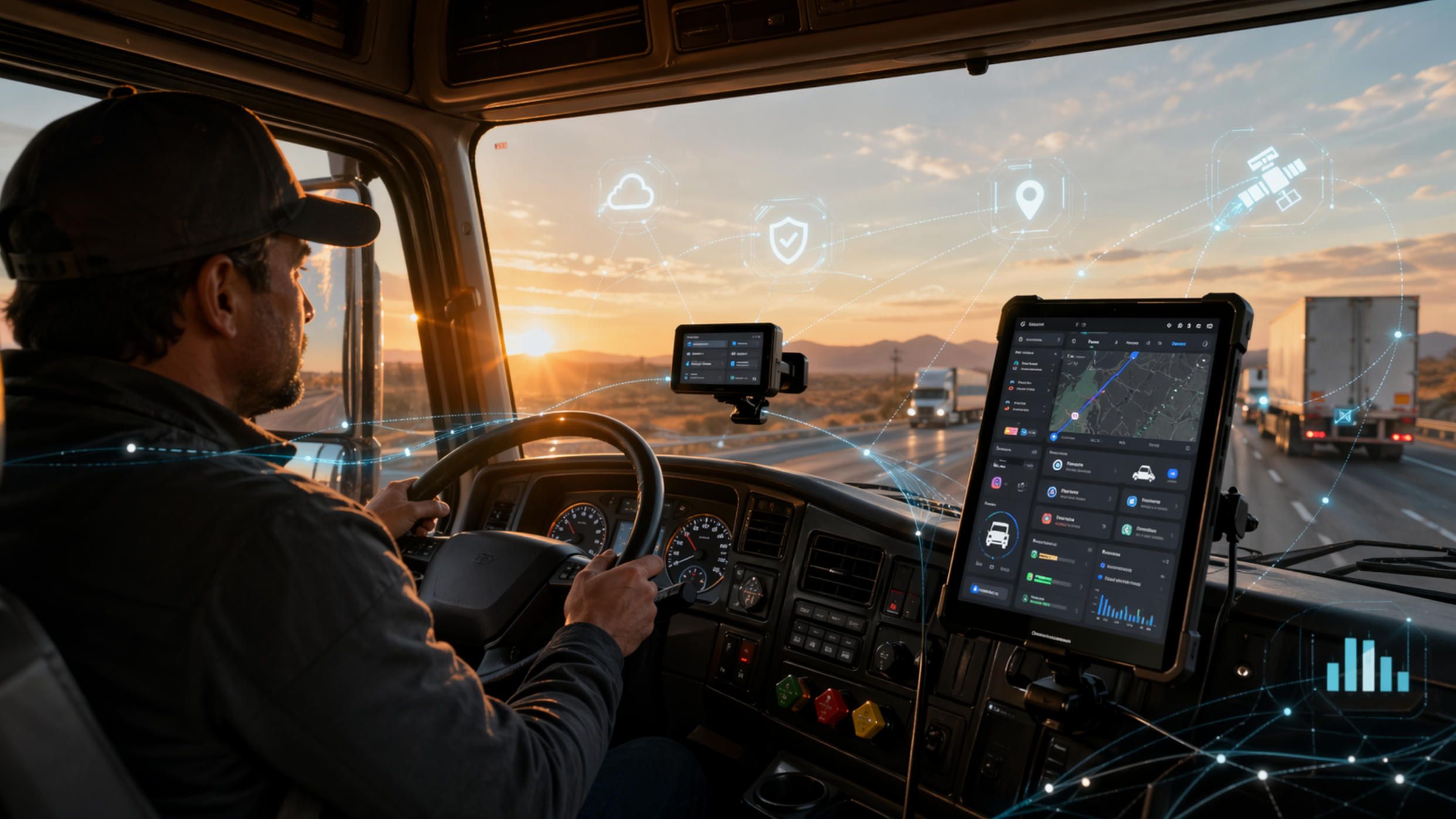
The ROI case for custom mobile development equipment for truck drivers has four components, and the one that gets under-counted is almost always the third.
The first is subscription avoidance. A 150-truck fleet at $40 per vehicle per month runs $72,000 per year in software alone, or $216,000 over the three-year contract. A one-time custom build often lands in that range, after which the cost line bends.
The second is operational savings. Teletrac Navman's benchmark data shows 55% of fleets report measurable fuel cost reductions after telematics implementation; Geotab research puts the reduction at up to 12% in workforce productivity alone. These savings apply whether the software is custom or off-the-shelf — but a custom build captures them without the recurring subscription drag.
The third is the strategic tax. When the vendor changes pricing, deprecates an endpoint, raises contract floors, or gets acquired, the carrier has no response beyond "pay more" or "start over." Trustpilot and BBB complaints filed in early 2026 against major telematics vendors document enforcement of early-termination clauses even during fleet downsizing. Independent reviews document fleet customers leaving Geotab for Samsara citing "unreliability, limited features, and fragmented system" — only to land on Samsara's own 3-year lock-in. Own the stack and the strategic tax disappears.
The fourth is option value. A carrier with its own platform can ship features competitors cannot. Predictive maintenance trained on proprietary data. Real-time customer visibility branded as the carrier's own product. Broker integrations that lock in higher-margin lanes. None of that exists in the subscription model.
Put together, for fleets above the relevant breakpoints, the custom math usually pays back inside eighteen to twenty-four months. Above that horizon it compounds.
Where A-Bots.com Comes In
A-Bots.com has spent years shipping mobile software that controls, integrates with, and survives rough hardware. The engineering patterns we applied to the Shark Clean robotic-vacuum app — a React Native application reliably controlling a physical device in the field with full offline handling, BLE pairing resilience, and hardware-specific edge cases — are the same patterns that mobile development equipment for truck drivers needs at scale.
Our trucking-project stack centers on React Native with Kotlin and Swift native modules for Bluetooth, background location, CAN bus bridges, and camera pipelines. The backend runs on Node.js, Django, GraphQL, PostgreSQL, and AWS. MQTT and WebSocket handle live telematics. Google Maps SDK and Mapbox power truck-aware routing. J1939 and OBD-II integrations go through commodity gateways with custom firmware where the project requires it. FMCSA-compliant ELD logic is implemented directly in the driver app against Appendix A to 49 CFR Part 395, Subpart B.
We work in the three modes above — full custom, integration and extension, and QA hardening — and we start every trucking engagement with a discovery phase that maps the carrier's actual workflows, the actual pain points, and the actual breakpoints against the three walls. That upfront diligence is how we keep projects from turning into the same vendor-trap our clients are trying to escape.
A-Bots.com has completed more than 70 projects across mobile, IoT, web, chatbots, and blockchain, with offices in the United States, Ukraine, and Romania. Most of our clients stay with us for eighteen months or longer — the retention curve that matters when the platform has to be maintained for a decade, not a sprint.
What the Next Article Covers
Article 3 in this series takes compliance seriously. It walks through FMCSA 49 CFR Part 395 (the ELD mandate), Part 396 (DVIR and roadside inspections), IFTA fuel-tax automation, and eCMR for carriers running international freight. It also covers the specific compliance failure modes that get carriers fined — the ones that sit at the software level, below the vendor dashboards, where a custom build either gets it right or doesn't.
Closing
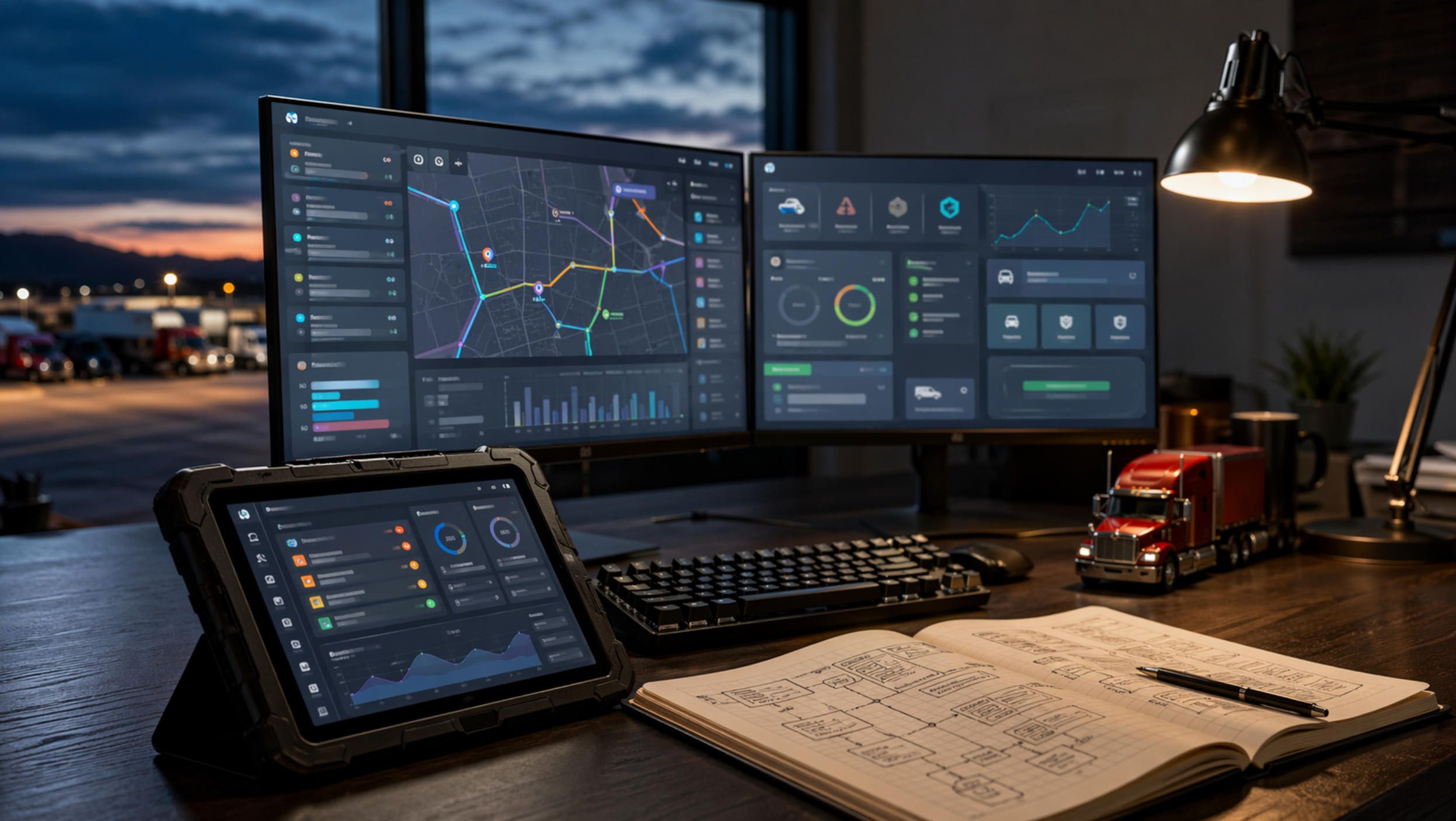
Off-the-shelf mobile development equipment for truck drivers is the right answer for a large slice of the US trucking market. It will stay the right answer for small fleets running generic freight on generic lanes. But the market is bifurcating. At the top end — specialized verticals, 100+ truck fleets, carriers building a tech moat — the three walls show up reliably, and the carriers that hit them and keep paying the subscription are the ones losing margin to carriers that decided to own their platform.
If you are mapping the next twelve months of fleet IT and the three walls look familiar, a conversation with A-Bots.com will save time. Send the brief — current vendor, fleet size, workflows that do not fit, integrations you need — to info@a-bots.com. We will come back with a realistic read on whether custom, hybrid, or off-the-shelf is the right move, and a grounded plan for whichever answer applies to your operation.
✅ Hashtags
#ELDCompliance
#CustomSoftware
#FleetManagement
#TruckingTech
#Samsara
#Motive
#FleetTelematics
#MobileAppDevelopment
Other articles
Bluetooth and UWB Item Trackers 2026: AirTag vs SmartTag The smart tracker market surpassed $856 million in 2025 and continues to grow rapidly as consumers and businesses adopt Bluetooth and UWB tracking solutions. This article examines the technical architecture behind modern item trackers, including BLE crowdsourced networks, Ultra-Wideband precision finding, and the DULT anti-stalking standard. It provides a detailed comparison of Apple AirTag 2, Samsung Galaxy SmartTag 2, and Tile Pro across key metrics such as range, battery life, accuracy, network size, and privacy safeguards. The article also explores practical use cases from luggage tracking to bicycle theft prevention and highlights opportunities in custom tracking app development for businesses entering this space.
GPS Trackers 2026: Tracki vs Invoxia vs LandAirSea Compared The GPS tracking device market reached $4.9 billion in 2025 and is projected to grow to $13.6 billion by 2033, driven by fleet management demand, IoT adoption, and rising vehicle theft concerns. This article examines the technical architecture behind modern cellular GPS trackers, including multi-constellation GNSS positioning, LTE-M and NB-IoT connectivity protocols, and hybrid indoor-outdoor location systems. It compares three leading long-range trackers: Tracki 4G, Invoxia GPS Tracker Pro, and LandAirSea 54 across range, battery life, accuracy, pricing, and subscription models. The article also presents NICB vehicle theft recovery data demonstrating that GPS-equipped vehicles are recovered at rates exceeding 90%, and explores custom GPS tracking app development opportunities for logistics, fleet management, and enterprise clients.
NVIDIA DGX Spark: A $4,699 Supercomputer on Your Desk - Is Personal AI Sovereignty Worth the Price? NVIDIA DGX Spark packs one petaFLOP of AI compute and 128 GB of unified memory into a 1.2 kg desktop box — enough to run 200-billion-parameter models entirely offline. But at $4,699 (now up from $3,999 after a February 2026 price hike), with monthly ownership costs rivaling a ChatGPT Pro subscription and models that still lag behind cloud frontiers, who is this actually for? This deep-dive covers real benchmark data, a full European cost-of-ownership breakdown, the NemoClaw agent stack, the global AI sovereignty trend from Gartner to Vitalik Buterin, head-to-head comparisons with AMD Strix Halo and Mac Studio, and what the next generation of home AI servers will look like.
App Controlled Sauna: Top 3 Models on the US Market 2026 The app controlled sauna has moved from premium novelty to baseline expectation on the US market, with IoT-enabled systems now driving 61% of buyer demand. This expert guide reviews the three models leading the category in 2026 — Harvia Fenix with its AI-adaptive MyHarvia 2 app, HUUM UKU WiFi with its cult-favorite minimalist app, and Sun Home Luminar with its full-spectrum infrared wellness ecosystem — evaluated entirely through the lens of the mobile application. Covers IoT architecture, regulatory requirements under the new ANSI/UL 60335-2-53 standard, and what sauna manufacturers should learn about multi-user access, OTA updates, door-interlock safety, and ecosystem design when building their own custom app controlled sauna platform.
Mobile Development Equipment for Truck Drivers: 2026 Stack This pillar article maps the complete 2026 stack of mobile development equipment for truck drivers across four layers: rugged in-cab hardware (Samsung Galaxy Tab Active5, Panasonic TOUGHBOOK G2, Getac F110-EX, Zebra XSlate R12), sensor electronics (FMCSA-certified ELDs, AI dashcams from Samsara, Lytx, Nauto, and Motive), driver-facing software (HOS, DVIR, IFTA, dispatch, load boards like DAT One and Truckstop Go), and integration plumbing (SAE J1939, OBD-II, MQTT, REST APIs). It also covers the operational details that separate weekend prototypes from production deployments — offline-first behavior, power management, real-device QA, and security — and explains how A-Bots.com builds, extends, and hardens custom driver platforms for trucking carriers of every size.
Top stories

Copyright © Alpha Systems LTD All rights reserved.
Made with ❤️ by A-BOTS