
Home
Services
About us
Blog
Contacts
ecobee3 Lite Smart Thermostat: Complete Guide to Features, Setup, and What Comes Next
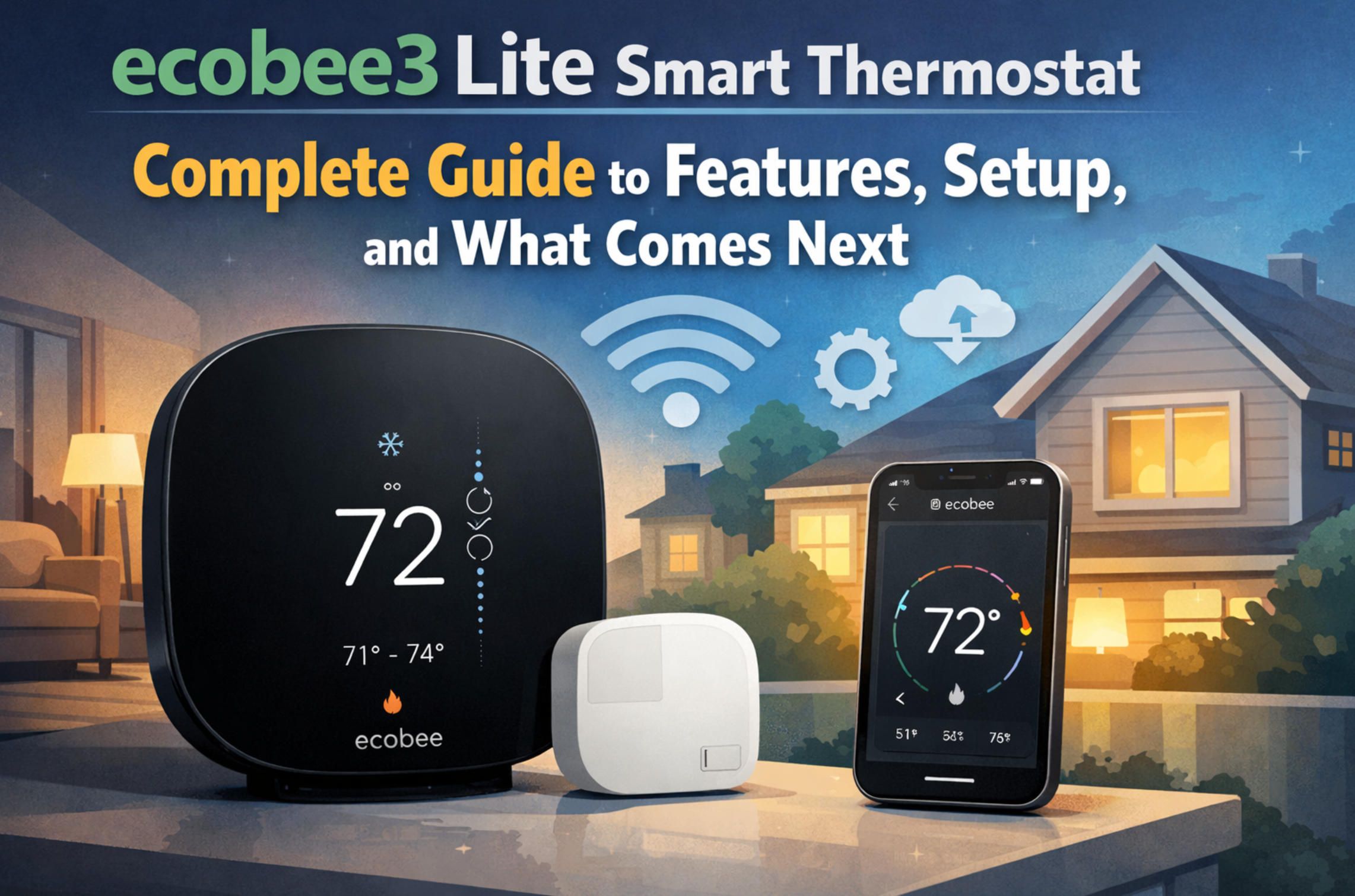
The ecobee3 lite smart thermostat has become one of the most recognized names in home climate control — and for good reason. Priced accessibly, certified by ENERGY STAR, and packed with features that used to belong only to premium devices, it changed what homeowners expect from a wall-mounted thermostat. But what exactly does it do, how does it work, and what does its success tell us about where the smart home industry is heading? This guide covers everything you need to know.
What Is the ecobee3 Lite and Why It Matters
The ecobee3 lite is a Wi-Fi-enabled programmable smart thermostat developed by ecobee, a Canadian company founded in 2007 that has been in the connected home space since 2008. The device connects to your home's HVAC system, links to your smartphone via the ecobee app (available on iOS and Android), and uses a combination of scheduling, occupancy logic, and weather data to manage your home's temperature automatically.
Unlike basic programmable thermostats that simply follow a fixed weekly schedule regardless of what is actually happening in the home, the ecobee3 lite responds to real-world conditions. It knows when nobody is home. It knows when the outdoor temperature dropped overnight and adjusts the heating curve accordingly. It knows that a room on the south-facing side of your house is running three degrees warmer than the hallway where the thermostat lives — and it can account for that if you pair it with an optional SmartSensor.
What made the ecobee3 lite a landmark product when it launched, and what still makes it relevant today, is the combination of genuine intelligence and broad compatibility. It supports conventional systems (2H/2C), heat pumps (4H/2C), dual-fuel setups, radiant heating, and boilers — covering the vast majority of residential HVAC configurations found across North America. Most smart thermostats on the market at a comparable price point impose significant compatibility restrictions. The ecobee3 lite largely does not.
Key Technical Specifications
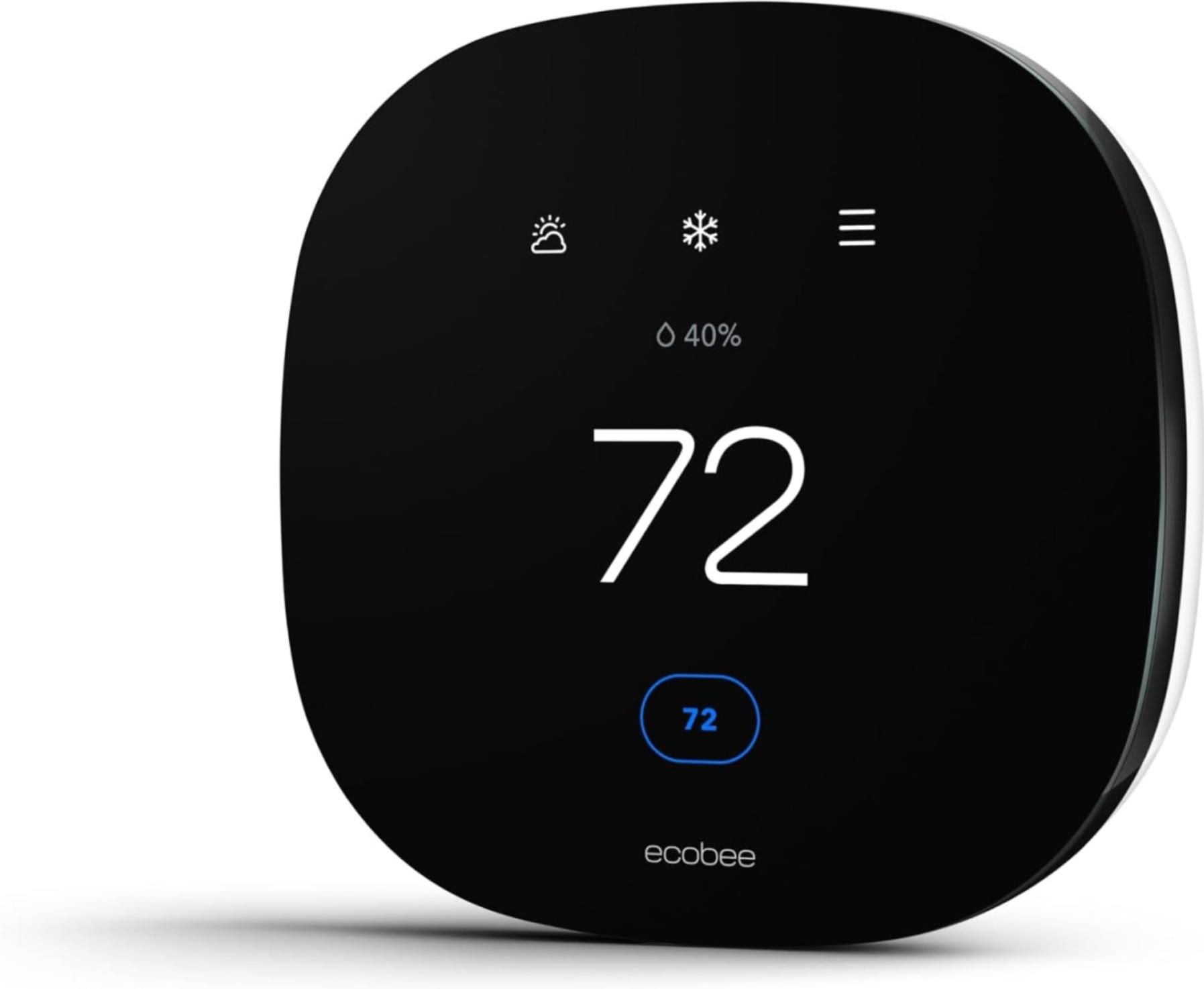
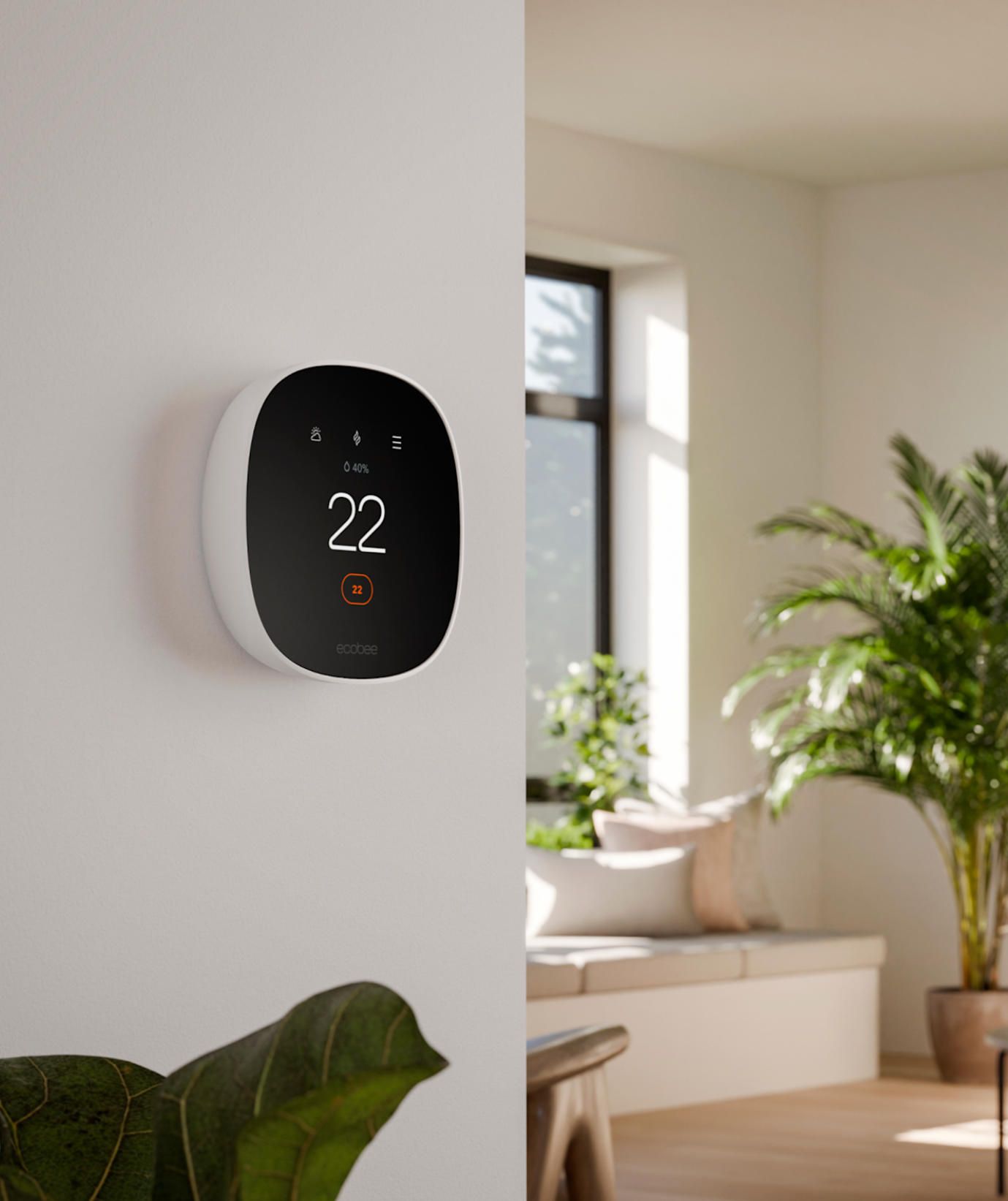
The ecobee3 lite ships with a 3.5-inch capacitive touchscreen display, a built-in occupancy sensor, and Wi-Fi connectivity supporting both 2.4 GHz and 5 GHz networks. The thermostat communicates with the ecobee cloud infrastructure, which processes scheduling logic, weather compensation, and eco+ optimization features server-side rather than locally on the device. This architecture means the thermostat stays lightweight in terms of on-device processing while the intelligence scales transparently through over-the-air software updates.
The hardware package includes the thermostat unit, a Power Extender Kit, a mounting plate, a trim plate for covering holes left by older devices, a hardware pack, wire labels, and installation guides. Professional installation comes with an extended 5-year warranty through authorized contractors; standard consumer self-installation comes with a 3-year limited warranty. The device is powered via 24VAC through its wiring terminals and does not require batteries for operation, which eliminates a common failure point in wireless-only thermostats.
Installation: What to Expect in Practice
Installation typically takes about 45 minutes. The ecobee app includes a guided setup wizard that walks you through identifying your existing wiring, inserting the wires into the new terminal block, mounting the device, and connecting it to your Wi-Fi network. The terminal block uses a push-in design that does not require a screwdriver for most wires, and a built-in bubble level on the mounting plate helps ensure the device sits straight on the wall without needing a separate level tool.
The most common installation challenge involves homes without a C-wire — the dedicated common wire that provides continuous low-voltage power to the thermostat. Many homes built before the early 2000s only have four wires running to the thermostat location. The included Power Extender Kit solves this by reassigning the G (fan) wire to function as the common wire and using a module installed at the air handler to restore fan control through a different signal path. This approach works reliably in most conventional forced-air systems, though homes with unusual wiring or proprietary HVAC communication protocols may require a professional installer.
For homes with separate Rc and Rh wires — meaning separate power sources for heating and cooling circuits — only one R wire should be inserted into the Rc terminal. The installation guide covers this scenario explicitly, but it remains a frequent source of confusion for first-time installers. The ecobee compatibility checker on ecobee.com allows you to enter your existing wire configuration before purchasing and confirms whether the standard installation will work or whether additional hardware is needed.
After physical installation, the app prompts you to configure your heating and cooling system type, set your initial comfort schedule, and optionally enroll in any available utility rebate programs. In many US states and Canadian provinces, utility companies offer rebates between $50 and $150 for installing an ENERGY STAR-certified smart thermostat. The ecobee app includes a rebate lookup tool by ZIP or postal code that surfaces available programs at the time of setup.
One practical note that installation guides often understate: taking a photograph of your existing thermostat's wiring before disconnecting anything is strongly recommended. The color coding of thermostat wires is not standardized across all manufacturers and installation eras. A clear photo of the original terminal connections is the fastest way to resolve any confusion during the process — and in homes where the previous thermostat was installed by a contractor who improvised with whatever wire was available, it may be the only reliable reference you have.
The eco+ Feature Set: Where the Intelligence Actually Lives
The most technically interesting part of the ecobee3 lite is its eco+ software layer. This is a suite of five intelligent optimization features that run continuously in the background to reduce energy consumption without requiring manual input from the homeowner. Understanding how each one works — and how they interact — explains most of the device's real-world energy savings performance and separates the ecobee3 lite from simpler connected thermostats that merely put a Wi-Fi radio behind a conventional schedule.
Time of Use is the feature with the most direct financial impact in regions where electricity pricing varies by time of day. Under time-of-use utility rates, electricity costs significantly more during peak demand hours — typically weekday afternoons and early evenings — and significantly less overnight and on weekends. The thermostat queries your utility's rate schedule and automatically pre-heats or pre-cools your home during off-peak hours so that less active heating or cooling is needed during expensive periods. The home coasts on stored thermal mass through the peak window, maintaining comfort while the compressor or furnace stays idle. According to a third-party study conducted across the US and Canada, households in regions with time-of-use rates can save up to 24% annually on HVAC costs — exceeding the baseline 23% savings figure — specifically because of this pre-conditioning behavior.
Schedule Assistant monitors whether your actual daily pattern matches the programmed comfort schedule and surfaces suggested updates when it detects consistent mismatches. The algorithm observes patterns over multiple weeks: if you consistently arrive home 45 minutes earlier than your schedule assumes, or if the thermostat's occupancy sensor confirms that nobody is ever present on Friday afternoons despite the schedule treating Friday as a standard weekday, Schedule Assistant will propose a revised schedule through the app. Accepting the suggestion requires a single tap. The feature is entirely opt-in — the system makes recommendations but never changes your schedule autonomously — which addresses a privacy and autonomy concern that some users have about learning thermostats in general.
Smart Home and Away uses the thermostat's built-in occupancy sensor to detect whether the home is unexpectedly occupied or empty and overrides the current schedule accordingly. If your schedule says the home should be in away mode but the sensor detects motion, the system switches to home mode to maintain comfort. If the schedule says the home is occupied but no motion has been detected for an extended period, the system switches to an energy-saving setback. This feature is most powerful when combined with additional ecobee SmartSensors in other rooms, which extend occupancy detection beyond the single hallway location. Without remote sensors, Smart Home and Away can miss occupancy in rooms outside the thermostat's direct sightline — a real limitation in open-plan homes where residents may sit quietly reading for hours in a space the hallway sensor cannot reach.
Feels Like addresses a physiological reality that most thermostats ignore entirely: the temperature you feel is not the same as the temperature a dry-bulb sensor reads. High indoor humidity makes a room feel warmer than its actual temperature because perspiration evaporates more slowly and the body's cooling mechanism becomes less efficient. The thermostat monitors indoor humidity and adjusts the cooling setpoint to compensate. If you have the thermostat set to 70°F and indoor humidity climbs to 65%, the space feels considerably warmer than 70°F. Feels Like will lower the cooling setpoint to deliver perceived comfort rather than chasing the numeric target. In heating mode, dry winter air has the opposite effect — low humidity makes a space feel cooler than it measures — and the system adjusts upward accordingly. For households where certain members are more sensitive to humidity than to temperature changes, this feature can meaningfully improve day-to-day comfort without increasing energy use.
Community Energy Savings integrates the thermostat with utility demand-response programs. When electricity demand peaks across the local grid — during a summer heat wave when millions of air conditioners run simultaneously — utilities face the expensive and emissions-intensive choice of activating peaker plants or importing power from neighboring grids. Demand-response programs address this by requesting that enrolled smart thermostats accept a minor, temporary temperature adjustment during the peak event: typically one or two degrees for a period of one to four hours. The thermostat makes the adjustment automatically if you have opted in. Participation typically earns bill credits or rebates, and ecobee reports that its thermostats are enrolled in more than 20 demand-response programs across North America, with the combined fleet directly reducing strain on electricity infrastructure during the most carbon-intensive and expensive grid conditions.
Taken together, eco+ delivers an additional 6% reduction in HVAC energy use on top of standard scheduling savings. The baseline ENERGY STAR certification confirms up to 23% annual savings compared to a fixed 72°F hold — approximately $250 per year for an average US household. The eco+ layer pushes that figure higher in the right conditions, particularly for households enrolled in time-of-use rate plans or utility demand-response programs.
Home IQ and Energy Monitoring: Making Savings Visible
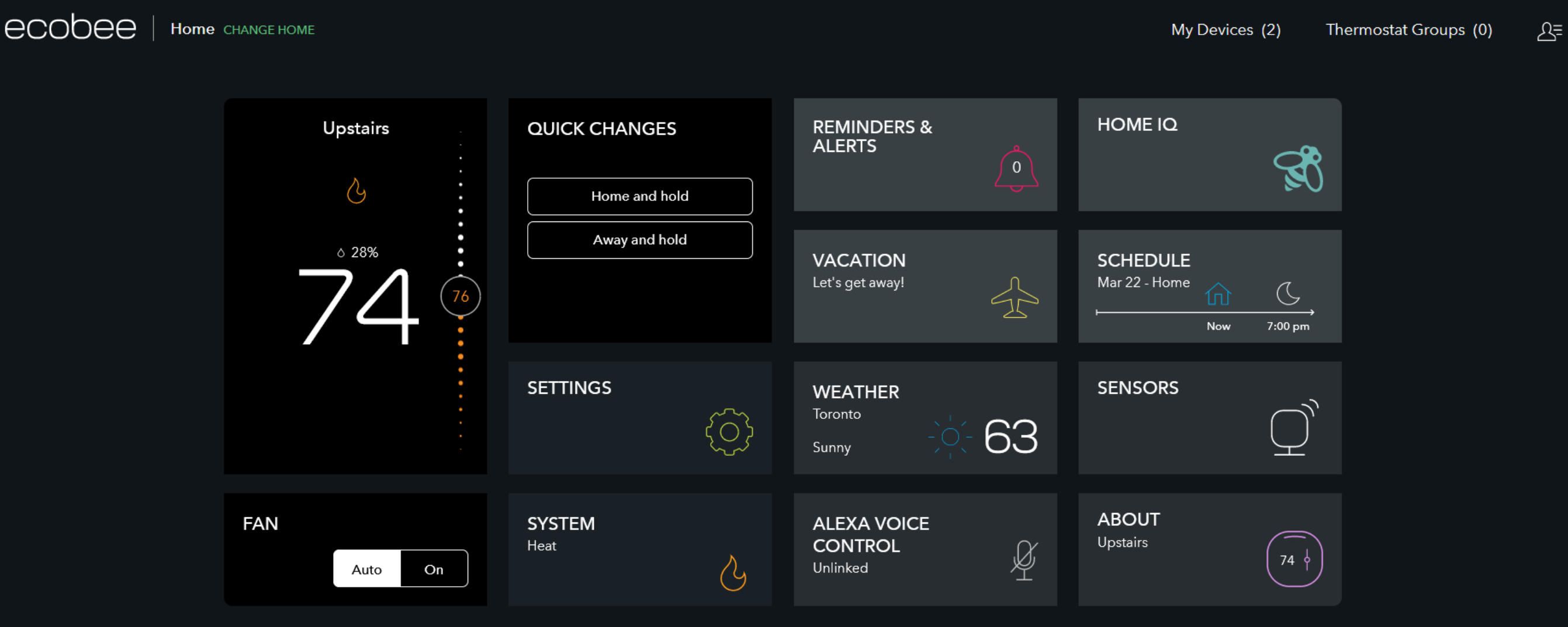
Every ecobee account includes access to Home IQ, an analytics dashboard available through both the ecobee web portal and the mobile app. Home IQ provides monthly energy reports that compare your HVAC runtime and estimated savings against statistically similar homes in your area, accounting for square footage, climate zone, and system type. The comparison benchmarking transforms an abstract efficiency metric into something concrete: not just "you saved energy this month" but "you used 18% less than comparable homes in your region."
The dashboard surfaces granular operational data: how many hours your system ran each day, what percentage of that runtime occurred during away periods when the setback was active, how much consumption fell during peak pricing hours versus off-peak hours, and where the largest remaining opportunities for efficiency improvement exist. For homeowners who have never had visibility into how their HVAC system actually operates, this reporting function frequently reveals surprising patterns — systems running far longer than expected on mild days, or setback periods that are not saving as much as assumed because the system has to work hard to recover temperature on re-occupancy.
Filter change reminders are triggered based on actual system runtime hours rather than calendar intervals, which is more accurate than a fixed 90-day alert that has no relationship to real usage. If your household runs the HVAC aggressively through a long winter, you may need a filter change well before three months. The thermostat also monitors system behavior for anomalies — unusually long run cycles, failure to reach setpoint within expected timeframes, unexpected short cycling — and sends push notifications through the app when it detects conditions that could indicate a maintenance issue or equipment problem developing.
Smart Home Integration: The Full Ecosystem Picture
The ecobee3 lite integrates with all major smart home platforms. Apple HomeKit support is the most native-feeling integration: the thermostat appears as a first-class device in the Apple Home app, supports Siri voice commands, and can be included in HomeKit automations alongside other compatible devices — door locks, lights, occupancy sensors, blinds. The integration works with Apple Watch for temperature adjustments from the wrist.
Amazon Alexa and Google Assistant integrations work through their respective voice assistant platforms once the ecobee skill or action is enabled. Voice commands work naturally for both status queries and control: "Alexa, increase the temperature by two degrees" or "Hey Google, what is the thermostat set to?" Samsung SmartThings integration enables location-based presence automations, where the thermostat shifts to away mode when the SmartThings system confirms all household members have left based on phone GPS — a more reliable approach to away detection than relying solely on the built-in occupancy sensor in homes with complex layouts.
IFTTT integration opens the thermostat to a broader ecosystem of conditional automations beyond the official partner list. Users have connected ecobee to weather services, smart plugs, calendar applications, and dozens of other services using IFTTT applets, enabling niche use cases that native integrations do not address. None of the integrations require a paid subscription tier — all platform connectivity is included with the device.
The ecobee SmartSensor: Solving the Single-Point Problem
One of the most important limitations of any single-unit thermostat is that it measures temperature at one location — almost always a hallway — and makes decisions for the entire home based on that single data point. Rooms facing south accumulate solar gain. Spaces above unconditioned garages run cold in winter. Second-floor rooms collect rising heat that the ground floor never sees. A thermostat in the hallway has no visibility into any of this variation, and the consequences show up as comfort complaints in specific rooms regardless of what the hallway temperature reads.
The ecobee SmartSensor (sold separately) is a small wireless device that adds temperature and occupancy monitoring to any room. It communicates with the thermostat using ecobee's proprietary 915 MHz radio, which provides better range and wall penetration than Bluetooth and does not consume Wi-Fi bandwidth. The sensors are battery-powered with a stated battery life of approximately four years under normal use conditions.
Once paired, you configure which sensors the thermostat prioritizes during which time periods. The bedroom sensor becomes the primary reference between 10 PM and 7 AM. The living room sensor takes precedence from 4 PM to 10 PM. The thermostat's own sensor handles the rest. This room-weighting approach means the system optimizes for the space that is actually being used rather than maintaining a temperature in an empty corridor. A single ecobee3 lite supports up to 32 SmartSensors, making it applicable to large or architecturally complex homes where a single thermostat location is genuinely inadequate as a representative measurement point.
The Broader Market Context: Why This Category Is Accelerating
The ecobee3 lite exists within a rapidly expanding market being driven by converging forces: rising energy costs, government efficiency mandates, the maturation of smart home ecosystems, and the steady decline in IoT hardware costs. Understanding the market trajectory provides important context for why the category is attracting sustained investment from both legacy HVAC manufacturers and technology-first entrants.
According to Grand View Research, the global smart thermostat market was valued at $4.99 billion in 2024 and is projected to reach $13.35 billion by 2030, growing at a compound annual growth rate of 18.5%. North America dominated with approximately 38 to 40 percent of global revenue in 2024, driven by high consumer awareness, widespread broadband penetration, government rebate programs at federal and state levels, and the maturity of smart home platform ecosystems. The US market specifically was valued at $2.36 billion in 2024 and is expected to grow at a 17.5% CAGR through 2030.
Retrofit installations — replacing conventional or basic programmable thermostats with smart models — accounted for 57.8% of global smart thermostat unit demand in 2024, according to Mordor Intelligence. This is the primary use case for the ecobee3 lite. The retrofit segment dominates because the addressable base is enormous: the US alone has over 120 million owner-occupied homes, the majority of which still run on thermostats that predate smart connectivity entirely. Market Data Forecast notes that Home Depot reports 84% of its smart thermostat sales are replacement purchases rather than new construction installations — a figure that illustrates both the scale of the opportunity and the sustained demand that makes this category different from products dependent on new housing starts.
The shift toward AI-powered learning thermostats represents the next significant wave. Learning thermostats commanded 45% of market share by product intelligence level in 2024, and the segment is expected to grow faster than the connected (app-only) segment through 2030. The ecobee3 lite sits at the boundary between these categories: it uses eco+ machine learning algorithms for schedule optimization but relies more heavily on rule-based logic and sensor inputs than on purely adaptive behavior. Newer models in the ecobee lineup push further into true learning behavior, and the trajectory across the industry is clearly toward devices that require progressively less manual configuration from the user over time.
Cybersecurity is an emerging concern the industry is beginning to address seriously. Academic penetration tests published in 2024 demonstrated that many consumer-grade IoT devices ship with default credentials and outdated TLS implementations. Mordor Intelligence identifies this as a growing factor affecting consumer confidence in connected thermostats. ecobee has responded by certifying its products and infrastructure against the IEC 62443 industrial security standard — a level of rigor more commonly associated with industrial control systems than consumer devices — which positions the company favorably as both US and EU regulators tighten IoT security requirements.
The emergence of utility partnerships as a structural business model is worth noting separately. ecobee's Community Energy Savings feature is not only a user benefit — it is the commercial foundation of a relationship between ecobee and North American utilities, with the thermostat fleet functioning as a distributed demand-response asset. As grid conditions become more volatile due to the integration of intermittent renewable energy sources, the economic value of controllable distributed thermal loads increases significantly. This dynamic is pulling smart thermostat manufacturers deeper into the energy services business and is one of the structural reasons the category is growing at rates well above typical consumer electronics. In May 2025, Generac Holdings — ecobee's parent company — announced a new thermostat that integrates directly with home standby generators and solar battery storage systems, illustrating how the thermostat is evolving from a comfort device into a node in a broader home energy management network.
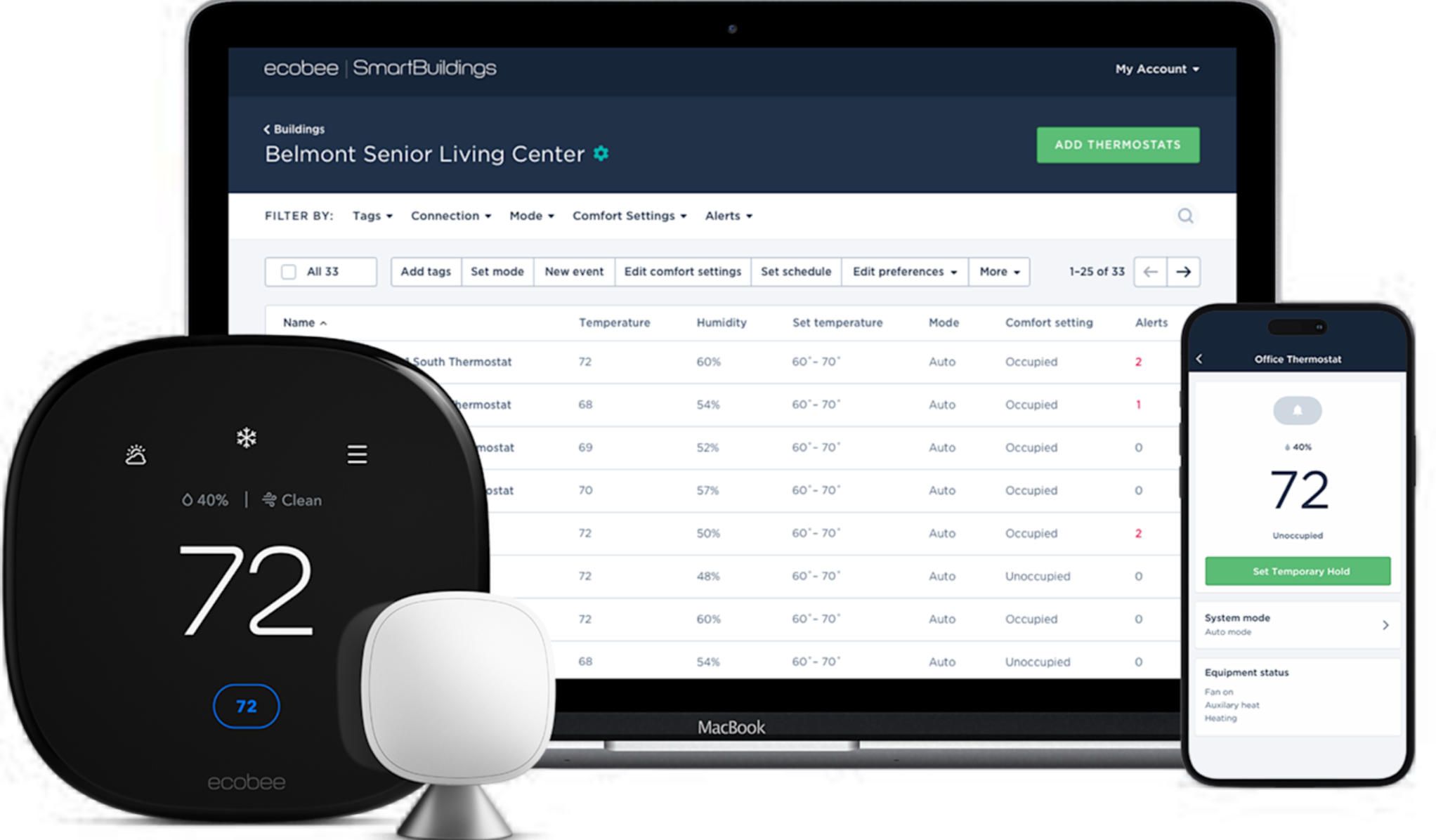
What Custom HVAC App Development Looks Like in 2026
The success of the ecobee platform makes one thing structurally clear: the competitive advantage in smart climate control is not the hardware — it is the software layer. The thermostat itself is a commodity. What differentiates ecobee is the mobile app, the cloud back-end, the eco+ algorithm suite, the Home IQ analytics engine, the demand-response infrastructure, and the quality of integration with third-party ecosystems. None of that intelligence runs on the device. All of it is software engineering — and that is where the real development complexity lives.
For HVAC manufacturers, property technology companies, energy management startups, and building automation firms that want to build their own smart thermostat ecosystem — whether as a white-label alternative to ecobee, a proprietary platform tied to specific hardware, or an energy management layer for commercial or multifamily residential buildings — the core development requirements are well understood and technically demanding. A real-time device communication layer using MQTT or WebSocket protocols handles the bidirectional messaging between thermostats and the cloud back-end at scale. A scheduling and rule engine processes comfort programs, eco+-style optimizations, and override logic across thousands of simultaneous device sessions. Occupancy and sensor data pipelines ingest and normalize readings from heterogeneous sensor hardware with varying reporting frequencies and data formats. Utility API integrations enable demand-response program enrollment, rate schedule retrieval, and event handling. And a clean, responsive mobile interface for both iOS and Android is the surface through which all of this complexity becomes usable by someone who simply wants to feel comfortable and pay less for it.
This is precisely the kind of project that A-Bots.com is built for. With over 70 completed mobile application and IoT projects — spanning smart home devices, industrial automation, healthcare, and consumer applications — A-Bots.com brings both the architectural experience and the platform-specific engineering depth that custom HVAC software requires. The team has built real-time communication layers, sensor data pipelines, and cross-platform mobile interfaces that handle the edge cases straightforward implementations miss: connection interruptions, sensor dropout handling, time-zone-aware scheduling logic, background sync behaviors that keep application state coherent when a device has been offline for an extended period, and push notification architectures that deliver alerts reliably without draining device batteries.
Beyond greenfield development, A-Bots.com provides comprehensive QA and software testing services for companies that already have an existing HVAC application and need independent technical verification. This covers functional testing against defined behavior specifications, API reliability and latency testing under realistic load conditions, edge-case handling under degraded network environments, performance testing with concurrent device connections at scale, and cross-device compatibility testing across the fragmented Android hardware ecosystem — a dimension of quality assurance that is consistently underestimated during development and consistently expensive to discover deficiencies in after a public launch.

The market window for differentiated smart HVAC applications is wide open. Retrofit demand through 2030 means sustained commercial opportunity for applications designed to work with existing hardware rather than requiring new construction. Commercial and multifamily residential buildings represent a largely underserved segment: a single office building that replaces 500 conventional thermostats with networked smart units creates immediate, measurable energy reductions and generates an energy management data asset with real financial value for the property owner. Developers building the platform layer for this transition — the software that turns hardware investments into operational intelligence — are in a structurally strong position. If your company is building in this space, or if you have an existing application that needs a thorough technical review and testing pass, A-Bots.com is available for consultation at a-bots.com.
Conclusion
The ecobee3 lite smart thermostat delivers a compelling combination of energy savings, smart home compatibility, and accessible pricing. Its eco+ feature set goes meaningfully beyond basic scheduling to provide genuine intelligence around occupancy, humidity, utility pricing, and grid conditions. The Home IQ reporting tools make energy management visible and actionable in a way that a standard thermostat never could. The breadth of smart home platform integrations — HomeKit, Alexa, Google Assistant, SmartThings, IFTTT — ensures compatibility with whatever connected home ecosystem a household has already built or is building toward.
The 23% annual energy savings figure, validated by ENERGY STAR certification and backed by third-party studies, means the device pays for itself within six months for most households. The optional SmartSensor ecosystem extends the device's intelligence from a single corridor measurement point to every room that actually matters. And the cloud-first architecture means the thermostat gets meaningfully smarter over time through software, without requiring hardware replacement — a design philosophy that aligns with a market growing at nearly 18% annually and a user base that will only grow more connected as the decade progresses.
For homeowners, the ecobee3 lite remains one of the most practical and verifiable energy efficiency upgrades available today. For the developers, manufacturers, and technology companies building the next generation of this category, the platform behind it is a clear illustration of what well-engineered IoT software can accomplish — and what genuine commitment to that engineering actually requires.
Sources:
- ecobee official product page — Smart Thermostat Lite: https://www.ecobee.com/en-us/smart-thermostats/smart-thermostat-lite/
- ecobee official product page — ecobee3 lite installation guide: https://www.ecobee.com/en-us/installing-your-ecobee3-lite/
- ENERGY STAR certification database — ecobee3 Lite: https://www.energystar.gov/productfinder/product/certified-connected-thermostats/details/2295127
- Grand View Research — Global Smart Thermostat Market: https://www.grandviewresearch.com/industry-analysis/smart-thermostat-market
- Grand View Research — US Smart Thermostat Market: https://www.grandviewresearch.com/industry-analysis/us-smart-thermostat-market-report
- Mordor Intelligence — Smart Thermostat Market Size, Trends, Growth: https://www.mordorintelligence.com/industry-reports/smart-thermostat-market
- Market Data Forecast — United States Smart Thermostat Market: https://www.marketdataforecast.com/market-reports/united-states-smart-thermostat-market
- TechGearLab — ecobee3 Lite Review (updated March 2024): https://www.techgearlab.com/reviews/smart-home/thermostat/ecobee3-lite
- ECI Comfort — ecobee3 Lite Smart Thermostat: Features and Benefits: https://www.ecicomfort.com/blog/ecobee3-lite-smart-thermostat-features-and-benefits
- ACHR News — Rheem and ecobee Partner to Launch ecobee Smart Thermostat Lite: https://www.achrnews.com/articles/165817-rheem-and-ecobee-partner-to-launch-the-ecobee-smart-thermostat-lite
- Bryant HVAC — ecobee3 lite Pro Powered by Bryant: https://www.bryant.com/en/us/products/controls-thermostats/ecobee3-lite-pro-powered-by-bryant/
✅ Hashtags
#ecobee3lite
#SmartThermostat
#EnergyEfficiency
#SmartHome
#HVACControl
#EcoPlus
#HomeAutomation
#ConnectedHome
Other articles
Dyson TP09 vs Blueair Blue Pure 411i Max Choosing between the Dyson Purifier Cool Formaldehyde TP09 and the Blueair Blue Pure 411i Max means weighing premium multi-sensor intelligence against efficient, budget-friendly filtration. This in-depth comparison examines every critical factor: HEPA H13 and catalytic formaldehyde filtration versus HEPASilent electrostatic technology, four-sensor environmental monitoring versus single PM2.5 detection, MyDyson app dashboards versus Blueair's streamlined controls, noise performance, five-year ownership costs, and smart home integration. The article concludes with an expert analysis of how custom mobile app development by A-Bots.com can push air purifier technology further through predictive analytics, health platform integration, and multi-device management.
Litter-Robot 4 vs PETKIT Pura Max 2: Smart Litter Box Comparison Expert comparison of Litter-Robot 4 vs PETKIT Pura Max 2 using a practical decision framework: safety, odor control, reliability, and true total cost of ownership. Learn which model fits multi-cat homes, compact apartments, and owners who want fewer maintenance headaches. The article also explains how a custom mobile app can upgrade smart litter boxes with better alerts, multi-cat analytics, health trend detection, predictive maintenance, and a unified pet-device dashboard. Built for pet-tech brands and product teams seeking a competitive software layer from A-Bots.com.
LG InstaView Door-in-Door vs Samsung Family Hub - Smart Fridge Ecosystems Compare LG InstaView Door-in-Door and Samsung Family Hub in real-life use - food access workflows, ecosystem value, app experience, and long-term ownership. Learn which smart fridge approach fits families, meal-preppers, and smart-home users. The article also explains how a custom mobile app can make connected refrigerators genuinely smarter: low-friction inventory intelligence, freshness insights, energy optimization, predictive maintenance, and service workflows - with privacy-by-design. For appliance brands and product teams, A-Bots.com can build the mobile app, cloud backend, and device API layer that turns hardware into a durable ecosystem.
Samsung Bespoke AI WF53BB8700AT vs LG WM6700HBA: Samsung Bespoke AI WF53BB8700AT and LG WM6700HBA are two leading smart front-load washers competing for dominance in the rapidly growing connected laundry market. This expert comparison examines their AI wash systems, drum capacity, speed cycles, automatic detergent dispensing, companion mobile apps, noise performance, energy efficiency, warranty coverage, and long-term reliability backed by real service call data. The article also explores how companion apps like SmartThings and ThinQ are reshaping the appliance industry and how A-Bots.com helps manufacturers build custom IoT mobile applications for connected home devices.
App Controlled Thermostat Smart thermostats have moved far beyond simple temperature control. Today, an app controlled thermostat learns your schedule, detects when you leave home, and adjusts the climate automatically — all managed through a smartphone. This article explores how smart smartphone thermostats work, what leading brands like Honeywell and ecobee have built, where consumer products fall short for businesses, and why hotels, property developers, and commercial facilities are investing in custom thermostat app solutions. Whether you need a new IoT application built from scratch or professional QA testing for an existing system, A-Bots.com delivers expert mobile development tailored to your business requirements.
Top stories

Copyright © Alpha Systems LTD All rights reserved.
Made with ❤️ by A-BOTS