
Home
Services
About us
Blog
Contacts
Dyson Purifier Cool Formaldehyde TP09 vs Blueair Blue Pure 411i Max: Which Air Purifier Deserves a Spot in Your Home?
The air inside your home may not be as clean as you think. According to the U.S. Environmental Protection Agency, indoor air can contain pollutant concentrations two to five times higher than outdoor levels. From volatile organic compounds off-gassing from new furniture to microscopic allergens carried by pets, the invisible threats to respiratory health are constant and cumulative. This reality has fueled remarkable growth in the air purification industry. The global smart air purifier market reached USD 2.85 billion in 2025 and is projected to nearly double to USD 5.56 billion by 2030, growing at a compound annual growth rate of 14.3%, according to Mordor Intelligence.
Two devices consistently appear when consumers begin researching air purifiers: the Dyson Purifier Cool Formaldehyde TP09 and the Blueair Blue Pure 411i Max. These models represent fundamentally different philosophies in air purification. Dyson delivers a premium, sensor-rich ecosystem designed around deep environmental monitoring and multi-function airflow. Blueair focuses on efficient, quiet filtration at an accessible price point. Both come with companion mobile applications, Wi-Fi connectivity, and smart home integration, but the experience each provides is remarkably different.
Choosing between them means understanding not just what each device filters, but how its mobile app enhances daily use, what data it provides, and where the software experience falls short of what modern hardware can deliver. Companies like A-Bots.com specialize in exactly this intersection of hardware capability and mobile software innovation. With over 70 completed projects spanning IoT applications, mobile development for both Android and iOS, and real-world experience building control apps for smart home devices including robotic vacuum cleaners, A-Bots.com understands how a well-designed mobile application transforms a household appliance into an intelligent, responsive system. Their portfolio includes the Shark Clean app for controlling robotic vacuum cleaners, demonstrating direct expertise in connecting physical devices with intuitive mobile interfaces.
Whether you are an allergy sufferer seeking relief, a parent protecting a nursery, or a homeowner renovating a space filled with fresh paint and new cabinetry, this comparison will walk you through every meaningful difference between the Dyson TP09 and the Blueair Blue Pure 411i Max, from filtration technology and sensor capabilities to app functionality and long-term ownership costs.
Understanding the Contenders: Design Philosophy and Build
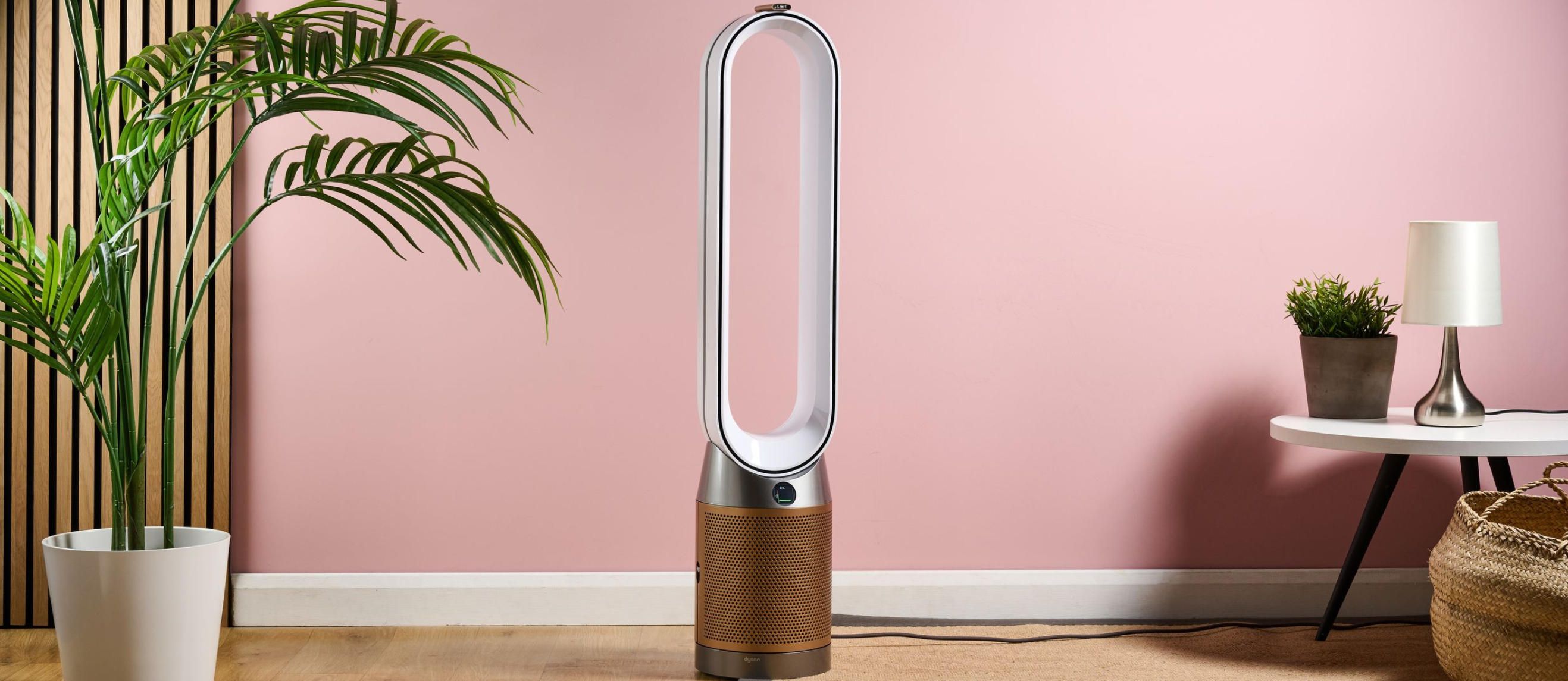
The Dyson Purifier Cool Formaldehyde TP09 immediately announces itself as a premium appliance. Standing tall with Dyson's signature bladeless loop amplifier design, the TP09 serves dual duty as both an air purifier and a cooling fan. The tower form factor projects over 77 gallons of purified air per second throughout a room, circulating clean air rather than simply filtering what passes through the intake. Available in a distinctive Nickel/Gold or White/Gold finish, the TP09 carries a list price of $749.99 in the United States, though retail discounts frequently bring the street price closer to $490 to $520 at major retailers like Amazon and Walmart.
The device houses a sophisticated four-sensor array inside its base. A solid-state formaldehyde sensor works alongside PM2.5, PM10, VOC, and nitrogen dioxide detectors to provide real-time air quality data. Dyson engineered the entire machine, not just the filter media, to meet the HEPA H13 sealed standard. This means that once pollutants enter the device, they cannot leak back into the room through gaps in the housing. The 360-degree filtration system combines a Glass HEPA and activated carbon filter, and uniquely, a catalytic filter that continuously converts formaldehyde molecules into water and carbon dioxide. This catalytic filter regenerates itself and never requires replacement, a genuine engineering achievement that addresses a pollutant many competing devices simply cannot detect, let alone destroy.
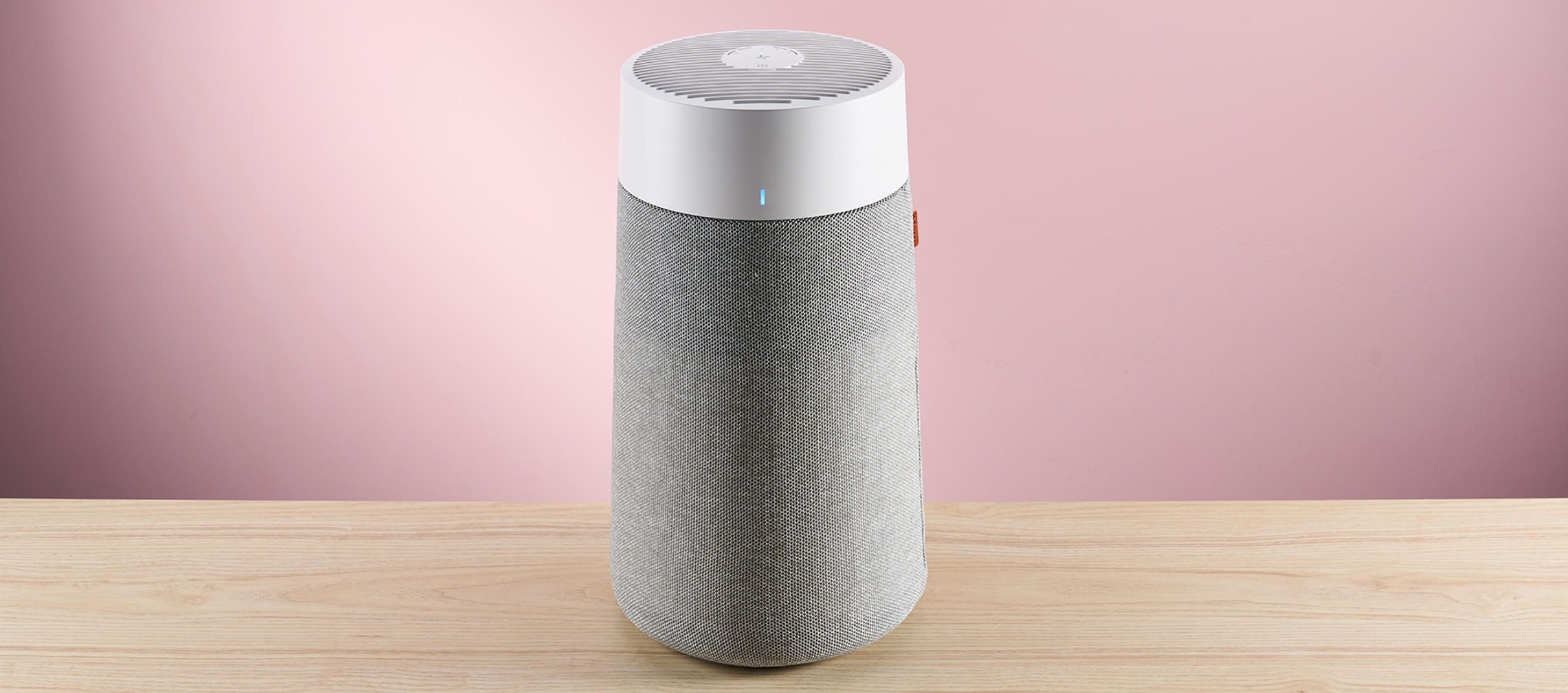
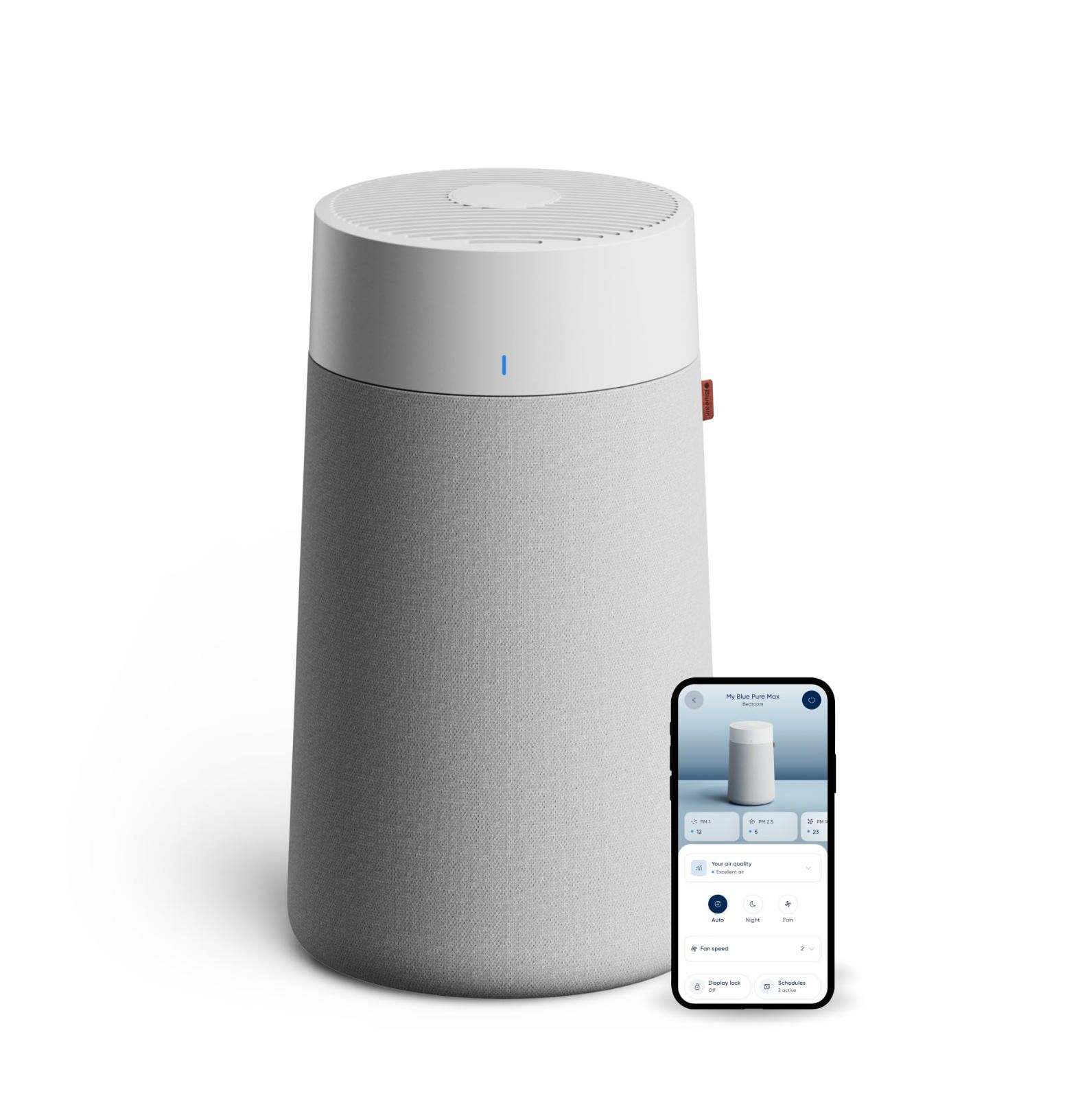
The Blueair Blue Pure 411i Max takes the opposite approach to nearly everything the Dyson represents. Compact, cylindrical, and weighing just 7.5 pounds, the 411i Max is designed to disappear into a room rather than dominate it. Priced at $169.99, it costs less than a quarter of the Dyson's list price. Its Scandinavian-inspired design features a washable fabric pre-filter available in multiple colors, from Stockholm Fog gray to Arctic Trail blue, allowing owners to match the device to their decor. The pre-filter wraps around the main filtration unit and catches larger particles like pet hair and lint before they reach the primary filter, extending the life of the internal media.
Inside, Blueair's proprietary HEPASilent technology combines mechanical filtration with electrostatic charging. Incoming particles receive an electrostatic charge just before reaching the filter media, causing them to adhere more readily. This hybrid approach allows the 411i Max to achieve high filtration efficiency while using smaller, quieter fans. Blueair claims the device removes at least 99.97% of airborne particles down to 0.1 microns, covering pollen, dust, smoke, pet dander, and bacteria. The 411i Max is Energy Star certified, consuming less energy than a standard LED lightbulb on its lowest setting, and it earned the Energy Star Most Efficient designation in 2023.
Filtration Technology: What Each Device Actually Removes
The core job of any air purifier is removing contaminants from the air, and here the Dyson TP09 and Blueair 411i Max take distinctly different paths to the same goal. Understanding these differences matters because not all air quality problems are the same, and each device has measurable strengths and limitations.
The Dyson TP09 employs a HEPA H13 filter rated to capture 99.97% of particles as small as 0.3 microns. This covers the vast majority of household allergens including dust mites, pollen, mold spores, and bacteria. Dyson further claims the TP09 has been tested to show 99.9% reduction of MS-2 bacteriophage virus aerosol within 165 minutes and 99.9% reduction of E. Coli bacteria aerosol within 150 minutes in controlled conditions. The activated carbon layer handles gaseous pollutants like volatile organic compounds and household odors from cooking, cleaning products, and paints.
Where the TP09 truly differentiates itself is in formaldehyde destruction. Formaldehyde is a colorless gas classified as a Group 1 carcinogen by the International Agency for Research on Cancer. It off-gases continuously from pressed wood products, laminate flooring, insulation materials, furniture adhesives, and even some fabrics. Most air purifiers with carbon filters can temporarily adsorb formaldehyde, but the carbon eventually saturates and begins releasing the gas back into the room. Dyson's catalytic filter uses a crypto-mic oxidation process to permanently break formaldehyde molecules into water (H2O) and carbon dioxide (CO2). Because the reaction regenerates the catalyst, the filter maintains its effectiveness indefinitely without replacement.
The Blueair Blue Pure 411i Max relies on its HEPASilent system, which Blueair describes as a combination of electrostatic and mechanical filtration. By pre-charging particles with a negative ion before they enter the filter, the 411i Max achieves effective particle capture rates comparable to traditional HEPA at a fraction of the noise and energy consumption. The main filter combines particle and carbon filtration in a single replaceable unit. Blueair states the device captures 99.97% of particles at 0.1 microns, which is actually a more aggressive claim than the Dyson's 0.3-micron specification.
However, the 411i Max lacks a dedicated formaldehyde sensor or destruction mechanism. Its carbon filter can adsorb VOCs and some gaseous pollutants, but it has no way to specifically identify or neutralize formaldehyde. For households dealing with new construction, renovation materials, or furniture off-gassing, this is a meaningful gap. On the other hand, for the far more common concerns of dust, pollen, pet dander, and smoke particles, the 411i Max performs admirably. TechRadar's testing confirmed the device detected and cleared PM2.5 contamination from sprayed dry shampoo within 10 minutes, and it was sensitive enough to detect air quality changes caused by hair products used in an adjacent room.
The filtration philosophy difference is clear. The Dyson TP09 is engineered to address a broader spectrum of pollutants, including specialized threats like formaldehyde and nitrogen dioxide, with dedicated sensors for each. The Blueair 411i Max is engineered for efficient, quiet, and affordable removal of the most common particulate pollutants, doing that job exceptionally well for its price.
Room Coverage and Airflow Performance
Room size compatibility is one of the most practical considerations when choosing an air purifier, and these two devices serve very different spaces. The Blueair Blue Pure 411i Max is rated for rooms up to 219 square feet at the AHAM-recommended rate of four air changes per 12.5-minute cycle. It can cover up to 526 square feet with one complete air exchange every 30 minutes, but peak performance is achieved in smaller spaces like bedrooms, home offices, nurseries, and studio apartments. Consumer Reports tested the 411i Max in a 219-square-foot space and confirmed effective performance within its rated coverage area.
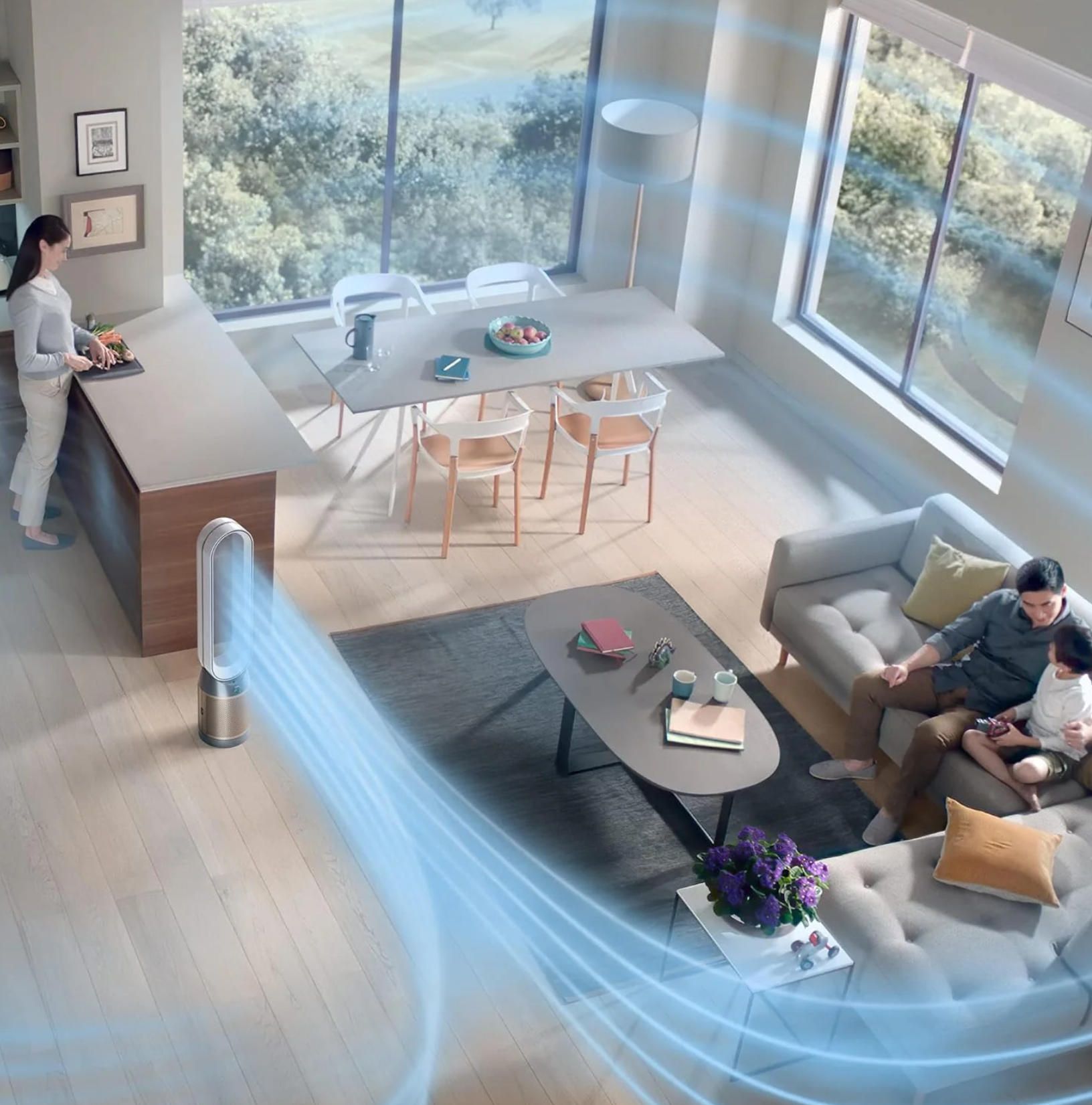
The Dyson TP09 does not publish traditional CADR (Clean Air Delivery Rate) numbers in the way most competitors do. Dyson has publicly stated its belief that CADR testing does not accurately reflect real-world purification performance in furnished, lived-in rooms. Instead, Dyson references its internal testing standards for whole-room air projection (TM-005021) and purification coverage (TM-003711). In practice, the TP09's Air Multiplier technology generates significant circulation, drawing distant pollutants across the room and into the base intake. Reviewers from Homes & Gardens noted the TP09 restored poor air quality readings to healthy levels in under 40 minutes in a standard bedroom after windows had been left open.
The fan function of the TP09 deserves separate attention. With 10 speed settings and oscillation adjustable from 0 to 350 degrees, the TP09 functions as a legitimate cooling fan during warmer months. It will never replace a dedicated air conditioner, but the directed airflow is strong enough to provide noticeable comfort on warm days. For cooler months, Dyson includes a Diffused mode that redirects airflow out the back of the loop amplifier, allowing the device to purify the room without blowing cool air directly at occupants. This dual-mode operation means the TP09 earns its place year-round, which partially justifies the higher price by consolidating two appliance roles into one.
The Blueair 411i Max has no fan or airflow direction capability beyond its internal purification function. Air is drawn in through the 360-degree base, filtered, and expelled upward through the top vent. The design is efficient for purification but does not provide any cooling benefit. For consumers who already own a fan or ceiling fan system, this is irrelevant. For those looking to reduce appliance clutter, the Dyson's combination design offers clear advantages.
Sensor Technology and Air Quality Monitoring
Sensor capability is where the price difference between these two devices becomes most apparent. The Dyson TP09 packs four distinct environmental sensors into its base unit. The PM2.5 sensor tracks fine particulate matter from sources like cooking smoke, candle soot, and traffic pollution. The PM10 sensor monitors larger particles including pollen, dust, and mold spores. A VOC sensor detects gaseous pollutants from cleaning products, paints, adhesives, and personal care items. And the solid-state formaldehyde sensor, a technology Dyson developed specifically for this product line, provides precise detection of formaldehyde concentrations distinct from general VOC readings. Most competitors that claim formaldehyde detection are actually measuring total VOC levels and inferring formaldehyde presence, a far less accurate method.
The TP09's built-in LCD screen displays real-time readings for each pollutant category, along with temperature and humidity levels. The display uses color-coded graphics that make it easy to glance across a room and understand current air quality at a glance. An algorithm processes data from all four sensors simultaneously, automatically adjusting fan speed and filtration intensity in Auto mode. When pollutants spike, for example when cooking begins or someone applies a cleaning spray, the TP09 ramps up within seconds.
The Blueair Blue Pure 411i Max includes a single PM2.5 particle sensor. This sensor drives the auto mode functionality, adjusting fan speed based on detected particulate levels. An LED indicator on the front of the unit uses a five-color scale from blue (clean) to red (heavily polluted) to provide a visual air quality reading. In testing, this sensor proved responsive and accurate for particulate matter. Best Buy customer reviews confirm the 411i Max reliably detects cooking fumes, aerosol sprays, and even cleaning products used in adjacent rooms.
However, the 411i Max cannot detect VOCs, nitrogen dioxide, formaldehyde, or any gaseous pollutant. It can filter these substances through its carbon filter media, but it has no way to tell you they are present or to adjust its operation in response to them. For many users, particularly those in older homes without recent renovations, PM2.5 detection alone provides sufficient intelligence for automated operation. For users concerned about chemical off-gassing from new furniture, fresh paint, or building materials, the lack of gas-phase detection means operating the 411i Max requires more manual intervention and guesswork.
Mobile App Experience: MyDyson vs Blueair App
Both devices connect to companion mobile applications via Wi-Fi, and both support voice control through Amazon Alexa and Google Assistant. The quality and depth of the app experience, however, differs substantially.
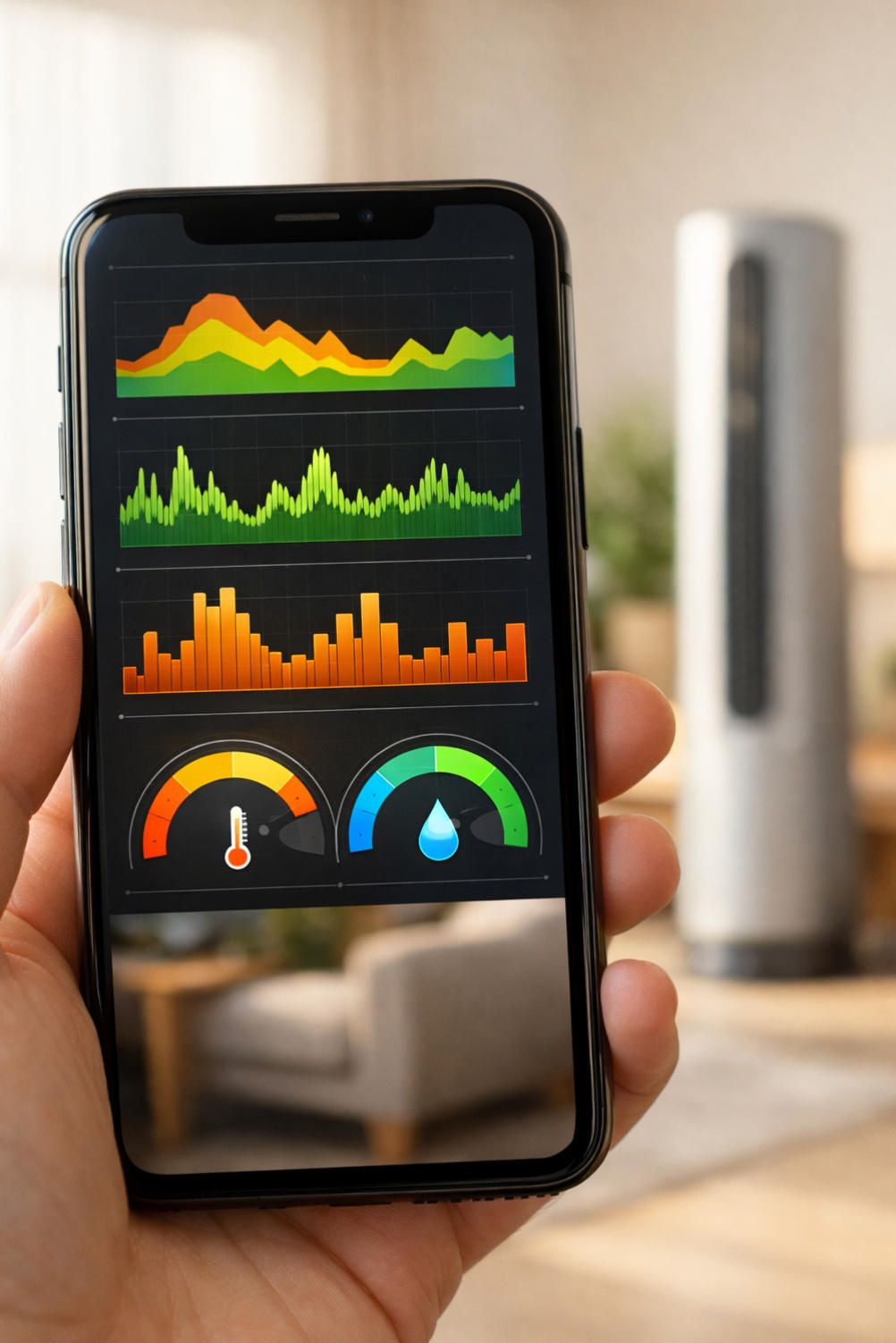
The MyDyson app serves as a comprehensive environmental monitoring dashboard. After connecting the TP09 to a 2.4 GHz Wi-Fi network (a quick, app-guided process that takes just minutes), users gain access to real-time readings for every sensor in the device. The home screen displays current air quality with individual breakdowns for PM2.5, PM10, VOCs, formaldehyde, nitrogen dioxide, temperature, and humidity. Swiping through the interface reveals historical graphs tracking each pollutant over time, with the app storing up to seven days of continuous data. This historical view allows users to identify patterns, for example, discovering that air quality consistently drops during evening cooking or that formaldehyde levels spike when the heating system activates.
The MyDyson app provides full remote control of the TP09 from anywhere with an internet connection. Users can power the device on or off, adjust fan speed across all 10 levels, toggle between Breeze and Diffused airflow modes, set oscillation angle, enable Night mode for quiet overnight operation, and create automated schedules. Filter life monitoring is integrated, with the app tracking usage hours and notifying owners when the HEPA and carbon filter approaches its 12-month replacement cycle. The catalytic formaldehyde filter displays separately, confirming it remains active without need for replacement.
TechRadar's review praised the MyDyson app as insightful and responsive, noting its particular value in communicating air quality changes and providing a detailed data breakdown that justifies the device's premium positioning. For data-oriented users who want to understand their home environment at a granular level, the MyDyson app delivers a genuinely useful experience.
The Blueair app provides a more streamlined, simpler mobile experience. After pairing the 411i Max over Wi-Fi, users can control power, fan speed, and switch between Auto and Night modes. The app includes scheduling functionality, allowing preset on/off times for different days of the week. Blueair's RealTrack algorithm monitors filter usage based on fan speed, operating time, and detected pollution levels, providing a more personalized filter life estimate than simple hour counting. When the filter nears the end of its useful life, the app sends a notification and offers a direct link to order a replacement.
One notable feature of the Blueair app is outdoor air quality monitoring. Based on the user's location, the app displays local outdoor air quality data and tracks how it varies over time. This contextual information helps users understand whether outdoor pollution events like wildfires, high pollen counts, or industrial activity are affecting their indoor air.
Where the Blueair app falls short is in depth and polish. Best Buy reviewers noted the interface can feel clunky and unintuitive at times, particularly when navigating settings. The app lacks the granular environmental data that the MyDyson app provides, showing only PM2.5 levels from the device's single sensor. There are no historical air quality graphs from the device itself, no VOC tracking, and no formaldehyde monitoring. Voice control through Alexa and Google Assistant is limited to basic on/off commands.
This is precisely the type of gap where custom mobile app development can make a transformative difference. The hardware inside the 411i Max is capable of effective filtration, but the software layer does not fully leverage the device's potential or provide the environmental intelligence that modern consumers increasingly expect.
Noise Levels and Daily Livability
Living with an air purifier means hearing it run for hours at a time, making noise performance a critical factor in real-world satisfaction. The Blueair Blue Pure 411i Max excels here. On its lowest fan speed, the device produces just 18 decibels, which is quieter than a whisper and virtually inaudible in any room with ambient background noise. Even at maximum speed, the 411i Max reaches only 46 decibels, roughly equivalent to a quiet library or a normal conversation heard from across a room. Blueair earned Quiet Mark certification for this model, an independent endorsement of exceptionally low noise output. TechRadar's review confirmed the 411i Max could run unnoticed on low settings throughout the night without disturbing sleep.
The Dyson TP09 has been engineered to be 20% quieter than its predecessor models, according to Dyson. On lower fan speeds and in Night mode, the TP09 operates quietly enough for bedroom use. However, as fan speed increases above level 7, the airflow noise becomes noticeably more prominent. This is an inherent trade-off of the dual-purpose fan design: moving enough air to provide noticeable cooling requires more powerful, and therefore louder, fan operation. Reviewers from Tech360 noted that the TP09's noise at higher speed settings can be distracting, particularly in quiet environments. For most users, the Auto mode strikes a good balance, running at lower, quieter speeds during periods of acceptable air quality and ramping up only when sensor readings indicate a pollution event.
In Night mode, both devices dim their displays and operate at minimum fan speeds, prioritizing silence. The Dyson's Night mode additionally locks the device to its quietest operational parameters while continuing to monitor and purify. The Blueair's Night mode similarly reduces fan speed and dims the LED indicator to avoid light disturbance during sleep.
Filter Replacement and Long-Term Costs
The upfront purchase price tells only part of the ownership story. Replacement filter costs accumulate over the years and can significantly affect the total cost of ownership.
The Dyson TP09 uses a 360-degree Combi Glass HEPA and Carbon filter that Dyson recommends replacing every 12 months, based on approximately 12 hours of daily use. The replacement filter set retails for $79.99. The catalytic formaldehyde filter is a permanent component that never requires replacement, which is a meaningful cost advantage for the formaldehyde-specific functionality. Over a five-year period, assuming annual filter changes, the Dyson TP09's total cost of ownership comes to approximately $749.99 (purchase) plus $399.95 (five filter replacements), totaling roughly $1,150 before any retail discounts.
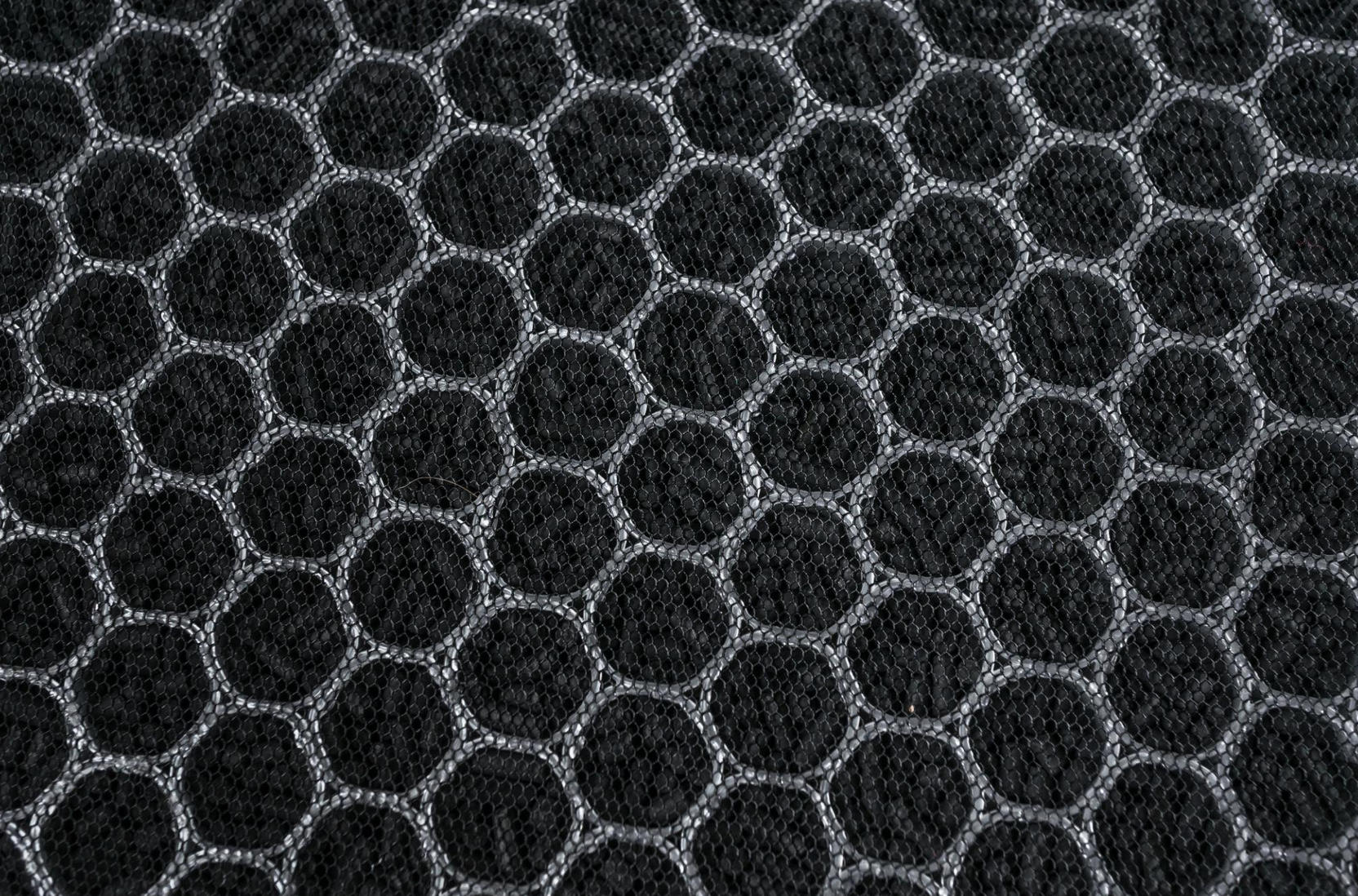
The Blueair Blue Pure 411i Max uses a combined Particle and Carbon filter (model F4MAX) priced at $29.99 per replacement. Blueair states this filter can last between six and nine months depending on usage and environmental conditions, with the RealTrack algorithm providing personalized replacement timing. The washable fabric pre-filter does not need replacement, only periodic machine washing. Assuming an average filter life of seven months, roughly two replacements per year, the five-year ownership cost comes to approximately $169.99 (purchase) plus $299.90 (ten filter replacements), totaling about $470.
The Blueair's total five-year cost is less than half the Dyson's, and actually less than the Dyson's purchase price alone. For budget-conscious consumers, this math is compelling. For consumers who need formaldehyde detection and destruction, the Dyson's cost premium buys functionality that simply does not exist at any price in the Blueair's design.

Smart Home Integration and Connectivity
Both devices support the major voice assistant platforms. The Dyson TP09 works with Amazon Alexa, Google Assistant, and Siri, providing voice-activated control for power, fan speed, and mode selection. Through the MyDyson app, the TP09 integrates into broader smart home routines, for example, automatically activating when a connected motion sensor detects someone entering a room or adjusting operation based on time-of-day schedules.
The Blueair Blue Pure 411i Max supports Amazon Alexa and Google Assistant for basic voice commands. Connecting the 411i Max to a Google Home ecosystem is described by reviewers as straightforward, though the command vocabulary is limited primarily to power on/off functions. The Blueair app does not currently support Apple HomeKit, which may be a consideration for households invested in the Apple ecosystem. Some higher-priced Blueair models do include HomeKit support, but the 411i Max does not.
Neither device supports the Matter smart home standard as of early 2025, though this is an evolving landscape. For users building comprehensive smart home systems, the Dyson's broader voice assistant support and more capable app-based automation provide greater flexibility. The Blueair remains functional within smart home setups but in a more limited capacity.
Who Should Choose the Dyson TP09
The Dyson Purifier Cool Formaldehyde TP09 is the right choice for homeowners dealing with new construction, recent renovations, or new furniture purchases where formaldehyde off-gassing is a genuine concern. It is equally suited to anyone who values comprehensive environmental data and wants a detailed, sensor-driven understanding of their indoor air quality. The dual-function fan capability adds legitimate value for those who want to reduce appliance clutter and need both purification and cooling in a single unit.
The MyDyson app experience is meaningfully superior for data-oriented users. If you want to track PM2.5 trends over a week, identify which activities cause VOC spikes, or confirm that formaldehyde levels in a nursery remain safe, the TP09 provides this information in an accessible, well-designed interface. The premium price reflects premium engineering across sensors, filtration, airflow, and software.
Who Should Choose the Blueair Blue Pure 411i Max
The Blueair Blue Pure 411i Max makes the strongest case for anyone prioritizing effective particulate filtration at an accessible price. For bedrooms, home offices, dorm rooms, nurseries, and small apartments, the 411i Max delivers quiet, energy-efficient air cleaning that handles the most common indoor pollutants, including dust, pollen, pet dander, and smoke, at a fraction of the cost of premium alternatives. Its compact size and light weight make it easy to move between rooms as needed.
The 411i Max is also the ideal choice for renters, students, and anyone who wants clean air without a significant financial commitment. The low upfront cost, affordable replacement filters, and minimal energy consumption make it one of the most cost-effective paths to healthier indoor air. The Blueair app provides enough functionality for basic scheduling and monitoring, and the device's Auto mode handles most situations without requiring manual intervention.
How Custom Mobile App Development Elevates Air Purifier Technology
Both the Dyson TP09 and the Blueair 411i Max demonstrate a broader industry truth: the mobile application has become as important as the hardware itself. The smart air purifier market's projected growth to $5.56 billion by 2030 is driven not just by better filters, but by the connected intelligence that mobile apps provide. Consumers expect real-time data, remote control, predictive maintenance alerts, and integration with their broader smart home ecosystems. According to Grand View Research, the residential segment accounted for 66.8% of smart air purifier market revenue in 2023, with app integration and real-time air quality monitoring cited as key purchasing drivers.
Yet even leading brands leave significant functionality on the table. The Blueair app, while functional, lacks the environmental data depth that its hardware could theoretically support. The MyDyson app, while feature-rich, stores only seven days of historical data and does not offer predictive analytics or health correlation insights. Neither app provides personalized recommendations based on user behavior patterns, seasonal allergen data, or integration with health platforms like Apple Health or Google Fit.
This is where A-Bots.com brings transformative value to manufacturers, startups, and established brands looking to elevate their air purifier products through custom mobile application development. With a proven track record of over 70 completed projects and deep expertise in IoT mobile applications, including their work on the Shark Clean robotic vacuum control app, A-Bots.com understands the unique challenges of connecting physical devices with intuitive, data-rich mobile interfaces.
A custom-developed air purifier application built by A-Bots.com could incorporate advanced features that no current off-the-shelf air purifier app delivers. Multi-sensor data fusion dashboards could combine indoor sensor readings with outdoor pollution data, weather forecasts, and pollen count APIs to provide a truly comprehensive air quality picture. Machine learning algorithms could analyze weeks or months of air quality data to predict pollution patterns, for example, alerting users that formaldehyde levels typically rise on Tuesday mornings when the heating system cycles through its warmup phase, or that PM2.5 spikes correlate with a neighbor's regular lawn maintenance schedule.
Health-focused integrations could connect air quality data with wearable health metrics, helping users understand how indoor air quality affects sleep quality, respiratory symptoms, or exercise recovery. Predictive filter replacement powered by actual sensor data and usage patterns could optimize maintenance timing, ensuring filters are replaced neither too early (wasting money) nor too late (compromising air quality). Multi-device management interfaces could allow homeowners with purifiers in multiple rooms to view and control their entire system from a single dashboard, something neither the MyDyson nor Blueair apps do elegantly for multi-unit households.
For manufacturers and hardware startups entering the air purifier market, A-Bots.com offers full-cycle development from strategy and product definition through deployment on both Android and iOS platforms. Their technology stack, including React Native for cross-platform mobile development, Node.js and Python for backend services, and experience with real-time IoT data processing, aligns precisely with the requirements of connected air purification systems. Custom chatbot integration, another A-Bots.com specialty, could provide users with conversational AI support that answers questions about air quality readings, recommends optimal device settings, or guides filter replacement procedures.
The air purifier that wins consumer loyalty in 2025 and beyond will not just be the one with the best filter. It will be the one with the smartest, most intuitive, and most responsive mobile application. Whether you are developing a new smart air purifier from scratch or looking to enhance an existing product's mobile experience, A-Bots.com has the expertise to build the connected software layer that transforms hardware capability into genuine daily value for users.
To discuss your air purifier application project or explore how custom IoT mobile development can differentiate your product in this rapidly growing market, visit a-bots.com or reach out directly at info@a-bots.com.
✅ Hashtags
#AirPurifierComparison
#DysonTP09
#BlueairBluePure411iMax
#SmartAirPurifier
#IndoorAirQuality
#HomeApplianceApp
#IoTMobileDevelopment
#CustomAppDevelopment
Other articles
Best Food Delivery App in Riyadh Riyadh's food delivery market is experiencing explosive growth, projected to reach $15.12 billion by 2030. This comprehensive guide analyzes the best food delivery app in Riyadh platforms including HungerStation, Jahez, KeeTa, Talabat, Mrsool, ToYou, and Careem NOW. A-Bots.com specializes in developing custom food delivery applications tailored for Saudi Arabian market requirements, offering both new platform development and quality assurance testing for existing systems. Learn about essential technical features, security requirements, cultural localization, and competitive strategies that define successful food delivery platforms in Riyadh. Whether you're choosing a platform as a consumer or developing a new solution, this analysis provides expert insights into one of Saudi Arabia's most dynamic technology sectors.
Wellington App Development: Custom Mobile Solutions Wellington's position as New Zealand's creative and technology capital creates unique opportunities for mobile app development. A-Bots.com delivers custom Wellington app solutions across diverse sectors including the globally renowned film industry anchored by Weta FX, the thriving fintech ecosystem led by Xero, and Wellington's expanding tourism sector generating NZ$1.3 billion annually. This comprehensive guide explores Wellington app development opportunities in visual effects workflows, financial services platforms, tourism experiences, smart city initiatives, and enterprise applications. With 70+ completed projects and client partnerships spanning 1.5 to 5+ years, A-Bots.com provides full-spectrum services from native iOS and Android development to comprehensive quality assurance testing, positioning Wellington businesses for digital success in New Zealand's capital.
Professional App Development Auckland: IoT, Parking, E-Scooter and Drone Solutions Auckland's technology sector demands sophisticated mobile applications that address unique urban challenges. A-Bots.com delivers professional app development Auckland businesses rely on, with specialized expertise in IoT smart device control, parking management systems, micromobility platforms, and UAV applications. With over 70 completed projects and client relationships spanning 1.5 to 5+ years, the company provides full-cycle development from concept through deployment and ongoing support. A-Bots.com's technical team masters React Native, Swift, Java, and Kotlin to build cross-platform and native applications serving Auckland's $10 billion technology ecosystem. Whether developing consumer-facing apps or enterprise systems, A-Bots.com combines local market knowledge with international development standards to deliver solutions that drive business growth across New Zealand's economic powerhouse.
App Development Christchurch: Custom Mobile Solutions for Canterbury Businesses Christchurch has emerged as New Zealand's innovation hub, with a tech sector contributing $2.4 billion to regional GDP. This comprehensive guide explores app development Christchurch opportunities across key industries including tourism, agriculture, healthcare, and technology. Learn about development costs ranging from $5,000 for simple apps to $300,000+ for complex solutions, platform selection strategies, and the structured development process from discovery to deployment. The article examines how Canterbury businesses leverage mobile applications to serve the region's 96% internet-connected population. A-Bots.com offers custom development and testing services backed by 70+ completed projects and long-term client partnerships spanning over five years.
App Development New Zealand: Build a Custom Mobile Product New Zealand's tech sector contributes NZ$23.8 billion to GDP, and mobile app usage among Kiwis exceeds 70%. This guide covers everything businesses need to know about app development New Zealand — from market data and user behavior to development costs, regulatory compliance under the Privacy Act 2020, and technology choices between native and cross-platform frameworks. Key industries driving mobile demand include agritech, fintech, healthtech, and tourism. A-Bots.com offers full-cycle development, QA testing, and strategic consulting backed by 70+ completed projects across mobile, web, IoT, chatbot, and blockchain solutions. The article includes cost breakdowns, emerging technology trends, and practical advice for launching a competitive mobile product in the New Zealand market.
Top stories

Copyright © Alpha Systems LTD All rights reserved.
Made with ❤️ by A-BOTS