
Home
Services
About us
Blog
Contacts
App Controlled Thermostat: How Smart Smartphone Thermostats Are Changing the Way We Live (and Why Businesses Want More)
You come home after a long day at work. It's either freezing cold or unbearably hot inside — because your old thermostat doesn't know you're on your way. Now imagine a different scenario: your smartphone quietly detects that you left the office 20 minutes ago, sends a signal to your thermostat, and by the time you open the front door, the temperature inside is exactly the way you like it. No waiting, no sweating, no guilt about wasted energy.
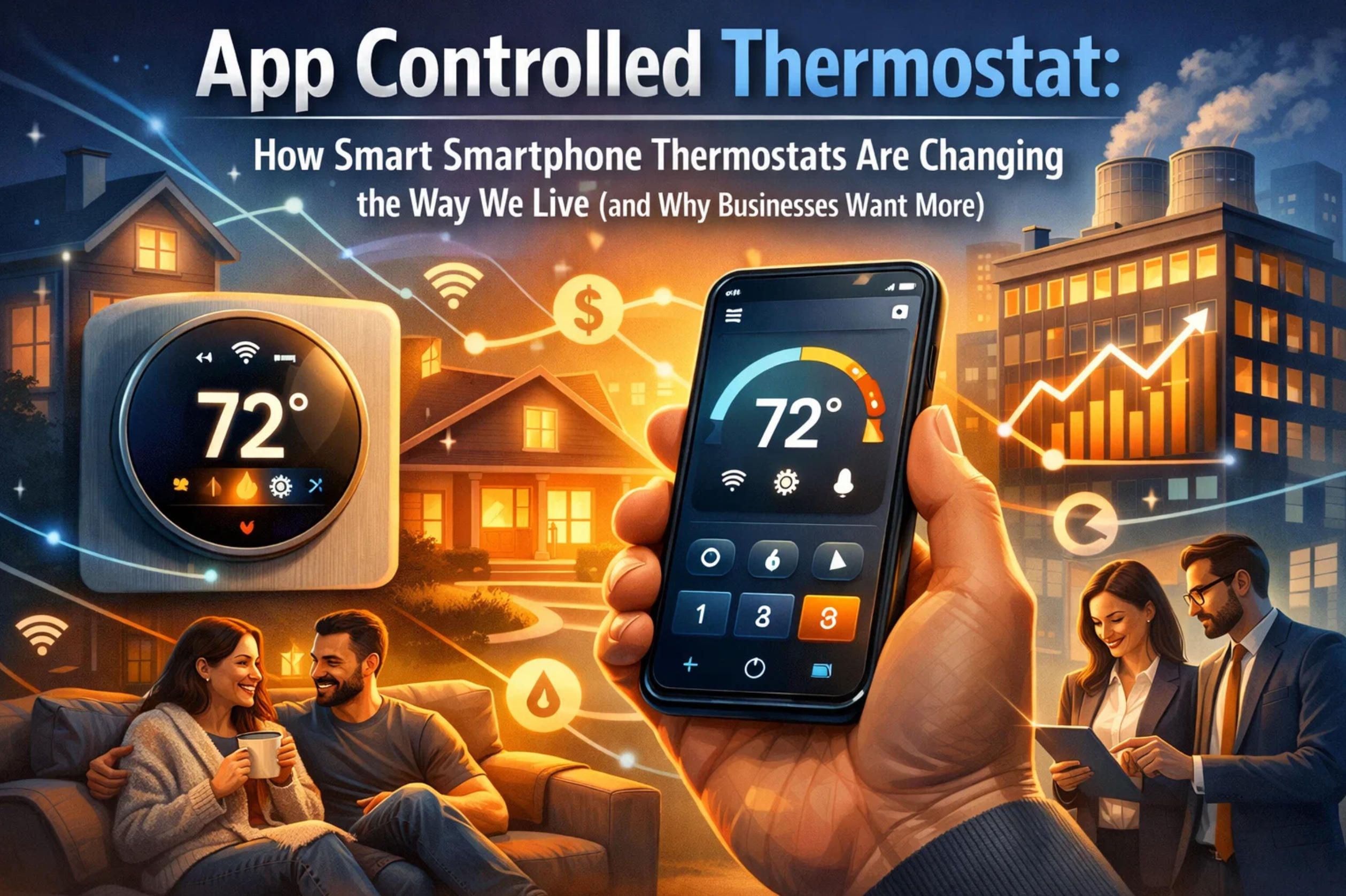
That's not a smart home brochure fantasy. That's what a modern app controlled thermostat does, right now, in millions of homes across the world. And if you're a business owner, property developer, hotel chain, or startup founder, this technology is becoming one of the most important decisions you'll make in the next few years.
Let's break it all down — from how these devices work, to what Honeywell and ecobee figured out, to why more and more companies are going beyond off-the-shelf solutions and ordering custom apps.
What Is an App Controlled Thermostat, and Why Should You Care?
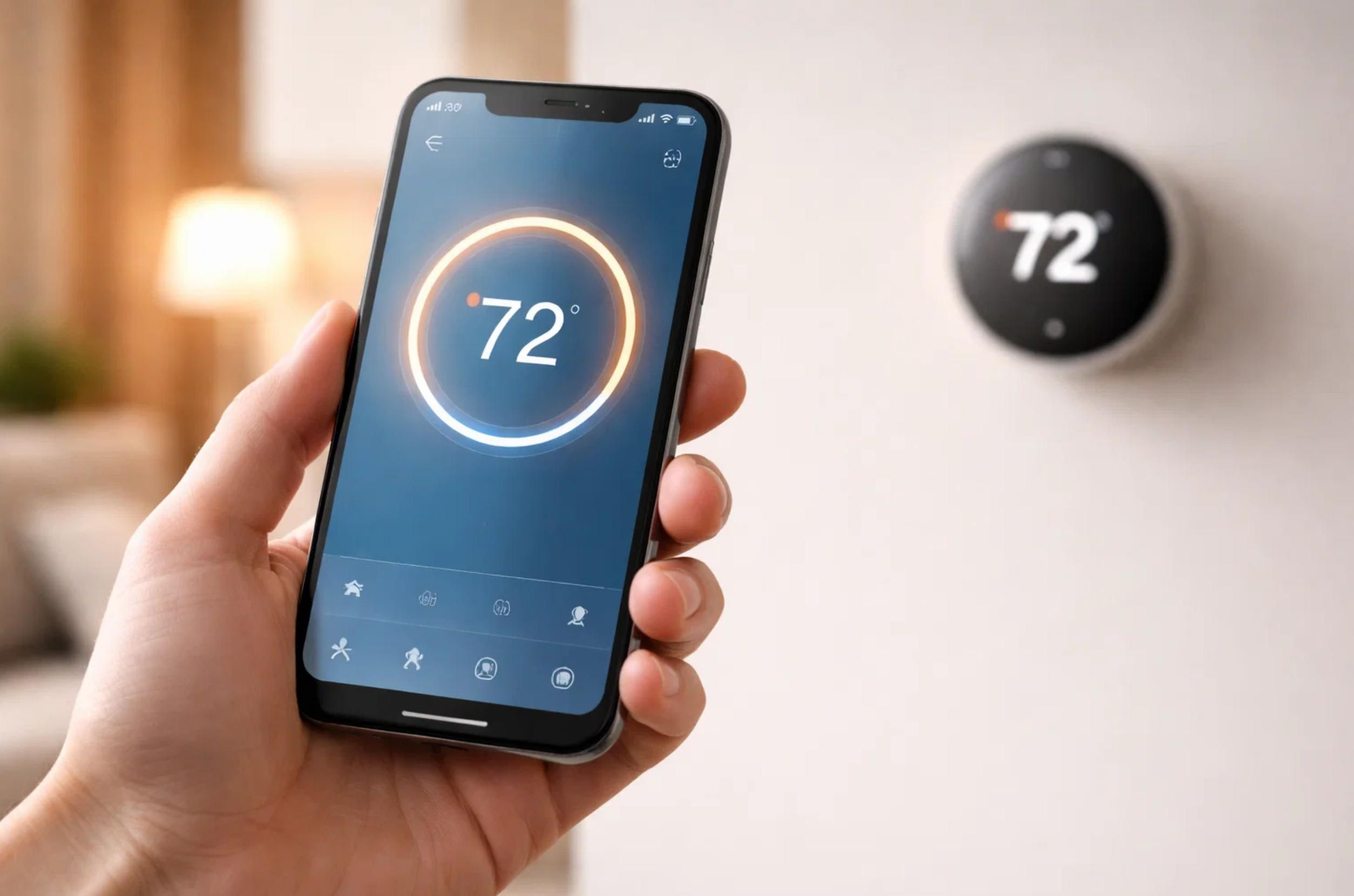
An app controlled thermostat is exactly what it sounds like: a climate control device that you manage through a smartphone application, from anywhere in the world. You could be sitting in a café in Barcelona and turn down the heat in your New York apartment with a single tap.
But calling it "just a thermostat with an app" is like calling a Tesla "just a car with a USB port." The magic is in the intelligence underneath.
Modern smart smartphone thermostats use a combination of Wi-Fi (or Zigbee, Z-Wave, or the newer Matter protocol — more on those in a moment), cloud computing, and machine learning algorithms to do things old thermostats simply couldn't dream of. They learn your schedule. They detect when you leave the house. They check the local weather forecast and pre-cool your bedroom before a hot night. They warn you if a pipe might freeze while you're away.
And they do all of this through an app on your phone, which has become the most natural remote control most of us already carry everywhere.
According to Grand View Research, the global smart thermostat market was valued at approximately $5 billion in 2024 and is projected to grow to $13.35 billion by 2030, at a compound annual growth rate of 18.5%. North America currently dominates with over 61% of global revenue — and yet, according to Parks Associates, only 16–17% of US internet households currently own a smart thermostat. That gap represents an enormous, mostly untouched opportunity.
A Quick Look at the Leaders: Honeywell and ecobee
Before we talk about custom solutions, it helps to understand what the best consumer products on the market currently offer — because they've done a lot of the heavy lifting in educating users about what a smart smartphone thermostat can do.
Honeywell: The Legacy Giant Learning New Tricks
Honeywell is one of the oldest names in home climate control, and their move into smart thermostats has been... eventful. The Honeywell Home app (now officially rebranded as the Resideo app, which confused basically everyone) connects their Wi-Fi thermostats to your phone and gives you remote scheduling, temperature adjustments, and system alerts.
Their newest product, the Honeywell Home X2S, launched at CES 2025, is Matter-enabled, ENERGY STAR certified, and priced accessibly at $79.99. "Matter" here refers to a universal smart home connectivity standard — think of it as the USB-C of smart home devices: finally, everything can speak the same language. The X2S also monitors indoor air quality and humidity, which is a genuinely useful feature if you've ever wondered why your house feels stuffy in winter.
The honest user feedback on Honeywell's app, however, is... mixed. Many users report connectivity issues, unexpected logouts, and the frustrating experience of getting up to manually adjust a thermostat because the app won't respond. One user in the App Store memorably wrote: "I have six of these expensive thermostats in my home — I either have to put up with it or spend a lot of money replacing them with Ecobees." That's the kind of review that keeps product managers awake at night.
The lesson here isn't that Honeywell makes bad thermostats — it's that the app experience is just as important as the hardware. A great device with a poor mobile interface is a frustrating device.
ecobee: The App-First Smart Thermostat
ecobee, a Canadian company now part of Generac, built its reputation by taking the app experience seriously from the start. Their ecobee app is consistently rated as the best in its category on both the Apple App Store and Google Play — a claim they make proudly and, based on user reviews, mostly deserve.
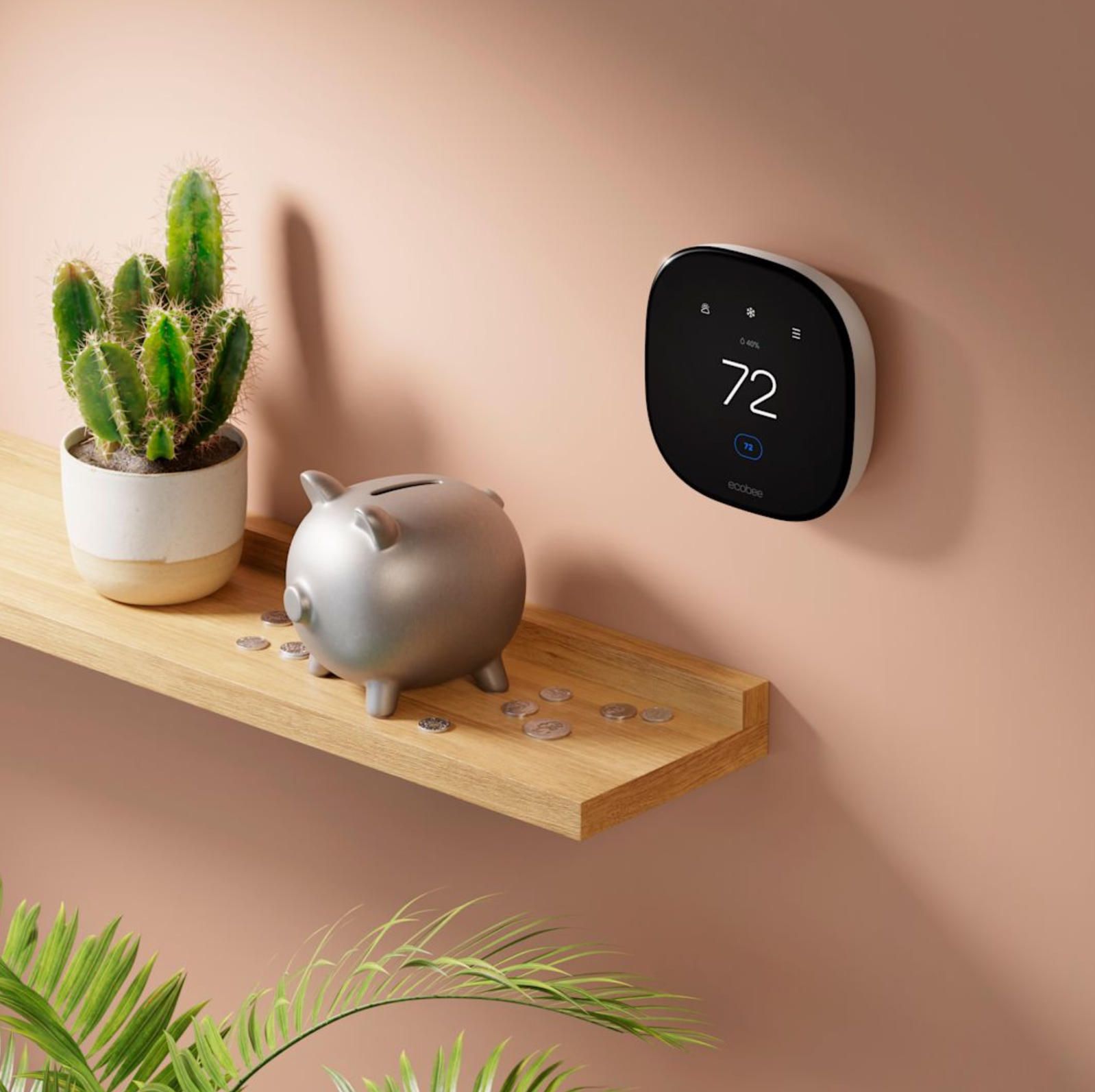
What makes ecobee thermostats compelling is the ecosystem thinking. A smart smartphone thermostat from ecobee doesn't just control temperature — it works with SmartSensors placed in different rooms to detect which rooms are actually occupied and adjust accordingly. (Because why heat the guest bedroom when nobody's sleeping there? Your money is literally going out the window.) Their eco+ software saves users an average of up to 26% on heating and cooling costs, which translates to roughly $284 per year.
The ecobee app allows you to set schedules, enable geofencing (the thermostat knows when you've left home based on your phone's GPS), view energy reports, get maintenance reminders, and integrate with Alexa, Google Assistant, Apple HomeKit, SmartThings, and IFTTT. The Smart Thermostat Premium model even listens for smoke alarms and sends you a mobile alert — a feature that is either genuinely life-saving or the kind of thing that makes you realize your thermostat now has ears. Probably both.
The ecobee Smart Thermostat Essential, launched in early 2025, starts at an accessible price point while offering a color touchscreen and energy savings that can pay for the device in as little as six months.
How Does It Actually Work? (The Technical Bit, Made Human)
If words like "Zigbee" or "MQTT protocol" make your eyes glaze over, don't worry — here's what you actually need to know.
The hardware is the physical thermostat on your wall. It has temperature sensors, a display screen, a Wi-Fi or Zigbee chip to communicate with the internet, and a microprocessor that runs the logic.
The connectivity layer is how it talks to your phone. Most consumer-grade app controlled thermostats use Wi-Fi (the same network your laptop uses). Some use Zigbee or Z-Wave, which are lower-power protocols designed specifically for smart home devices — they don't hog bandwidth and are more secure than regular Wi-Fi, but they require a separate hub device to bridge to your phone. The Matter standard, adopted by Apple, Google, Amazon, and Samsung in 2022-2024, is designed to make all of these work together without compatibility headaches.
The cloud is where the intelligence lives. When you tap "set to 70°F" in the ecobee app while sitting in your car, that command goes to ecobee's cloud servers, which send an instruction to your thermostat over the internet. The thermostat executes the command and reports back. The whole thing happens in under two seconds.
Machine learning algorithms analyze your behavior over weeks: when you wake up, when you leave, when you return, how quickly your home heats or cools. Over time, the thermostat stops asking you for instructions and starts anticipating what you want. This is what the industry calls a "learning thermostat" — and it's one of the fastest-growing segments of the market, projected to reach 45% of total market share by 2030.
Geofencing (the feature where your thermostat knows you're on your way home) uses your phone's GPS. A virtual boundary is drawn around your home address. When your phone crosses that boundary on the way in, the app sends a command to start heating or cooling. When you leave, it switches to an energy-saving mode. No manual action required.
Where Consumer Products Hit Their Limits
Honeywell and ecobee are excellent for individual homeowners. But what happens when you need something... more?
Consider a few real-world scenarios:
A hotel chain with 200 rooms needs a thermostat app that integrates directly with their property management system. When a guest checks out, the thermostat automatically switches to an energy-saving mode. When a new booking is confirmed for that room, the thermostat pre-conditions the room 30 minutes before arrival. No off-the-shelf consumer product handles this workflow — because it was never designed to.
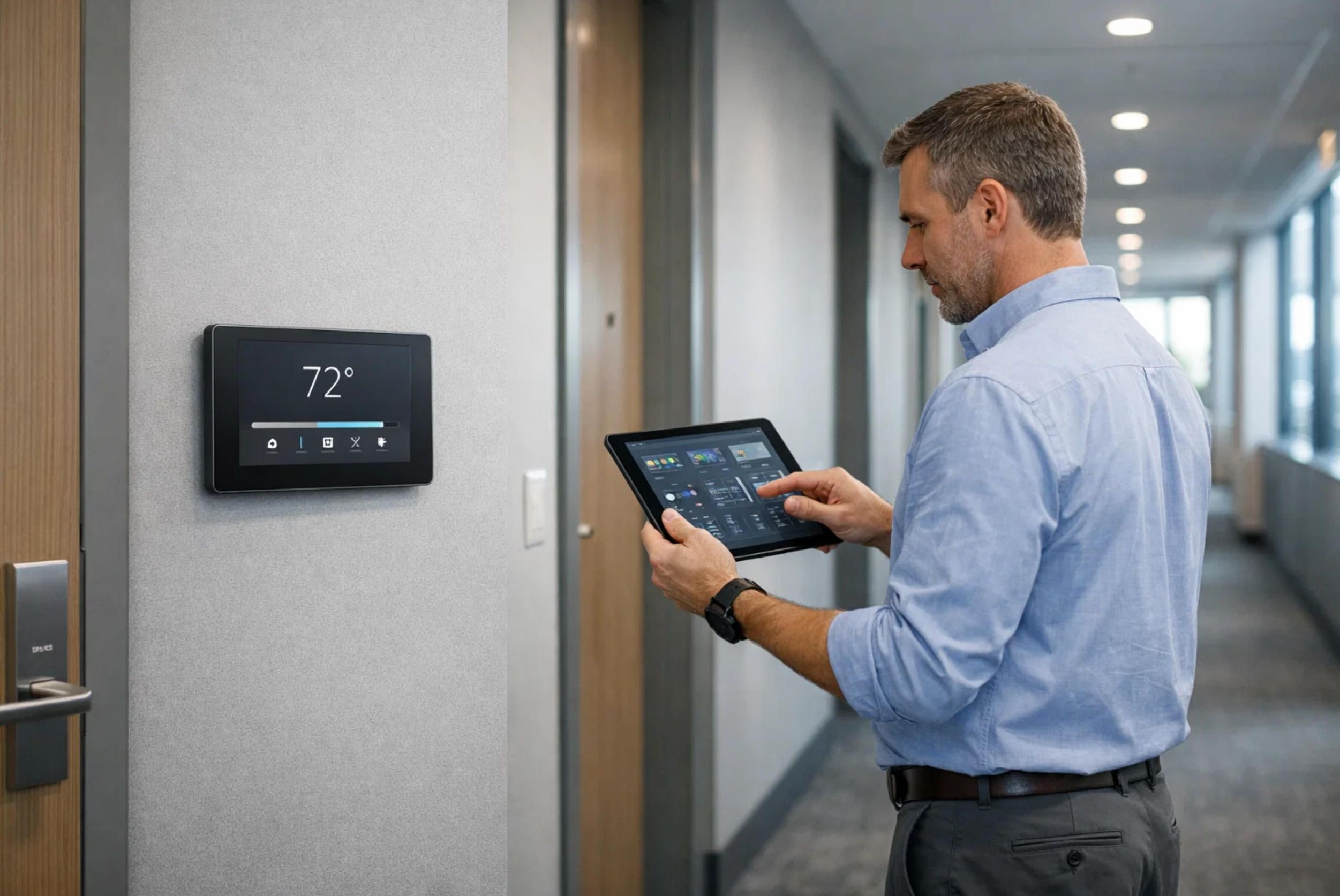
A commercial real estate developer managing 15 office buildings needs centralized climate control dashboards, per-zone scheduling for different tenants, automated energy reporting for ESG compliance, and integration with their BMS (Building Management System). The ecobee app is great for one home. It was not designed to manage 15 buildings and 800 individual zones.

A healthcare facility needs temperature data logged every 5 minutes for regulatory compliance, with alerts going to both a facilities manager app and a compliance system simultaneously. The Honeywell app has alerts. It does not have an API that feeds structured data into a compliance platform.
A smart apartment startup wants to offer tenants a branded app — not a third-party app with someone else's logo — where they control their thermostat, smart locks, and lighting all in one place, and the developer can see aggregate energy data across the entire building.
In all of these cases, the question is not "which consumer smart thermostat should we buy?" The question is: "Who can build us a custom app controlled thermostat solution?"
The Case for Custom Smart Thermostat Apps
This is where custom mobile development becomes not just a nice-to-have, but a genuine competitive advantage.
A custom smart smartphone thermostat application can be designed from the ground up around your specific users, your specific hardware, and your specific business logic. Here's what that actually means in practice.
White-label branding. Your app. Your logo. Your color scheme. Your users never interact with a third-party brand — they interact with yours. This matters enormously for hotels, property management companies, and any business where brand experience is part of the product.
Custom integrations. A bespoke app can connect to your existing systems: your CRM, your billing platform, your building management system, your enterprise resource planning software. It can send temperature data to a data warehouse for analysis. It can trigger actions in other systems based on thermostat events. The ecobee API allows some of this, but within limits set by ecobee's roadmap, not yours.
Custom UX/UI design. Consumer apps are designed for the median user. Your users may need something simpler (hotel guests who just arrived and are tired and want it colder right now), or something more complex (facilities engineers who need multi-zone control with scheduling templates and override logs).
Proprietary business logic. Want your thermostat app to automatically drop to 65°F when a hotel room is unoccupied for more than 2 hours, then warm back up 45 minutes before the next check-in based on data from your reservation system? That's custom logic. Nobody sells that off-the-shelf.
Data ownership. With a consumer product, your usage data lives on that company's servers, under their privacy policy, monetized (or not) according to their terms. With a custom solution, your data is yours. This is increasingly important as energy data becomes valuable for utility rebates, ESG reporting, and AI-driven optimization.
Hardware flexibility. Custom app development isn't locked to one thermostat brand. A capable development team can build apps that work with multiple hardware platforms, giving you flexibility as technology evolves. Want to switch from a Zigbee-based system to a Matter-based one next year? A custom app can be updated. A consumer app may or may not support your new hardware.
What Does Building a Custom Thermostat App Actually Involve?
For those who haven't commissioned custom software before, this is often the mysterious part. Let's demystify it.
A custom app controlled thermostat project typically involves several interconnected components.
The mobile application itself — iOS, Android, or both — is the user-facing layer. This is what your hotel guests, tenants, or facility managers actually see and touch. It needs to be fast, intuitive, and reliable. Crash rates above 1% are considered poor. UI response times above 300 milliseconds feel sluggish to users. These are engineering problems with known solutions — they just require experienced developers.
The backend and API layer is the cloud infrastructure that connects the mobile app to the physical thermostats. This handles authentication (making sure only authorized users control each device), data storage (logging temperature history, user actions, energy usage), and business logic (the rules that determine when and how the system responds to various conditions).
IoT communication protocols — MQTT, HTTP REST APIs, WebSocket connections — are the technical plumbing that lets cloud servers talk to physical hardware in real time. Getting low-latency, reliable communication between a cloud server and a thermostat on a home Wi-Fi network requires specific expertise. This isn't the place to learn on the job.
Third-party integrations connect the thermostat system to the outside world: weather APIs for predictive control, utility company APIs for demand-response programs (where your system automatically reduces consumption during peak grid demand in exchange for credits), voice assistant platforms (Alexa, Google Assistant, Siri Shortcuts), and enterprise systems as described above.
Security architecture is non-negotiable. Academic research published in 2024 found that many consumer-grade IoT devices ship with default passwords and outdated security libraries. A custom-built system, designed with security as a first-class requirement, is auditable, updatable, and doesn't carry the accumulated technical debt of a mass-market product.
This is a meaningful engineering effort. But for businesses where climate control is part of the core product — hospitality, real estate, healthcare, logistics, commercial property management — the return on investment is clear and measurable.
QA Testing: When You Already Have a Thermostat System and Something Feels Wrong
Not every company needs to build from scratch. Some organizations already have a smart thermostat solution in place — perhaps inherited through acquisition, built by a previous vendor, or purchased as a commercial product — and it's... not quite working the way it should.
Maybe the app crashes intermittently on Android. Maybe the geofencing works for some users but not others. Maybe the thermostat sometimes ignores schedule changes. Maybe your integration with the property management system occasionally sends the wrong commands.
These are QA problems — and they're more common than most organizations admit.
Thorough quality assurance testing for IoT applications is a specialized discipline. Unlike testing a regular web app, thermostat QA requires testing the interaction between three different systems simultaneously: the physical hardware, the cloud backend, and the mobile application. A bug that only appears when the Wi-Fi drops for 2 seconds is not caught by testing any one of those components in isolation.
Effective IoT QA testing covers functional testing (does the app do what it's supposed to do?), performance testing (how does the system behave with 1,000 devices connected simultaneously?), connectivity testing (what happens when the network is unreliable?), security testing (can unauthorized users access controls they shouldn't?), and compatibility testing across different operating systems, app versions, and hardware models.
For a system where a failure could mean a hotel full of guests without heat in February, or a data center running at the wrong temperature, the cost of inadequate testing is not abstract.
A-Bots.com: Custom Development and Testing for Smart Thermostat Applications
This is where we come in. A-Bots.com is a mobile and web development company with over 70 completed projects across diverse industries, including IoT solutions, smart home applications, and connected device platforms.
We build custom app controlled thermostat solutions for businesses that have outgrown what consumer products can offer. Our development teams work with all major connectivity protocols — Wi-Fi, Zigbee, Z-Wave, Matter, BLE — and have experience integrating thermostat systems with property management platforms, building management systems, energy management software, and enterprise data infrastructure.
Our approach to IoT application development is grounded in real-world deployment experience. We understand that the gap between a demo that works in a conference room and a system that works reliably for thousands of concurrent users in the field is significant — and we've navigated that gap across multiple projects. We design systems for scale from the beginning, because retrofitting scalability after launch is always more expensive than building it in.
We also offer comprehensive QA testing services for existing smart thermostat applications. Whether you've built a system in-house and want an independent quality audit, or you've inherited a product that needs improvement, our QA engineers combine automated test frameworks with manual exploratory testing to identify issues that typical testing misses. We test across hardware configurations, network conditions, operating system versions, and edge cases that real users encounter in the real world.
Our client relationships average between 1.5 and 5 years — not because we lock clients in, but because long-term partnerships let us understand your business deeply enough to add value that a new vendor couldn't. The best thermostat application we can build for you today becomes even better when we've seen how your users actually use it for a year.
If you're evaluating whether custom development is the right path for your smart thermostat project, we're happy to have a technical conversation about your requirements, timeline, and budget — no commitment required.
What to Look for When Choosing a Development Partner
If you're shopping for a team to build your smart thermostat application (whether that's us or someone else), here are the questions worth asking.
Have they built IoT applications before, specifically for connected hardware? General mobile app development experience and IoT experience are different disciplines. The former is necessary but not sufficient.
What backend infrastructure do they use, and why? AWS IoT, Azure IoT Hub, and Google Cloud IoT are the major platforms. Each has tradeoffs in terms of cost, scalability, and developer tooling. A team that can explain those tradeoffs has clearly thought about it. A team that just says "we use AWS" without elaboration hasn't.
How do they handle connectivity failures? Every IoT system experiences intermittent connectivity. How does your app behave when the internet goes down? What data is cached locally? What commands queue for retry? These questions separate experienced IoT teams from those who learned IoT on the job.
What's their QA process for hardware-dependent features? Ask specifically how they test features that require physical device interactions. If the answer is "we test it manually on our office devices," that's worth noting.
Do they have experience with security in IoT contexts? This should not be an afterthought. Ask about authentication mechanisms, data encryption at rest and in transit, and their approach to vulnerability disclosure.
Looking Ahead: Where Smart Thermostat Apps Are Going
The next five years in the smart thermostat space will be shaped by a few clear trends.
AI-driven predictive control will move from luxury feature to baseline expectation. Systems that learn individual user preferences, predict occupancy patterns, and optimize for both comfort and energy cost simultaneously will become standard in commercial and premium residential applications.
Demand response integration will become commercially significant as electricity grids become more dynamic. Smart thermostats that can automatically reduce consumption during peak demand periods — in exchange for utility credits or lower rates — represent a real financial opportunity for building owners. This requires deep API integration with utility companies, which is a custom development challenge.
Air quality integration is growing rapidly. The line between "thermostat" and "indoor climate management system" is blurring as sensors for CO2, particulate matter, humidity, and volatile organic compounds become cheap enough to embed in consumer devices. Applications that manage all of these parameters through a single interface represent the next generation of the category.
Commercial real estate is adopting smart thermostats at an accelerating pace, driven by energy cost pressures and ESG reporting requirements. Commercial deployments are projected to grow at an 18.9% CAGR through 2030 — faster than residential. The applications serving this market are, almost by definition, custom or semi-custom solutions built on top of commercial hardware.
Matter protocol adoption is simplifying the hardware landscape, making it easier for custom applications to support a broader range of devices without managing multiple proprietary APIs. For developers, this is genuinely good news: less time fighting proprietary SDKs, more time building features users actually want.
The Bottom Line
A smart smartphone thermostat is no longer a novelty. It's a utility — as expected as indoor plumbing, as valued as a good Wi-Fi connection. For individual homeowners, excellent consumer products from ecobee and Honeywell (in its better moments) cover the use case adequately.
For businesses — hotels, apartment developers, commercial property managers, healthcare facilities, retail chains, logistics operators — the question shifts from "which product should we buy?" to "what system should we build?"
The answer depends on your scale, your users, your integrations, and your ambitions. But the pattern is consistent: businesses that invest in custom app controlled thermostat solutions get white-label branding, proprietary business logic, data ownership, and the flexibility to evolve as technology changes. Businesses that rely on consumer products get their features on the consumer product's roadmap and their brand hidden behind someone else's app.
The technology to build a sophisticated, reliable, secure smart thermostat application exists today. The market demand for better climate control experiences — measured in a projected $13+ billion market by 2030 — is clearly there. What remains is finding the right team to build the right system for your specific needs.
That's a conversation worth having.
Frequently Asked Questions
What is an app controlled thermostat? An app controlled thermostat is a climate control device that connects to your smartphone via Wi-Fi or other wireless protocols. You can adjust temperature, set schedules, enable automatic modes, and monitor energy usage remotely through a dedicated mobile application.
What is the difference between a smart thermostat and an app controlled thermostat? These terms are often used interchangeably. Technically, all smart thermostats include app control, but not all "app controlled" thermostats have learning algorithms. A basic app controlled thermostat lets you change settings remotely; a fully "smart" thermostat also learns your habits, uses geofencing, and makes automatic adjustments without manual input.
How much can a smart smartphone thermostat save on energy bills? According to ecobee's own research, their Smart Thermostat can save households up to 26% on heating and cooling costs, or approximately $284 per year. The U.S. EPA's ENERGY STAR program estimates typical savings of around 8% for certified smart thermostats. Your actual savings depend on your climate, home insulation, previous thermostat usage, and system efficiency.
What connectivity protocol should a smart thermostat use? Wi-Fi is the most common and easiest to set up for residential use. Zigbee and Z-Wave offer more reliable mesh networking and lower power consumption, but require a hub. The Matter protocol (2022+) is becoming the new standard, offering interoperability across Apple, Google, Amazon, and Samsung ecosystems. For commercial or enterprise applications, the choice of protocol depends on scale, security requirements, and integration architecture.
Can a custom thermostat app integrate with existing business systems? Yes — and this is precisely the main advantage of custom development over consumer products. A properly architected custom application can integrate with property management systems, building management systems, energy monitoring platforms, utility demand-response programs, CRM platforms, and compliance reporting systems.
How long does it take to develop a custom thermostat app? A basic MVP (minimum viable product) with core thermostat control, scheduling, and remote access typically requires 3–6 months. A full-featured commercial platform with multiple integrations, custom analytics dashboards, and enterprise user management is typically a 6–12 month project. Timeline varies significantly based on hardware complexity, integration scope, and required compliance certifications.
What is involved in QA testing for a smart thermostat application? Comprehensive QA for thermostat applications covers functional testing of all controls and automations, network resilience testing under various connectivity conditions, performance testing at scale (many concurrent devices), security penetration testing, cross-platform compatibility testing across iOS and Android versions, and hardware integration testing across different thermostat models. IoT QA is more complex than standard app testing because failures can occur at the hardware layer, the communication layer, the cloud layer, or the mobile app layer — and sometimes only when all four interact in specific ways.
Does A-Bots.com develop both iOS and Android thermostat apps? Yes. A-Bots.com develops native iOS and Android applications, as well as cross-platform solutions depending on project requirements. We also develop the backend infrastructure and cloud services necessary to support IoT applications at scale, and we offer dedicated QA testing services for existing systems.
✅ Hashtags
#AppControlledThermostat
#SmartThermostat
#SmartSmartphoneThermostat
#IoTDevelopment
#SmartHome
#MobileAppDevelopment
#EnergyEfficiency
#ABots
Other articles
App Development New Zealand: Build a Custom Mobile Product New Zealand's tech sector contributes NZ$23.8 billion to GDP, and mobile app usage among Kiwis exceeds 70%. This guide covers everything businesses need to know about app development New Zealand — from market data and user behavior to development costs, regulatory compliance under the Privacy Act 2020, and technology choices between native and cross-platform frameworks. Key industries driving mobile demand include agritech, fintech, healthtech, and tourism. A-Bots.com offers full-cycle development, QA testing, and strategic consulting backed by 70+ completed projects across mobile, web, IoT, chatbot, and blockchain solutions. The article includes cost breakdowns, emerging technology trends, and practical advice for launching a competitive mobile product in the New Zealand market.
Dyson TP09 vs Blueair Blue Pure 411i Max Choosing between the Dyson Purifier Cool Formaldehyde TP09 and the Blueair Blue Pure 411i Max means weighing premium multi-sensor intelligence against efficient, budget-friendly filtration. This in-depth comparison examines every critical factor: HEPA H13 and catalytic formaldehyde filtration versus HEPASilent electrostatic technology, four-sensor environmental monitoring versus single PM2.5 detection, MyDyson app dashboards versus Blueair's streamlined controls, noise performance, five-year ownership costs, and smart home integration. The article concludes with an expert analysis of how custom mobile app development by A-Bots.com can push air purifier technology further through predictive analytics, health platform integration, and multi-device management.
Litter-Robot 4 vs PETKIT Pura Max 2: Smart Litter Box Comparison Expert comparison of Litter-Robot 4 vs PETKIT Pura Max 2 using a practical decision framework: safety, odor control, reliability, and true total cost of ownership. Learn which model fits multi-cat homes, compact apartments, and owners who want fewer maintenance headaches. The article also explains how a custom mobile app can upgrade smart litter boxes with better alerts, multi-cat analytics, health trend detection, predictive maintenance, and a unified pet-device dashboard. Built for pet-tech brands and product teams seeking a competitive software layer from A-Bots.com.
LG InstaView Door-in-Door vs Samsung Family Hub - Smart Fridge Ecosystems Compare LG InstaView Door-in-Door and Samsung Family Hub in real-life use - food access workflows, ecosystem value, app experience, and long-term ownership. Learn which smart fridge approach fits families, meal-preppers, and smart-home users. The article also explains how a custom mobile app can make connected refrigerators genuinely smarter: low-friction inventory intelligence, freshness insights, energy optimization, predictive maintenance, and service workflows - with privacy-by-design. For appliance brands and product teams, A-Bots.com can build the mobile app, cloud backend, and device API layer that turns hardware into a durable ecosystem.
Samsung Bespoke AI WF53BB8700AT vs LG WM6700HBA: Samsung Bespoke AI WF53BB8700AT and LG WM6700HBA are two leading smart front-load washers competing for dominance in the rapidly growing connected laundry market. This expert comparison examines their AI wash systems, drum capacity, speed cycles, automatic detergent dispensing, companion mobile apps, noise performance, energy efficiency, warranty coverage, and long-term reliability backed by real service call data. The article also explores how companion apps like SmartThings and ThinQ are reshaping the appliance industry and how A-Bots.com helps manufacturers build custom IoT mobile applications for connected home devices.
Top stories

Copyright © Alpha Systems LTD All rights reserved.
Made with ❤️ by A-BOTS