
Home
Services
About us
Blog
Contacts
AI Sales Agents in Mobile Apps: Lead Qualification, Product Guidance, Follow-Ups, and CRM Automation
Sales teams are under pressure from both sides. Buyers expect faster answers, more relevant recommendations, transparent pricing, and smooth digital communication. At the same time, companies want sales managers to handle more leads, update CRM records more accurately, follow up faster, personalize communication, and close deals without expanding teams endlessly.
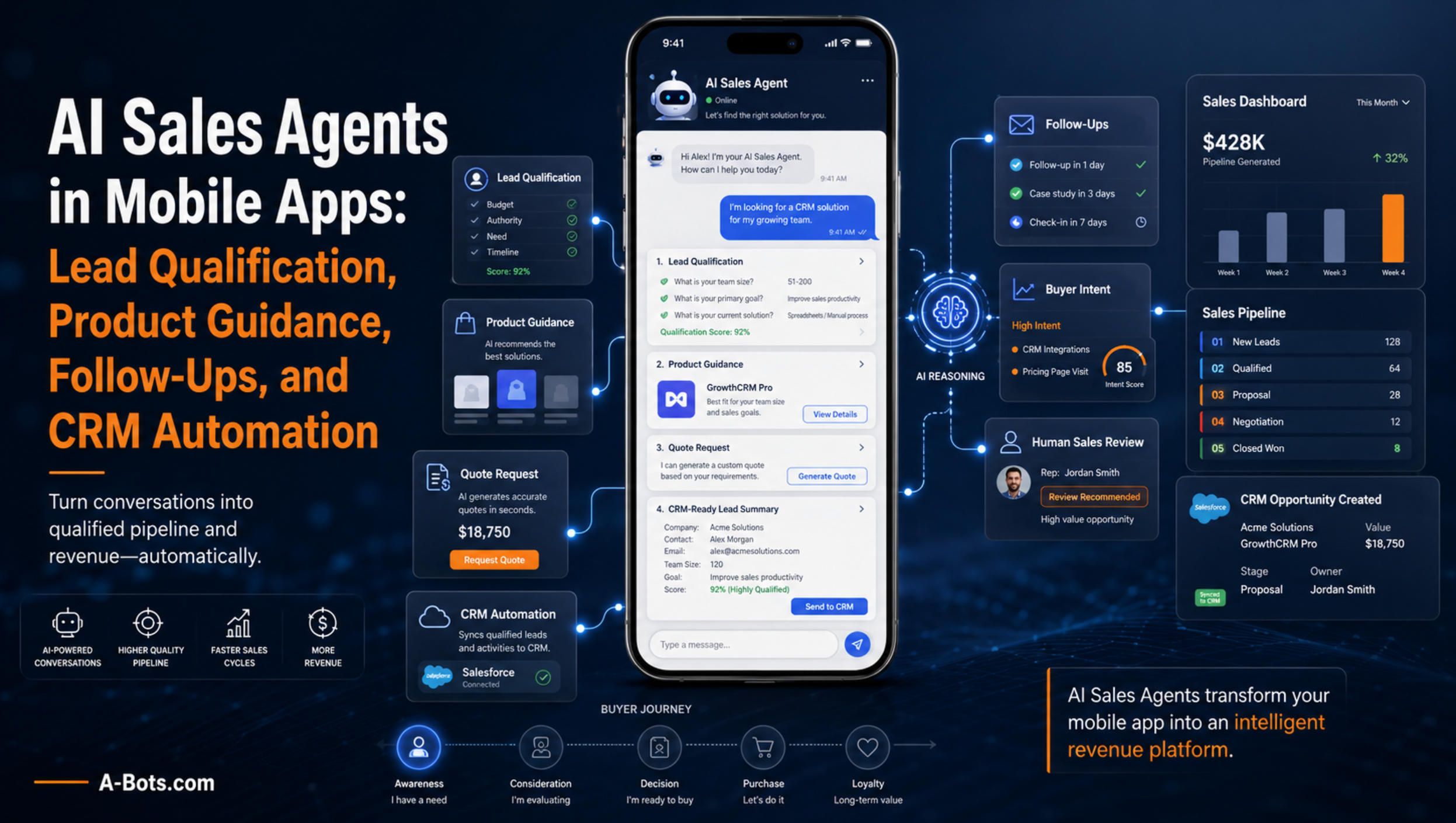
This tension is one of the reasons AI sales agents are becoming a serious business topic. They are not just another chatbot category. They represent a new layer of sales automation that can qualify leads, guide customers through product choices, recommend next steps, prepare follow-ups, update CRM systems, and support human sales teams with structured context.
The shift is already visible in the market. Salesforce’s 2026 sales statistics report says that sales teams identify investment in AI as the number one tactic for growth, and 94 percent of sales leaders using agents say they are essential for meeting business demands. The same report also states that 88 percent of reps using agents say the technology increases their odds of hitting sales targets (Salesforce). HubSpot’s 2025 State of Sales Report, based on more than 1,000 global sales professionals, found that 68 percent of sales teams reported improved lead quality year over year, while 91 percent said win rates were stable or improving (HubSpot Blog).
These numbers do not mean AI automatically sells better than people. They show something more practical: sales organizations are trying to remove friction from the sales cycle. AI sales agents can handle repetitive, data-heavy, and time-sensitive parts of the process so that human teams can focus on trust, negotiation, strategy, and relationship-building.
For businesses that already use or plan to build mobile apps, this creates a major opportunity. A custom mobile app can become more than a product catalog, booking interface, or customer portal. It can become an AI-powered sales interaction platform where a buyer asks questions, compares options, receives personalized guidance, gets qualified, requests a quote, books a consultation, and receives timely follow-up - while the company captures clean CRM data in the background.
That is the commercial logic behind AI sales agent app development. The real value is not in having a chatbot that sounds intelligent. The value is in turning buyer conversations into structured, measurable sales actions.
Why AI Sales Agents Are Emerging Now
Sales automation is not new. Companies have used CRM systems, email sequences, lead scoring, marketing automation, chat widgets, and sales enablement tools for years. The problem is that many of these systems still depend on manual effort. Sales representatives must research leads, interpret intent, update CRM fields, write follow-up messages, check product fit, find documents, and decide when to escalate a prospect.
The result is predictable: leads are missed, CRM data becomes incomplete, follow-ups arrive too late, and buyers receive generic communication.
AI sales agents are emerging because they can operate across the gaps between conversation, data, and workflow. They can interpret what a buyer is asking, connect that request to customer data, recommend the next step, and trigger actions in business systems.
Salesforce describes AI prospecting tools as systems that use machine learning, predictive analytics, and natural language processing to automate time-consuming prospecting tasks, including lead scoring, prospect research, engagement, personalization at scale, and buyer intent analysis. This is exactly where sales agents become more useful than older automation. They do not simply send a prewritten sequence. They can adapt to the buyer’s situation.
The rise of CRM and AI adoption also supports this shift. Grand View Research estimates that the global customer relationship management market was valued at 73.40 billion dollars in 2024 and is projected to reach 163.16 billion dollars by 2030, with AI, automation, hyper-personalization, and digital customer communication among the key growth drivers. In other words, the CRM market is not only growing because companies want databases. It is growing because customer relationships are becoming more data-driven, automated, and real-time.
Mobile apps are a natural interface for this transformation because they can combine identity, behavior, product browsing, chat, documents, payments, booking, notifications, and CRM-connected actions in one controlled environment.
What Makes an AI Sales Agent Different from a Sales Chatbot
A traditional sales chatbot usually follows a narrow script. It asks a few questions, collects contact details, and passes the lead to a sales team. That can be useful, but it rarely changes the sales process deeply.
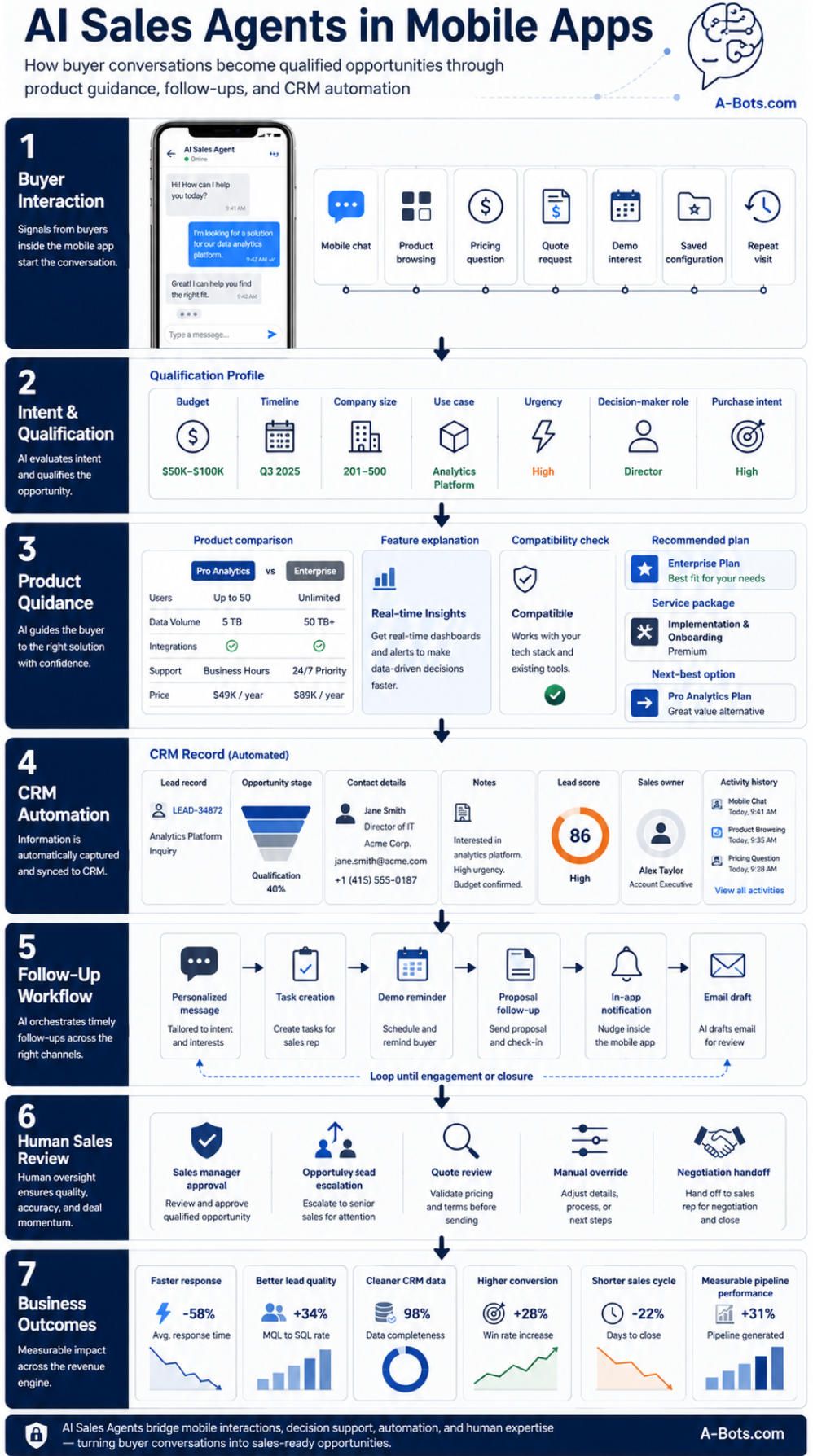
An AI sales agent is different because it can work as a dynamic assistant across the buyer journey. It can ask qualifying questions, interpret free-text answers, detect intent, guide product selection, compare options, recommend next steps, update CRM fields, generate a lead summary, and trigger follow-up workflows.
A basic chatbot might ask:
“What is your name, phone number, and email?”
An AI sales agent can ask:
“What problem are you trying to solve, how soon do you need a solution, what budget range are you considering, which systems do you already use, and who will make the final decision?”
Then it can classify the lead, identify urgency, suggest a relevant service package, create a CRM record, assign the right sales manager, and prepare a personalized follow-up.
The difference is not only conversational intelligence. The difference is operational integration.
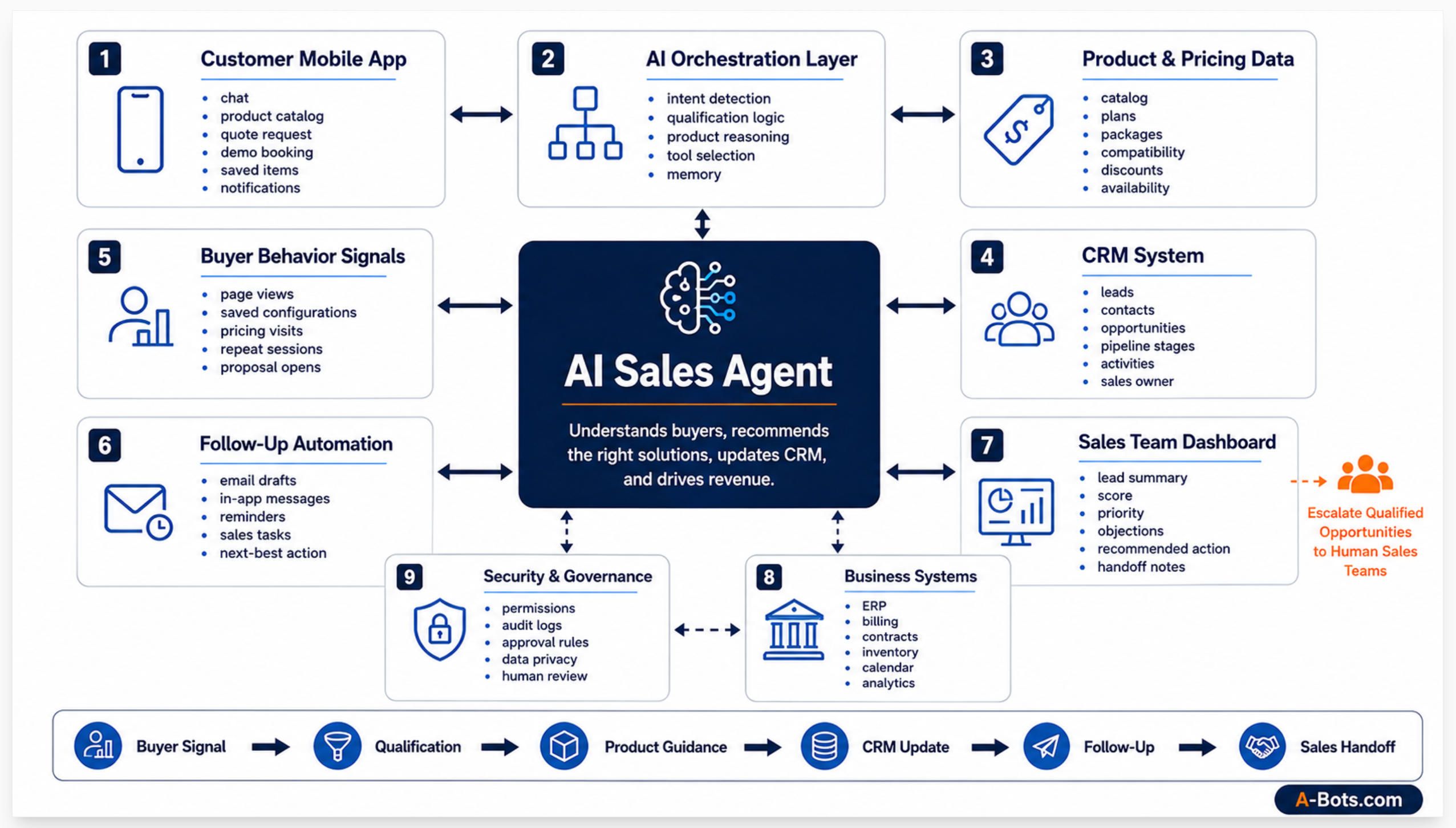
An AI sales agent becomes valuable when it can connect to:
- CRM systems;
- product catalogs;
- pricing rules;
- quote tools;
- customer profiles;
- lead sources;
- analytics;
- calendars;
- email and notification systems;
- sales team dashboards;
- knowledge bases and proposal templates.
Without those integrations, the agent is mostly a smart conversation layer. With those integrations, it becomes part of the revenue engine.
This is why custom mobile app development matters. Businesses do not always need a generic chatbot widget. Many need a custom sales app, customer portal, product configurator, dealer app, booking app, or B2B mobile platform where AI is embedded into the real commercial workflow.
Lead Qualification: Turning Conversations Into Sales-Ready Data
Lead qualification is one of the most valuable use cases for AI sales agents. In many companies, leads arrive from websites, ads, marketplaces, social media, referrals, events, mobile apps, and direct messages. Some are ready to buy. Some are researching. Some are not a fit. Some are high-value opportunities but provide too little information in the first message.
Human sales teams often spend too much time sorting these leads manually. AI sales agents can reduce this friction by asking the right questions at the right moment and turning unstructured conversations into structured CRM data.
For example, a custom mobile app for a moving company could ask about move date, locations, property type, inventory size, stairs, elevator access, packing needs, insurance, and urgency. A mobile app for a smart equipment manufacturer could ask about device type, fleet size, integration needs, region, dealer relationship, maintenance model, and expected deployment timeline. A custom app for a B2B service company could ask about company size, decision-maker role, project budget, timeline, required features, and current software stack.
The agent can then assign a lead score, recommend a sales path, and create a clean summary:
“High-intent B2B lead. Company has 80 field technicians, wants a custom service app with CRM integration, target launch in 6 months, budget range confirmed, decision-maker involved.”
This kind of summary saves time and improves sales handoff quality.
Salesforce’s 2026 report states that high-performing teams are 1.7 times more likely than underperforming teams to use prospecting agents, and it gives the example of Salesforce using an SDR agent to create 3,200 opportunities in four months from low-score leads that were previously too expensive to work manually. That example illustrates an important point: AI sales agents do not only help with obvious high-value leads. They can also make it economically possible to process long-tail demand.
For businesses with mobile apps, this is especially powerful. The app can collect behavioral signals before a lead even fills out a form. Which products did the user view? Did they compare pricing? Did they save a configuration? Did they return after a push notification? Did they ask about implementation? Did they invite another user from the same company?
A custom AI sales agent can use these signals to qualify intent more accurately than a static lead form.
Product Guidance: Helping Buyers Choose Without Overwhelming Them
Modern buyers often research before speaking with sales. They compare options, read reviews, check features, calculate cost, and look for proof. But too much information can create decision paralysis. Product catalogs, service packages, technical specifications, and pricing models may be difficult to understand without expert guidance.
AI sales agents can act as product guidance assistants inside mobile apps.
For eCommerce, the agent can ask what the customer wants to achieve, what constraints they have, which products they already own, and what price range they prefer. It can then recommend suitable products, explain trade-offs, suggest accessories, and warn about compatibility problems.
For B2B SaaS, the agent can guide users through modules, integrations, user roles, implementation timelines, and pricing plans.
For equipment manufacturers, it can help customers select models, spare parts, service plans, or connected-device features.
For real estate, it can recommend properties based on location, budget, commute, lifestyle, financing stage, and urgency.
For service businesses, it can help users choose the right service package, estimate complexity, and understand what information is needed before booking.
The key is that AI product guidance should not feel like aggressive selling. It should feel like a consultative assistant. It should reduce uncertainty, not push random offers.
This is where mobile apps have a major advantage over public web pages. A mobile app can remember preferences, save configurations, connect to loyalty status, access purchase history, support rich media, and send follow-up notifications. A buyer who is not ready today can return later to the same guided path.
The AI agent can also support sales teams by capturing why a customer hesitated. Was the price unclear? Was delivery too slow? Was integration too complex? Did the buyer need manager approval? Did they compare with a competitor? These insights are extremely valuable for sales strategy and product positioning.
Follow-Ups: The Hidden Revenue Layer
Many sales opportunities are not lost because the product is bad. They are lost because follow-up is slow, generic, or inconsistent.
A lead asks for information. A sales representative is busy. A quote is delayed. A reminder is forgotten. The buyer loses momentum. Another company responds faster.
AI sales agents can help solve this by automating follow-up logic without removing human control.
Inside a custom mobile app, an AI agent can detect relevant triggers:
- the user viewed pricing twice;
- the user saved a product configuration;
- the user abandoned a quote request;
- the user asked about integration;
- the user opened a proposal;
- the user completed onboarding but has not activated a key feature;
- the user returned after several weeks of inactivity.
Based on these signals, the system can create tasks, draft follow-up messages, send personalized in-app notifications, recommend content, or notify a sales manager.
The follow-up should be contextual. For example:
“You were comparing two service plans last week. The Premium plan includes technician dispatch tracking and automated customer notifications, which may be useful if your team manages recurring field jobs.”
This is very different from a generic “Are you still interested?” message.
HubSpot’s 2025 State of Sales Report notes that sales professionals are operating in a difficult environment with tighter budgets, cautious buyers, and pricing instability, but also says AI and new strategies are helping teams stay resilient. In that environment, relevant follow-up becomes more important. Buyers may not convert immediately, but they may convert later if the company continues the conversation intelligently.
For mobile apps, follow-up can happen across push notifications, in-app messages, email, sales tasks, and CRM workflows. The AI agent can support consistency while allowing human teams to approve or personalize high-value communication.
CRM Automation: Fixing the Data Problem Behind Sales
CRM systems are supposed to be the source of truth for sales. In practice, many CRM databases are incomplete, outdated, or inconsistent. Sales representatives often see CRM updates as administrative work, not sales work. As a result, managers lack visibility, forecasts become weaker, and follow-up processes break.
AI sales agents can help by reducing manual CRM work.
After a conversation in a mobile app, the agent can extract structured information:
- buyer role;
- company size;
- industry;
- budget range;
- urgency;
- product interest;
- objections;
- requested integrations;
- next action;
- preferred communication channel;
- decision timeline.
It can then suggest or apply CRM updates, create tasks, attach summaries, and route the opportunity to the right team.
Salesforce’s report emphasizes that agents are only as good as the context they receive and warns that if data is trapped in silos across collaboration apps, email, and documents, agents will fail. This is one of the central lessons for custom AI sales agent development. The AI layer cannot compensate for chaotic data architecture. It needs clean integration with CRM, product data, user accounts, communication history, and business rules.
The CRM market’s growth also shows how central this issue has become. Grand View Research notes that mobile CRM solutions are increasingly important because sales, marketing, and service teams need to access customer information, update records, and engage with clients from mobile devices (Customer Relationship Management Market (2025 - 2030)). This directly supports the case for custom mobile apps with AI-powered CRM automation.
A mobile app can become the front-end where buyer interaction happens, while CRM becomes the operational backbone where sales data is stored, analyzed, and acted on.
The Sales Agent as a Bridge Between Buyer and Sales Team
One of the best ways to understand AI sales agents is not as replacements for salespeople, but as bridges.
On the buyer side, the agent provides fast answers, product guidance, quote assistance, scheduling, reminders, and personalized recommendations.
On the sales team side, the agent provides qualification, summaries, CRM updates, lead scoring, next-best-action suggestions, and follow-up drafts.
This bridge is valuable because buyers and sales teams often experience the same process differently. Buyers want speed and clarity. Sales teams need structure and context. Managers need visibility and forecasting. The AI agent can help all three if it is properly designed.
For example, imagine a B2B customer opens a custom mobile app for an industrial equipment supplier. The customer asks which model is suitable for a particular facility. The AI sales agent asks about capacity, environment, integration requirements, maintenance plan, budget range, and deployment date. It recommends two options, explains the difference, checks whether a demo is available, and offers to schedule a consultation.
Behind the scenes, the agent creates a CRM opportunity, attaches the technical requirements, assigns the correct regional sales manager, drafts a follow-up email, and flags that the lead has high purchase intent.
- The buyer receives a smooth experience.
- The salesperson receives a prepared opportunity.
- The manager receives clean pipeline data.
- That is the practical value of AI sales agent app development.
Why Mobile Apps Create Better Sales Signals Than Websites Alone
Websites are useful for discovery, SEO, and initial conversion. But mobile apps can generate deeper sales signals because they support repeat engagement and logged-in behavior.
A website visitor may be anonymous. A mobile app user is often known.
A website session may last a few minutes. A mobile app relationship can last months or years.
A website form captures only what the user types. A mobile app can combine behavior, preferences, saved items, account history, notifications, support history, bookings, purchases, and product usage.
This makes the mobile app an excellent environment for AI sales agents.
For example, an app can show that a user has repeatedly viewed enterprise pricing, saved a product configuration, invited a colleague, opened a support article about integration, and requested a demo. These signals are much stronger than a single website page view.
An AI sales agent can use these signals responsibly to personalize the buyer journey. It can recommend relevant content, ask qualifying questions, notify a sales representative, or suggest a next step.
This does not mean every company needs a mobile app. But companies with recurring customer relationships, complex products, repeat purchases, service operations, B2B accounts, connected devices, field teams, or customer portals can often benefit from a mobile-first sales interaction layer.
A-Bots.com’s experience in custom mobile app development is relevant here because AI sales agents require more than a model. They require UX, backend logic, integrations, security, analytics, and workflow design.
Industries Where AI Sales Agents Can Create Strong Value
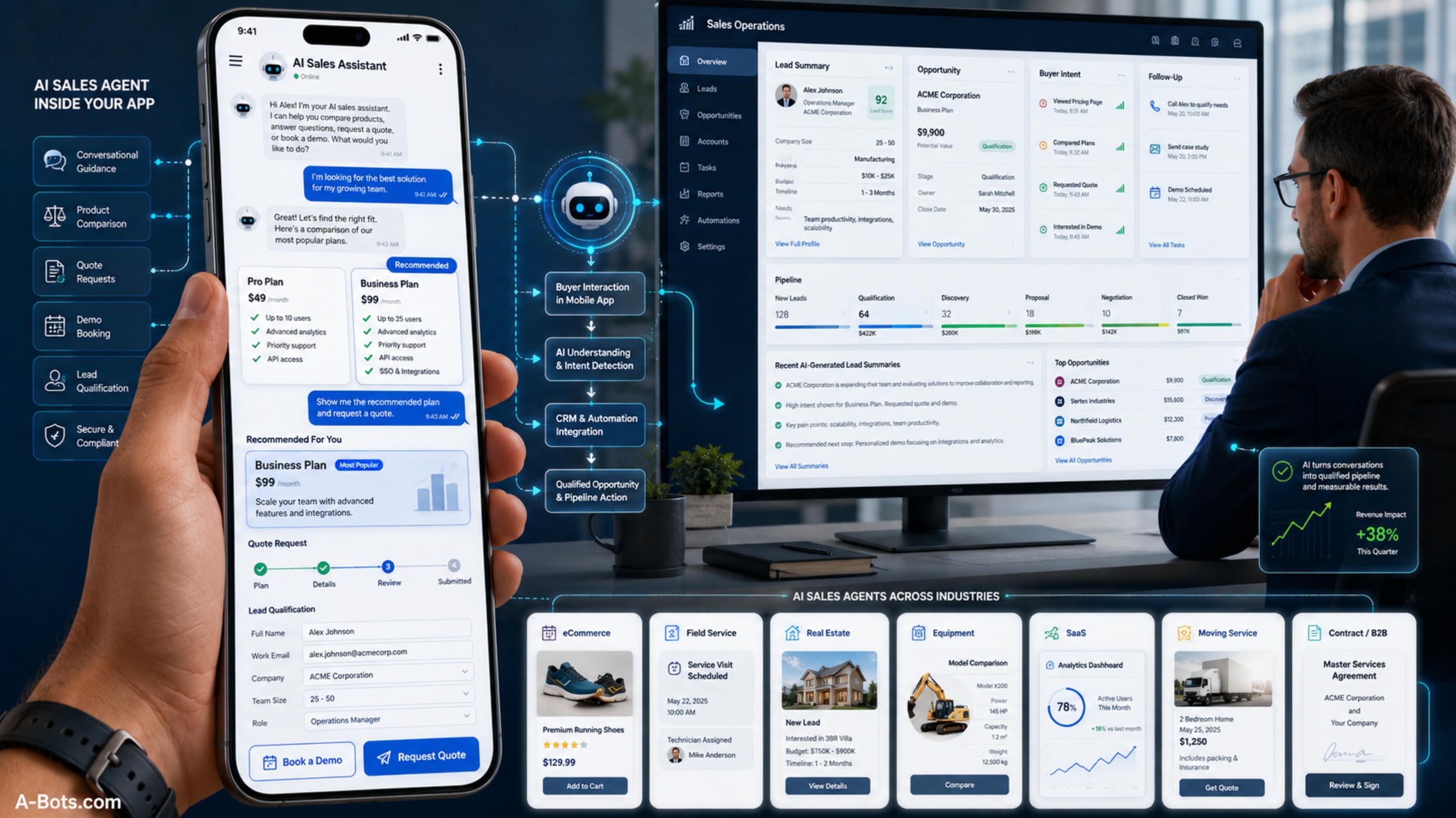
AI sales agents can be useful in many industries, but they are especially valuable where buying decisions require guidance, data, and follow-up.
In eCommerce, they can recommend products, explain compatibility, reduce cart abandonment, and support upsell or cross-sell journeys.
In field service and home services, they can qualify service requests, estimate complexity, recommend packages, and move users from inquiry to booking.
In real estate, they can qualify buyers or tenants, recommend properties, schedule viewings, and update CRM records.
In moving and logistics, they can collect move details, estimate job size, qualify urgency, and prepare quote requests.
In equipment manufacturing, they can guide buyers through technical requirements, compare models, register interest, and connect leads to dealers or sales engineers.
In SaaS, they can explain plans, recommend features, guide onboarding, qualify enterprise leads, and trigger customer success workflows.
In healthcare and wellness, they can support service selection, appointment preparation, eligibility questions, and safe handoff to human staff.
In all these cases, the agent’s value depends on domain-specific logic. A generic AI sales chatbot cannot reliably handle complex quoting rules, regulated communication, technical compatibility, or service-area constraints. A custom AI sales agent can be designed around the business model.
Human Control and Sales Governance
Sales automation needs governance. An AI sales agent may influence buyer expectations, pricing perception, contract terms, product recommendations, and sales promises. That means companies must control what the agent can say and do.
- The agent should not invent discounts.
- It should not promise unavailable delivery dates.
- It should not qualify regulated services without required checks.
- It should not misrepresent technical capabilities.
- It should not update CRM records without traceability.
- It should not send sensitive information to the wrong user.
Human-in-the-loop design is therefore essential. Some actions can be fully automated, such as collecting lead details or suggesting public product information. Other actions should require review, such as high-value quotes, contract terms, custom pricing, refund promises, or regulated recommendations.
A recent paper on Sales Research Agent and Sales Research Bench describes the need for AI systems that can answer sales-leader questions over live customized CRM data while producing decision-ready insights with transparent quality measurement, including groundedness, relevance, explainability, and schema accuracy. (arXiv) Although this research focuses on sales analytics rather than mobile lead interaction, the same principle applies: sales AI must be grounded, explainable, and connected to reliable data.
For businesses, this means the AI sales agent should be designed as a controlled system, not an uncontrolled conversational experiment.
What a Custom AI Sales Agent Mobile App Can Include
A custom AI sales agent app can include several connected modules.
On the customer side, it may include AI chat, product guidance, quote request, pricing explanation, saved configurations, demo booking, document upload, order inquiry, payment initiation, notifications, and account history.
On the sales team side, it may include lead scoring, CRM updates, opportunity summaries, next-best-action recommendations, sales task creation, follow-up drafts, manager dashboards, lead source analytics, and conversation review.
On the integration side, it may connect with CRM, ERP, product catalog, pricing engine, calendar, email platform, payment system, analytics tools, help desk, and internal knowledge base.
The goal is not to overload the app with features. The goal is to create one coherent sales interaction platform where the AI agent improves the journey for both the buyer and the sales team.
A-Bots.com can help design and develop such systems because the challenge is not only AI prompting. It is product architecture. The agent must be connected to the right screens, backend services, permissions, data flows, and business processes.
How to Start: A Practical Roadmap for Businesses
A company should not begin by asking, “Which AI sales tool should we install?” A better question is:
“Where does our sales process lose the most value because of slow response, poor qualification, weak product guidance, missed follow-up, or incomplete CRM data?”
That question leads to a better roadmap.
The first step is to identify the highest-friction sales interactions. These may include quote requests, product selection, demo scheduling, lead intake, pricing questions, abandoned carts, onboarding questions, or reactivation campaigns.
The second step is to define what the AI agent should be allowed to do. It may only collect information and prepare summaries at first. Later, it may trigger CRM updates, create tasks, send approved follow-ups, or recommend offers.
The third step is to connect the agent to reliable data. Product information, pricing rules, CRM fields, customer profiles, and sales policies must be clear and structured.
The fourth step is to build a mobile or web app experience that makes the agent useful, not intrusive. The AI should appear where it helps the buyer move forward.
The fifth step is to measure outcomes. Useful metrics include qualified lead rate, response time, booking rate, quote completion rate, CRM data completeness, follow-up speed, conversion rate, sales cycle length, and revenue per lead.
This is where custom development becomes valuable. A generic tool may automate a narrow interaction, but a custom AI sales agent can be built around the company’s actual funnel.
Why This Matters for A-Bots.com Clients
For many businesses, sales growth is limited not by demand, but by operational friction. Leads arrive, but they are not qualified quickly. Buyers ask questions, but answers are delayed. Products are complex, but guidance is generic. CRM exists, but data is incomplete. Follow-ups are planned, but not always sent. Sales managers want visibility, but the pipeline is noisy.
AI sales agents can address these problems when they are integrated into a proper software product.
A-Bots.com develops custom mobile applications and digital platforms for businesses that need software aligned with their operations. In the context of AI sales agents, that means building apps where buyer interaction, product guidance, lead qualification, CRM automation, follow-ups, and human sales workflows are designed as one system.
This is especially relevant for companies with complex services, technical products, field operations, recurring customer relationships, B2B sales cycles, or mobile-first customer journeys. These businesses often need more than a chatbot. They need a custom revenue interaction platform.
An AI sales agent inside a mobile app can help the company respond faster, qualify better, guide buyers more intelligently, and keep CRM data cleaner. But the system must be designed responsibly, with clear rules, reliable integrations, and human oversight where needed.
Conclusion: AI Sales Agents Turn Mobile Apps Into Revenue Platforms
AI sales agents are changing the role of business mobile apps. A mobile app is no longer only a digital brochure, account portal, or support channel. It can become a guided sales environment where buyers explore, ask, compare, configure, qualify, book, and request quotes while the company captures structured sales data.
The strongest value is not in replacing sales teams. It is in helping them work with better information and better timing.
- [ ] AI can qualify leads.
- [ ] AI can guide product selection.
- [ ] AI can prepare follow-ups.
- [ ] AI can update CRM.
- [ ] AI can detect buyer intent.
- [ ] AI can route opportunities.
- [ ] AI can summarize conversations.
But human teams still provide trust, judgment, negotiation, creativity, and relationship-building.
The future of sales technology will likely belong to companies that combine both: intelligent automation and human expertise. Custom mobile apps are one of the best environments for this combination because they bring customer identity, product interaction, communication, notifications, CRM integration, and sales workflows into one controlled digital experience.
For businesses, the opportunity is clear. AI sales agents can transform mobile apps from passive interfaces into active revenue platforms. They can help companies move from missed leads and generic follow-ups to faster qualification, better guidance, cleaner CRM data, and more measurable sales performance.
That is why AI sales agent app development is becoming an important direction for companies that want not just more conversations, but better commercial outcomes.
✅ Hashtags
#AISalesAgents
#SalesAutomation
#AILeadQualification
#CRM Automation
#CustomMobileAppDevelopment
#AIAppDevelopment
#MobileSalesPlatform
#ABotsCom
Other articles
CRM and Mobile App Development for Movers This article explains why App Development for Movers and CRM for Moving Companies are becoming essential for modern relocation businesses. It explores how custom software can improve the entire moving journey - from lead capture, virtual surveys, digital estimates, crew dispatch, and QR inventory to customer apps, claims management, online payments, and analytics. The article shows how mobile apps help customers feel informed and in control, while CRM systems help moving companies reduce errors, improve communication, manage crews, protect reputation, and scale operations. It also positions A-Bots.com as a custom development partner for movers ready to become technology-enabled service brands.
AI Field Service Mobile Apps: Custom Software for Connected Service Operations This article explores why AI field service mobile apps are becoming a strategic software investment for companies that manage technicians, customers, equipment, smart devices, and distributed service operations. It explains how custom mobile apps can connect technician workflows, customer portals, IoT diagnostics, CRM systems, service documentation, payments, warranty logic, and AI-assisted troubleshooting into one operational ecosystem. The article is especially relevant for equipment manufacturers, HVAC companies, smart device brands, repair networks, cleaning businesses, moving companies, and industrial service providers that want to improve field productivity, customer trust, and service intelligence through custom software developed by A-Bots.com.
Smart Equipment App Development Smart equipment is no longer just hardware with connectivity. For manufacturers, the real business opportunity begins after the sale, when a mobile app can connect customers, devices, technicians, warranty workflows, spare parts, diagnostics, updates, and service analytics. This article explains how custom mobile apps turn connected equipment into after-sales service platforms that improve support, reduce friction, generate product intelligence, and create new recurring value. It is especially relevant for manufacturers of smart appliances, industrial machines, robotics, HVAC systems, cleaning equipment, agricultural devices, and other connected products that need a stronger digital relationship with customers.
From Chatbots to AI Agents Explains how business chatbots are evolving into AI agents capable of handling customer interaction, workflow automation, CRM updates, support requests, lead qualification, service operations, and personalized digital journeys. Instead of treating chatbots as simple FAQ tools, the article shows how companies can use AI-powered mobile apps and custom software platforms to turn conversations into structured business actions. It also explores architecture, integrations, governance, security, and practical use cases across customer service, sales, field service, eCommerce, equipment manufacturing, and B2B operations. The article positions A-Bots.com as a custom development partner for AI agent app development.
AI Customer Service Agents How AI customer service agents are transforming business apps from simple support channels into intelligent customer interaction platforms. It explores how custom mobile apps can automate support, bookings, order tracking, service requests, warranty cases, complaint intake, technician workflows, and human escalation. The article shows why traditional chatbots are no longer enough for businesses with complex customer journeys, recurring service operations, and high expectations for speed and personalization. It also highlights the importance of data integration, governance, security, mobile UX, and human-in-the-loop control when building AI-powered customer service systems with A-Bots.com.
Top stories

Copyright © Alpha Systems LTD All rights reserved.
Made with ❤️ by A-BOTS