
Home
Services
About us
Blog
Contacts
AI Field Service Mobile Apps: How Custom Software Connects Technicians, Customers, IoT Devices, and Business Operations
Field service is becoming one of the most important software battlegrounds for companies that work with physical products, equipment, smart devices, maintenance teams, home services, repair networks, and distributed operations.
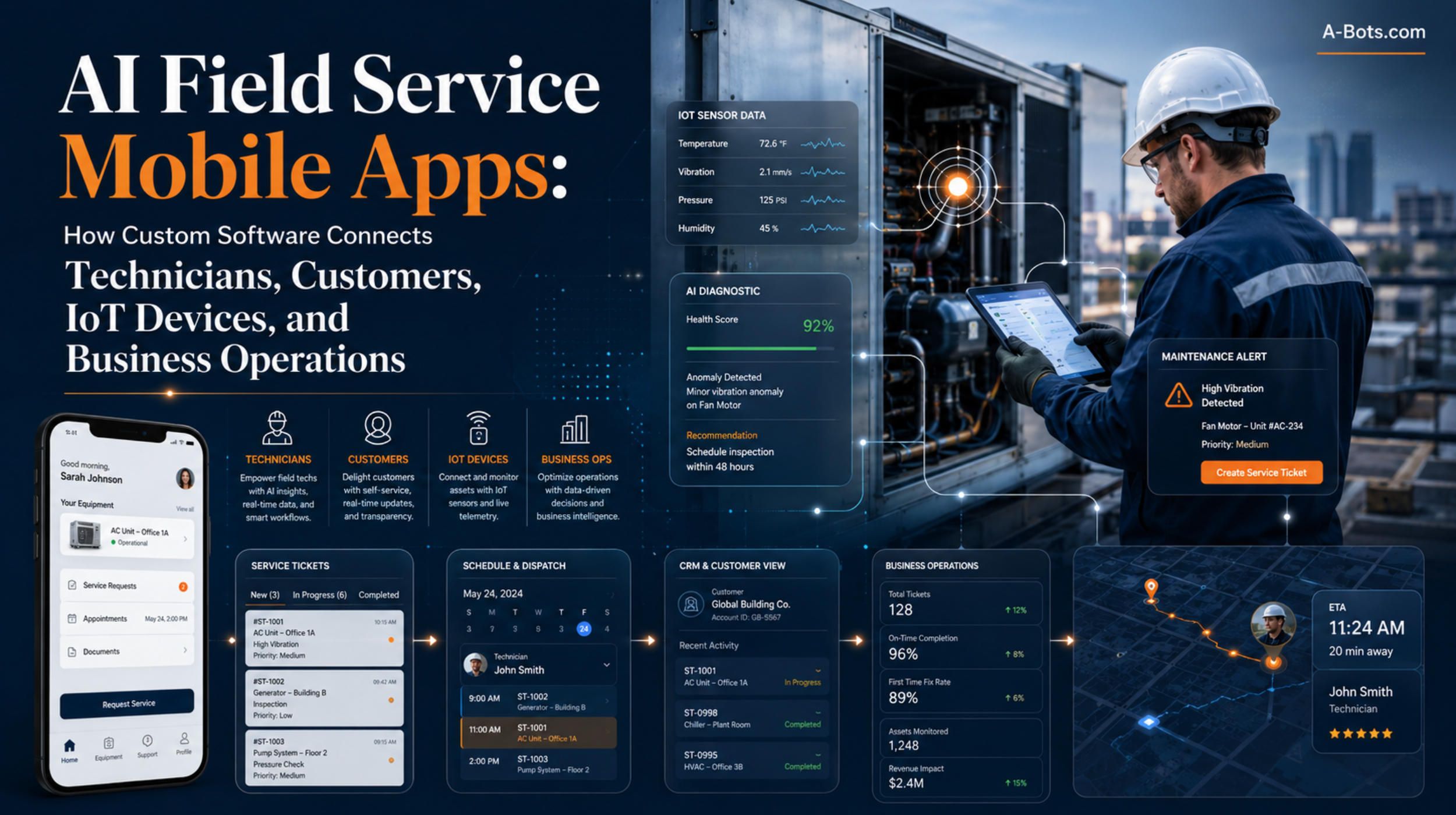
For many years, businesses treated mobile apps as an additional digital convenience. A customer could request a service visit. A technician could receive a job order. A dispatcher could check a schedule. A manager could see a basic status update. That was enough when customer expectations were lower and operational complexity was easier to hide behind phone calls, spreadsheets, paper forms, and manual coordination.
In 2026, that logic is no longer sufficient.
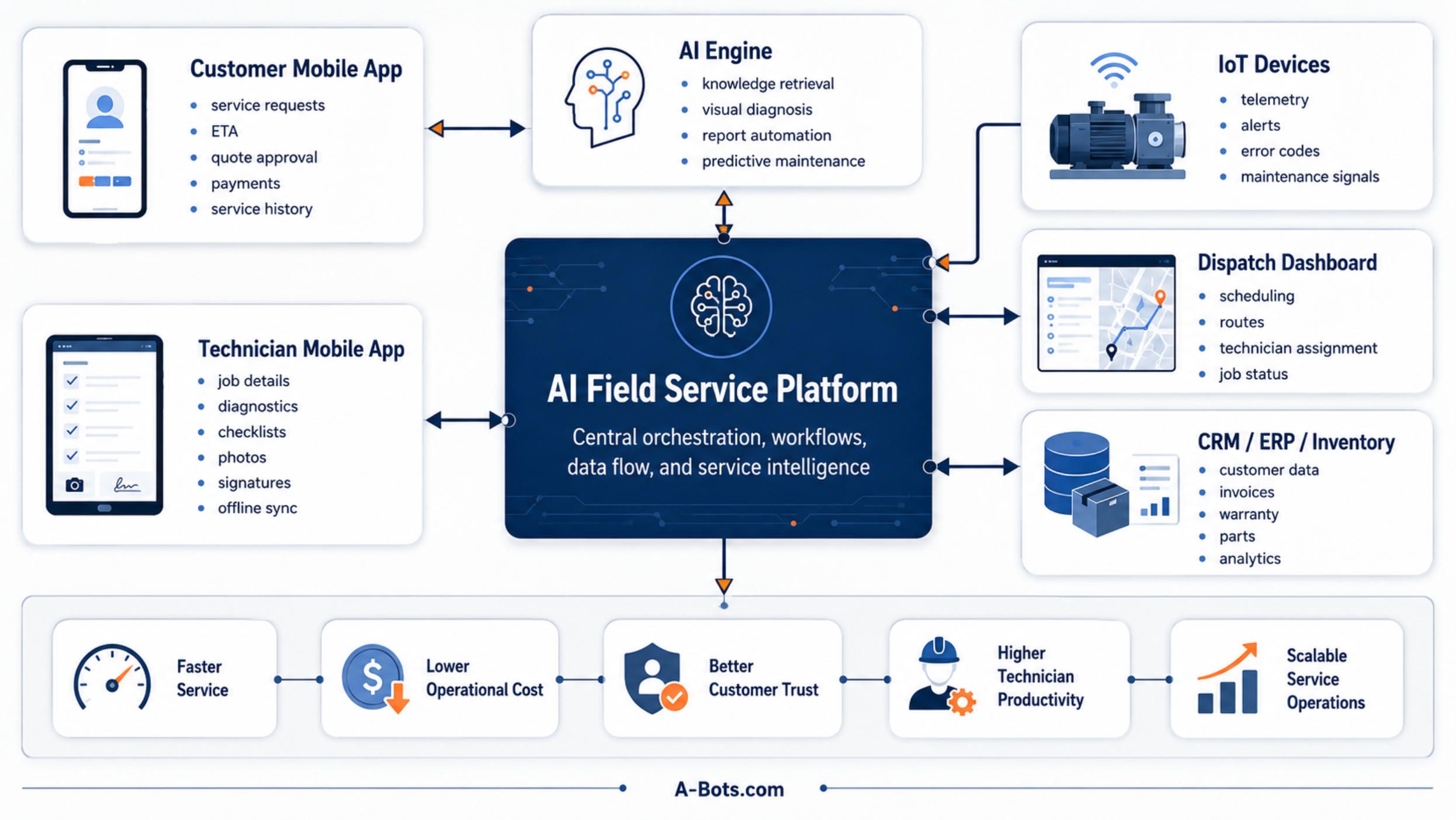
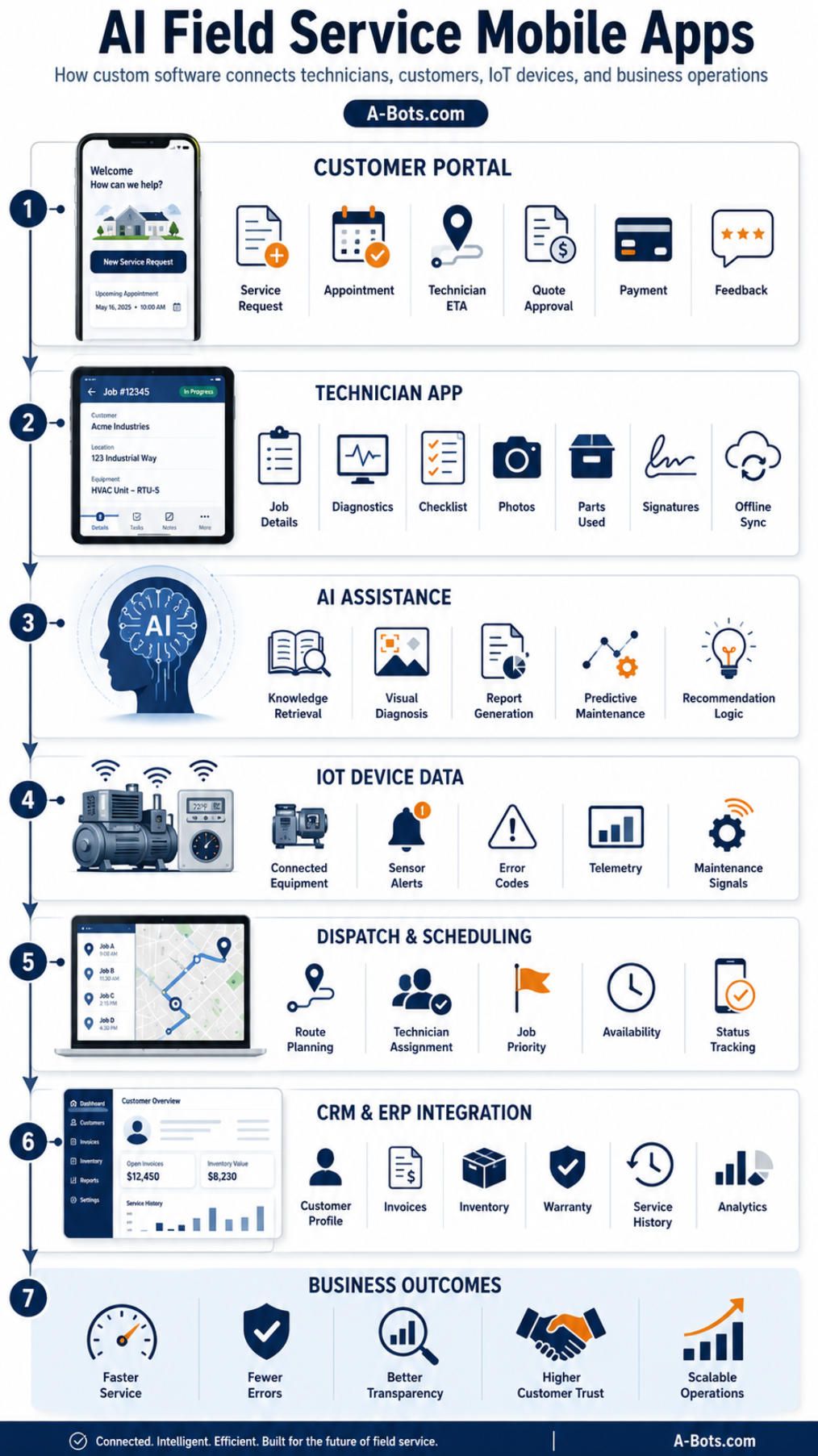
The modern field service business is not just mobile. It is connected, data-driven, increasingly AI-assisted, and deeply dependent on real-time operational visibility. Companies that send people, crews, or technicians into the field now need more than scheduling software. They need a digital service ecosystem that connects customers, technicians, dispatchers, IoT devices, CRM systems, spare parts inventory, payment workflows, documentation, warranty logic, and management analytics.
This is where AI field service mobile apps are becoming strategically important.
The trend is supported by market and technology signals. Salesforce reports that ninety-six percent of field service teams plan to use AI for knowledge retrieval, and forty-five percent already use AI for visual diagnosis and AR-guided repairs. (Salesforce) IoT Analytics estimates that the number of connected IoT devices will reach 39 billion by 2030, with artificial intelligence acting as a major growth driver because businesses increasingly need device data for automation, diagnostics, and decision-making.
“The technology exists. The mobile workforce wants it.”
This quote captures the practical reality of the field service market. AI is not waiting for some distant future. The tools are already mature enough to influence dispatching, diagnostics, documentation, preventive maintenance, customer communication, and technician support. The question for many companies is not whether this transformation will happen, but whether they will build the right software architecture before competitors do.
For A-Bots.com, this is a highly relevant direction. Custom mobile app development for field service is not about creating another generic app. It is about building a business-critical software layer that reflects how a specific company actually works: its service model, technicians, equipment, customers, products, contracts, safety rules, inventory logic, warranty structure, and operational priorities.
Why Field Service Is Becoming a Mobile-First Business Function
Field service is not one process. It is a chain of decisions and actions.
A customer reports an issue. A dispatcher evaluates priority. A technician is assigned. Parts may need to be reserved. The customer receives an appointment window. The technician travels to the location. The job is diagnosed, documented, approved, completed, paid for, and reported. In more advanced businesses, the service record then feeds warranty analysis, product improvement, customer retention, future sales, and predictive maintenance.
When this process is managed through disconnected tools, even strong companies lose control. The dispatcher may not see the real technician status. The technician may not have the full customer history. The customer may not know when the crew will arrive. The manager may not understand job profitability. The manufacturer may not see patterns in recurring failures. The support team may not know whether a problem is caused by product defect, installation error, customer misuse, or missing maintenance.
A field service mobile app solves this problem by becoming the operational interface of the business.
For technicians, it is a mobile command center. For customers, it is a service transparency portal. For dispatchers, it is a coordination tool. For managers, it is a real-time control layer. For manufacturers and smart device companies, it is a bridge between physical products and digital service intelligence.
This is especially important in industries where the product and the service are inseparable. A smart HVAC system, robotic cleaner, connected coffee machine, medical device, industrial sensor, security system, smart appliance, or energy storage unit does not end its relationship with the customer after the sale. It continues to generate service expectations, support requests, maintenance needs, software updates, and device data.
A basic mobile app may allow the customer to control the device. A serious field service app goes further. It helps the company understand what is happening, why it is happening, who should respond, what data should be collected, and how the result should be documented.
That is the difference between a simple app and an operational platform.
The New Role of AI in Field Service Apps
AI in field service should not be reduced to a chatbot placed inside a mobile interface. That is the shallow version of the trend. The real value of AI is operational. It helps companies reduce repetitive work, retrieve technical knowledge, support diagnosis, predict service needs, generate documentation, improve scheduling, and make better decisions at the point of work.
A technician standing next to a malfunctioning device does not need a generic AI assistant. They need context-aware help. The app should know the customer, device model, installation date, warranty status, previous service history, error code, available manuals, recommended repair steps, required parts, safety warnings, and similar cases from the company’s service archive.
This is where custom development becomes important. A generic AI layer can answer broad questions. A custom AI-assisted field service app can work with the company’s real data and real workflows.
For example, an AI field service app can help a technician identify likely causes of failure based on device telemetry, photos, error codes, and historical service records. It can summarize previous visits before the technician arrives. It can suggest the most probable spare parts. It can turn voice notes, photos, checklists, and customer approvals into a structured report. It can help new technicians access the knowledge of experienced specialists without constantly interrupting senior staff.
The strongest AI use cases in field service are practical:
- Knowledge retrieval from manuals, previous tickets, internal documentation, installation guides, and product databases.
- Visual diagnosis from photos and videos, including damaged parts, leaks, corrosion, incorrect installation, missing components, or visible wear.
- Automated service reporting based on field notes, checklists, images, time logs, parts used, and customer signatures.
This matters because many service businesses have a hidden knowledge problem. The best technicians know how to solve complex problems, but their expertise often lives in memory, personal habits, phone calls, and informal conversations. New employees need time to learn. Dispatchers may not know technical details. Support teams may not understand what actually happened on-site. Managers may have reports, but not structured operational intelligence.
A well-designed AI field service mobile app can turn daily work into reusable company knowledge.
Customer Apps: From Appointment Booking to Service Transparency
Many companies still think of customer-facing service apps as booking tools. That view is too narrow. A modern customer app should not only help people schedule service. It should reduce uncertainty, increase trust, and make the service experience easier to understand.
This is especially important in industries where customers feel vulnerable. Moving companies handle personal belongings. Cleaning companies enter homes and offices. HVAC technicians work with expensive systems. Appliance repair companies make decisions about whether repair is worth the cost. Smart device brands support users who may not understand technical issues. Industrial service providers must document downtime, compliance, and repair history.
In all these cases, the customer wants clarity.
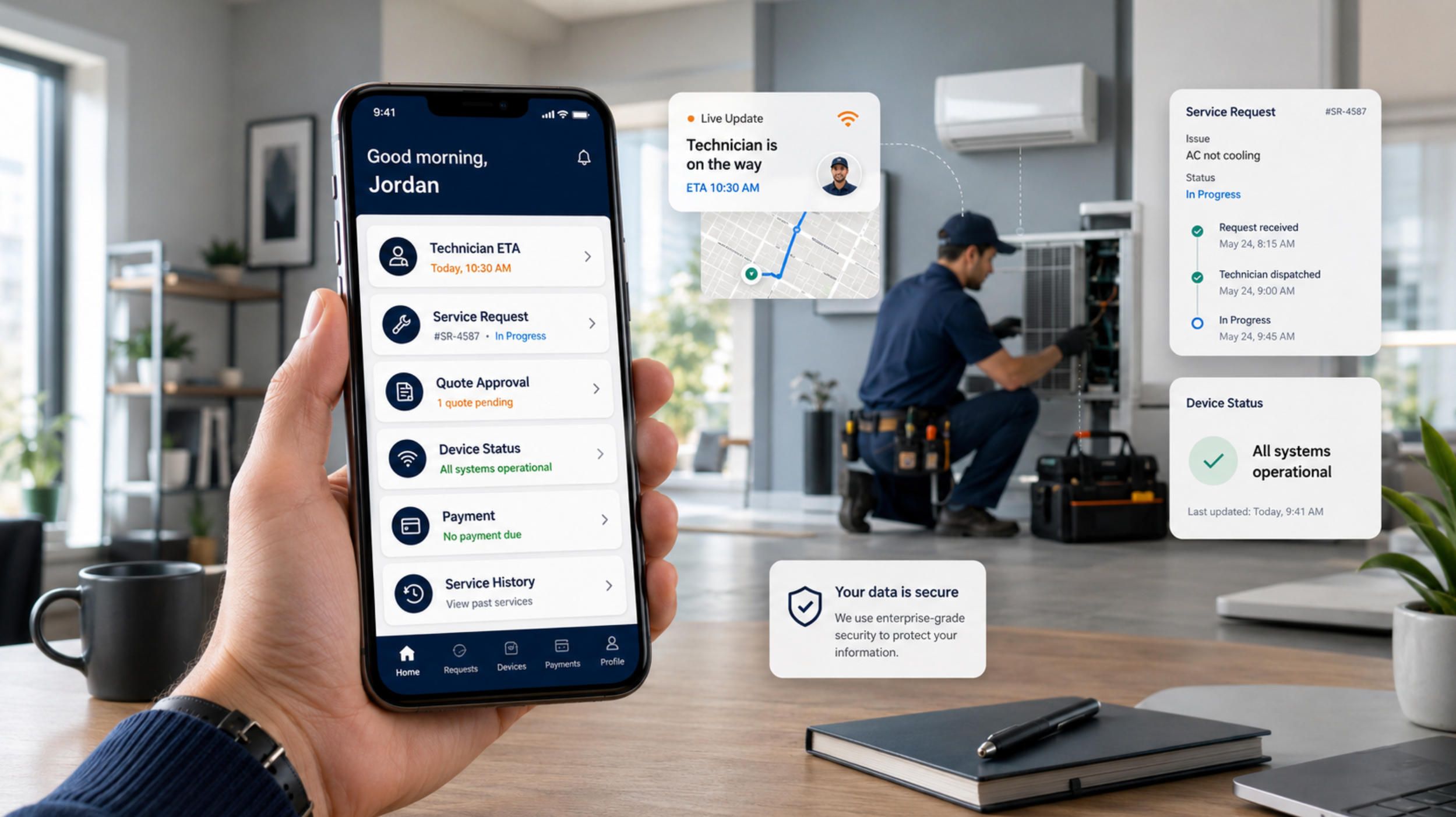
A customer-facing field service app can show appointment status, technician ETA, service preparation instructions, quote approval, in-app chat, photo upload, payment, warranty information, service history, digital documents, and post-service feedback. For connected products, it can also show device status, maintenance alerts, error explanations, usage insights, and remote troubleshooting instructions.
This is not only about convenience. It is about reducing support pressure and increasing customer confidence. When customers can upload photos before a visit, approve estimates digitally, receive real-time updates, and access a professional service report, they do not need to call the office repeatedly. They feel that the company is organized.
That feeling has commercial value.
In premium service categories, digital transparency becomes part of the brand. A company that provides a smooth app-based experience can appear more reliable than a competitor that still relies on missed calls, handwritten notes, unclear appointment windows, and delayed documentation.
For product companies, the customer app has another strategic function: retention. A smart equipment manufacturer should not lose the customer after purchase. The app can become the place where users receive maintenance reminders, order consumables, schedule service, approve upgrades, access tutorials, communicate with support, and receive personalized product recommendations.
That is why custom development can be more powerful than an off-the-shelf portal. A standard platform may manage appointments, but it rarely reflects the exact product logic, customer journey, brand positioning, and after-sales strategy of a specific company.
Technician Apps: The Real Center of Field Productivity
The technician app is where field service software either becomes valuable or fails.
If the app is slow, confusing, overloaded with unnecessary fields, or unreliable offline, technicians will resist it. They will return to calls, messages, paper notes, and personal workarounds. If the app is clear, fast, field-ready, and genuinely useful, it becomes a productivity tool that technicians actually want to use.
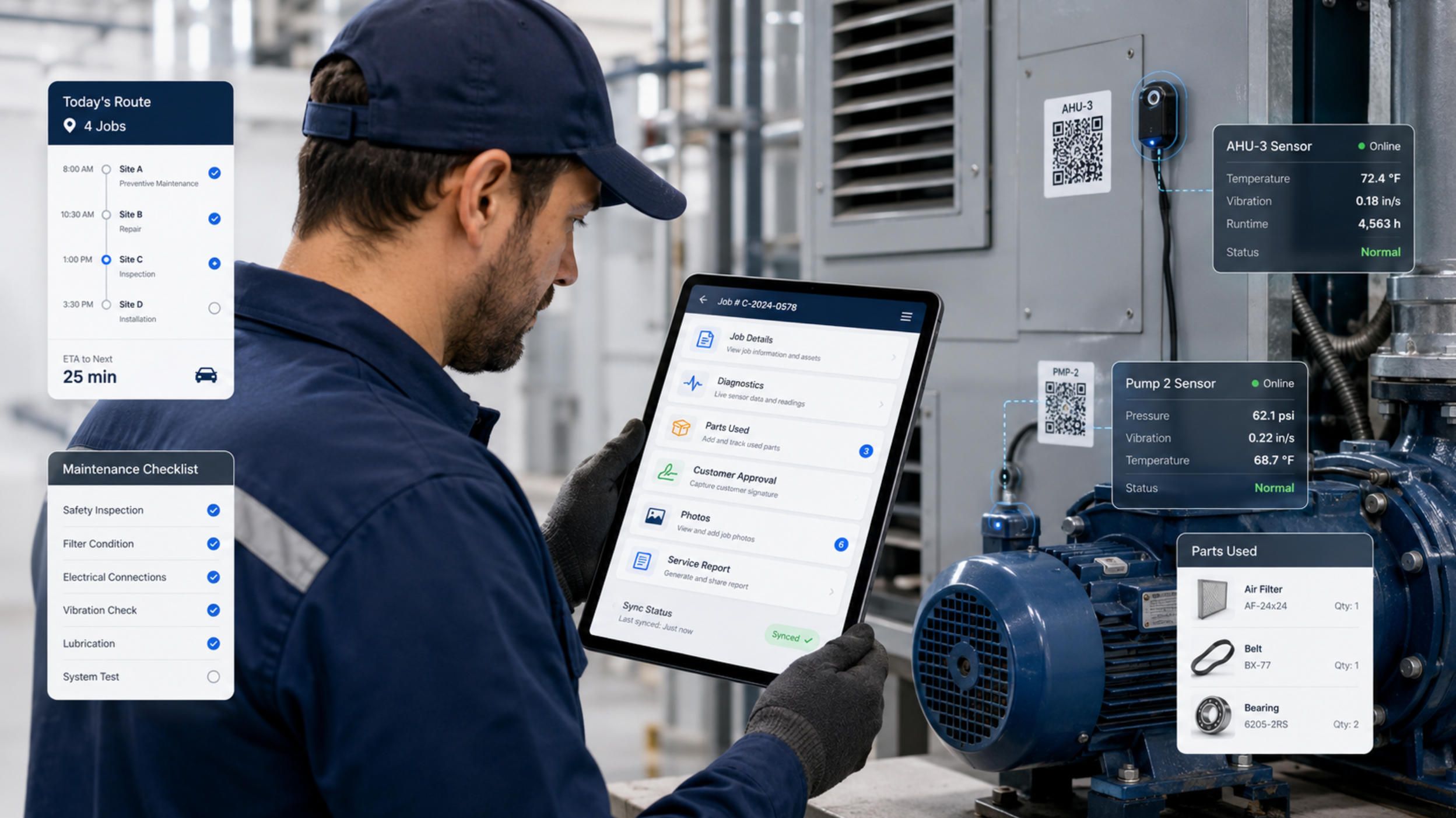
A strong technician mobile app should guide the entire job lifecycle: job acceptance, route details, arrival, inspection, diagnosis, parts usage, customer approval, repair steps, photos, signatures, payment, and final report submission.
But different industries need different workflows. This is one of the main reasons custom mobile app development remains relevant.
A moving company may need room-by-room inventory, QR labels, item photos, damage documentation, crew notes, parking instructions, elevator details, claims forms, and customer signatures. An HVAC company may need equipment model lookup, maintenance plans, refrigerant logs, safety checklists, parts compatibility, and recurring service agreements. A smart appliance company may need device pairing, diagnostic logs, firmware data, error codes, warranty validation, and remote support escalation. An industrial maintenance provider may need asset history, safety permits, inspection protocols, downtime tracking, and compliance documentation.
A generic app cannot always handle this level of industry logic without becoming inefficient or heavily customized anyway.
Field conditions also matter. Technicians may work in basements, elevators, rural areas, construction sites, warehouses, high-rise buildings, or homes with poor connectivity. This makes offline-first architecture a serious requirement. The app should allow technicians to complete forms, take photos, capture signatures, scan QR codes, and view critical job information even when the connection is unstable. Once the connection returns, the system should sync cleanly without duplicate records, missing images, or broken reports.
A-Bots.com can bring real value here by designing field apps around the actual work environment, not around a generic office-based assumption of how service should happen.
IoT Integration: When Devices Start Creating Service Workflows
The rise of connected devices changes the entire logic of field service.
Traditionally, a service process started when a customer noticed a problem. The customer called support, explained the issue, waited for an appointment, and hoped the technician would arrive with the right parts and knowledge.
In an IoT-enabled model, the device can detect the issue before the customer fully understands it.
A smart coffee machine can report abnormal pressure. A robotic cleaner can detect motor overload. A smart HVAC system can show performance degradation. A connected industrial machine can report vibration anomalies. A smart battery system can show voltage or charging irregularities. A medical or laboratory device can flag calibration requirements.
But device alerts alone are not enough. Without software architecture, IoT data becomes noise.
“Artificial intelligence is expected to act as a key growth driver.” (iot-analytics.com)
This is important because AI and IoT become much more valuable together. IoT produces signals. AI helps interpret them. Mobile apps deliver the interpretation to the right person at the right moment.
A custom field service app can turn raw device signals into operational workflows. It can create a ticket, classify severity, notify the customer, recommend remote troubleshooting, assign a technician, reserve parts, check warranty, update the CRM, and generate a service report after completion.
For manufacturers, this is a major opportunity. Many product companies invest heavily in hardware but treat service software as secondary. They may have a basic companion app, a support email, and a PDF manual. That may be enough for simple products, but it is not enough for connected equipment that generates data, requires maintenance, and affects customer satisfaction after the sale.
A custom IoT field service app can create a closed feedback loop between product usage, service operations, and product improvement. The company can learn which components fail most often, which issues are caused by installation mistakes, which customers need proactive support, and which updates could reduce support costs.
This is not just support. It is product intelligence.
CRM, ERP, and Business System Integration
A field service mobile app becomes much more powerful when it is connected to CRM, ERP, inventory, billing, support, and analytics systems. Without integration, the app may look modern while still creating manual work behind the scenes.
The customer profile should connect to CRM. Job pricing should connect to estimates and invoices. Parts usage should connect to inventory. Technician time should connect to payroll or profitability analytics. Warranty status should connect to product registration. Customer feedback should connect to marketing and retention. Service history should connect to future sales and support.
This is why companies should think in terms of a field service software ecosystem, not a standalone mobile app.
The mobile interface is visible, but the real value comes from architecture: APIs, user roles, data models, offline synchronization, business rules, automation logic, analytics, and security.
Many businesses do not need to replace every tool they already use. They need to connect them intelligently. A company may already work with Salesforce, HubSpot, Zoho, Microsoft Dynamics, QuickBooks, Xero, Stripe, Shopify, a warehouse system, or an internal database. The field service app should not create another isolated silo. It should become the field-facing layer of the company’s operational system.
This is also where off-the-shelf platforms reach their limits. SaaS field service tools are useful for standard scheduling, work orders, and dispatching. But when a business needs custom customer portals, AI-assisted diagnostics, device integration, offline workflows, warranty logic, role-based technician apps, payment flows, IoT alerts, and CRM synchronization, custom software becomes much more defensible.
Security, Privacy, and Operational Trust
Field service apps often handle sensitive information. They may store customer addresses, access instructions, payment data, device diagnostics, photos from private homes, warranty records, technician locations, contracts, internal pricing, and business documents.
That makes security and privacy central to the product design.
A poorly built field service app can create serious risks. Customer images may be stored without proper access control. Former employees may retain access. Offline data may be stored insecurely. APIs may expose sensitive information. Admin dashboards may give excessive permissions. Device data may be collected without clear user consent.
A professional field service mobile app should include secure authentication, role-based access control, encrypted data transfer, carefully designed offline storage, audit logs, permission management, secure file handling, and clear data retention policies. In regulated industries such as healthcare, energy, security, finance, or industrial infrastructure, compliance requirements may be even stricter.
Trust is not only technical. It is also operational.
Customers should understand what service data is collected, what the technician did, what they approved, what they paid for, and where they can find documentation. Technicians should understand what the app tracks and why. Managers should have visibility without creating a surveillance culture that damages morale.
Good field service software protects both the business and the people who use it.
Which Companies Should Build Custom AI Field Service Apps?
The strongest candidates for custom AI field service mobile apps are companies where service quality directly affects revenue, retention, reputation, and operational cost.
This includes equipment manufacturers, HVAC companies, appliance repair networks, cleaning businesses, moving companies, smart home brands, robotic device manufacturers, medical device service providers, industrial maintenance companies, solar installation and maintenance firms, security system providers, and telecom or utility service teams.
These companies often have workflows that standard SaaS tools cannot fully capture. They may need specialized checklists, device logic, installation protocols, compliance documents, customer communication flows, pricing rules, warranty rules, technician roles, or product-specific diagnostics.
For example, a smart home brand may need one mobile app for customers, another for installers, and a backend dashboard for support managers. A moving company may need a customer app, crew app, dispatch CRM, QR inventory module, claims management system, and payment workflow. An equipment manufacturer may need IoT alerts, dealer access, spare parts logic, AI troubleshooting, warranty tracking, and service history by serial number.
This is where A-Bots.com can be positioned not as a generic app development vendor, but as a software development partner for companies that need operational systems built around their business model.
The value is not only in writing code. The value is in understanding workflow, designing architecture, building mobile UX for real field conditions, integrating business systems, and creating software that can scale with the company.
From Service Cost to Service Intelligence
The old view of field service was defensive. Service was treated as a cost center. Companies wanted to reduce visits, close tickets faster, and move to the next job.
The new view is more strategic.
Field service is becoming a source of data, loyalty, upsell opportunities, product improvement, operational insight, and competitive differentiation. Every service visit can reveal something important: which product fails, which customer needs an upgrade, which technician workflow is inefficient, which spare parts are overused, which locations produce recurring issues, and which customer segments need more proactive communication.
AI field service mobile apps make this intelligence usable. They structure data at the moment of work. They reduce the gap between the field and the office. They connect device behavior to customer experience. They help companies move from reactive support to proactive service.
This creates a serious advantage for companies that still rely on disconnected tools. A service business can no longer compete only by having skilled technicians. It also needs the digital infrastructure that allows those technicians to work with speed, accuracy, documentation, and context.
Customers may not care what technology stack a company uses. But they care when a technician arrives on time, already understands the issue, has the right part, documents the work clearly, accepts digital approval, and sends a professional report immediately after the visit.
That experience feels premium. And in many industries, premium service protects margins.
The Future of Field Service Is Custom, Connected, and Mobile
AI field service mobile apps are becoming one of the most practical software investments for companies that operate in the physical world. They are not simply apps for scheduling. They are digital operating systems for service delivery.
The strongest solutions connect five layers: the customer, the technician, the dispatcher, the device, and the business system. AI adds knowledge retrieval, diagnosis, automation, reporting, and predictive logic. IoT adds live product data. CRM and ERP integrations connect field activity to sales, billing, inventory, warranty, and management analytics. Mobile UX makes the entire system usable where work actually happens.
For B2B companies, this creates a clear opportunity. A custom field service app can reduce manual work, improve customer trust, increase technician productivity, turn device data into action, and create a more scalable service model.
For manufacturers, it can transform after-sales support into product intelligence. For service companies, it can turn daily operations into a controlled, measurable, and customer-friendly process. For growing businesses, it can become the digital foundation for expansion.
A-Bots.com develops custom mobile applications and software ecosystems for companies that need more than a standard app template. For field service businesses, equipment manufacturers, smart device brands, and service networks, the next step is not simply to “go mobile.” The next step is to build a connected service platform that matches the real complexity of the business.
In 2026, field service is not just about sending the right person to the right place. It is about giving that person the right data, the customer the right visibility, the manager the right control, and the company the right intelligence to grow.
✅ Hashtags
#FieldServiceAppDevelopment
#AIMobileApps
#CustomMobileAppDevelopment
#FieldServiceManagement
#IoTAppDevelopment
#TechnicianApp
#ServiceBusinessSoftware
#ABotsCom
Other articles
Top 4 Best Movers in Charlotte Charlotte is one of the fastest-growing cities in the United States, adding over 157 new residents every single day. That kind of growth means serious, year-round demand for professional movers. This guide reviews the four best movers in Charlotte, NC — Hornet Moving, Reign Moving Solutions, Two Men and a Truck Charlotte, and All My Sons Moving & Storage — based on verified ratings across Google, Yelp, BBB, and Angi, confirmed FMCSA SAFER credentials, and real customer feedback. Each company is evaluated on pricing transparency, crew quality, licensing, and customer experience across local and long-distance moves.
Top 4 Best Movers in Atlanta, GA: Expert Reviews and Local Rankings This article reviews the top 4 best movers in Atlanta, GA through the lens of reputation, customer feedback, service quality, operational maturity, and modern moving standards. Instead of offering a generic list, it analyzes how leading movers handle complex residential and commercial relocations, communication, estimates, claims, and customer trust. The article also highlights a major industry shift: top movers are no longer judged only by trucks and crews, but by digital experience. Mobile apps, CRM systems, virtual surveys, inventory tracking, and claims workflows are becoming signs of a truly premium moving company.
Top 4 Best Movers in Houston: Expert Reviews and Local Rankings This article reviews the top 4 best movers in Houston through reputation signals, customer feedback, service depth, licensing relevance, and operational maturity. It analyzes A Better Tripp Moving & Storage, 3 Men Movers, Johnnie T. Melia Moving & Storage, and Firefighting’s Finest Moving & Storage, showing how each company serves different moving needs. The article also highlights a major industry shift: top movers are increasingly defined not only by crews and trucks, but by digital customer experience. CRM systems, mobile apps, inventory tracking, virtual surveys, dispatch dashboards, and claims workflows are becoming essential tools for premium moving companies.
Top 4 Best Movers in San Antonio: Expert Reviews and Local Rankings This article reviews the top 4 best movers in San Antonio through reputation signals, customer feedback, service range, local credibility, and operational maturity. It analyzes 3 Men Movers, Einstein Moving Company, Swift Movers LLC, and Move Logistics Inc., showing how each company serves different moving needs in a fast-growing relocation market. The article also highlights a major industry shift: top movers are increasingly defined not only by trucks and crews, but by digital customer experience. Mobile apps, CRM systems, virtual surveys, inventory tracking, dispatch dashboards, and claims workflows are becoming essential tools for premium moving companies.
CRM and Mobile App Development for Movers This article explains why App Development for Movers and CRM for Moving Companies are becoming essential for modern relocation businesses. It explores how custom software can improve the entire moving journey - from lead capture, virtual surveys, digital estimates, crew dispatch, and QR inventory to customer apps, claims management, online payments, and analytics. The article shows how mobile apps help customers feel informed and in control, while CRM systems help moving companies reduce errors, improve communication, manage crews, protect reputation, and scale operations. It also positions A-Bots.com as a custom development partner for movers ready to become technology-enabled service brands.
Top stories

Copyright © Alpha Systems LTD All rights reserved.
Made with ❤️ by A-BOTS