
Home
Services
About us
Blog
Contacts
From Chatbots to AI Agents: How Business Apps Are Becoming Smarter Customer Interaction Platforms
For many years, business chatbots were treated as a convenient but limited automation layer. They answered frequently asked questions, collected contact details, routed customers to a support team, and reduced the number of repetitive messages handled by human agents. That was useful, but it was not transformational. A traditional chatbot could usually respond, but it could not understand a business process deeply enough to complete it.
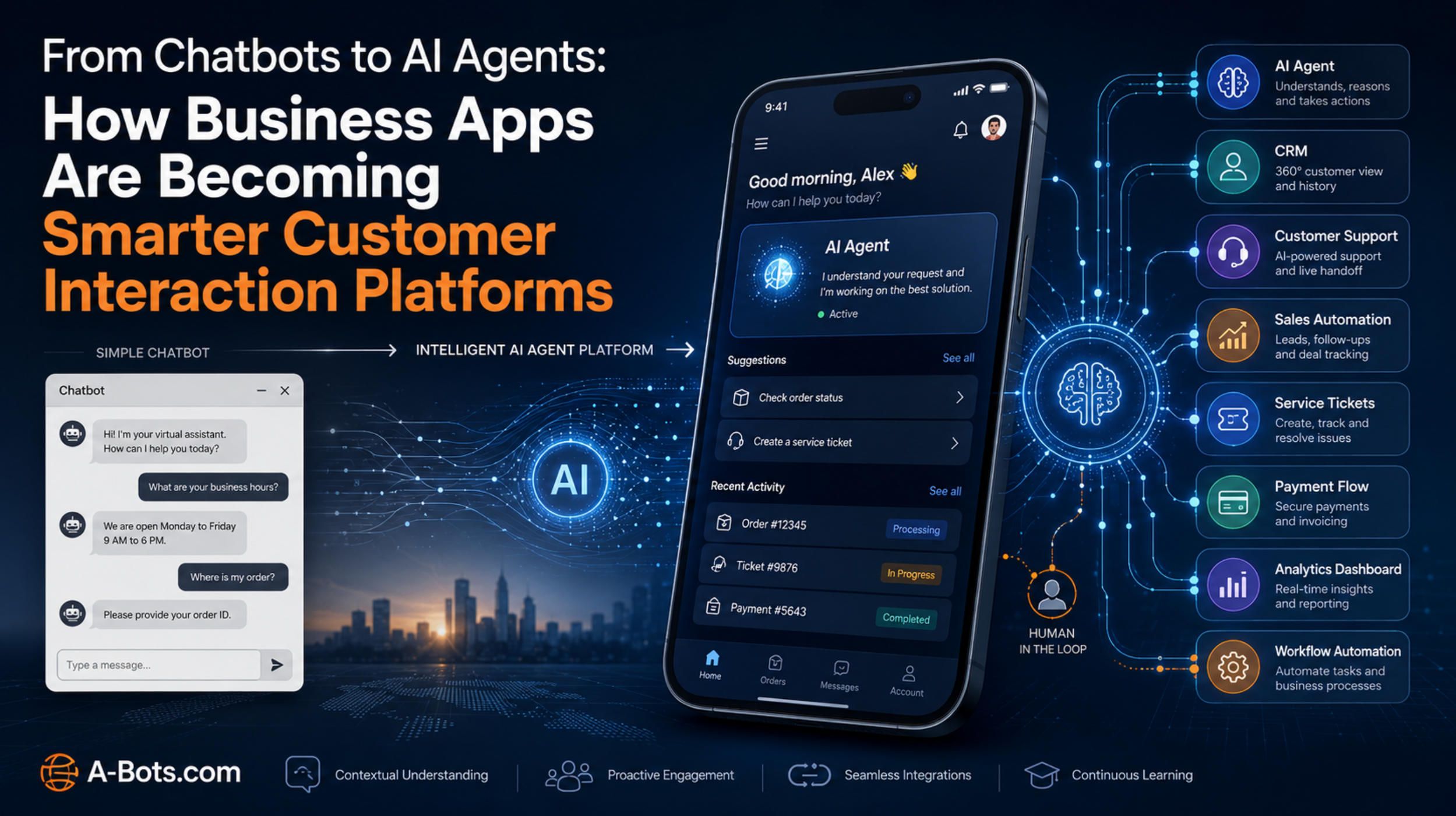
This is changing fast. The new generation of AI agents is turning chatbots from scripted conversation tools into intelligent customer interaction platforms. Instead of simply matching a user’s phrase with a predefined answer, an AI agent can interpret intent, retrieve relevant information, check business rules, connect with CRM or ERP systems, create tickets, update customer records, recommend products, schedule appointments, initiate workflows, and hand over complex cases to human employees with context already prepared.
That shift matters for almost every company that communicates with customers through websites, mobile apps, marketplaces, service portals, messengers, email, or call centers. Customer interaction is no longer just a support function. It is becoming a software-driven operational layer where sales, service, logistics, onboarding, loyalty, payments, warranty, and internal team workflows converge.
The timing is important. McKinsey’s 2025 State of AI survey found that 88 percent of respondents said their organizations use AI in at least one business function, up from 78 percent the previous year, although many companies still have not scaled AI across the enterprise. (McKinsey & Company) Deloitte also predicts that 25 percent of companies using generative AI will launch agentic AI pilots or proofs of concept in 2025, rising to 50 percent in 2027. (Deloitte Italia) In customer service specifically, Salesforce reports that AI resolved 30 percent of service cases in 2025 and is expected to resolve 50 percent by 2027. (Salesforce)
For business owners and technology leaders, the message is clear: the question is no longer whether a company should have a chatbot. The real question is whether the business needs a custom AI-powered interaction system that can turn conversations into measurable actions.
Why Traditional Chatbots Reached Their Limit
The first wave of business chatbots was built around rules, decision trees, keywords, and basic natural language understanding. A user typed something like “Where is my order?” and the chatbot looked for the closest predefined answer or asked the user to choose from buttons. For simple flows, this worked. For anything more nuanced, it often failed.
The main limitation was not the chat interface itself. The limitation was that the chatbot was usually disconnected from the real operational core of the business. It could not reliably understand context, access live systems, reason across multiple data points, or decide what should happen next.
A traditional chatbot might answer:
“Please contact support for more information.”
An AI agent can do something more useful:
“I found your order, checked the delivery status, confirmed that the courier attempted delivery yesterday, and created a rescheduling request for tomorrow afternoon. I also sent the updated delivery window to your email.”
That difference is the foundation of the new market.
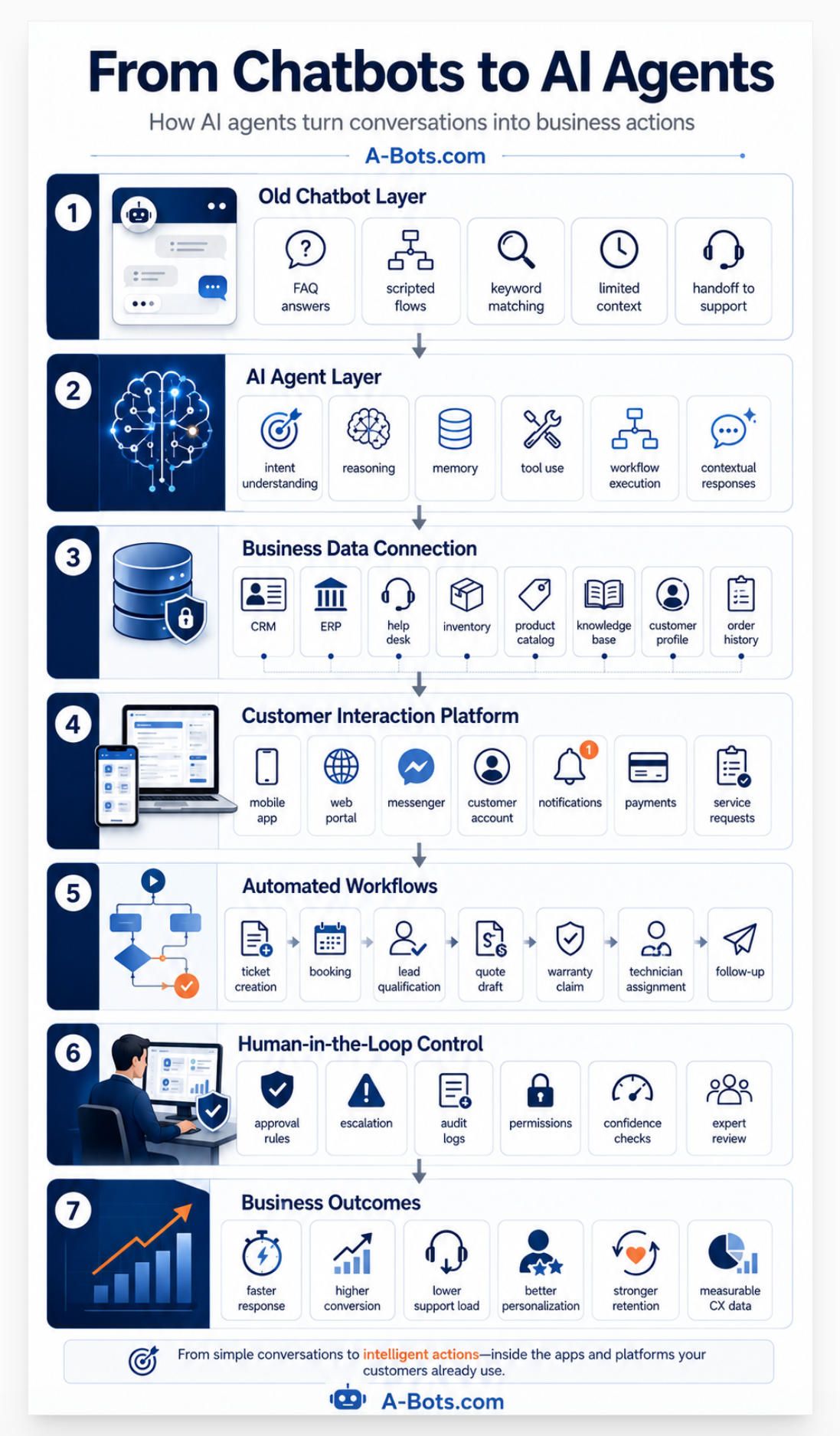
Traditional chatbots were designed mainly for response automation. AI agents are designed for task execution. They are not merely conversational overlays. They are software components that connect natural language, business logic, user identity, enterprise data, and workflow automation.
This is especially important for companies with recurring customer interactions: equipment manufacturers, cleaning and moving companies, healthcare providers, real estate platforms, logistics firms, eCommerce brands, SaaS companies, insurance providers, education platforms, and field service businesses. In these industries, many customer conversations are not isolated questions. They are part of a process.
A customer does not only ask about a service. They want to book it.
A buyer does not only ask about a product. They want to compare options, check availability, calculate cost, and place an order.
A technician does not only need instructions. They need diagnostics, job history, parts availability, safety steps, and reporting tools.
A sales manager does not only need a lead notification. They need qualification, prioritization, CRM updates, reminders, and follow-up content.
That is why custom AI chatbot development is becoming part of a broader software strategy. Businesses do not just need an assistant that talks. They need an assistant that acts inside the company’s digital environment.
What Makes an AI Agent Different from a Chatbot
The difference between a chatbot and an AI agent is not only the use of a large language model. Many companies add an LLM to a chatbot and call it an agent, but that is often just a more fluent FAQ tool. A real AI agent has a wider set of capabilities.
First, it understands intent beyond keywords. A customer may write, “The machine is making a strange sound again after the last repair,” and the agent should recognize that this is not a general complaint. It may be a warranty issue, a repeat service case, a safety concern, or a maintenance escalation.
Second, it can use memory and context. It should know whether the user is a first-time visitor, existing customer, active subscriber, service technician, reseller, or internal employee. Zendesk’s CX Trends 2026 report states that 83 percent of CX leaders say memory-rich AI agents are key to truly personalized customer journeys. (Zendesk CX Trends 2026)
Third, it can connect to tools and systems. A useful business AI agent should be able to work with CRM, help desk software, inventory databases, payment systems, scheduling systems, product catalogs, knowledge bases, analytics, and internal dashboards. This is why new interoperability approaches are becoming important. Zendesk recently announced support for the Model Context Protocol, a standard designed to help AI agents connect more securely and efficiently with external tools and enterprise systems. (TechRadar)
Fourth, it can execute workflows. This is the largest practical difference. An AI agent can create a ticket, generate a quote draft, assign a job, request missing documents, update a customer profile, check eligibility, create a maintenance checklist, or trigger a human review.
Fifth, it can escalate intelligently. In many business cases, full automation is not the goal. The goal is to let AI handle routine steps and prepare complex cases for a human expert. IBM notes that AI agents in customer service can automate repetitive tasks such as ticket creation and free human representatives to focus on complex or sensitive interactions. (IBM)
This creates a more realistic vision of automation. AI agents should not be marketed as a magic replacement for all employees. Their real value is in structured collaboration between software, data, customers, and human teams.
The Business App Is Becoming the Control Center
The rise of AI agents changes the role of the business mobile app. In the past, many companies saw mobile apps mainly as customer-facing conveniences: booking, notifications, account access, loyalty points, order tracking, or product control. Those features still matter, but the app can now become something more strategic.
A modern AI-powered mobile app can become the customer’s direct interface with the company’s operational intelligence.
For a service business, the app can let customers describe a problem in natural language, upload images, receive an estimated service category, select time slots, approve a quote, track technician arrival, pay after completion, and rate the result. The AI agent can classify the request, ask clarifying questions, check service availability, summarize the case for dispatchers, and prepare technician instructions.
For an equipment manufacturer, the app can connect with smart devices, read error codes, explain what is happening, recommend safe user actions, create warranty cases, suggest compatible spare parts, and escalate dangerous issues to certified service teams.
For an eCommerce brand, the app can become a guided purchasing assistant. It can ask what the customer wants to achieve, compare products, check compatibility, explain differences, apply promotions, recover abandoned carts, and recommend accessories based on previous purchases.
For a B2B company, the app can support account-based workflows: request a proposal, check contract status, access documents, ask product questions, schedule demos, and push qualified leads into CRM.
This is where AI agent app development becomes commercially relevant. The mobile app is no longer just a container for screens. It becomes a secure, branded, measurable environment where AI can interact with real users and real business systems.
A-Bots.com works exactly in this area: custom mobile applications and software platforms where user experience, backend logic, integrations, and business workflows are designed together. That is important because AI agents create value only when they are embedded into the right product architecture.
Customer Expectations Are Moving Faster Than Legacy Systems
The strongest reason to invest in AI-powered interaction platforms is not technology hype. It is customer behavior.
Customers now expect speed, continuity, personalization, and transparency. They do not want to repeat the same information across a website chat, mobile app, support email, and phone call. They do not want to wait for a human agent to answer a routine question. They do not want generic answers when the company already has their order history, device data, warranty status, or account profile.
Zendesk reports that 76 percent of customers say they would choose a company if they could drop text, images, and video into the same thread without restarting. (Zendesk CX Trends 2026) Intercom’s customer service transformation research also found that 85 percent of respondents believe AI customer service tools such as AI agents or copilots are responsible for rising customer expectations. (intercom.com)
This is a critical point. AI does not only reduce operational cost. It changes what customers consider normal.
A slow response used to be annoying. Now it can feel outdated.
A chatbot that asks users to “choose option 1, 2, or 3” used to be acceptable. Now it feels primitive.
A mobile app that only displays static account information used to be useful. Now customers expect it to help them solve problems.
This is why business apps are becoming customer interaction platforms. The competitive advantage is not just having an app or having an AI chatbot. The advantage is creating a smooth path from user intent to business outcome.
The New Architecture: Conversation, Data, Tools, and Governance
Behind every effective AI agent is a software architecture that determines what the agent can know, what it can do, and where it must stop.
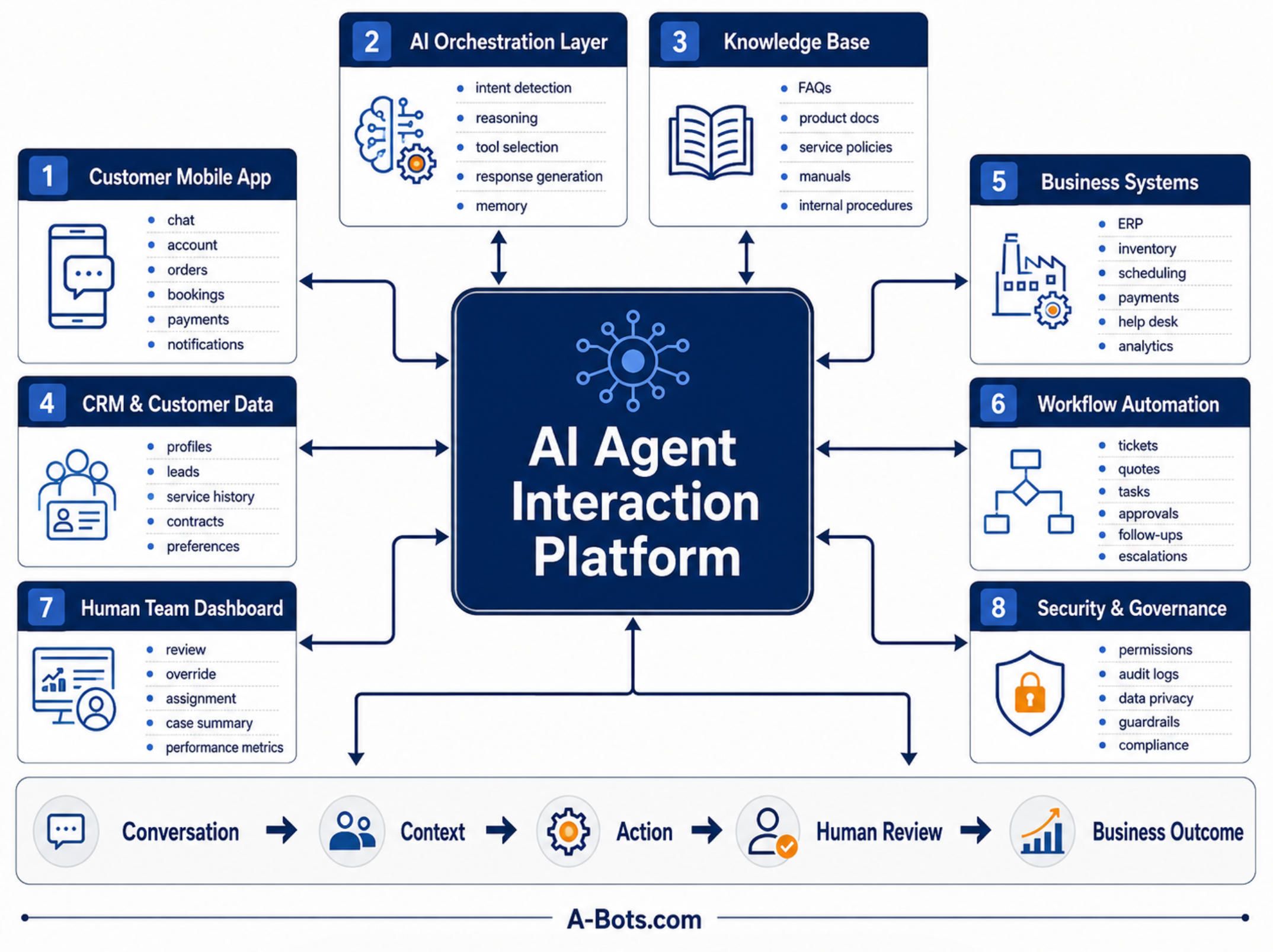
A basic chatbot can be deployed quickly. A business-grade AI agent needs careful design. The architecture usually includes several layers:
- user interface: mobile app, web app, customer portal, messenger, voice channel, or internal dashboard;
- AI orchestration layer: intent detection, reasoning, tool selection, response generation, workflow planning;
- knowledge layer: product documentation, service policies, FAQs, internal procedures, training materials, contracts, manuals;
- integration layer: CRM, ERP, help desk, inventory, payments, scheduling, IoT, analytics, authentication;
- governance layer: permissions, audit logs, escalation rules, human approval, data privacy, security boundaries.
The governance layer is not optional. As AI becomes more autonomous, risk increases. Salesforce UK and Ireland leadership recently warned that AI tools deployed without proper data, safety structures, and guardrails can create serious business risks.
This is where custom development matters. A company may be able to test a generic AI widget quickly, but serious business automation requires more control.
The agent should know which data it can access.
It should know which actions require human approval.
It should produce auditable logs.
It should respect user roles.
It should avoid exposing confidential data.
It should escalate when confidence is low.
It should be tested on real business scenarios before launch.
For example, an AI agent in a healthcare-related app must behave differently from one in a furniture eCommerce store. An agent for field service technicians must support offline mode and structured reporting. An agent for financial services must follow stricter compliance rules. An agent for smart equipment must handle telemetry, error states, and safety instructions carefully.
There is no universal AI agent that fits every business. The quality of the system depends on domain logic, integrations, UX design, and workflow constraints.
From Reactive Support to Proactive Engagement
One of the most important advantages of AI agents is the move from reactive support to proactive engagement.
Traditional customer service waits for a user to report a problem. AI-powered business apps can detect signals earlier and act before the customer becomes frustrated.
In a smart equipment app, the system can detect unusual usage patterns, battery degradation, overheating, repeated error codes, or maintenance intervals. The AI agent can explain the issue, recommend a check, offer a service appointment, or notify a technician.
In a subscription business, the agent can detect churn signals: reduced usage, failed payments, repeated complaints, or inactivity. It can offer guidance, escalate to customer success, or propose a more suitable plan.
In a booking app, the agent can remind users about missing documents, weather-related delays, preparation steps, or schedule changes.
In a sales app, the agent can detect when a prospect revisits pricing pages, opens a proposal, or asks detailed implementation questions. It can prepare a follow-up task for the sales team and summarize the lead’s needs.
IBM identifies proactive customer engagement and omnichannel integration as major customer experience trends, especially when paired with AI capabilities. (IBM) This is exactly where AI-powered mobile apps become more valuable than isolated chatbot widgets. A mobile app can combine identity, permissions, notifications, camera input, geolocation, documents, payments, device data, and conversation history in one controlled environment.
The result is a more intelligent customer relationship. The business does not only answer questions. It anticipates needs, guides decisions, and reduces friction.
Why Generic Chatbot Tools Are Not Enough for Many Businesses
There are many ready-made AI chatbot platforms on the market, and they are useful for quick experiments. They can help companies test demand, automate basic FAQ answers, or reduce simple support tickets. But they are not always enough for companies with complex workflows, proprietary data, regulated processes, mobile-first customers, or industry-specific logic.
A generic tool usually works best when the process is generic.
But many business processes are not generic.
A moving company needs quote estimation based on addresses, inventory, stairs, building rules, truck availability, insurance, and crew scheduling.
A cleaning company needs recurring visits, property details, before-and-after photos, checklists, customer preferences, access instructions, and quality control.
An equipment manufacturer needs device registration, warranty validation, spare parts compatibility, telemetry, service manuals, technician certification, and dealer networks.
A healthcare or wellness provider needs sensitive data handling, appointment logic, consent, reminders, and safe escalation.
A B2B software company needs lead scoring, role-based product education, account history, CRM updates, and sales enablement.
These use cases require custom AI chatbot development or custom AI agent app development because the agent must work inside a specific business model. It is not enough for the system to “sound smart.” It must produce the right operational result.
This is also why AI agent projects should not start with the question, “Which chatbot should we install?” A better starting question is:
“What customer interactions create the highest operational load, revenue leakage, or user frustration, and how can software turn those interactions into structured workflows?”
That question leads to better products.
The Economic Logic: Automation, Revenue, and Experience
The market momentum around AI agents is supported by both cost pressure and growth ambition. Grand View Research estimates that the global AI for customer service market was 13.01 billion dollars in 2024 and is expected to reach 15.78 billion dollars in 2025, with a projected compound annual growth rate of 23.2 percent from 2025 to 2033. (Grand View Research) MarketsandMarkets projects the AI agents market to grow from 7.84 billion dollars in 2025 to 52.62 billion dollars by 2030. (MarketsandMarkets)
These numbers reflect a larger business reality. Companies are under pressure to serve more customers without scaling headcount at the same rate. They need faster response times, lower support costs, better lead conversion, stronger retention, and more consistent service quality.
However, the economic logic should not be reduced to “replace people with AI.” That framing is too narrow and often creates poor implementation decisions.
The more valuable logic is this:
AI handles repetitive interactions.
Human teams handle judgment, trust, exceptions, negotiations, and relationship-building.
Software connects both into one measurable system.
In this model, an AI agent is not a toy and not a threat. It is an operational interface. It turns unstructured customer messages into structured business events. It helps companies measure what customers ask, where processes fail, which products create confusion, which service issues repeat, and which interactions should be redesigned.
This data can be more valuable than the automation itself. A smart customer interaction platform becomes a source of business intelligence.
Where AI Agents Create the Most Value First
Not every process should be automated immediately. The best starting points are usually high-volume, repeatable, data-supported interactions where the cost of delay is visible.
The strongest early use cases include customer service triage, order and booking management, appointment scheduling, service request intake, lead qualification, product selection, warranty claims, onboarding, internal knowledge search, technician assistance, and customer follow-up.
These processes share several characteristics. They involve many similar questions, require access to existing data, follow recognizable business rules, and often lead to a clear next step. That makes them suitable for AI-assisted automation.
For example, a customer support AI agent can identify the issue, ask for missing information, check the customer’s record, create a support ticket, suggest a knowledge base article, and summarize everything for a human specialist if escalation is needed.
A sales AI agent can qualify a lead, ask about budget and timeline, recommend a service category, create a CRM record, assign a sales manager, and draft a personalized follow-up.
An operations AI agent can help internal staff search procedures, generate reports, check order status, or prepare customer updates.
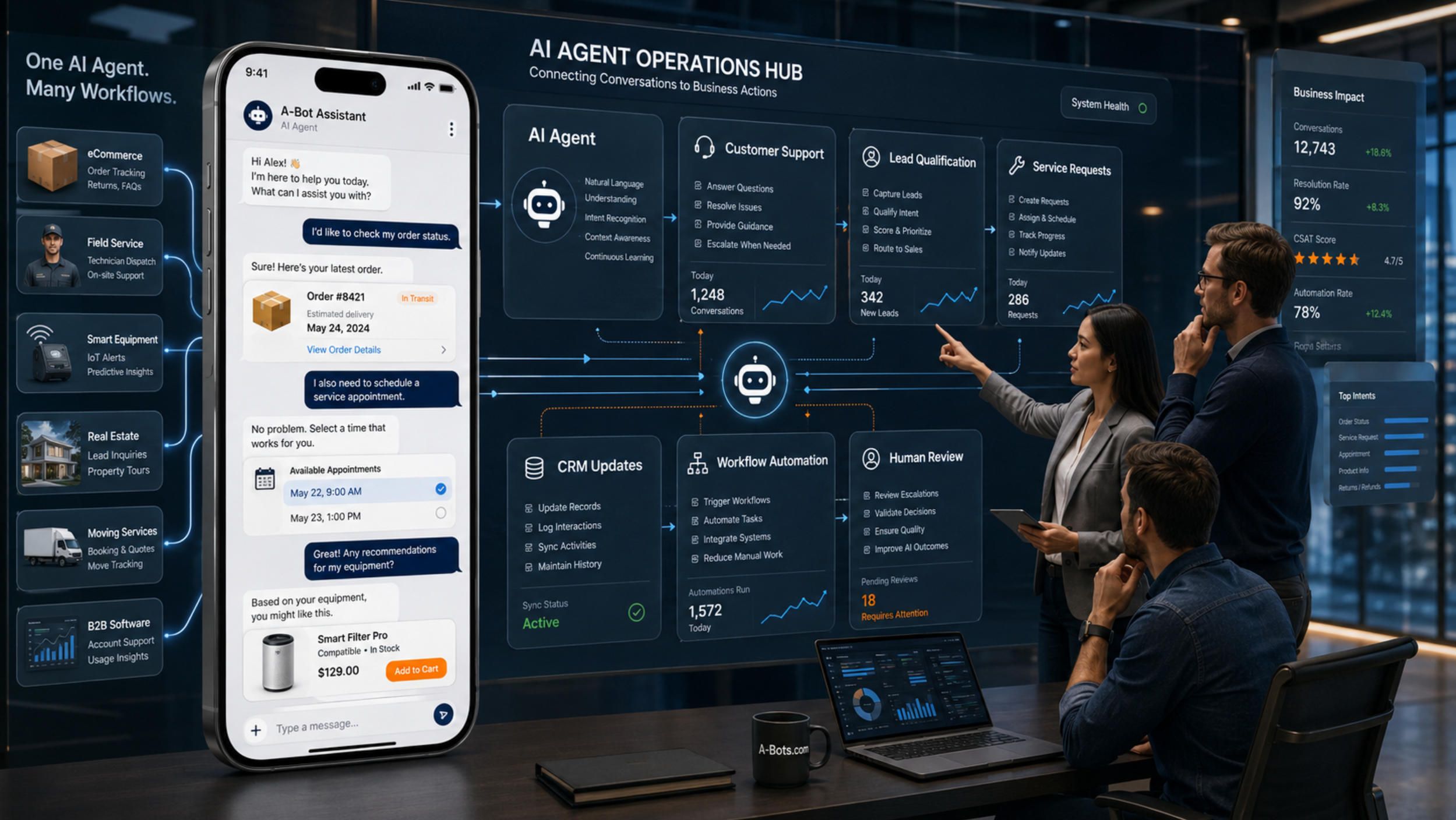
The strategic value comes from connecting these use cases into one platform. A business does not need five disconnected AI experiments. It needs a coherent roadmap where AI agents support the customer journey from first contact to long-term retention.
The Role of A-Bots.com in This Shift
For companies planning to move beyond simple chatbot automation, the key challenge is product design. AI should not be added randomly. It should be built into the app’s business logic, user journeys, data model, backend integrations, and operational workflows.
This is where a custom development partner becomes important.
A-Bots.com develops mobile applications and software platforms for businesses that need more than a template solution. In the context of AI agents, that means designing systems where the AI layer is connected with real product functions: onboarding, booking, CRM, support, payments, notifications, dashboards, analytics, and internal team tools.
A well-designed AI-powered business app should answer several practical questions before development begins:
- What customer problems should the agent solve first?
- Which systems must the agent connect to?
- What data can the agent access?
- Which actions can be automated, and which require approval?
- How will the company measure success: response time, conversion, resolution rate, retention, cost per case, or customer satisfaction?
These questions are not theoretical. They determine whether the AI agent becomes a useful business asset or another experimental feature that looks impressive but does not change operations.
A-Bots.com’s opportunity is to help businesses turn the current AI agent trend into concrete software products: customer apps, technician apps, service platforms, AI-enhanced CRM systems, smart equipment apps, booking platforms, and industry-specific customer interaction systems.
Conclusion: The Chat Interface Is Becoming an Operating Layer
The evolution from chatbots to AI agents is not simply a technology upgrade. It is a change in how businesses interact with customers, employees, and operational data.
Traditional chatbots were mostly designed to reduce repetitive communication. AI agents are designed to participate in business processes. They can understand context, retrieve information, use tools, trigger workflows, personalize responses, and collaborate with human teams.
That is why business apps are becoming smarter customer interaction platforms. The app is no longer only a digital brochure, booking screen, or account dashboard. It can become the place where customers ask, decide, buy, book, troubleshoot, upload, approve, pay, and receive support - while the company captures structured data and automates the next step.
The companies that benefit most will not be the ones that simply add an AI chatbot to their website. The winners will be businesses that redesign customer interaction as a software system: secure, integrated, measurable, and aligned with real workflows.
For business owners, the practical question is not whether AI agents are impressive. They already are. The practical question is where an AI agent can remove friction, increase conversion, improve service quality, and create a better digital experience for customers.
That is the new role of custom mobile app development. It is not just about building screens. It is about building intelligent interaction platforms where AI, data, workflows, and people work together.
✅ Hashtags
#AIAgents
#AIChatbotDevelopment
#CustomAppDevelopment
#BusinessAutomation
#CustomerExperience
#MobileAppDevelopment
#EnterpriseAI
#ABotsCom
Other articles
Top 4 Best Movers in Houston: Expert Reviews and Local Rankings This article reviews the top 4 best movers in Houston through reputation signals, customer feedback, service depth, licensing relevance, and operational maturity. It analyzes A Better Tripp Moving & Storage, 3 Men Movers, Johnnie T. Melia Moving & Storage, and Firefighting’s Finest Moving & Storage, showing how each company serves different moving needs. The article also highlights a major industry shift: top movers are increasingly defined not only by crews and trucks, but by digital customer experience. CRM systems, mobile apps, inventory tracking, virtual surveys, dispatch dashboards, and claims workflows are becoming essential tools for premium moving companies.
Top 4 Best Movers in San Antonio: Expert Reviews and Local Rankings This article reviews the top 4 best movers in San Antonio through reputation signals, customer feedback, service range, local credibility, and operational maturity. It analyzes 3 Men Movers, Einstein Moving Company, Swift Movers LLC, and Move Logistics Inc., showing how each company serves different moving needs in a fast-growing relocation market. The article also highlights a major industry shift: top movers are increasingly defined not only by trucks and crews, but by digital customer experience. Mobile apps, CRM systems, virtual surveys, inventory tracking, dispatch dashboards, and claims workflows are becoming essential tools for premium moving companies.
CRM and Mobile App Development for Movers This article explains why App Development for Movers and CRM for Moving Companies are becoming essential for modern relocation businesses. It explores how custom software can improve the entire moving journey - from lead capture, virtual surveys, digital estimates, crew dispatch, and QR inventory to customer apps, claims management, online payments, and analytics. The article shows how mobile apps help customers feel informed and in control, while CRM systems help moving companies reduce errors, improve communication, manage crews, protect reputation, and scale operations. It also positions A-Bots.com as a custom development partner for movers ready to become technology-enabled service brands.
AI Field Service Mobile Apps: Custom Software for Connected Service Operations This article explores why AI field service mobile apps are becoming a strategic software investment for companies that manage technicians, customers, equipment, smart devices, and distributed service operations. It explains how custom mobile apps can connect technician workflows, customer portals, IoT diagnostics, CRM systems, service documentation, payments, warranty logic, and AI-assisted troubleshooting into one operational ecosystem. The article is especially relevant for equipment manufacturers, HVAC companies, smart device brands, repair networks, cleaning businesses, moving companies, and industrial service providers that want to improve field productivity, customer trust, and service intelligence through custom software developed by A-Bots.com.
Smart Equipment App Development Smart equipment is no longer just hardware with connectivity. For manufacturers, the real business opportunity begins after the sale, when a mobile app can connect customers, devices, technicians, warranty workflows, spare parts, diagnostics, updates, and service analytics. This article explains how custom mobile apps turn connected equipment into after-sales service platforms that improve support, reduce friction, generate product intelligence, and create new recurring value. It is especially relevant for manufacturers of smart appliances, industrial machines, robotics, HVAC systems, cleaning equipment, agricultural devices, and other connected products that need a stronger digital relationship with customers.
Top stories

Copyright © Alpha Systems LTD All rights reserved.
Made with ❤️ by A-BOTS