
Home
Services
About us
Blog
Contacts
Smart Equipment App Development: How Custom Mobile Apps Turn Connected Devices into After-Sales Service Platforms
Introduction: the product is no longer finished when it leaves the factory
Smart equipment used to be defined by hardware: better sensors, stronger motors, more accurate controllers, cleaner industrial design, safer mechanics, and more reliable components. Today, that definition is no longer enough. A connected product becomes commercially powerful only when the manufacturer can keep working with it after the sale: monitor performance, support the customer, deliver software updates, manage warranty claims, recommend maintenance, sell spare parts, and understand how the product behaves in real conditions.
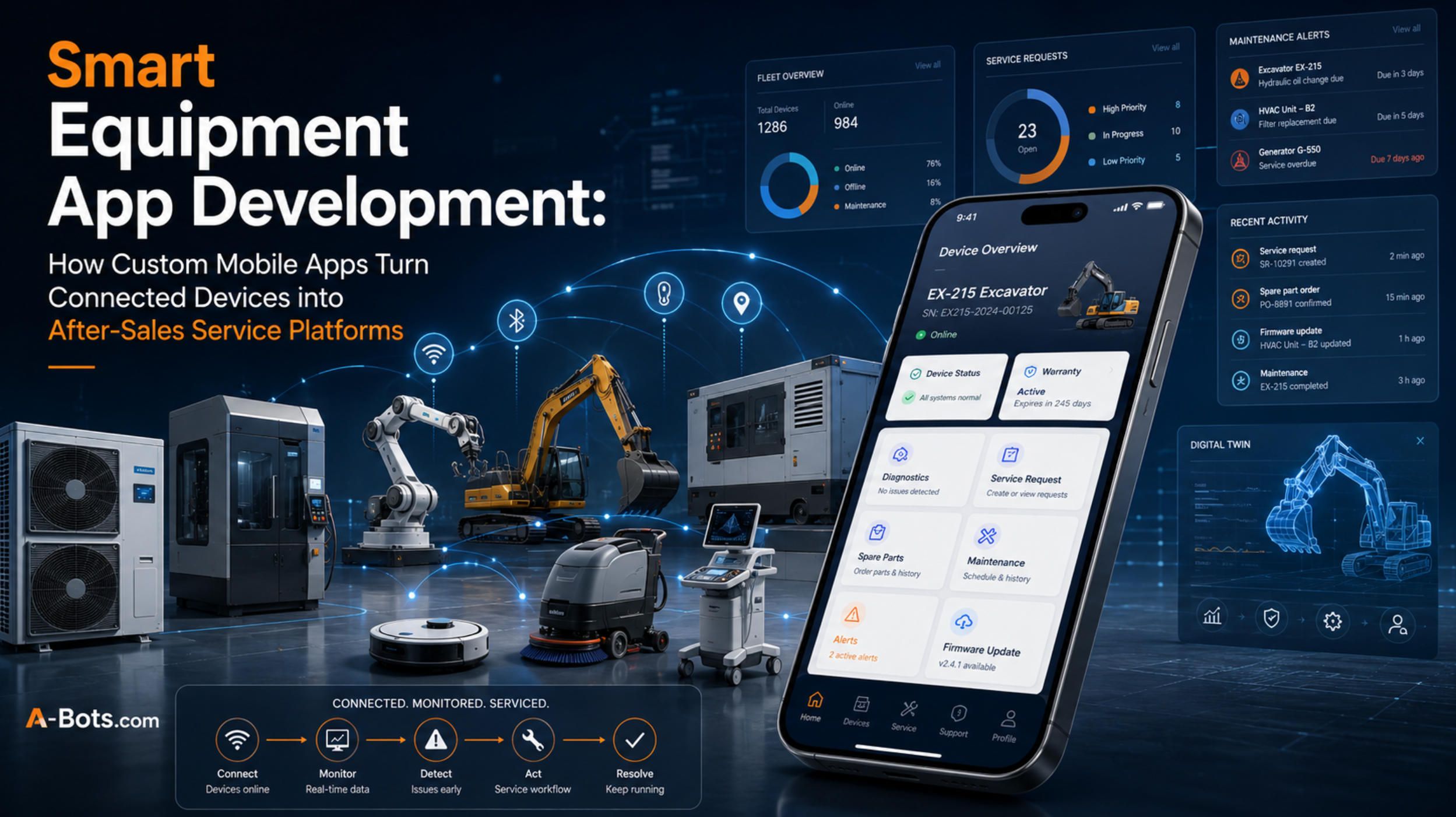
This is why smart equipment app development is becoming a strategic topic for manufacturers. A mobile app is not just a remote control screen. It can become the customer interface, the service channel, the diagnostic layer, the warranty gateway, the spare parts assistant, the product education center, and the long-term relationship between the manufacturer and the user.
The timing is important. IoT Analytics estimated that the number of connected IoT devices grew to 21.1 billion by the end of 2025, with enterprise IoT accounting for a major part of the market. The same research expects connected IoT devices to reach 39 billion by 2030 (iot-analytics.com). In parallel, the enterprise IoT market grew by 13 percent year over year in 2025 to 324 billion dollars, with projected growth in 2026 driven partly by AI technologies.
This growth creates a new reality for equipment manufacturers. When machines, devices, appliances, robots, tools, vehicles, sensors, and industrial systems become connected, customers expect more than connectivity. They expect a useful digital experience. They expect the product to explain itself, warn them before problems happen, guide them through service, and make ownership easier.
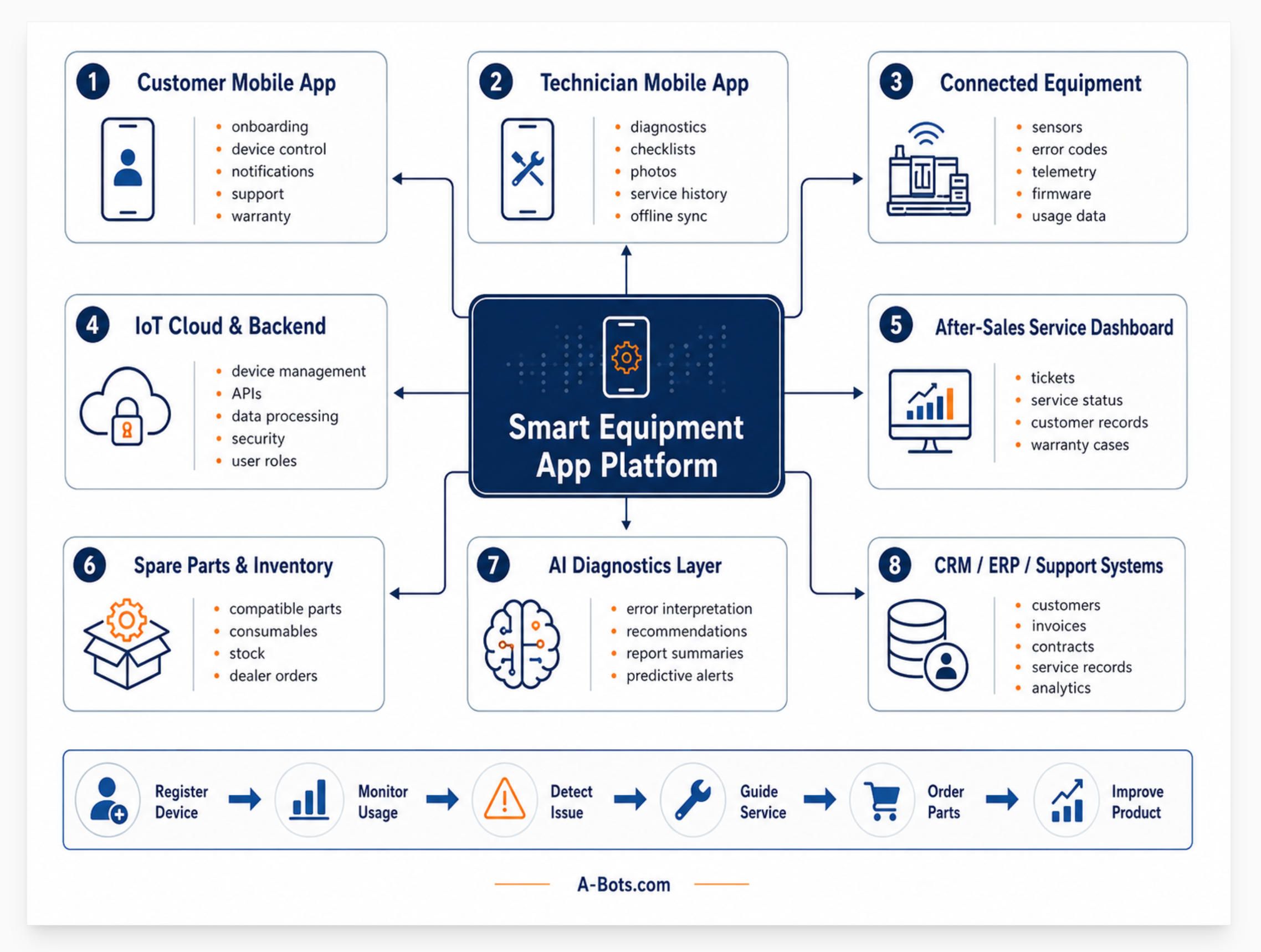
For A-Bots.com, this is a strong direction for custom mobile app development. Many manufacturers do not need a generic app template. They need a custom product ecosystem: iOS and Android apps, backend infrastructure, IoT connectivity, service dashboards, device diagnostics, warranty workflows, customer accounts, technician access, analytics, and sometimes AI-powered recommendations. The mobile app becomes the layer where hardware, software, data, service, and business value meet.
1. Why smart equipment manufacturers need an after-sales platform
Manufacturers traditionally think about after-sales service as a cost center. Something breaks, the customer contacts support, the company sends instructions, ships a part, or dispatches a technician. This model is reactive. It starts after the customer has already experienced a problem.
Connected equipment changes the logic. If a product can report usage data, error codes, battery condition, firmware version, temperature, vibration, runtime, cleaning cycles, load level, pressure, humidity, location, or operating mode, the manufacturer does not have to wait for the customer to complain. The company can build a proactive after-sales platform around the device.
That platform may start with a mobile app, but it does not end there. It connects multiple business functions: product support, service operations, customer success, engineering, spare parts, warranty, marketing, sales, and data analytics. The app becomes the front-end layer of a larger digital service system.
Deloitte describes servitization as a shift from a product-centric model to a service model, where manufacturers move from “selling products” toward “selling an experience.” (Deloitte). PwC similarly notes that connected physical products create opportunities for new business models by enabling data sharing, connectivity, and service innovation. (PwC) In practice, this means a manufacturer can compete not only through hardware quality, but through the quality of ownership.
A smart equipment app can support several after-sales functions at once:
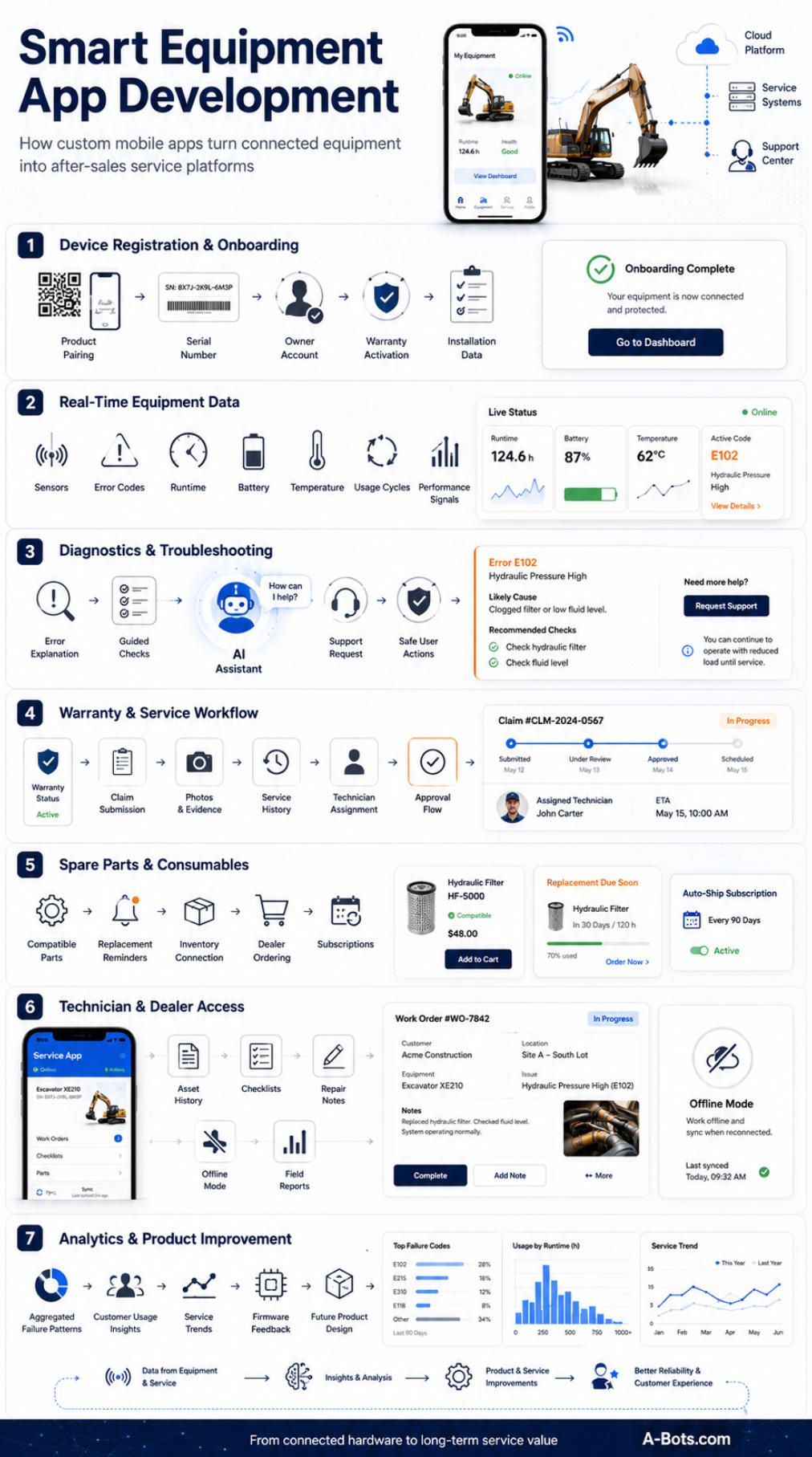
- product registration, onboarding, device pairing, and warranty activation;
- real-time diagnostics, error explanations, maintenance reminders, and service history;
- spare parts ordering, consumables, subscription services, and customer support.
This is commercially important because after-sales is often where long-term margin and loyalty are created. Once the product is installed, the manufacturer has a chance to build a recurring relationship instead of disappearing until the next purchase cycle.
For example, a manufacturer of smart floor-cleaning machines can use an app to track filter wear, battery health, brush replacement cycles, cleaning area statistics, error codes, and service needs. A manufacturer of agricultural equipment can use a mobile app to show machine usage, maintenance intervals, spare part compatibility, service documentation, and dealer support. A company producing industrial compressors can use an app to monitor pressure anomalies, runtime, energy consumption, oil replacement schedules, and predictive failure signals.
In each case, the app is not decorative. It becomes the operational bridge between the product and the manufacturer.
2. The market signal: connected products are becoming service businesses
The growth of connected devices is only one part of the story. The more important trend is that connected products are changing the business model of manufacturing.
McKinsey’s long-term IoT research estimated that IoT could enable between 5.5 trillion and 12.6 trillion dollars in global economic value by 2030, including value captured by consumers and customers of IoT products and services (SITIC). That number is not simply about selling sensors. It is about turning data into operational value: uptime, efficiency, maintenance, automation, safety, customer experience, and new revenue streams.
Capgemini describes intelligent products and services as products connected with a broader ecosystem that can enhance customer experience, optimize product performance, improve services, and help organizations transition toward “solution-provider” status. This is exactly the direction smart equipment manufacturers are moving toward. They are no longer only shipping physical units. They are building digital ecosystems around those units.
The shift is visible across industries:
In consumer appliances, customers expect mobile control, notifications, energy insights, firmware updates, and guided troubleshooting.
In industrial equipment, customers expect asset dashboards, predictive maintenance, service documentation, spare parts visibility, and remote diagnostics.
In professional cleaning equipment, customers expect usage analytics, fleet management, battery monitoring, maintenance reminders, and proof-of-work reporting.
In HVAC and building systems, customers expect performance monitoring, fault alerts, scheduled maintenance, technician coordination, and energy optimization.
In robotics and autonomous devices, customers expect maps, missions, logs, safety alerts, remote configuration, software updates, and service workflows.
The deeper trend is that the product is becoming a data source, and the mobile app is becoming the human interface to that data. Without a good app, the manufacturer may technically have a connected product, but the customer may not experience much value from that connectivity.
This is why custom development matters. A generic app can pair a device and show basic status. A serious smart equipment platform must reflect the product category, the service model, the customer journey, the manufacturer’s support process, and the data architecture behind the device.
3. What customers actually expect from smart equipment apps
Customers do not think in terms of “IoT architecture.” They think in terms of convenience, reliability, and trust. If they buy a smart machine, they expect the app to make ownership easier. If the app is confusing, unstable, slow, or poorly connected to service, the “smart” label becomes a source of irritation.
The customer expectation is simple: the product should help them understand what is happening and what to do next.
A smart equipment app should answer practical questions:
- Is my device working correctly?
- Does it need maintenance?
- What does this error mean?
- Is this covered by warranty?
- Which part or consumable do I need?
- Can I update the software safely?
- Can I contact support without repeating all product details?
- Can a technician see the same information I see?
This is where many manufacturers fail. They build an app as a remote control, but not as an ownership platform. The app may turn the device on or off, but it does not help the user solve problems, maintain performance, document service history, or communicate with the manufacturer.
Capgemini’s customer service research in 2025 focused on evolving customer expectations and the growing role of generative AI and AI agents in service transformation (Capgemini). This direction is especially relevant for connected products because equipment support is often information-heavy. Customers need manuals, warranty rules, troubleshooting logic, error interpretation, part identification, service scheduling, and escalation paths.
A strong mobile app reduces friction. It can automatically attach the product model, serial number, firmware version, error log, purchase date, warranty status, photos, and usage data to a support request. That single feature can save both the customer and the support team significant time.
For B2B equipment, the value is even higher. A facility manager responsible for 150 machines does not want 150 paper files. A cleaning company operating a fleet of robotic cleaners needs equipment status, service tickets, and battery health in one place. A distributor needs dealer-level access. A technician needs diagnostic history. A manufacturer needs aggregated failure patterns.
A custom app can support all these roles with different permissions, dashboards, and workflows.
4. The mobile app as a warranty and service gateway
Warranty is one of the most important after-sales functions, but in many companies it is still fragmented. Customers keep receipts in email. Serial numbers are written on labels. Warranty forms are PDF-based. Support agents manually ask for proof of purchase. Service teams do not always have complete repair history. Engineering teams may not receive structured defect data.
A smart equipment app can turn warranty into a structured digital workflow.
The user registers the product inside the app. The app stores the purchase date, serial number, installation date, device model, dealer information, region, and warranty terms. If a problem occurs, the app can check whether the product is still covered, ask the customer to upload photos or video, collect diagnostic logs, and create a service ticket with all necessary data.
For the manufacturer, this is not only about faster service. It is about better data. Warranty claims can reveal recurring design issues, weak components, misuse patterns, installation mistakes, regional differences, and service bottlenecks. If this data is structured from the beginning, it becomes useful for product improvement.
The app can also reduce fraudulent or incomplete warranty claims. Device identity, activation history, firmware logs, and usage data can help verify whether a claim matches warranty conditions. At the same time, the customer experience can become smoother because the app already knows the product.
This matters more as regulation around repair, product support, and software-enabled devices becomes stricter. The European Commission’s Directive on common rules promoting the repair of goods entered into force in July 2024, with EU member states required to apply national rules from July 31, 2026 (European Commission). The regulation reflects a broader policy trend: repairability, access to service information, spare parts, and long-term product support are becoming more visible issues.
For manufacturers, this does not mean every app must become a legal compliance tool. But it does mean that after-sales service can no longer be treated as a hidden back-office process. Customers, regulators, distributors, and service partners increasingly expect clarity: what can be repaired, how service is requested, how long support lasts, and what information is available.
A mobile app is one of the most practical places to organize that clarity.
5. Software updates, cybersecurity, and the trust problem
Connected products create an obligation that traditional products did not have: software support. A mechanical product may age slowly. A connected product can become insecure, incompatible, or partially unusable if its software is abandoned.
This is now a visible regulatory and reputational issue. The EU Cyber Resilience Act entered into force in December 2024 and introduces cybersecurity requirements for products with digital elements, including connected hardware and software. Some reporting obligations start in September 2026, and the regulation fully applies from December 2027. NIST also maintains cybersecurity guidance for IoT manufacturers, emphasizing the need to incorporate cybersecurity into product development (NIST).
For smart equipment manufacturers, this has direct implications for app development. The mobile app is part of the product’s security surface. It may handle user accounts, device pairing, firmware updates, cloud data, location, diagnostic logs, remote control, payment details, and support documents. A weak app can compromise trust in the entire product.
Security should not be added at the end. It should be designed into the mobile ecosystem from the beginning:
- secure device onboarding and authentication;
- encrypted communication between app, cloud, and equipment;
- role-based access for owners, operators, technicians, dealers, and admins;
- controlled firmware update workflows;
- audit logs for critical actions;
- secure handling of diagnostic and customer data.
This is another reason why custom smart equipment app development requires serious engineering. A simple consumer-style app may not be enough for professional equipment, industrial systems, medical-adjacent devices, or connected machines used in regulated environments.
The Federal Trade Commission also released a staff report in 2024 examining software support disclosures for connected devices. The report found that many manufacturer web pages did not clearly disclose how long smart products would receive software updates (Seyfarth Shaw). That finding points to a broader trust problem: customers increasingly understand that connected products depend on long-term digital support.
A smart equipment app can help solve part of this problem by making software status visible. It can show firmware version, update availability, support lifecycle information, release notes, security notices, and compatibility alerts. For premium equipment, this transparency can become a competitive advantage.
6. From product data to predictive service
One of the strongest promises of connected equipment is predictive service. But predictive maintenance is often misunderstood. It is not magic. It is not enough to collect data. The manufacturer must connect device signals to service logic.
A predictive service workflow may include several layers. The equipment sends operating data. The backend detects anomalies or maintenance thresholds. The app sends the user a clear notification. The system recommends an action. If necessary, it creates a support case or service appointment. The technician receives diagnostic context before visiting. The manufacturer records the result and improves future recommendations.
This is where AI can become useful, but only when it is connected to real product data and verified service knowledge. An AI assistant inside a smart equipment app can help explain error codes, summarize service history, suggest likely causes, guide the user through safe checks, and prepare information for support. For professional equipment, AI can also help technicians interpret logs, compare symptoms with known failures, and generate service reports.
However, AI must be designed carefully. A smart equipment app should not give unsafe repair instructions, invent technical procedures, or bypass warranty rules. The AI layer should rely on approved documentation, structured diagnostics, confidence levels, escalation rules, and human review where needed.
This is why the best architecture is not “add a chatbot.” The better approach is to build an AI-assisted service layer:
The app collects structured equipment data.
The backend connects manuals, service bulletins, warranty rules, and known issue databases.
The AI assistant retrieves relevant information, summarizes it, and guides the next step.
The user or technician confirms actions.
The system records outcomes for future analytics.
This creates value without turning maintenance into a black box. For many manufacturers, the first AI use case does not need to be fully autonomous repair. It can be simpler and more practical: smarter troubleshooting, better support request classification, faster service report generation, and proactive maintenance recommendations.
7. Why manufacturers should think beyond one app
A common mistake is to think of smart equipment app development as one mobile application for one user type. In reality, a serious after-sales platform usually needs multiple interfaces.
The customer app is designed for owners, operators, and product users. It handles onboarding, control, notifications, maintenance reminders, support, warranty, payments, documentation, and product education.
The technician app is designed for service teams. It handles diagnostics, checklists, asset history, repair instructions, parts usage, photos, signatures, reports, offline access, and work order completion.
The dealer or distributor portal supports regional partners. It may include customer equipment lists, service tasks, spare parts availability, installation records, warranty cases, and support escalation.
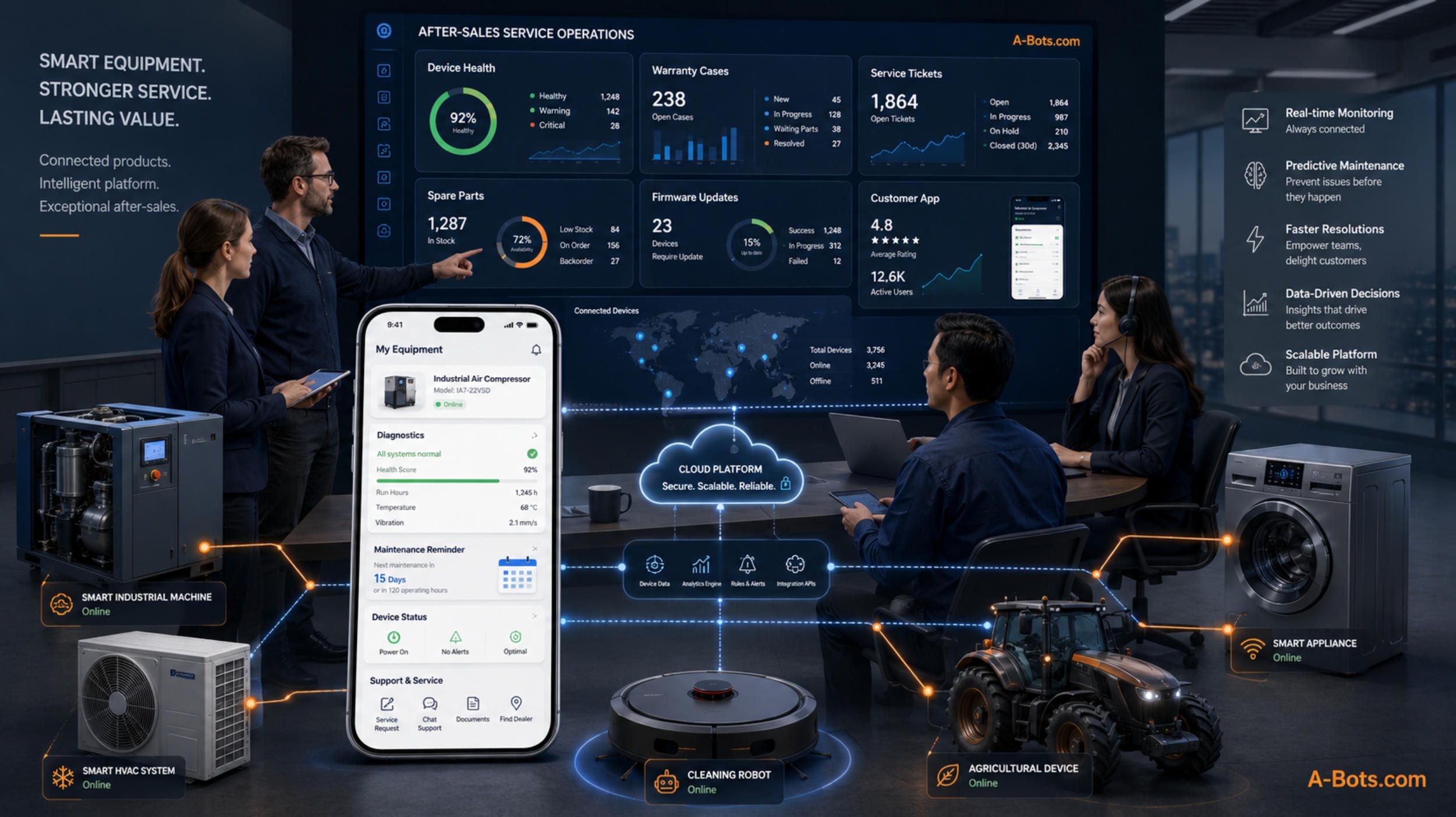
The manufacturer dashboard gives internal teams visibility into device performance, recurring issues, customer behavior, warranty patterns, service quality, and product improvement opportunities.
These interfaces do not need to be built all at once. But they should be considered in the product architecture from the beginning. If the first app is designed only as a remote control, it may be difficult to expand later into service, analytics, and partner workflows.
A-Bots.com can help manufacturers design this architecture in stages. The first stage may be a customer app with device onboarding, control, maintenance reminders, and support requests. The second stage may add diagnostics and warranty. The third stage may add technician workflows, service dashboards, spare parts, AI assistance, and predictive alerts.
This staged approach is usually better than trying to build everything at once. It lets the manufacturer validate business value early while keeping the platform ready for expansion.
8. The role of spare parts, consumables, and recurring revenue
Smart equipment app development is not only about service cost reduction. It can also create revenue.
Many equipment categories depend on parts and consumables: filters, blades, brushes, batteries, pads, belts, nozzles, sensors, cartridges, oils, seals, cleaning fluids, calibration kits, accessories, replacement modules, and maintenance packages. Without a digital channel, the manufacturer often loses this revenue to third-party sellers, distributors, or customer neglect.
A mobile app can recommend parts at the right time based on actual usage, not generic intervals. It can show compatible items for the exact model. It can prevent customers from ordering the wrong part. It can support subscriptions for consumables. It can connect to dealers or e-commerce systems. It can remind customers before performance drops.
For B2B equipment, the app can support fleet-level purchasing. A facility manager can see which machines need replacement parts this month. A dealer can prepare inventory based on installed base data. A service company can plan maintenance kits for upcoming visits.
This is where connected equipment becomes a commercial ecosystem. The initial sale is only the beginning. The app helps the manufacturer participate in the full product lifecycle.
The same logic applies to software features. Some manufacturers may create premium digital services: advanced analytics, fleet dashboards, automated reports, remote diagnostics, predictive maintenance packages, compliance logs, or priority support. Not every product needs a subscription model, but many professional equipment categories can support paid digital services when the value is clear.
9. What makes a smart equipment app technically complex
From the outside, a smart equipment app may look simple. The user opens the app, connects a device, sees status, and receives notifications. Behind that experience, however, there may be a complex engineering system.
A robust app may need Bluetooth Low Energy, Wi-Fi provisioning, cellular IoT integration, MQTT, REST APIs, WebSocket communication, cloud device management, user authentication, firmware update orchestration, offline mode, push notifications, analytics, payments, CRM integration, ERP integration, and service ticket workflows.
For industrial and professional equipment, the complexity grows further. The app may need multi-tenant architecture, role-based permissions, fleet management, geolocation, QR scanning, serial number validation, technician modes, audit trails, compliance records, and integration with third-party systems.
Offline capability is also important. Equipment is often used in warehouses, basements, factories, farms, rooftops, utility rooms, construction sites, remote facilities, and areas with unstable connectivity. A serious app should not become useless when the connection is weak. It should cache essential data, record events locally, and sync safely later.
Another challenge is lifecycle management. A connected product may stay in use for years. During that time, mobile operating systems change, security standards evolve, cloud infrastructure changes, APIs are updated, and new equipment models are released. Smart equipment app development is therefore not a one-time project. It requires long-term support and product thinking.
This is why manufacturers should not treat the app as a small accessory. It is part of the product’s digital infrastructure.
10. A practical roadmap for building a smart equipment after-sales platform
A good roadmap starts with the business model, not the interface. Before designing screens, the manufacturer should define what the app must improve.
Is the goal to reduce support calls? Increase spare parts revenue? Improve warranty control? Add remote diagnostics? Support technicians? Create a premium customer experience? Collect product data for engineering? Enable subscriptions? Improve dealer operations?
Once the goal is clear, the platform can be built in stages.
The first stage is usually the product foundation: user accounts, device registration, onboarding, pairing, basic status, documentation, notifications, and support request creation.
The second stage adds after-sales workflows: warranty, service history, maintenance reminders, diagnostic logs, spare parts recommendations, and customer communication.
The third stage adds operational intelligence: technician app, service dashboard, dealer portal, AI assistant, predictive alerts, fleet analytics, and integrations with CRM, ERP, inventory, or customer support systems.
For many manufacturers, the most effective first release is not the most impressive one. It is the version that solves one expensive problem clearly. For example, reducing support calls by guiding users through safe troubleshooting. Or reducing warranty friction by collecting complete claim data. Or increasing consumables revenue by reminding customers when parts need replacement.
A-Bots.com can support this process from discovery to launch: workflow analysis, UX architecture, iOS and Android development, backend development, IoT integration, AI feature design, dashboard development, quality assurance, security, and post-launch scaling.
11. Why this opportunity is still early
Many manufacturers already understand that they need mobile apps. Fewer understand that the app should become an after-sales service platform. That gap creates an opportunity.
A company that builds only a basic control app may soon look outdated. A company that builds a service-oriented mobile ecosystem can create a stronger customer relationship, better product intelligence, and new revenue channels.
This is especially important for mid-sized manufacturers. Large global brands already invest heavily in connected platforms. Smaller manufacturers may still rely on manuals, dealer calls, email support, and fragmented service records. But custom development is now accessible enough for mid-market companies to build focused, high-value systems without trying to copy enterprise giants.
The key is to avoid overbuilding. A smart equipment app should begin with the workflows that matter most to the product and the customer. For one manufacturer, that may be diagnostics. For another, warranty. For another, consumables. For another, technician service. For another, fleet monitoring.
The competitive advantage comes from matching the app to the real product lifecycle.
The future of smart equipment is after-sales intelligence
Smart equipment is not only hardware with connectivity. It is a product that continues to create value after installation, purchase, or deployment. The manufacturer’s challenge is to turn that ongoing relationship into a structured digital experience.
A custom mobile app can become the center of this experience. It can connect the customer, device, technician, dealer, service team, spare parts system, warranty process, and analytics platform. It can make the product easier to own, easier to maintain, and easier to improve.
For manufacturers, this is not just a technical upgrade. It is a business model shift. The app can reduce service friction, increase customer loyalty, support repairability, improve cybersecurity communication, generate recurring revenue, and provide real-world product intelligence.
The companies that understand this early will not treat mobile apps as accessories. They will treat them as strategic after-sales platforms.
For manufacturers of smart appliances, industrial equipment, robotics, HVAC systems, cleaning machines, agricultural devices, professional tools, energy systems, and connected hardware, the question is no longer whether the product should have an app. The better question is: what kind of after-sales business can the app help build?
A-Bots.com develops custom mobile applications and software ecosystems for companies that need more than a standard interface. For smart equipment manufacturers, that means building the digital layer that keeps the product useful, supported, secure, and commercially valuable long after the first sale.
✅ Hashtags
#SmartEquipmentAppDevelopment
#ConnectedDevices
#IoTAppDevelopment
#AfterSalesService
#CustomMobileAppDevelopment
#EquipmentMaintenance
#SmartDeviceSoftware
#ABotsCom
Other articles
Top 4 Best Movers in Atlanta, GA: Expert Reviews and Local Rankings This article reviews the top 4 best movers in Atlanta, GA through the lens of reputation, customer feedback, service quality, operational maturity, and modern moving standards. Instead of offering a generic list, it analyzes how leading movers handle complex residential and commercial relocations, communication, estimates, claims, and customer trust. The article also highlights a major industry shift: top movers are no longer judged only by trucks and crews, but by digital experience. Mobile apps, CRM systems, virtual surveys, inventory tracking, and claims workflows are becoming signs of a truly premium moving company.
Top 4 Best Movers in Houston: Expert Reviews and Local Rankings This article reviews the top 4 best movers in Houston through reputation signals, customer feedback, service depth, licensing relevance, and operational maturity. It analyzes A Better Tripp Moving & Storage, 3 Men Movers, Johnnie T. Melia Moving & Storage, and Firefighting’s Finest Moving & Storage, showing how each company serves different moving needs. The article also highlights a major industry shift: top movers are increasingly defined not only by crews and trucks, but by digital customer experience. CRM systems, mobile apps, inventory tracking, virtual surveys, dispatch dashboards, and claims workflows are becoming essential tools for premium moving companies.
Top 4 Best Movers in San Antonio: Expert Reviews and Local Rankings This article reviews the top 4 best movers in San Antonio through reputation signals, customer feedback, service range, local credibility, and operational maturity. It analyzes 3 Men Movers, Einstein Moving Company, Swift Movers LLC, and Move Logistics Inc., showing how each company serves different moving needs in a fast-growing relocation market. The article also highlights a major industry shift: top movers are increasingly defined not only by trucks and crews, but by digital customer experience. Mobile apps, CRM systems, virtual surveys, inventory tracking, dispatch dashboards, and claims workflows are becoming essential tools for premium moving companies.
CRM and Mobile App Development for Movers This article explains why App Development for Movers and CRM for Moving Companies are becoming essential for modern relocation businesses. It explores how custom software can improve the entire moving journey - from lead capture, virtual surveys, digital estimates, crew dispatch, and QR inventory to customer apps, claims management, online payments, and analytics. The article shows how mobile apps help customers feel informed and in control, while CRM systems help moving companies reduce errors, improve communication, manage crews, protect reputation, and scale operations. It also positions A-Bots.com as a custom development partner for movers ready to become technology-enabled service brands.
AI Field Service Mobile Apps: Custom Software for Connected Service Operations This article explores why AI field service mobile apps are becoming a strategic software investment for companies that manage technicians, customers, equipment, smart devices, and distributed service operations. It explains how custom mobile apps can connect technician workflows, customer portals, IoT diagnostics, CRM systems, service documentation, payments, warranty logic, and AI-assisted troubleshooting into one operational ecosystem. The article is especially relevant for equipment manufacturers, HVAC companies, smart device brands, repair networks, cleaning businesses, moving companies, and industrial service providers that want to improve field productivity, customer trust, and service intelligence through custom software developed by A-Bots.com.
Top stories

Copyright © Alpha Systems LTD All rights reserved.
Made with ❤️ by A-BOTS