
Home
Services
About us
Blog
Contacts
CRM and Mobile App Development for Movers: How Custom Software Is Changing the Moving Industry
The moving industry is built on trust, logistics, timing, and physical execution. But in 2026, that is no longer enough. Customers still want careful crews, clean trucks, transparent pricing, and safe delivery, but they also expect the same digital clarity they get from banking, food delivery, ride-hailing, healthcare booking, e-commerce, and travel apps. This is why App Development for Movers and CRM for Moving Companies are becoming central business topics for relocation brands that want to grow.
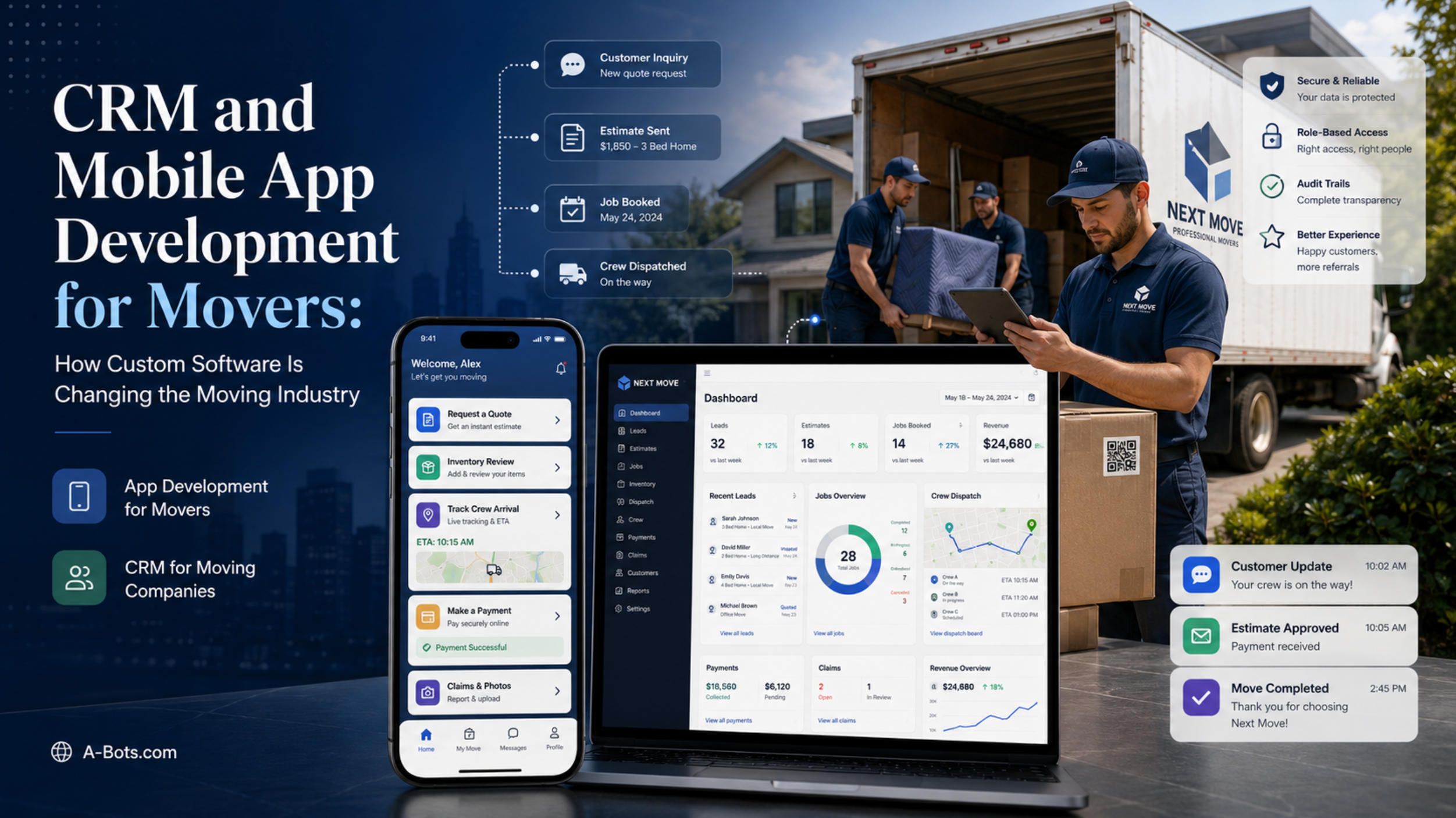
A moving company is not just a team with dollies, blankets, and trucks. It is a complex service operation. Every move includes lead intake, quote preparation, inventory assessment, crew planning, route timing, packing details, customer communication, payment, damage documentation, and sometimes claims. For interstate moves, there is also a regulatory layer: FMCSA states that interstate household goods movers must be registered with the federal government and have a U.S. DOT number. FMCSA also provides consumer guidance through its Protect Your Move program, warning about moving fraud and complaint procedures.
That complexity explains why generic spreadsheets, manual phone calls, disconnected email threads, and paper estimates are no longer enough. CRM for Moving Companies helps the business control the sales and operations pipeline. App Development for Movers gives customers, crews, dispatchers, and managers a real-time digital interface for the entire relocation journey.
The best moving brands of the next decade will not be defined only by who has the strongest crews. They will be defined by who can make the moving process visible, trackable, documented, and easier to trust.
1. Why Movers Need Custom Software Now
The moving market is unusually sensitive to friction. A customer may be changing homes, relocating for work, managing family stress, dealing with deadlines, or coordinating storage and real estate closings. When communication is unclear, trust collapses quickly. A missed call, vague estimate, late crew, broken item, or unresolved claim can turn one move into a public negative review.
This is where CRM for Moving Companies becomes more than a sales tool. It becomes the operational memory of the business. It stores the customer history, lead source, estimate details, inventory notes, crew assignments, documents, payments, claims, and follow-up tasks. Without it, the company depends on individuals remembering details. With it, the company builds a repeatable process.
The software landscape already proves that movers are looking for more structured systems. SmartMoving positions itself as an all-in-one moving software and CRM used by thousands of moving companies. Movegistics promotes moving-company software with CRM, automation, AI-supported estimate comparison, and move-day audit features. Capterra’s moving software category highlights features such as billing, calendar management, communication management, and customer databases as high-value capabilities. (smartmoving.com)
But off-the-shelf systems are not always enough. A small local mover, a regional franchise, a premium white-glove mover, a commercial relocation provider, and a long-distance interstate carrier do not operate the same way. This is why App Development for Movers becomes strategically important. Custom software can be built around the real workflow of the company, not around a generic template.
A moving business usually needs digital tools in four major areas:
- Customer experience: quote requests, virtual surveys, move status, inventory, payment, and claims.
- Internal operations: CRM, dispatch, crew scheduling, route planning, job notes, and documents.
- Field execution: crew app, item photos, QR inventory, signatures, damage notes, and checklists.
- Management: analytics, lead conversion, revenue by crew, claims ratio, cancellation reasons, and customer satisfaction.
That is why CRM for Moving Companies and App Development for Movers should not be treated as separate ideas. The CRM is the brain of the operation. The mobile app is the interface that makes the process usable for customers and crews.

2. What a Customer App for Movers Should Do
The customer side is where App Development for Movers becomes immediately visible. Customers do not want to wonder whether the mover understood the scope of the job. They want proof. They want to upload photos, confirm details, see the estimate, track timing, and know what happens if something goes wrong.
A strong customer app can begin before the estimate. Instead of a basic contact form, the customer can create a move profile: origin address, destination address, move date, property type, elevator access, stairs, parking restrictions, storage needs, specialty items, and packing preferences. The app can guide the customer through a room-by-room inventory and allow photo or video upload.
Virtual surveys are becoming especially important. Industry software providers increasingly emphasize survey apps and remote inventory collection. For example, Mover Survey on the App Store describes itself as an onsite estimating app with inventory, pictures, offline capability, search, and a moving CRM on a tablet. Yembo’s industry content also argues that movers should offer pre-move virtual surveys to build inventory and estimates remotely. (App Store)
For customers, this creates convenience. For movers, it improves quote accuracy. For the business owner, it reduces one of the most expensive problems in moving: underestimating the job.
A well-designed customer app can include:
- Video survey upload and AI-assisted volume estimation.
- Digital estimate approval with clear binding or non-binding language.
- Move-day timeline with crew arrival updates.
- Digital inventory with photos, item notes, and room labels.
- Online payment, tips, receipts, and post-move review requests.
- Claims submission with photos, timestamps, and status tracking.
This is where App Development for Movers creates a visible difference between a modern mover and an old-style mover. One company says, “Call us if you have questions.” Another says, “Everything is in your app: estimate, inventory, arrival window, crew status, payment, and claim history.”
That difference is not cosmetic. It changes customer psychology. Moving is stressful because customers feel a loss of control. App Development for Movers gives some of that control back.
3. What a Crew App Should Do
The crew is where the brand promise becomes reality. A beautiful website and polished sales call mean nothing if the crew arrives without correct instructions. This is why App Development for Movers should never focus only on the customer app. The crew app is just as important.
A moving crew needs practical information, not office clutter. They need to know the address, access conditions, parking notes, stairs, elevator reservation, fragile items, packing scope, disassembly requirements, customer preferences, and time expectations. They also need the ability to document what actually happened on-site.
A crew app should support job check-in, item photos, QR-code labels, condition notes, digital signatures, packing confirmation, damage documentation, and completion status. If the company handles specialty moves, the app should show piano notes, antique-handling instructions, art-packing requirements, safe-moving details, and custom crating instructions.
For the company, this is where CRM for Moving Companies connects directly to field execution. The CRM stores the job. The crew app turns that job into action. When the crew updates the app, the CRM should update automatically.
That integration helps solve a common moving-company problem: the office sells one version of the move, while the crew discovers another version on-site. If the customer said there was one bedroom but actually has a garage full of boxes, the crew app can document the difference immediately. If a dresser was already scratched before loading, the crew can photograph it before the move begins. If the customer adds packing services on-site, the app can record approval and update billing.
This is why CRM for Moving Companies should not be limited to sales follow-up. It should be connected to operations, billing, claims, and service quality. Without that connection, the CRM becomes a digital address book. With that connection, it becomes the operating system of the moving company.
4. How CRM Changes Sales, Dispatch, and Management
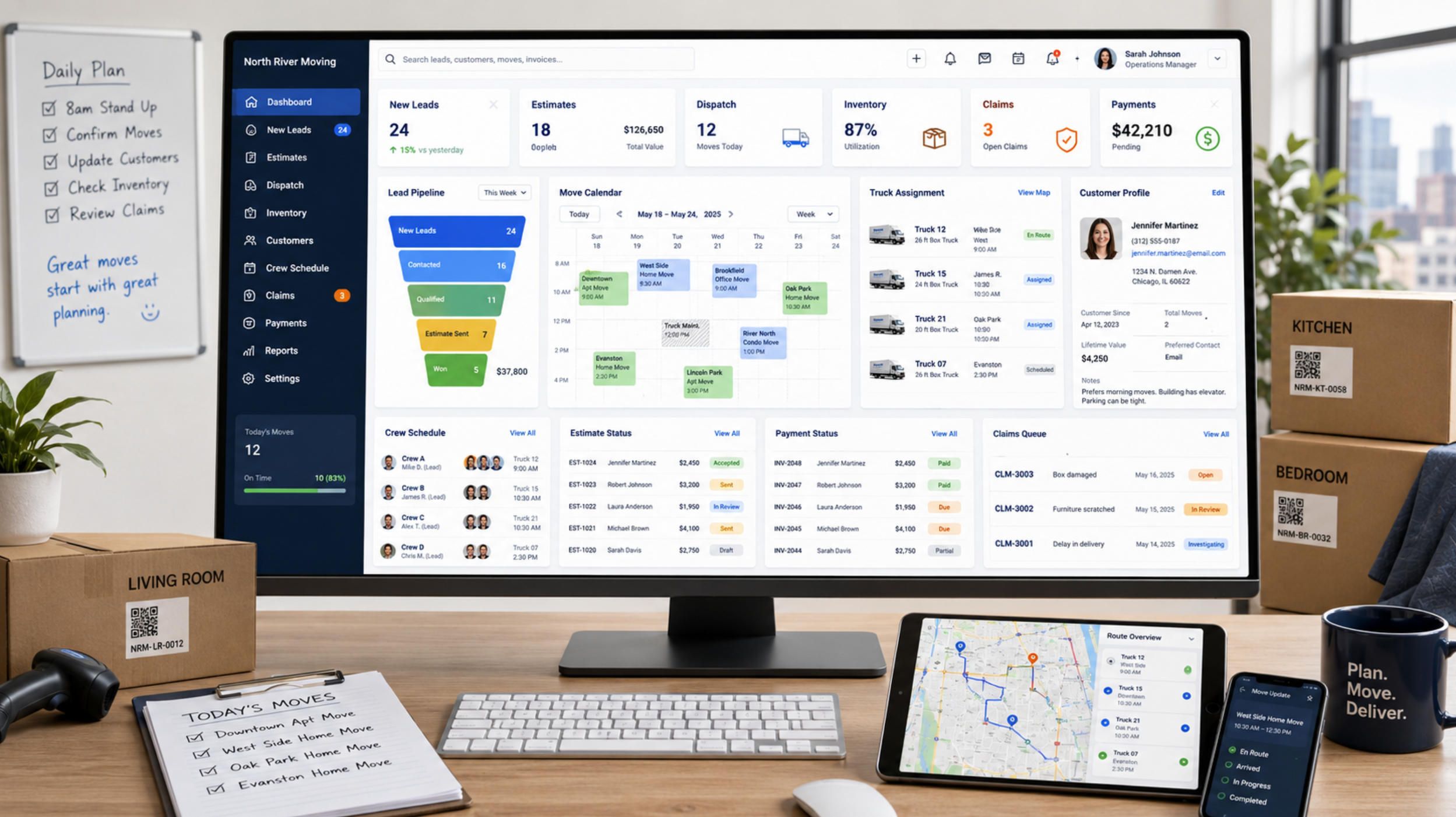
Sales in moving is fast, competitive, and often emotional. The customer may request quotes from several movers in one afternoon. The company that responds quickly, explains pricing clearly, and follows up intelligently has a strong advantage. CRM for Moving Companies is essential because it turns random inquiries into a managed sales pipeline.
A strong CRM should capture leads from the website, Google Ads, organic search, referrals, phone calls, social media, review platforms, and repeat customers. It should show where each lead came from, what services they need, whether they opened the estimate, whether they approved the quote, and what follow-up is needed.
Pipedrive’s 2025 overview of CRM tools for movers notes that moving CRM software helps organize leads, automate scheduling, and improve communication between teams and customers. It also lists platforms such as Pipedrive, SmartMoving, Supermove, Movegistics, and MoversTech CRM as options in the category. (Pipedrive)
However, many movers eventually discover that generic CRM logic does not fully match moving operations. A move is not a simple sales deal. It is a scheduled service with inventory, labor, trucks, access conditions, materials, regulations, payments, and claim exposure. That is why custom CRM for Moving Companies can be much more powerful than a generic pipeline.
A custom CRM can include:
- Lead scoring by move size, distance, service type, date, and revenue potential.
- Estimate management with virtual survey data and inventory records.
- Dispatch calendar with trucks, crews, skills, and availability.
- Document storage for certificates, valuation forms, contracts, and receipts.
- Claims workflow with deadlines, internal responsibility, and customer updates.
- Reporting on conversion rate, average job value, crew performance, claims rate, and repeat business.
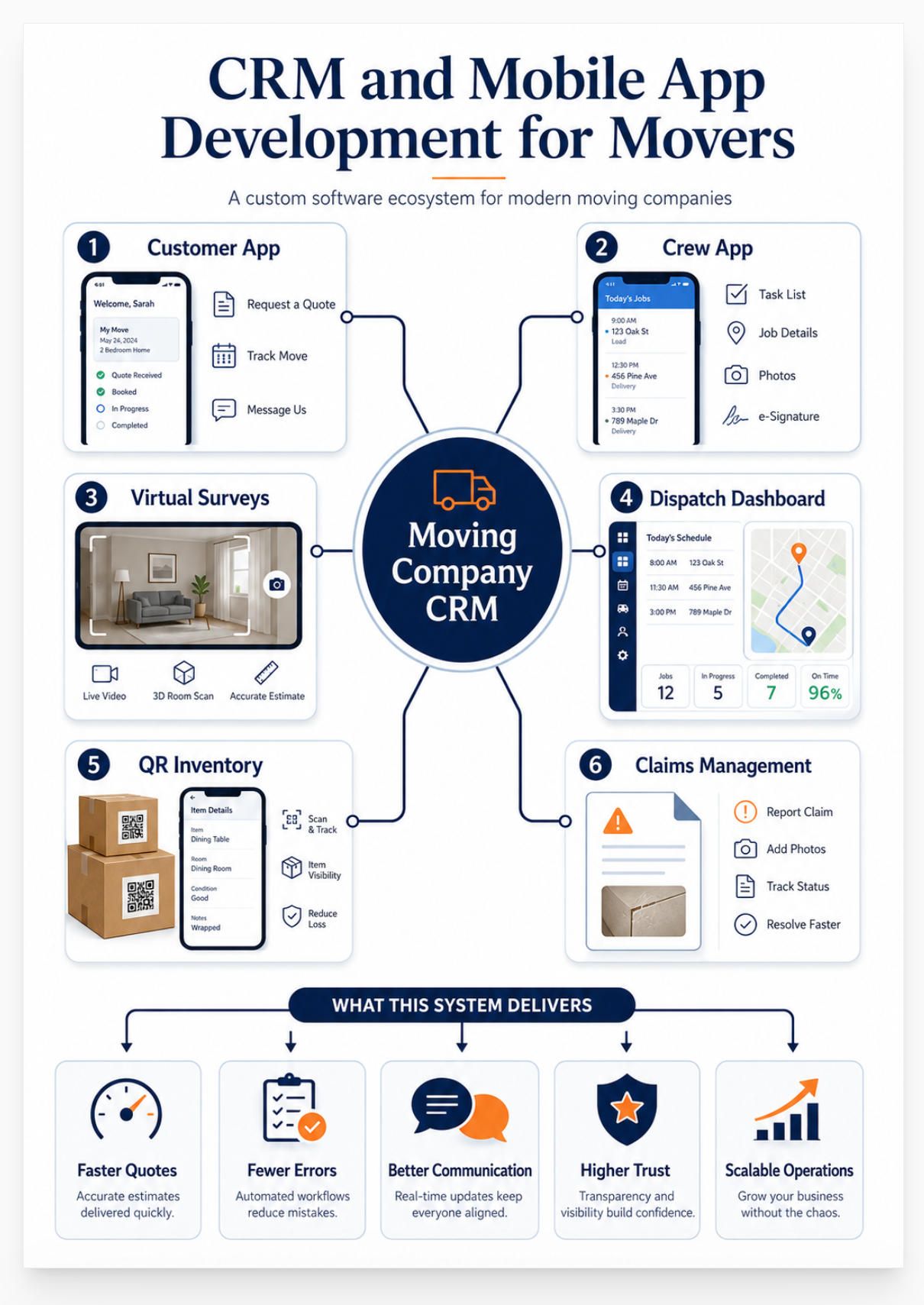
This is also where App Development for Movers and CRM design should be planned together. The customer app collects data. The CRM organizes it. The dispatch dashboard assigns resources. The crew app executes the move. Management analytics reveal what is profitable and what is broken.
A company without this structure may still complete moves. But it will struggle to scale without losing control.
5. Why Claims Management Should Be Built Into the System
Claims are one of the most sensitive parts of moving. Customers rarely judge a mover only by whether something broke. They judge the mover by how the company responds. If there is silence, confusion, or slow communication, the customer feels ignored.
FMCSA explains that it does not resolve claims against moving companies, although it provides complaint resources and guidance for consumers who believe they have been victims of fraud or poor conduct. The Washington Post also reported in 2025 that moving scams and disputes remain a serious consumer issue, especially when brokers misrepresent themselves or pass jobs to third parties.
This is a major reason CRM for Moving Companies must include claims management. A claim should not live in someone’s inbox. It should become a structured workflow: item, photo, customer statement, crew notes, valuation coverage, internal reviewer, deadline, decision, payment, repair, denial, or escalation.
The customer app should also show claim status. Even if the company cannot immediately resolve the issue, the customer should see that the claim was received, assigned, reviewed, and updated. Transparency reduces frustration.
This is one of the strongest business arguments for App Development for Movers. A mover that documents inventory, condition, photos, customer approvals, and claim history has a better chance of resolving disputes fairly. It can also identify recurring problems: one crew has more damage claims, one truck has equipment issues, one type of move generates more complaints, or one estimator consistently underquotes jobs.
In other words, claims management is not only customer service. It is business intelligence.
6. Why Custom Development Can Beat Off-the-Shelf Software
There are already many software products for movers. SmartMoving, Supermove, Movegistics, MoveitPro, Elromco, QuickMove, and other platforms all serve parts of the industry. Some companies need exactly that: a ready platform with standard features. But growing movers often reach a point where generic tools become restrictive.
Supermove’s own software guide describes different moving software options and compares categories such as CRM-focused solutions and broader operational platforms. Movegistics published a 2026 comparison of moving-company software solutions including Movegistics AI, SmartMoving, Supermove, Chariot, and MoveitPro. (supermove.com)
The problem is not that SaaS platforms are bad. The problem is fit. A mover may need bilingual workflows, special commercial relocation logic, franchise reporting, custom pricing rules, local regulatory forms, storage-unit integrations, claims automation, crew compensation tracking, or a customer app that reflects its own brand.
This is where A-Bots.com can create a stronger solution. App Development for Movers allows the company to own the customer experience. CRM for Moving Companies allows the business to own its operating logic. Instead of bending the company around software, the software is built around the company.
Custom development is especially relevant when a mover has outgrown basic tools, wants a branded mobile app, needs integrations, or wants software as a competitive differentiator. A premium mover should not look identical to every competitor using the same template. Its app, customer journey, estimate logic, and operational dashboards should reflect its own service model.
A-Bots.com can build:
- Customer mobile apps for iOS and Android.
- Crew apps for field teams.
- Custom CRM and sales pipelines.
- Dispatch dashboards.
- Inventory and QR-code systems.
- Virtual survey modules.
- Claims management workflows.
- Payment and document automation.
- Analytics dashboards for owners and managers.
- Integrations with websites, call tracking, maps, accounting, review tools, and marketing platforms.
That is the strategic value of App Development for Movers. It is not just an app. It is a digital service layer. And the strategic value of CRM for Moving Companies is not just storing leads. It is creating a controlled, measurable, scalable moving operation.
7. What the Customer Feels When a Mover Has an App
From the customer’s perspective, the difference is simple. A traditional mover may feel like a black box. The customer asks for a quote, waits for a call, receives an estimate, wonders if the inventory is correct, waits for crew arrival, signs paper forms, and hopes nothing goes wrong.
A mover with a well-designed app feels different. The customer can see the move plan. They can upload room videos. They can approve the estimate. They can check the arrival window. They can review inventory. They can pay online. They can submit feedback. If there is a claim, they can document it properly.
That experience creates trust before the move even begins.
This is why App Development for Movers has a marketing effect as well as an operational effect. The app becomes a signal: this mover is organized, transparent, and serious. In a market where many customers fear scams, surprise charges, and poor communication, that signal matters.
A customer app also helps premium movers justify premium pricing. Customers are more willing to pay for a company that looks controlled, documented, and professional. The app does not replace the crew. It makes the crew’s professionalism more visible.
8. What the Moving Company Gains
For the moving company, the benefits are even broader. CRM for Moving Companies can improve lead conversion because every inquiry is tracked and followed up. It can reduce lost opportunities because sales teams know who needs a call, who needs an estimate, and who is ready to book. It can improve management because owners can see revenue, conversion, crew productivity, and claims trends.
App Development for Movers can reduce manual communication, because customers no longer need to call for every update. It can reduce disputes, because inventory and item condition are documented. It can improve crew performance, because teams arrive with clearer instructions. It can improve reviews, because customers experience a smoother process.
The deeper advantage is scalability. A mover can be excellent at 20 moves per month using manual systems. At 200 moves per month, manual systems become fragile. At 500 moves per month, they become dangerous. Growth exposes every weak process.
This is why CRM for Moving Companies is a growth infrastructure, not just software. It creates consistency. And consistency is the foundation of a scalable service brand.
9. The A-Bots.com Approach: Custom Software Built Around Real Moving Operations
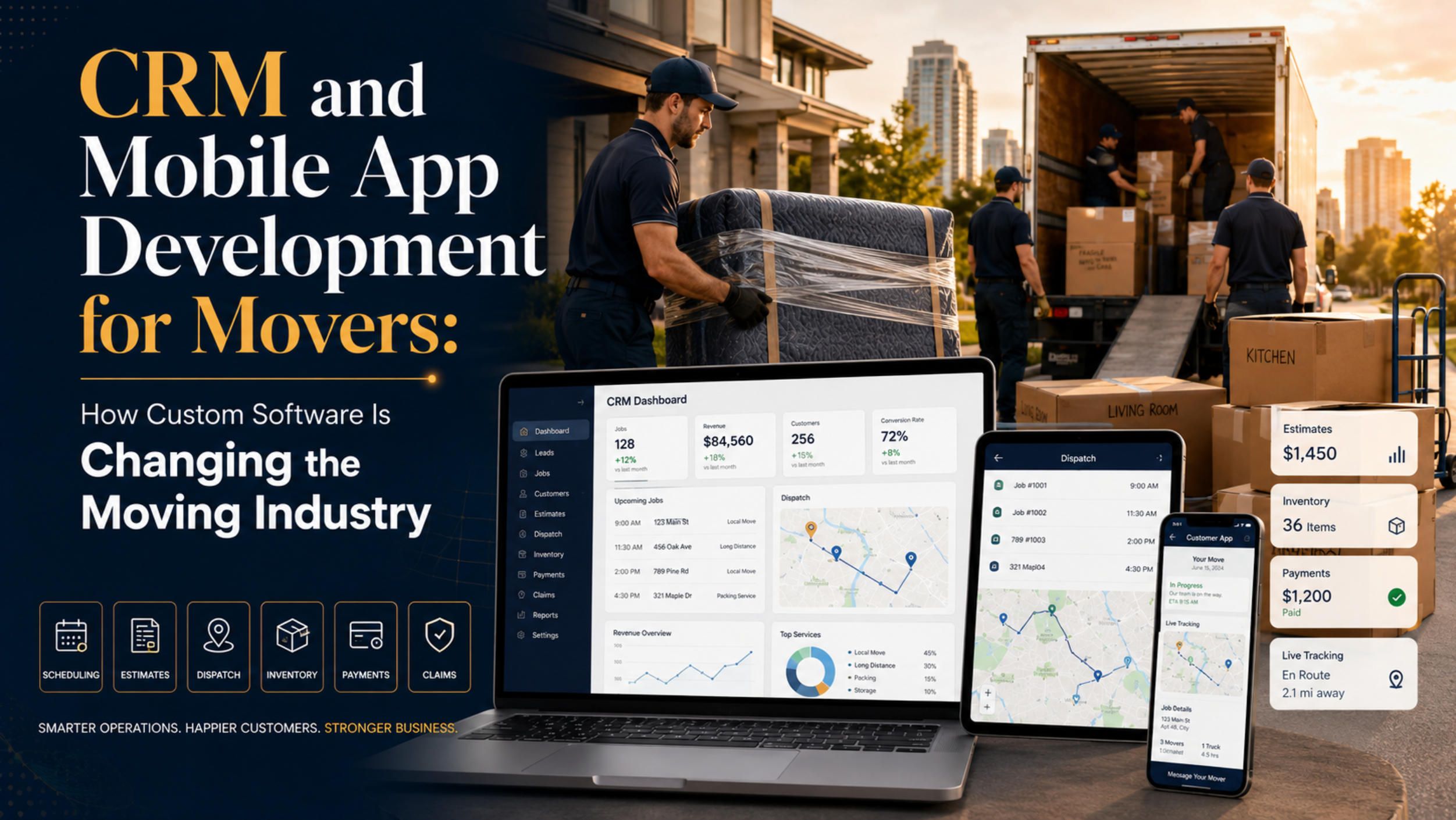
A-Bots.com is not offering movers another generic dashboard with a moving-truck icon. The real opportunity is to design software around how a moving company actually sells, estimates, dispatches, moves, documents, bills, and supports customers.
For some companies, the first step may be a customer app. For others, it may be CRM modernization. For larger movers, it may be a full platform: CRM, customer app, crew app, dispatch, inventory, claims, analytics, and integrations.
The strongest projects usually begin with workflow mapping. How does a lead enter the business? How is an estimate created? Who confirms inventory? How are crews assigned? What documents are required? Where do mistakes happen? What generates complaints? Which manual tasks consume the most time?
From there, A-Bots.com can design CRM for Moving Companies that reflects the company’s real process. Then it can deliver App Development for Movers that turns that process into a polished digital experience for customers and crews.
The result is not technology for technology’s sake. It is a better moving business.
Movers That Digitize the Experience Will Win More Trust
The moving industry will always depend on people. No app can carry a piano, protect a marble table, or calm a stressed customer at the door. But software can make the whole operation more reliable, transparent, and scalable.
That is why App Development for Movers and CRM for Moving Companies are becoming essential for serious relocation brands. Customers want visibility. Crews need clarity. Dispatchers need control. Owners need data. And the company needs a system that protects trust at every stage of the move.
The movers that continue relying only on phone calls, paper notes, disconnected spreadsheets, and manual follow-ups may still survive. But the movers that invest in custom software can create a different level of customer experience.
They can quote faster. Communicate better. Document more accurately. Dispatch smarter. Resolve claims more professionally. Protect their reputation. And grow without turning operations into chaos.
For moving companies ready to become premium, technology-enabled brands, A-Bots.com can build the custom CRM and mobile app ecosystem that makes that transition real.
✅ Hashtags
#AppDevelopmentForMovers
#CRMForMovingCompanies
#MovingSoftware
#MoverCRM
#MovingApp
#CustomSoftwareDevelopment
#MobileAppDevelopment
#ABotsCom
Other articles
CRM and Mobile App Development for Cleaning Companies The cleaning industry is moving beyond spreadsheets, disconnected SaaS tools, and generic field service platforms. This article examines the 2026 software landscape for cleaning companies, comparing cleaning-specific platforms, general field service systems, commercial janitorial tools, and the strategic role of custom CRM and mobile app development. It explains when off-the-shelf software is enough, when hybrid architecture becomes smarter, and why larger cleaning operators eventually need branded customer apps, field-employee mobile tools, property-manager portals, multilingual workflows, and IoT-aware integrations. The article also shows how A-Bots.com helps cleaning businesses build software stacks they actually own.
Top 4 Best Movers in Charlotte Charlotte is one of the fastest-growing cities in the United States, adding over 157 new residents every single day. That kind of growth means serious, year-round demand for professional movers. This guide reviews the four best movers in Charlotte, NC — Hornet Moving, Reign Moving Solutions, Two Men and a Truck Charlotte, and All My Sons Moving & Storage — based on verified ratings across Google, Yelp, BBB, and Angi, confirmed FMCSA SAFER credentials, and real customer feedback. Each company is evaluated on pricing transparency, crew quality, licensing, and customer experience across local and long-distance moves.
Top 4 Best Movers in Atlanta, GA: Expert Reviews and Local Rankings This article reviews the top 4 best movers in Atlanta, GA through the lens of reputation, customer feedback, service quality, operational maturity, and modern moving standards. Instead of offering a generic list, it analyzes how leading movers handle complex residential and commercial relocations, communication, estimates, claims, and customer trust. The article also highlights a major industry shift: top movers are no longer judged only by trucks and crews, but by digital experience. Mobile apps, CRM systems, virtual surveys, inventory tracking, and claims workflows are becoming signs of a truly premium moving company.
Top 4 Best Movers in Houston: Expert Reviews and Local Rankings This article reviews the top 4 best movers in Houston through reputation signals, customer feedback, service depth, licensing relevance, and operational maturity. It analyzes A Better Tripp Moving & Storage, 3 Men Movers, Johnnie T. Melia Moving & Storage, and Firefighting’s Finest Moving & Storage, showing how each company serves different moving needs. The article also highlights a major industry shift: top movers are increasingly defined not only by crews and trucks, but by digital customer experience. CRM systems, mobile apps, inventory tracking, virtual surveys, dispatch dashboards, and claims workflows are becoming essential tools for premium moving companies.
Top 4 Best Movers in San Antonio: Expert Reviews and Local Rankings This article reviews the top 4 best movers in San Antonio through reputation signals, customer feedback, service range, local credibility, and operational maturity. It analyzes 3 Men Movers, Einstein Moving Company, Swift Movers LLC, and Move Logistics Inc., showing how each company serves different moving needs in a fast-growing relocation market. The article also highlights a major industry shift: top movers are increasingly defined not only by trucks and crews, but by digital customer experience. Mobile apps, CRM systems, virtual surveys, inventory tracking, dispatch dashboards, and claims workflows are becoming essential tools for premium moving companies.
Top stories

Copyright © Alpha Systems LTD All rights reserved.
Made with ❤️ by A-BOTS