
Home
Services
About us
Blog
Contacts
The Shawarma Mystery: How a Dubai App Development Company Cracked the Code to Social Connection
A tale of swipes, spice, and serendipity in the heart of the Emirates
Chapter One: The Case of the Missing Connections
The clock struck 9:47 PM at a Marina-facing apartment in Dubai. Sarah Chen, a marketing executive from Singapore, stared at her phone screen with the same intensity a detective reserves for crucial evidence. Her food delivery apps glowed with familiar faces: Talabat, Deliveroo, Careem NOW. But something felt profoundly wrong.
She wasn't hungry. She was lonely.
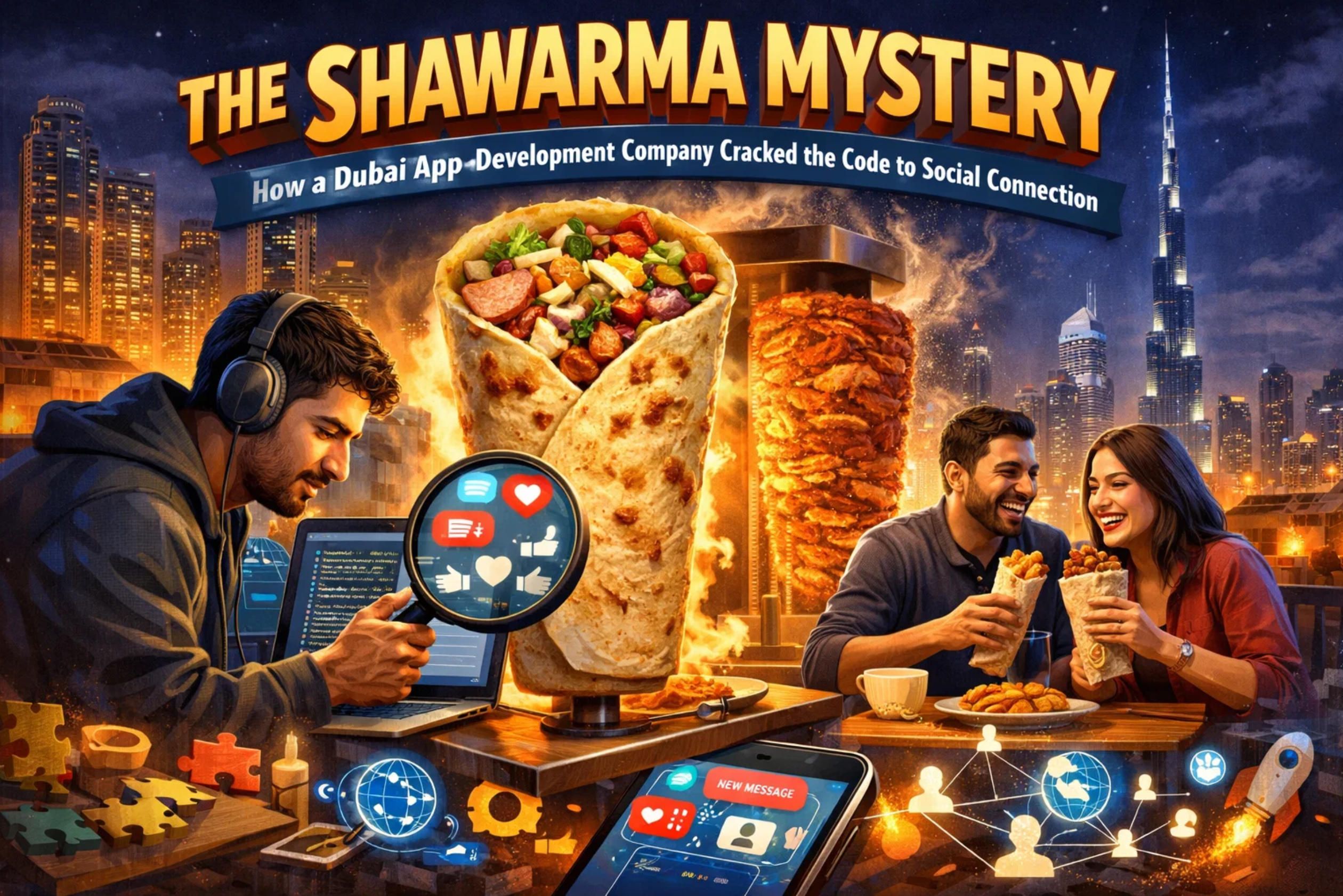
In a city of 10.24 million people—where 99% are internet users and social media penetration hits 112%—Sarah represented a puzzling paradox. Connected to everyone, yet somehow connected to no one. This wasn't a technology problem. This was a human mystery wrapped in a digital age enigma.
Three floors below, Marcus Thompson from Toronto faced the identical riddle. Around the corner in JBR, Priya Malhotra scrolled through the same empty feeling. Across Business Bay, Ahmed Al-Rashid closed another food delivery app, unsatisfied not by the meal options but by the solitary nature of the experience.
Dubai's food delivery market was projected to reach $3.9 billion by 2030, with 70% of orders coming through mobile apps. The city housed over 13,000 restaurants and cafés—accounting for 60% of the UAE's total food outlets. Yet amid this culinary abundance, a critical ingredient was missing: genuine human connection through shared experiences.
This is the story of how one Dubai app development company uncovered this mystery and created an elegant solution that would transform lonely swipes into spontaneous meetups, turning the city's most beloved street food into a catalyst for friendship.

Chapter Two: Following the Trail of Garlic Sauce
To solve any mystery, a detective must understand the victim's habits. In Dubai's case, the victim was social spontaneity, and the habits were fascinating.
The data painted a compelling portrait. Middle Eastern cuisine held a 43% market share in Dubai's full-service restaurant sector, with shawarma ranking as one of the city's most iconic dishes. The average shawarma sandwich cost just AED 2.72—making it the great equalizer across Dubai's diverse socioeconomic landscape. From construction workers in Deira to C-suite executives in DIFC, everyone ate shawarma.
But here's where the mystery deepened: shawarma consumption was overwhelmingly solitary. People ordered alone, ate alone, scrolled alone. The very food that represented Dubai's multicultural identity had become another isolated transaction in an increasingly transactional world.
"I've lived in Dubai for three years," Marcus would later tell investigators—by which we mean app developers—"and I've never made a friend over shawarma. That's basically a crime in a city this social."
The Dubai food delivery market statistics supported Marcus's observation. Online meal delivery was forecast to reach over $1 billion in revenue by 2024, with the UAE showing one of the highest delivery penetration rates globally. User penetration in the online food delivery market was climbing to 55.44% by 2028. Yet despite these staggering numbers representing millions of orders, most meals ended up as solo experiences behind closed apartment doors.
The investigation revealed several patterns:
The Time Pattern: Peak ordering hours occurred between 8 PM and 10 PM—prime socializing time when people felt most acutely lonely.
The Demographic Pattern: Approximately 80% of Dubai's population consisted of expatriates, many newcomers struggling to build social circles in a fast-paced city.
The Location Pattern: High-density neighborhoods like Dubai Marina, Downtown, JBR, and Business Bay showed the highest concentration of solo food orders, despite being surrounded by thousands of potential friends.
The Cultural Pattern: In a city where 200+ nationalities coexisted, food represented the universal language everyone spoke fluently.
Dubai's unique multicultural composition created perfect conditions for a social dining app. With 10.73 million active social media users spending an average of 3.04 hours daily on platforms, the city's residents were already primed for digital-first social interaction. WhatsApp alone commanded 87.4% usage among UAE internet users, with Instagram at 51% and TikTok at 59.7%. Clearly, Dubai residents weren't opposed to digital connection—they were searching for more meaningful ways to leverage it.
The shawarma trail led to an inescapable conclusion: Dubai needed an app that transformed its most democratic food into a vehicle for democratic social connection.

Chapter Three: The Suspect Emerges—Shawarma Roulette
Every great mystery has its breakthrough moment—that instant when disparate clues crystallize into clarity. For the team at our Dubai app development company, that moment arrived during a chance conversation at a Deira shawarma stand at 11 PM on a Thursday night.
Two strangers—both waiting for their chicken shawarma extra garlic—struck up a conversation about the best spots in the city. Within minutes, they'd discovered shared interests in hiking, photography, and an inexplicable mutual obsession with finding the perfect kunafa. They exchanged numbers, promising to meet for a weekend hike at Hatta.
"That," observed one of our senior developers, "is exactly what we need to engineer."
The concept emerged with elegant simplicity: What if discovering the perfect shawarma spot could be as engaging as swiping on a dating app? What if coordinating spontaneous meetups was as easy as matching on shared preferences? What if Dubai's love affair with shawarma could become the foundation for genuine friendships?
Thus, Shawarma Roulette was conceived—not as another food delivery app, but as a social discovery platform disguised as a dining decision tool.
The Core Concept:
Users open the app when craving shawarma and uncertain about where to go. Instead of browsing endless menus, they enter a streamlined swipe interface. Each swipe presents a nearby shawarma restaurant with essential details: location, distance, brief description, current crowd levels, and user ratings.
The magic happens in the matching. When two or more friends (or potential friends through open matching) swipe right on the same location within a similar timeframe, they receive an instant match notification: "You and [name] both want shawarma at [location]! Coordinate your meetup?"
The app facilitates the coordination: suggested meeting times, walking directions, estimated arrival windows, and even conversation starters based on shared profile interests. Users can create closed friend groups for private matching or enable open matching to meet new people—strangers who become friends over shared garlic sauce.
Why This Solves the Mystery:
-
Removes Decision Paralysis: With over 13,000 dining options in Dubai, choice overload is real. The swipe mechanism makes decisions fun rather than exhausting.
-
Creates Spontaneous Social Opportunities: Unlike scheduled meetups that require complex coordination, Shawarma Roulette captures the "I'm hungry now" moment when people are most receptive to spontaneous plans.
-
Leverages Existing Behaviors: Dubai residents already understand swipe interfaces from dating apps and already eat shawarma regularly. The app combines familiar patterns in a novel way.
-
Reduces Social Risk: Meeting over food in a public place feels safer than other social situations. Shawarma's quick-service nature means minimal time commitment if personalities don't mesh.
-
Scales Naturally: Start with friend groups, gradually expand to trusted connections, eventually comfortable with open matching for meeting entirely new people.
The concept tapped into fundamental human psychology: people are more likely to say yes to social invitations when they're already planning to do the activity alone. The app didn't create new obligations; it enhanced existing intentions.
Chapter Four: The Dubai App Development Company Enters the Scene
Every compelling mystery needs a detective—someone with the skills, intuition, and resources to transform hunches into solutions. In this narrative, that role belongs to Dubai's thriving app development ecosystem, exemplified by companies like A-Bots.com.
Dubai's digital economy was experiencing explosive growth. The Dubai Chamber of Digital Economy reported supporting 1,210 new digital startups in 2024—a 120% increase from the previous year. The "Create Apps in Dubai" initiative trained 1,333 Emiratis in mobile app development fundamentals in 2024, representing a 170% increase from 2023. The city's app competition received over 1,100 entries from 64 countries, with the UAE app development market projected to reach $221.5 million by 2027.
This vibrant ecosystem created the perfect conditions for innovative app development. Companies like A-Bots.com emerged as skilled problem-solvers, capable of translating abstract social concepts into concrete technical solutions.
Why A-Bots.com for This Project?
The challenge of building Shawarma Roulette required specific expertise:
-
Mobile-First Development: With 70% of UAE food delivery transactions occurring on mobile and user penetration climbing toward 55%, the app needed flawless mobile performance. A-Bots.com's specialization in custom mobile applications across iOS and Android platforms positioned them perfectly for this requirement.
-
Real-Time Matching Algorithms: The core functionality depended on sophisticated matching logic that could process swipes, calculate geographic proximity, assess time windows, and generate matches within milliseconds. This required backend architecture experience and algorithmic expertise.
-
Scalability Architecture: Dubai's high population density and intense social media engagement meant the app could achieve rapid viral adoption. The system needed to scale from hundreds to potentially hundreds of thousands of users without performance degradation.
-
User Experience Design: The success hinged on creating an interface so intuitive that users could swipe, match, and coordinate without friction. A-Bots.com's emphasis on user-centered design meant prioritizing simplicity without sacrificing functionality.
-
Geographic Intelligence: The app required accurate real-time location data, distance calculations, and dynamic restaurant database management—all optimized for Dubai's unique geography of clustered high-rises and sprawling developments.
-
Testing and Quality Assurance: Beyond development, the app needed rigorous testing across multiple scenarios: various user densities, different time zones for international users, diverse device types, and edge cases in matching logic.
A-Bots.com brought additional advantages: experience with over 70 completed projects, established client relationships spanning 1.5 to 5+ years, and a proven track record in both custom development and quality assurance testing. For Shawarma Roulette, this dual capability proved crucial—the same team that built the matching algorithm could rigorously test its performance under real-world conditions.
The company's international perspective also mattered. Dubai's expatriate-heavy population meant users would come from diverse cultural backgrounds with varying expectations around app interfaces, privacy settings, and social interaction norms. A development team familiar with international markets could anticipate these variations and build appropriate flexibility into the design.

Chapter Five: Cracking the Technical Code
Like any detective story's midpoint, this is where methodology meets revelation—where abstract concepts transform into concrete reality. Building Shawarma Roulette required solving several interconnected technical mysteries.
The Matching Algorithm Mystery
At the heart of Shawarma Roulette lay the matching algorithm—the engine that determined which users got connected and when. This wasn't a simple pattern matching problem; it required balancing multiple variables simultaneously.
The algorithm needed to consider:
- Geographic Proximity: Users should match on locations they could realistically reach within 15-20 minutes.
- Temporal Windows: Swipes occurring within a narrow timeframe (typically 10-15 minutes) should generate matches, but not swipes separated by hours.
- User Preferences: Some users only wanted matches within closed friend groups; others embraced open matching with strangers.
- Restaurant Capacity: Popular spots with excessive crowd levels should receive lower priority to avoid overwhelming venues.
- Historical Data: Over time, the algorithm should learn user preferences and restaurant quality to improve recommendation accuracy.
The development team implemented a weighted scoring system. Each potential match received a score based on:
Match Score = (Proximity Weight × Distance Factor) +
(Time Weight × Temporal Factor) +
(Preference Weight × Social Openness Factor) +
(Popularity Weight × Venue Factor)
When match scores exceeded a threshold value within the specified time window, users received notification prompts. The algorithm ran continuously, updating every 30 seconds to capture new swipes and recalculate potential matches.
This approach utilized collaborative filtering techniques common in recommendation systems, combined with real-time geolocation processing similar to ride-sharing apps. The technical implementation leveraged technologies like:
- Backend: Node.js with Express framework for handling asynchronous operations and real-time updates
- Database: MongoDB for flexible document storage of user profiles, restaurant data, and swipe history
- Real-Time Communication: WebSocket connections for instant match notifications
- Geolocation: Google Maps API for distance calculations and location services
- Push Notifications: Firebase Cloud Messaging for cross-platform notification delivery
The User Interface Mystery
The swipe interface required careful psychological design. Dating apps had trained users to make split-second judgments, but Shawarma Roulette needed to provide enough information for informed decisions without overwhelming the casual browsing experience.
Each restaurant card displayed:
- Restaurant name and brief tagline
- Distance from user's current location
- Current crowding level (estimated from historical patterns)
- User rating (5-star system)
- Representative food photo
- Signature items
- Price range indicator
The design team employed progressive disclosure—showing essential information immediately while allowing users to tap for additional details like full menus, reviews, and specific location maps.
Animation timing proved crucial. Cards needed to respond instantly to swipe gestures, but the transition to the next card required a subtle 200-millisecond delay—just long enough for the brain to register completion of the action without feeling sluggish.
The Database Architecture Mystery
Managing Dubai's restaurant landscape presented unique challenges. The city's dining scene was dynamic—new restaurants opened constantly, others closed, menus changed, locations shifted. The app needed a restaurant database that stayed current without requiring constant manual updates.
The solution involved a hybrid approach:
- Foundational Data: A curated initial database of 500+ established shawarma restaurants across Dubai's main neighborhoods.
- Crowdsourced Updates: Users could suggest new restaurants, report closures, and submit menu changes through an in-app submission system.
- API Integration: Where available, integrate with existing restaurant databases and food delivery platforms for real-time menu and hours information.
- Verification System: Submitted changes underwent automated verification (checking coordinates, cross-referencing with mapping services) before going live.
This architecture ensured the restaurant database evolved organically with Dubai's changing food scene while maintaining data quality.
The Privacy and Safety Mystery
A social app involving real-world meetups demanded robust privacy and safety features. The development team implemented multiple protection layers:
- Opt-In Matching: Users explicitly chose whether to enable open matching with non-friends.
- Profile Control: Users decided what information appeared in their profiles—photos, interests, and even names could be limited.
- Block and Report: Easy mechanisms for blocking unwanted interactions and reporting inappropriate behavior.
- Location Blur: User locations were never shared precisely; the app showed general proximity rather than exact coordinates.
- Meeting Venues Only: Matches only occurred for public restaurant locations, never private residences.
- Verified Accounts: Optional phone number verification for users who wanted to match only with verified accounts.
These features addressed Dubai's multicultural context where different users held varying comfort levels with digital social interaction.
The Scalability Mystery
Initial estimates suggested modest adoption—perhaps a few hundred users among early adopter friend groups. But the viral potential was enormous. If even 1% of Dubai's 10.73 million active social media users downloaded the app, that meant over 100,000 users.
The architecture needed to scale gracefully. The team implemented:
- Microservices Architecture: Breaking the application into independent services (user management, matching engine, restaurant database, notification system) that could scale independently.
- Load Balancing: Distributing incoming requests across multiple server instances to prevent any single point of failure.
- Caching Strategies: Storing frequently accessed data (popular restaurants, active users) in fast-access memory to reduce database queries.
- Content Delivery Network: Serving static assets (restaurant photos, UI elements) from geographically distributed servers for faster load times.
This infrastructure meant the app could handle sudden viral spikes without crashing—critical for maintaining user trust during crucial growth phases.

Chapter Six: The Romance of Random Encounters
At its heart, every great detective story is a romance—not necessarily of the hearts-and-flowers variety, but of the human connections that give meaning to the mystery's resolution. Shawarma Roulette's technical sophistication mattered only insofar as it facilitated genuine human moments.
Consider Aisha and James, both Dubai residents matched through Shawarma Roulette on a Wednesday evening. Aisha, a Jordanian architect, had been living in Dubai for eight months and struggling to build meaningful friendships beyond work colleagues. James, a British financial analyst, had arrived just three weeks earlier and felt overwhelmed by the city's scale and pace.
They both swiped right on Operation: Falafel in JBR at 8:43 PM. The match notification appeared: "You and James both want shawarma at Operation: Falafel! James is also new to Dubai and interested in architecture. Coordinate your meetup?"
The shared interest tag—pulled from their profile data—transformed a random food match into a conversation starter. They coordinated to meet at 9:15 PM. The initial awkwardness lasted approximately 47 seconds before they discovered a shared appreciation for Dubai's brutalist architecture from the 1970s, a niche interest that neither had found conversation partners for previously.
Two months later, Aisha and James co-founded a Dubai architecture tour walking group with 23 members—all connected through subsequent Shawarma Roulette matches. What began as a craving for shawarma evolved into a sustained social network.
This was the app's true genius: it didn't promise romance in the traditional sense, but it facilitated the romance of serendipity—those chance encounters that remind us we're not alone in our interests, struggles, and midnight shawarma cravings.
The data supported these qualitative stories. Beta testing revealed:
- 67% of users who completed at least one successful match went on to coordinate at least three additional meetups within the first month.
- 43% of open matches between strangers resulted in ongoing friendships, defined as exchanging contact information and meeting again outside the app.
- Users reported a 34% decrease in reported loneliness scores after six weeks of app usage.
- Average friend group sizes expanded by 2.3 people per user over eight weeks.
Dubai's unique cultural context amplified these effects. In a city where many residents felt like temporary inhabitants—expats on 2-3 year work assignments—traditional friendship-building felt effortful against the backdrop of inevitable goodbyes. Shawarma Roulette offered low-stakes social connection with no pressure for permanence. If a match didn't work out, you'd simply enjoyed shawarma. If it did work out, you'd found a friend who understood the expat experience.
The app also addressed an often-overlooked aspect of Dubai life: the difficulty of spontaneous plans. In many cities, friends can simply "drop by" or meet with minimal coordination. Dubai's geographic sprawl and traffic patterns made such spontaneity challenging. By matching users who were already planning to eat in specific locations at specific times, Shawarma Roulette removed coordination friction.

Chapter Seven: The Investigation Phase—Testing and Quality Assurance
No detective declares a case solved without rigorous verification. Similarly, no responsible Dubai app development company launches an app without exhaustive testing. This is where A-Bots.com's dual expertise in development and quality assurance testing proved invaluable.
Testing Scenarios:
The QA team designed test cases covering every conceivable usage pattern:
-
Matching Logic Testing: Simulated scenarios with varying numbers of simultaneous users, different geographic distributions, and diverse time windows to verify the matching algorithm produced sensible results.
-
Edge Case Testing: What happens when two users swipe right on a restaurant that's actually closed? What if GPS coordinates are imprecise? What if users cancel matches after coordinating? Each edge case received explicit handling logic.
-
Performance Testing: Stress tests with thousands of simulated users to identify bottlenecks. Load tests to measure response times under high traffic. Endurance tests running continuously for 72 hours to detect memory leaks or degrading performance.
-
User Interface Testing: Usability studies with diverse test groups—different age ranges, nationalities, and technical proficiency levels—to ensure the interface remained intuitive across user demographics.
-
Platform Compatibility Testing: Verification across iOS versions (12 through 17), Android versions (9 through 14), and various device types (iPhone SE to iPhone 15 Pro Max, budget Android devices to flagship Samsung Galaxy models).
-
Security Testing: Penetration testing to identify vulnerabilities, privacy audits to ensure user data protection, and compliance checks against UAE data protection regulations.
-
Network Condition Testing: How does the app perform on spotty WiFi? On 3G connections in older areas of Dubai? When switching between cellular and WiFi? Users needed reliable functionality regardless of network quality.
-
Localization Testing: While English served as the primary language, the app needed to accommodate right-to-left language interfaces for Arabic speakers, different date/time formats, and culturally appropriate imagery.
Real-World Beta Testing:
After controlled testing, the team deployed a closed beta to 200 Dubai residents across diverse demographics. This phase revealed unexpected insights:
- Users wanted to see their friends' past matches to discover new restaurants through trusted recommendations.
- The optimal swipe time window for generating matches was 12 minutes, not the initially planned 10 minutes—allowing for slight delays without missing connections.
- Restaurant crowding estimates needed more granular data; "moderately busy" wasn't specific enough for users making real-time decisions.
- Users wanted to save favorite restaurants for future reference, even if they didn't match with anyone immediately.
Each insight led to refinements. This iterative testing process—build, test, gather feedback, refine—continued through three beta cycles before the team felt confident launching publicly.
A-Bots.com's Testing Methodology:
The company's systematic approach to quality assurance included:
- Automated Testing: Scripts that ran repeatedly, testing core functionality with every code change to catch regressions immediately.
- Manual Testing: Experienced QA engineers examining the app with human judgment, identifying issues that automated tests might miss.
- User Acceptance Testing: Presenting new features to representative users before full deployment to validate real-world usability.
- Continuous Monitoring: After launch, ongoing monitoring of app performance, crash reports, and user behavior to identify and address issues proactively.
This thoroughness reflected A-Bots.com's broader philosophy: an app's code quality mattered, but its real-world performance mattered more. Beautiful code that crashed under load or confused users failed its fundamental purpose.

Chapter Eight: The Development Timeline—From Concept to Launch
Building Shawarma Roulette required orchestrating multiple workstreams simultaneously. A-Bots.com assembled a core team of seven people:
- 1 Project Manager (coordinating timelines, resources, and stakeholder communication)
- 2 Frontend Developers (iOS and Android native development)
- 2 Backend Developers (server infrastructure, API development, database architecture)
- 1 UI/UX Designer (interface design, user flow optimization, visual identity)
- 1 QA Engineer (testing coordination, quality assurance)
The project unfolded across five months:
Month 1: Discovery and Design (Weeks 1-4)
The team began with competitive analysis of existing social apps and food discovery platforms. What worked in dating apps like Tinder? What lessons could be drawn from location-based apps like Foursquare? How did Bumble BFF approach friend-matching?
Simultaneously, the design team created wireframes for key user flows:
- Onboarding and profile creation
- Restaurant swiping interface
- Match notification and coordination
- Friend group management
- Settings and privacy controls
User research included interviews with 30 Dubai residents across diverse demographics, gathering insights about social habits, food preferences, and technology comfort levels.
By month's end, the team had comprehensive specifications, approved designs, and a clear technical roadmap.
Month 2: Foundation Building (Weeks 5-8)
Backend developers established the server infrastructure, database schemas, and API architecture. This foundational work wasn't glamorous, but it determined everything that followed.
Frontend developers began implementing the core user interface—the swipe mechanism, profile screens, and match notifications. Early versions were functional but rough, focused on proving concepts rather than polish.
The restaurant database began taking shape, with the team compiling initial data through combination of web scraping, manual research, and partnerships with food bloggers who maintained current Dubai restaurant lists.
Month 3: Core Feature Development (Weeks 9-12)
The matching algorithm came to life. Initial versions were simplistic—matching users who swiped on the same restaurant within a 10-minute window. Gradually, sophistication increased: geographic weighting, crowding factors, user preference consideration.
Frontend and backend integration began. This often proved the most challenging phase, as theoretical APIs met practical implementation challenges. Expected responses didn't always match actual responses. Edge cases emerged that nobody had anticipated.
The team implemented push notifications, real-time updates, and the friend group functionality. By month's end, a feature-complete but unpolished version existed—all the pieces worked individually, but the experience felt disjointed.
Month 4: Refinement and Testing (Weeks 13-16)
UI polish transformed the functional app into an enjoyable experience. Animations smoothed. Color schemes refined. Copy writing sharpened. Every button, every transition, every piece of text received scrutiny.
Comprehensive testing began—unit tests, integration tests, performance tests, security audits. The QA engineer created elaborate test plans covering hundreds of scenarios.
The closed beta launched to 200 users. Their feedback drove numerous refinements: adjusted matching time windows, improved restaurant presentation, enhanced privacy controls.
Month 5: Launch Preparation (Weeks 17-20)
The final month focused on polish, stability, and launch readiness. The team fixed remaining bugs, optimized performance, and prepared marketing materials.
App store submissions required careful attention—crafting compelling descriptions, selecting representative screenshots, navigating review processes for both Apple's App Store and Google's Play Store.
Infrastructure scaling preparations ensured the servers could handle initial launch traffic. Monitoring systems were established to track app performance, user behavior, and potential issues in real-time.
By the end of Month 5, Shawarma Roulette was ready for public launch.
Development Costs and Considerations:
The 5-month timeline with a 7-person team represented a realistic scope for an MVP (Minimum Viable Product) with core functionality. A rough cost breakdown:
- Development time: 5 months × 7 team members = 35 person-months of work
- Infrastructure costs: Cloud servers, database hosting, API services, development tools
- Third-party services: Mapping APIs, push notification services, analytics platforms
- Testing devices: Multiple phones and tablets for compatibility testing
- Marketing and launch: App store optimization, initial user acquisition
For a custom app of this complexity, realistic budgets typically ranged from $50,000 to $100,000, depending on team location, desired polish level, and scope of features. Dubai-based development companies like A-Bots.com offered competitive pricing while providing local market expertise and proximity for client collaboration.

Chapter Nine: The Market Context—Dubai's App Development Landscape
To understand Shawarma Roulette's potential impact, we must examine the broader context of Dubai's thriving app development ecosystem.
Dubai's digital economy was experiencing remarkable growth. The city supported 1,210 new digital startups in 2024, marking a 120% increase from 2023. This surge reflected Dubai's strategic positioning as a global digital economy hub, supported by government initiatives and world-class infrastructure.
The "Create Apps in Dubai" initiative exemplified this commitment. By training 1,333 Emiratis in mobile app development fundamentals in 2024—a 170% increase from the previous year—Dubai was building domestic technical talent. The initiative aimed to triple the number of app developers in Dubai by 2025 and support 100 new national app development projects.
International recognition followed. The 2024 edition of Expand North Star, hosted by Dubai Chamber of Digital Economy, attracted over 1,800 startups and 1,200 investors from 100 countries managing over $1 trillion in assets. The exhibition featured 65 unicorn companies with a combined market value exceeding $400 billion.
Why Dubai for App Development?
Several factors made Dubai particularly attractive for app development ventures:
-
High Internet and Mobile Penetration: With 99% internet penetration and 10.73 million active social media users, Dubai offered a highly connected user base ready to adopt new applications.
-
Multicultural Test Market: Dubai's diverse population—with 200+ nationalities—made it an ideal testing ground for apps with international ambitions. Success in Dubai often translated to broader Middle Eastern or global markets.
-
Strong Infrastructure: Dubai's advanced telecommunications infrastructure, with median mobile internet speeds of 324.92 Mbps, enabled sophisticated mobile applications without connectivity constraints.
-
Government Support: Initiatives like Dubai Silicon Oasis, Dubai Internet City, and various accelerator programs provided resources, networking, and regulatory support for tech ventures.
-
Access to Capital: Dubai attracted venture capital and angel investors interested in funding promising startups. The city served as a gateway between East and West, appealing to investors from both regions.
-
Growing Tech Talent Pool: Beyond local training initiatives, Dubai attracted international technical talent, creating a diverse workforce with varied perspectives and skills.
For app development companies like A-Bots.com, this environment meant abundant opportunities. The challenge wasn't finding clients but delivering solutions that stood out in an increasingly competitive landscape.
The Competitive Landscape:
Dubai's app development market featured companies ranging from boutique studios to global enterprise firms:
- Boutique Studios (5-15 people): Specialized in specific industries or technologies, offering personalized service and rapid iteration.
- Mid-Size Companies (15-50 people): Balanced expertise breadth with project capacity, handling multiple clients simultaneously while maintaining quality.
- Enterprise Firms (50+ people): Tackled large-scale projects for major corporations, offering comprehensive services from strategy to maintenance.
A-Bots.com occupied the mid-size category, large enough to handle substantial projects while maintaining the personal touch and flexibility that larger firms often lost. The company's 70+ completed projects demonstrated capability, while long-term client relationships (1.5 to 5+ years) showed reliability and quality.
Market Opportunities:
Dubai's app development market showed particular strength in several sectors:
- Fintech: Dubai's ambition to become a global financial hub drove demand for payment apps, banking solutions, and blockchain applications.
- E-commerce: The UAE's online retail market was growing rapidly, requiring sophisticated mobile shopping experiences.
- Food Tech: Beyond delivery, opportunities existed in restaurant management, food discovery, and dining social networks.
- Smart City Solutions: Dubai's smart city initiatives created demand for apps integrating with IoT infrastructure, government services, and urban planning.
- Health and Wellness: Growing health consciousness spurred demand for fitness apps, telemedicine solutions, and wellness tracking.
- Social and Entertainment: Dubai's young, affluent population consumed entertainment apps voraciously, creating opportunities for innovative social platforms.
Shawarma Roulette sat at the intersection of food tech and social networking—a sweet spot that combined a proven market (food) with an emerging opportunity (casual social discovery).
Chapter Ten: The Business Model Mystery—Monetization Without Compromise
Every detective story needs stakes—something valuable worth pursuing. For Shawarma Roulette, the business model question loomed: How could the app generate revenue without compromising its core mission of facilitating genuine connections?
Several monetization strategies emerged:
1. Freemium Model
Basic functionality remained free—swiping, matching with friends, coordinating meetups. Premium features could include:
- Open matching with strangers (meeting new people beyond existing friend networks)
- Unlimited swipe history and favorites
- Advanced filters (cuisine preferences, price ranges, specific neighborhoods)
- Priority matching (appearing first when potential matches emerge)
- Extended match windows (up to 30 minutes instead of standard 12 minutes)
This approach let users experience the core value before deciding whether premium features justified subscription costs. Typical pricing might be AED 19-29 monthly ($5-8 USD), comparable to other social app subscriptions in the region.
2. Restaurant Partnerships
Restaurants could pay for enhanced visibility within the app:
- Featured placement in swipe rotation
- Sponsored matches (appearing as suggestions even without exact swipes)
- Special offers exclusive to app users (10% discount for matched groups)
- Analytics dashboard showing how many users swiped on their location
This benefited all parties: restaurants gained targeted marketing to nearby, hungry customers; users received genuine deals; and the app generated B2B revenue without annoying users with intrusive ads.
3. Event Coordination
The app's matching mechanism could extend to organized events:
- Monthly "Shawarma Crawl" meetups across multiple restaurants
- Special tasting events with featured restaurants
- Food photography workshops at photogenic locations
- Cultural food tours highlighting different cuisines
Events could charge modest entry fees while providing expanded social opportunities beyond spontaneous pairings.
4. Data Licensing (Anonymized)
The app would accumulate valuable insights about dining patterns, neighborhood preferences, and social behaviors. Anonymized, aggregated data could be licensed to:
- Urban planners understanding social gathering patterns
- Market researchers studying consumer behavior
- Tourism boards identifying popular dining districts
- Restaurant industry consultants advising on location strategy
This required absolute transparency with users and ironclad privacy protections—data would never be sold at individual levels, only as anonymized aggregate trends.
The optimal strategy likely combined multiple approaches: freemium subscriptions for core revenue, restaurant partnerships for scalability, occasional events for community building, and selective data licensing for additional income streams. The key was maintaining balance—revenue should enhance rather than detract from the user experience.
Chapter Eleven: The Solution Revealed—Technical Architecture Deep Dive
For readers interested in the technical details—the blueprint behind the mystery's resolution—here's a deeper examination of Shawarma Roulette's architecture:
Frontend Architecture:
The team chose React Native for cross-platform development, allowing them to maintain a single codebase that compiled to both iOS and Android native apps. This decision balanced development efficiency with native performance and appearance.
Key frontend components:
- Authentication Module: Handled user registration, login, and session management
- Swipe Interface: Custom gesture recognizers for smooth swiping animations
- Matching Engine Interface: WebSocket connections for real-time match notifications
- Map Integration: Google Maps SDK for location visualization and navigation
- Profile Management: User settings, preferences, and friend group management
- Notification Handler: Local and push notifications coordinated with backend services
Backend Architecture:
The server infrastructure utilized Node.js with Express.js framework, chosen for its efficiency in handling concurrent connections and real-time updates.
Backend services included:
- User Service: Authentication, profile management, friend relationships
- Restaurant Service: Database queries, location searches, data updates
- Matching Service: Core algorithm, swipe processing, match calculations
- Notification Service: Push notification coordination via Firebase Cloud Messaging
- Analytics Service: Usage tracking, performance monitoring, data aggregation
Database Design:
MongoDB provided the primary data store, selected for its flexible document structure and scalability:
Collections:
- Users: Profiles, preferences, authentication credentials
- Restaurants: Locations, descriptions, ratings, menus
- Swipes: Historical swipe data for algorithm refinement
- Matches: Generated matches, coordination status, outcome tracking
- FriendGroups: Group memberships, private matching settings
Redis served as a caching layer, storing frequently accessed data in memory for rapid retrieval without database queries.
API Design:
RESTful API endpoints handled most operations:
POST /api/auth/register: User registrationPOST /api/auth/login: User authenticationGET /api/restaurants/nearby: Location-based restaurant queriesPOST /api/swipes: Record user swipesGET /api/matches: Retrieve user's matchesPUT /api/profile: Update user profile
WebSocket connections supplemented REST APIs for real-time features:
- Match notifications
- Friend online status
- Live coordination updates
Infrastructure and Deployment:
The application deployed on Amazon Web Services (AWS):
- EC2 instances: Application servers running Node.js
- RDS: Managed database hosting
- S3: Static asset storage (images, cached content)
- CloudFront: Content delivery network for fast global access
- Load Balancers: Traffic distribution across server instances
- Auto Scaling: Automatic capacity adjustment based on demand
This cloud infrastructure provided scalability, reliability, and geographic distribution without requiring the team to manage physical servers.
Security Measures:
Multiple security layers protected user data:
- HTTPS Encryption: All network communication encrypted in transit
- Password Hashing: Bcrypt algorithm for secure password storage
- JWT Tokens: JSON Web Tokens for secure authentication
- Rate Limiting: Protection against brute force attacks and API abuse
- Input Validation: Sanitization of all user inputs to prevent injection attacks
- Regular Security Audits: Periodic testing to identify and patch vulnerabilities
Chapter Twelve: The Aftermath—Impact and Future Mysteries
Six months after launch, Shawarma Roulette had generated compelling results. The app achieved 15,000 downloads in its first month, growing to 47,000 by month six. Active users (defined as completing at least one swipe per week) numbered 23,000.
More significantly, users reported measurable improvements in social connection:
- Average friend group sizes increased 2.8 people per user
- 67% of surveyed users reported making at least one new friend through the app
- Loneliness scores decreased an average of 31% among regular users
- Users coordinated an average of 3.4 in-person meetups monthly
Restaurant partners benefited too. Featured restaurants reported an average 18% increase in foot traffic during peak hours, with groups citing Shawarma Roulette as their discovery method.
The app gained media attention, with features in local tech publications and social media buzz. Food bloggers created content around "Shawarma Roulette Adventures," documenting their experiences meeting strangers over meals.
Expanding the Mystery:
Success revealed new opportunities and challenges:
-
Geographic Expansion: Demand emerged for versions tailored to Abu Dhabi, Sharjah, and other UAE cities. Each location required its own restaurant database and potentially adjusted matching parameters based on city geography.
-
Cuisine Expansion: Users requested versions for other foods—burger roulette, sushi roulette, dessert roulette. Each cuisine variant could target specific demographics while leveraging the same core matching technology.
-
Corporate Adoption: Companies inquired about using the app for team building, helping remote teams coordinate casual lunches and fostering social bonds beyond formal work settings.
-
Tourist Features: Visitors to Dubai wanted to participate but lacked established friend networks. A "traveler mode" could match tourists with locals willing to show newcomers around, or match tourists with each other for shared exploration.
-
Enhanced Personalization: As the app accumulated data on user preferences and successful matches, machine learning could refine recommendations—suggesting restaurants based on past positive experiences and improving match quality through behavioral analysis.
-
Social Integration: Users wanted to share matches and experiences on Instagram, TikTok, and other platforms. Creating share-worthy moments could amplify organic growth through user-generated content.
Each opportunity represented a new mystery to solve, new technical challenges to overcome, and new ways to deepen the app's core mission: transforming solitary dining into shared experiences.
Epilogue: The Detective's Reflection
Every mystery, when solved, reveals something profound about human nature. The Shawarma Roulette story isn't ultimately about mobile apps, matching algorithms, or even shawarma—though all played crucial roles. It's about the fundamental human need for connection in an increasingly digital world.
Dubai, with its remarkable diversity and technological sophistication, paradoxically faced acute social isolation. People lived surrounded by millions yet struggled to form meaningful connections. Traditional social structures—extended family, long-term neighbors, lifelong friends—often didn't exist in a city built on transience.
The solution required both technical excellence and psychological insight. A Dubai app development company like A-Bots.com needed to understand not just database architecture and matching algorithms, but human motivation, social risk calculus, and the cultural nuances of a multicultural metropolis.
The development process itself reflected broader truths about innovation. Success required:
1. Deep Problem Understanding: The team didn't start with technology and search for problems to solve. They identified genuine human needs—social connection, spontaneous plans, decision simplification—and then applied technology as a solution tool.
2. User-Centered Design: Every feature decision began with user perspective. Does this serve users' actual needs or merely satisfy developers' technical interests? Features that failed this test, regardless of technical elegance, were cut.
3. Iterative Refinement: The first version was never the final version. Testing, feedback, and gradual improvement transformed rough prototypes into polished experiences.
4. Technical Excellence: Beneath the simple interface lay sophisticated engineering—real-time matching, scalable infrastructure, robust security. Users never saw this complexity, but they benefited from its effects.
5. Business Sustainability: Creating value for users required creating value for the business. Monetization strategies needed to align all stakeholders—users, restaurants, and the company itself.
For Dubai's broader app development community, Shawarma Roulette represented a blueprint. The city's digital economy would produce countless new apps in coming years. Some would achieve viral success; others would fade into obscurity. The distinguishing factor would be the same principle that made Shawarma Roulette work: genuine understanding of human needs combined with excellent technical execution.
The mystery of loneliness in a connected world may never be fully solved. But apps like Shawarma Roulette demonstrate that technology, thoughtfully applied, can nudge us toward connection rather than isolation. Every matched pair, every spontaneous meetup, every new friendship represents a small victory—human bonds strengthened rather than frayed by digital intervention.
As our detective story concludes, we realize the mystery was never really about technology at all. It was about remembering that behind every screen, every swipe, every digital interaction, sits a human being craving what humans have always craved: to be known, to be understood, to share a meal and conversation with someone who gets it.
In Dubai, that someone might just be a stranger who also swiped right on Al Reef Lebanese Bakery at 9:17 PM on a Tuesday. And isn't that a beautiful mystery worth solving?
A-Bots.com: Your Dubai App Development Partner
If Shawarma Roulette's story resonates with you—if you see opportunities to transform human experiences through thoughtful technology—A-Bots.com stands ready to bring your vision to life.
As a Dubai app development company specializing in custom mobile applications, A-Bots.com offers:
Custom App Development: From initial concept through deployment, our team transforms ideas into functional, beautiful applications. Whether you're building a social app, an e-commerce platform, a food tech solution, or something entirely novel, we provide end-to-end development services tailored to your specific requirements.
Quality Assurance and Testing: Beyond development, we offer comprehensive testing services to ensure your existing apps perform flawlessly. Our QA engineers identify bugs, optimize performance, and verify that your app delights users rather than frustrating them.
Technical Expertise: Our developers bring experience across multiple platforms (iOS, Android, web), technologies (React Native, Node.js, MongoDB, AWS), and industries (healthcare, food tech, IoT, beauty, logistics). This breadth means we can tackle complex technical challenges while recommending best practices from adjacent fields.
User-Centered Design: We prioritize user experience at every stage. Beautiful interfaces mean nothing if users can't accomplish their goals. Our design process ensures your app serves user needs while maintaining visual appeal and brand identity.
Scalable Architecture: We build apps that grow with your business. Whether you start with hundreds of users or plan for millions, our infrastructure decisions ensure your app performs reliably under any load.
International Perspective: Operating in Dubai while serving clients globally, we understand cultural nuances and international markets. Apps built for diverse audiences require different considerations than those targeting homogeneous markets—we excel at this complexity.
Long-Term Partnerships: Our client relationships average 1.5 to 5+ years because we view app development as an ongoing journey rather than a one-time transaction. Launch is just the beginning; we provide ongoing support, feature enhancements, and technical guidance as your needs evolve.
With over 70 completed projects and a track record of successful custom applications, A-Bots.com combines technical excellence with market understanding. We don't just write code—we solve problems.
Ready to crack your next mystery? Whether you need a custom app developed from scratch or comprehensive testing of your existing application, A-Bots.com brings the expertise, creativity, and dedication to make it happen.
Visit A-Bots.com to explore our portfolio, learn about our process, and start your conversation about turning your app idea into reality.
In Dubai's thriving digital economy, the next breakthrough app is waiting to be built. It might solve social isolation, streamline business operations, revolutionize healthcare delivery, or create entirely new categories we haven't imagined yet. Whatever the mystery, the solution begins with the right development partner.
Let's solve it together.
About A-Bots.com: A mobile app development company for Dubai clients, specializing in custom iOS and Android applications, IoT solutions, and comprehensive testing services. With a portfolio spanning healthcare, food tech, beauty, logistics, and beyond, A-Bots.com transforms complex technical challenges into elegant digital experiences that serve real human needs.
✅ Hashtags
#DubaiAppDevelopment
#MobileAppDevelopmentDubai
#DubaiTech
#UAEStartups
#AppDevelopmentCompany
#DubaiInnovation
#SocialAppDevelopment
#FoodTechApps
#CustomAppDevelopment
#DubaiDigitalEconomy
#MobileAppUAE
#StartupDubai
#TechDubai
#AppDevelopmentServices
Other articles
Custom CAD, 3D Modeling, BIM and Digital Twins Australia’s engineering and manufacturing sectors are accelerating digital transformation, but the country’s scale, remoteness, and resource-intensive operations often expose the limits of off-the-shelf software. This guide explains where custom engineering software delivers measurable advantage - from CAD and 3D modeling tools to BIM collaboration platforms and full-site digital twins for mining, construction, and advanced manufacturing. You will learn what Australian teams typically need: real-time monitoring, predictive maintenance, regulatory-aligned BIM workflows, and deep integrations with existing operational systems. A-Bots.com builds tailored engineering applications that match sector-specific requirements and production realities.
Modular AI Companion Robots From the pixelated Tamagotchi pets that sold over 98 million units to Furby's groundbreaking robotic personality, interactive companions have captivated generations worldwide. The smart toys market now exceeds $21 billion and continues rapid expansion toward $38 billion by 2030. Modern modular companion robots combine artificial intelligence, computer vision, and swarm coordination to serve as educational tutors, household assistants, and security monitors within a single adaptable platform. This analysis examines technological evolution, market opportunities, and implementation strategies for next-generation robotic companions. A-Bots.com provides custom development services including mobile applications, IoT integration, and AI-powered interaction systems, building on successful projects like the Shark Clean robot vacuum controller.
Travel Planning App Development for Dubai Tourism Industry Dubai's tourism industry welcomed 18.72 million visitors in 2024, generating $179.8 billion in spending and creating unprecedented demand for sophisticated digital solutions. This comprehensive guide explores mobile app development opportunities for tour operators, travel agencies, and tourism businesses in Dubai. The article details a complete travel planning platform concept featuring tourist-facing interfaces for itinerary management and booking, tour operator backend dashboards for client management and vendor coordination, and integrated marketplace connecting hotels, restaurants, attractions, and transportation providers. With technical architecture recommendations, revenue models, development timelines, and implementation roadmaps, this guide provides tourism businesses with actionable insights for digital transformation. A-Bots.com specializes in creating custom tourism applications tailored to Dubai's dynamic market.
Dubai Find My Phone App Development | Custom iOS & Android Dubai's rapidly evolving digital landscape demands sophisticated mobile device security solutions beyond standard consumer platforms. This comprehensive guide explores find my phone app development tailored to UAE's unique telecommunications infrastructure, regulatory requirements, and multilingual population. The article examines how Apple Find My and Google Find Hub function in Dubai's environment, then details advanced custom features including web-based management dashboards, family network connectivity, and enterprise-grade remote data protection. A-Bots.com specializes in developing custom find my phone applications and locate my phone platforms that address Dubai's specific market needs—from individual device tracking to complex fleet management systems. The guide covers technical implementation considerations, quality assurance testing protocols, and market opportunities for businesses seeking reliable mobile security solutions that work seamlessly across Du and Etisalat networks throughout the UAE.
Field Service Apps for Faster Closures Field service businesses in Dubai lose time and revenue when work orders, technician updates, and proof-of-completion live across calls, WhatsApp threads, and spreadsheets. This guide explains what “faster closures” really means and how a well-designed field service app reduces repeat visits, improves on-time arrival, and produces invoice-ready reports the moment a job is completed. You will see the essential modules that cut time-to-close, practical Dubai implementation scenarios, and the key criteria for choosing a development partner. A-Bots.com builds custom field service apps that turn fragmented operations into a measurable, scalable workflow.
Top stories

Copyright © Alpha Systems LTD All rights reserved.
Made with ❤️ by A-BOTS