
Home
Services
About us
Blog
Contacts
IoT Solutions for Agriculture in Saudi Arabia: Transforming Desert Farming with Smart Technology
The agricultural landscape of Saudi Arabia faces unprecedented challenges that demand innovative technological solutions. With agriculture consuming 80-88% of the Kingdom's total water supply and per capita water availability at just 89.5 cubic meters annually, the need for precise resource management has never been more critical. Internet of Things solutions integrated with mobile applications represent the frontier of sustainable farming in the region, enabling real-time monitoring, automated irrigation control, and data-driven decision-making that can reduce water consumption by up to 20% while increasing crop yields by 10-15%.
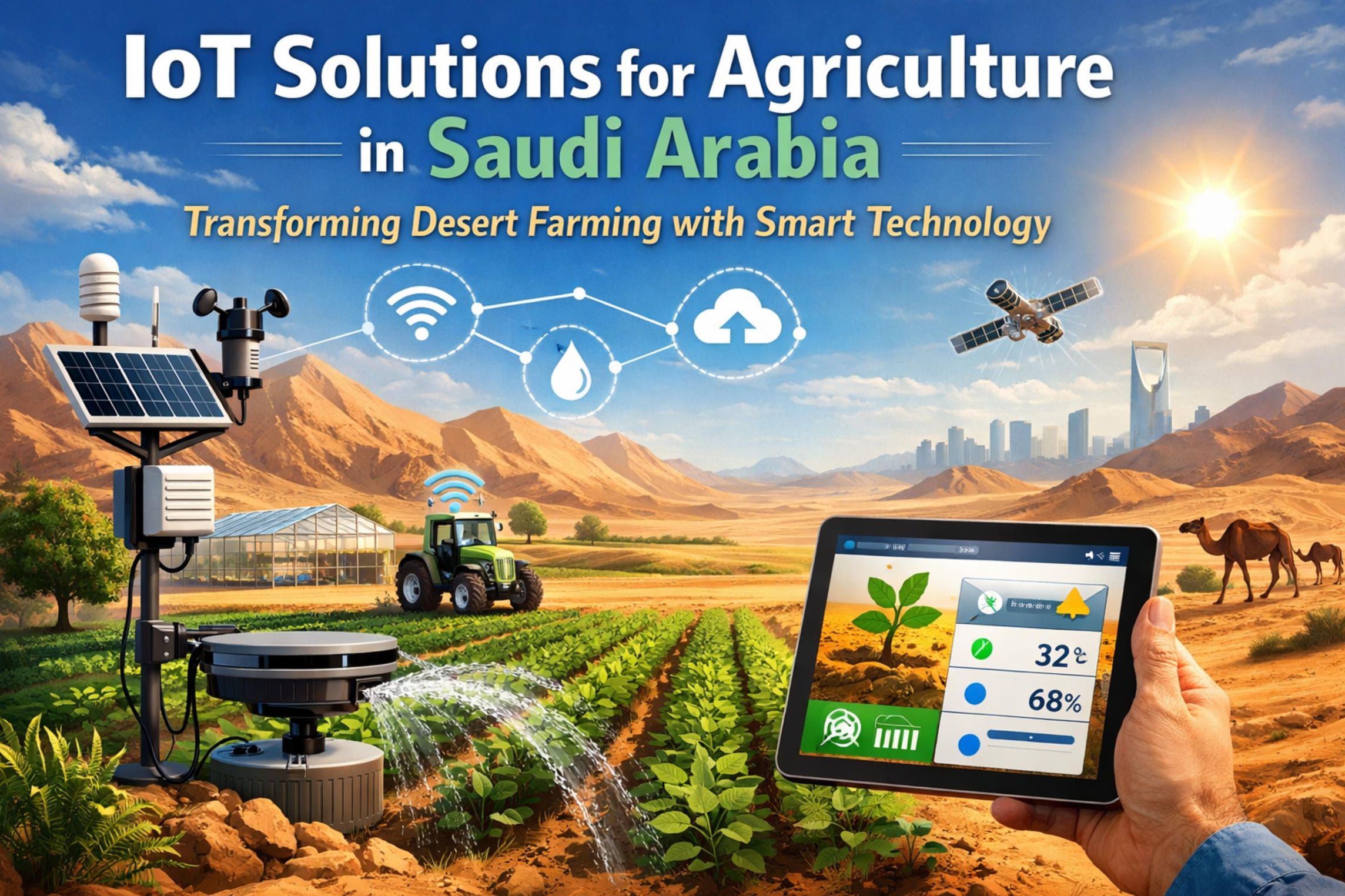
A-Bots.com brings comprehensive mobile app development expertise specifically tailored to IoT agricultural solutions for the Saudi Arabian market. Our development team creates custom applications that seamlessly integrate with soil moisture sensors, weather stations, automated irrigation controllers, and farm management systems to deliver actionable insights directly to farmers' smartphones. Whether you operate a 1,000-hectare commercial farm in Al-Qassim or a precision greenhouse facility in Riyadh, we develop iOS and Android applications that transform complex sensor data into intuitive dashboards, real-time alerts, and automated control interfaces optimized for the Kingdom's unique agricultural challenges.
Our IoT agricultural development capabilities extend beyond basic sensor integration to include comprehensive farm management platforms with multi-device synchronization, offline functionality for remote areas with limited connectivity, and integration with existing farm equipment through standard protocols like MQTT, Modbus, and REST APIs. A-Bots.com engineers work directly with agricultural technology suppliers to ensure compatibility with leading sensor manufacturers including METER Group, Campbell Scientific, Acclima, and regional suppliers, creating unified mobile interfaces that eliminate the complexity of managing multiple vendor platforms while maintaining the flexibility to incorporate new technologies as they emerge.
For agricultural enterprises with existing IoT deployments, A-Bots.com provides thorough quality assurance and testing services that validate sensor accuracy, network reliability, data transmission security, and application performance under real-world conditions including high temperatures, dust exposure, and network instability common to Saudi agricultural environments. Our testing protocols simulate extreme scenarios including sensor failures, communication disruptions, and rapid environmental changes to ensure your farming operations maintain consistent monitoring and control capabilities even during critical growing periods when system failures could result in significant crop losses or water waste.
Mobile app development for precision agriculture requires specialized understanding of both agricultural workflows and IoT architecture, areas where A-Bots.com demonstrates proven expertise through completed projects spanning irrigation management, crop health monitoring, livestock tracking, and supply chain optimization. We create applications that support variable rate irrigation based on soil moisture gradients, automated nutrient delivery systems, pest detection through image recognition, yield prediction using historical data and weather patterns, and integration with satellite imagery services for comprehensive field analysis all accessible through user-friendly mobile interfaces designed for use in field conditions with gloved hands and bright sunlight exposure.
The Saudi agricultural technology market is projected to expand from $274 million in 2025 to $553.6 million by 2032, driven primarily by government investments under Vision 2030 and the urgent need for water conservation technologies. A-Bots.com positions itself as the development partner that understands both the technical requirements of IoT sensor networks and the practical realities of farming in extreme climates, creating mobile solutions that combine sophisticated backend analytics with interfaces simple enough for operators with varying technical backgrounds. Our agricultural app development encompasses complete project lifecycles from initial sensor network design consultation through deployment, training, and long-term support with regular updates to incorporate new sensor types, analytical algorithms, and regulatory compliance requirements.
When agricultural operations require component-level development rather than complete systems, A-Bots.com delivers specialized modules including custom sensor calibration interfaces for Saudi soil conditions, weather forecast integration from regional meteorological services, Arabic language support with agricultural terminology specific to the Kingdom, integration with government reporting systems for water usage documentation, and blockchain-based traceability features for export markets. Our development approach prioritizes scalability to accommodate farm expansion, modular architecture enabling gradual technology adoption, and data ownership models ensuring farmers retain control over proprietary operational information while complying with emerging agricultural data governance frameworks.
Water Scarcity: The Driving Force Behind Agricultural Innovation
Saudi Arabia confronts water challenges that define the entire agricultural sector. The Kingdom possesses only 89.5 cubic meters of renewable water resources per capita annually, far below the absolute water scarcity threshold of 500 cubic meters, positioning it as one of the world's most water-stressed nations. Agriculture accounts for approximately 88% of total freshwater consumption despite limited natural water sources, creating an unsustainable situation that threatens long-term food security and economic stability. The Ministry of Environment, Water and Agriculture has set ambitious targets to reduce daily per capita water consumption from 263 liters to 150 liters by 2030, necessitating revolutionary changes in agricultural water management rather than incremental improvements.
This extreme water scarcity creates the perfect environment for IoT adoption in agriculture. Traditional irrigation methods based on scheduled watering or visual assessment waste substantial quantities of water through over-irrigation, evaporation, and runoff. The agricultural sector's massive water footprint combined with depleting groundwater reserves and energy-intensive desalination processes has positioned precision irrigation as a national priority. Government initiatives including the Qatrah water conservation program provide subsidies for modern irrigation systems, creating economic incentives that accelerate IoT technology adoption among farms of all sizes from smallholder operations to large commercial enterprises.
Research conducted across Saudi farms demonstrates that 90% of farmers encounter significant challenges related to weather variability, water scarcity, and labor shortages, with all participants expressing strong interest in adopting smart farming technologies to address these issues. However, only 60% currently utilize IoT technologies, indicating substantial growth potential as costs decline and technical expertise improves through government-sponsored training programs. The gap between farmer interest and actual adoption stems primarily from high initial investment costs exceeding SAR 500,000 for small to medium-sized farms, technical complexity requiring specialized knowledge, and concerns about data privacy and system reliability in harsh environmental conditions.

IoT Sensor Technologies Reshaping Saudi Agriculture
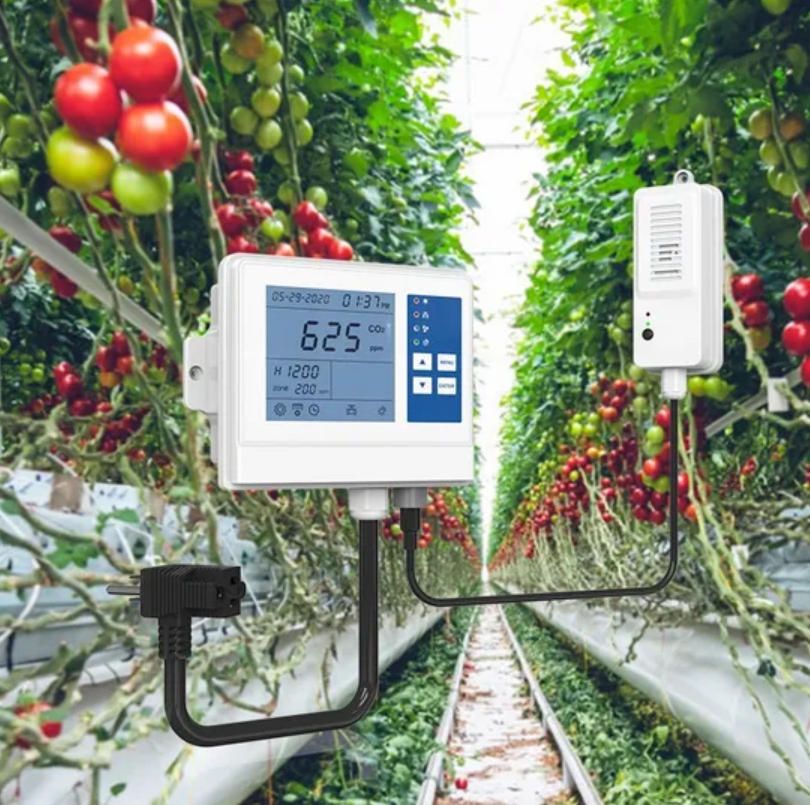
Soil moisture sensors form the foundation of precision irrigation systems deployed across the Kingdom's agricultural regions. These devices utilize various measurement technologies including tensiometric sensors that measure soil water tension, volumetric sensors using time-domain reflectometry or capacitance methods, and solid-state sensors offering lower costs and simplified installation. The Saudi agriculture sensor market generated $9.1 million in revenue in 2024 with soil moisture sensors representing the largest segment at 16.48% market share, expected to reach $16.1 million by 2030 at a CAGR of 9.7% as adoption accelerates among commercial farms and government demonstration projects.
Modern soil moisture sensors deployed in Saudi applications provide real-time data at multiple depths typically 15cm, 30cm, and 60cm to monitor water distribution throughout the root zone, enabling precise irrigation scheduling that matches crop water requirements. These sensors connect wirelessly via LoRa, Zigbee, or cellular networks to cloud platforms where machine learning algorithms analyze moisture patterns alongside weather forecasts, crop growth stages, and soil characteristics to generate irrigation recommendations. Field deployments demonstrate water savings of 20-30% compared to traditional scheduling methods while maintaining or improving crop yields through optimal moisture management that prevents both drought stress and waterlogging.
Integrated sensor networks extend beyond soil moisture to create comprehensive environmental monitoring systems. Weather stations equipped with temperature sensors, humidity monitors, wind speed anemometers, solar radiation detectors, and rainfall gauges provide localized climate data far more accurate than regional forecasts for agricultural decision-making. These stations typically cost between $100 and several thousand dollars depending on sensor quality and communication capabilities, with data transmitted to mobile applications where farmers receive alerts about frost risk, heat stress conditions, or optimal spraying windows based on wind speed and humidity levels.
The Saudi irrigation systems market, valued at $173 million in 2024 and projected to reach $290 million by 2030 with a CAGR of 9.2%, demonstrates the rapid integration of smart technologies with traditional infrastructure. Drip irrigation systems dominate with 43.7% market share due to exceptional water efficiency in arid conditions, delivering water directly to plant roots with minimal evaporation losses. Modern smart drip irrigation controllers integrate IoT sensors, allowing systems to automatically adjust watering schedules based on real-time soil moisture, weather conditions, and crop water requirements with no manual intervention required once properly configured and calibrated for specific field conditions.
Advanced precision agriculture deployments incorporate additional sensor types including electrical conductivity sensors measuring soil salinity a critical concern in desert agriculture where irrigation can concentrate salts, pH sensors enabling nutrient management optimization, water flow meters providing accurate irrigation volume tracking for regulatory compliance and efficiency analysis, and plant health monitoring sensors using chlorophyll fluorescence or spectral imaging to detect stress before visible symptoms appear. These multi-parameter monitoring systems generate massive data streams that mobile applications must process, analyze, and present in actionable formats accessible to farm managers who may lack extensive technical training.

Mobile Applications: The Control Center for Smart Farms
Mobile applications serve as the critical interface between complex sensor networks and agricultural decision-makers, transforming raw data into actionable intelligence. Effective agricultural apps for the Saudi market must provide real-time dashboards displaying current conditions across multiple fields or greenhouse zones, historical trend analysis showing moisture patterns, temperature variations, and irrigation volumes over customizable timeframes, automated alert systems notifying operators of sensor failures, threshold violations, or recommended actions via push notifications and SMS, and remote control capabilities enabling irrigation valve operation, pump activation, and climate control adjustments from anywhere with cellular connectivity.
Research demonstrates that farmers using mobile apps for precision agriculture can optimize water usage with up to 94.9% accuracy in predicting crop water requirements when machine learning algorithms process data from soil sensors, weather stations, and crop growth models. These applications employ sophisticated backend analytics including regression analysis identifying relationships between environmental factors and crop performance, neural networks predicting irrigation needs based on historical patterns and weather forecasts, and optimization algorithms calculating ideal irrigation schedules balancing water conservation against yield maximization under specific constraints like water allocation limits or electricity pricing structures.
Leading agricultural mobile platforms integrate multiple data sources beyond on-farm sensors to provide comprehensive decision support. Satellite imagery from services like Sentinel-2 and Landsat provides NDVI vegetation indices revealing crop health patterns across large fields at 10-30 meter resolution, enabling farmers to identify stressed areas requiring investigation or treatment. Weather forecast APIs from regional meteorological services deliver localized predictions for temperature, precipitation, wind, and humidity allowing irrigation scheduling optimization based on anticipated rainfall and evapotranspiration rates. Market price feeds help farmers time harvests to maximize returns, while soil mapping databases provide field-specific information about texture, drainage, and nutrient levels affecting irrigation requirements and fertilizer application rates.
User interface design for agricultural applications presents unique challenges in the Saudi context. Apps must function reliably in bright sunlight requiring high-contrast displays and large touch targets operable with gloved hands, support both Arabic and English interfaces with technical agricultural terminology correctly translated, provide offline capabilities maintaining core functionality when cellular connectivity is unavailable in remote farming areas, and consume minimal battery power enabling full-day field use without recharging. Successful applications balance sophistication with simplicity, offering advanced features for technical users while maintaining intuitive workflows for operators focused on practical farming tasks rather than technology management.
The Saudi smart IoT for desert agriculture market, projected to reach SAR 2.3 billion, emphasizes water management applications as the leading segment driven by critical conservation needs. Mobile applications in this category must support features including zone-based irrigation control allowing different watering schedules for crops with varying water requirements, fertigation management coordinating fertilizer injection with irrigation events based on crop growth stages and tissue testing results, and compliance reporting generating documentation of water usage and conservation measures required by regulatory agencies and export certification programs.
Precision Agriculture Platforms and Farm Management Systems
Comprehensive farm management platforms extend beyond irrigation control to encompass all aspects of agricultural operations through integrated mobile and web applications. These systems track field activities including planting dates, variety selections, input applications, and harvest records, creating digital farm histories that enable yield analysis, crop rotation planning, and compliance documentation for organic certification or good agricultural practices standards. Labor management modules track worker hours, task completion, and productivity metrics, particularly valuable for large farms employing significant seasonal workforce during harvest periods.
Equipment tracking through GPS enables precision agriculture practices including variable rate application where fertilizer, pesticide, or irrigation quantities vary across fields based on soil maps, yield data, or remote sensing imagery. Mobile applications guide tractor operators through automated application patterns or provide manual override capabilities when field conditions require operator judgment. Integration with farm machinery through ISOBUS, CAN bus, or proprietary protocols enables automated data collection as equipment operates, eliminating manual record-keeping and improving accuracy of input application documentation.
Supply chain integration represents an emerging application category particularly relevant to Saudi Arabia's goal of reducing food import dependency from the current 80% level. Mobile platforms connecting farms directly with retailers, food service operators, and export markets eliminate intermediaries while providing traceability from field to consumer. Blockchain integration creates immutable records of production practices, harvest dates, and handling procedures valuable for export markets requiring detailed provenance documentation or premium organic produce commanding higher prices that justify additional record-keeping requirements.
The Saudi AgriTech market expansion from $274 million in 2025 to $553.6 million by 2032 includes substantial investment in platform development and deployment. Major commercial farms increasingly adopt enterprise resource planning systems specifically designed for agriculture, integrating financial management, inventory control, and operational planning with field-level monitoring and control systems. These comprehensive platforms require mobile components enabling field personnel to access relevant information and input data directly from orchards, greenhouses, or processing facilities without returning to office computers, improving data accuracy and timeliness.
Real-World Implementations and Success Stories
Red Sea Farms, a startup emerging from King Abdullah University of Science and Technology, demonstrates innovative agricultural technology adapted to Saudi conditions. The company developed saltwater-cooled greenhouses that reduce freshwater consumption by up to 90% compared to conventional structures while simultaneously cultivating salt-tolerant crop varieties developed through collaborative research programs. Their 2,000-square-meter demonstration facility integrates IoT sensors monitoring temperature, humidity, light levels, and plant growth parameters, with data accessible through mobile dashboards enabling precise environmental control optimizing both resource efficiency and crop quality for fresh produce reaching Saudi supermarket chains.
NEOM's agricultural subsidiary Topian represents the Kingdom's commitment to next-generation farming technologies. Their climate-controlled greenhouse facility at Oxagon employs comprehensive sensor networks monitoring every aspect of plant growth from root zone moisture to canopy temperature, with automated systems adjusting irrigation, fertilization, lighting, and climate control based on real-time data analysis. The facility targets production of over 1 million tons of fresh produce annually using controlled environment agriculture techniques eliminating seasonal limitations and enabling year-round harvesting of high-value crops like tomatoes, cucumbers, peppers, and leafy greens previously requiring expensive imports.
Government demonstration projects funded through the Agricultural Development Fund showcase IoT applications accessible to smaller farms. These programs provide up to 75% financing for greenhouse projects and modern irrigation systems, with technical training helping farmers implement sensor-based management practices. Pilot projects in Al-Qassim and Riyadh regions demonstrate smart irrigation controllers integrated with soil moisture sensors achieving documented water savings of 25-35% while increasing vegetable yields through consistent optimal moisture management compared to traditional irrigation scheduling based on fixed intervals or visual assessment.
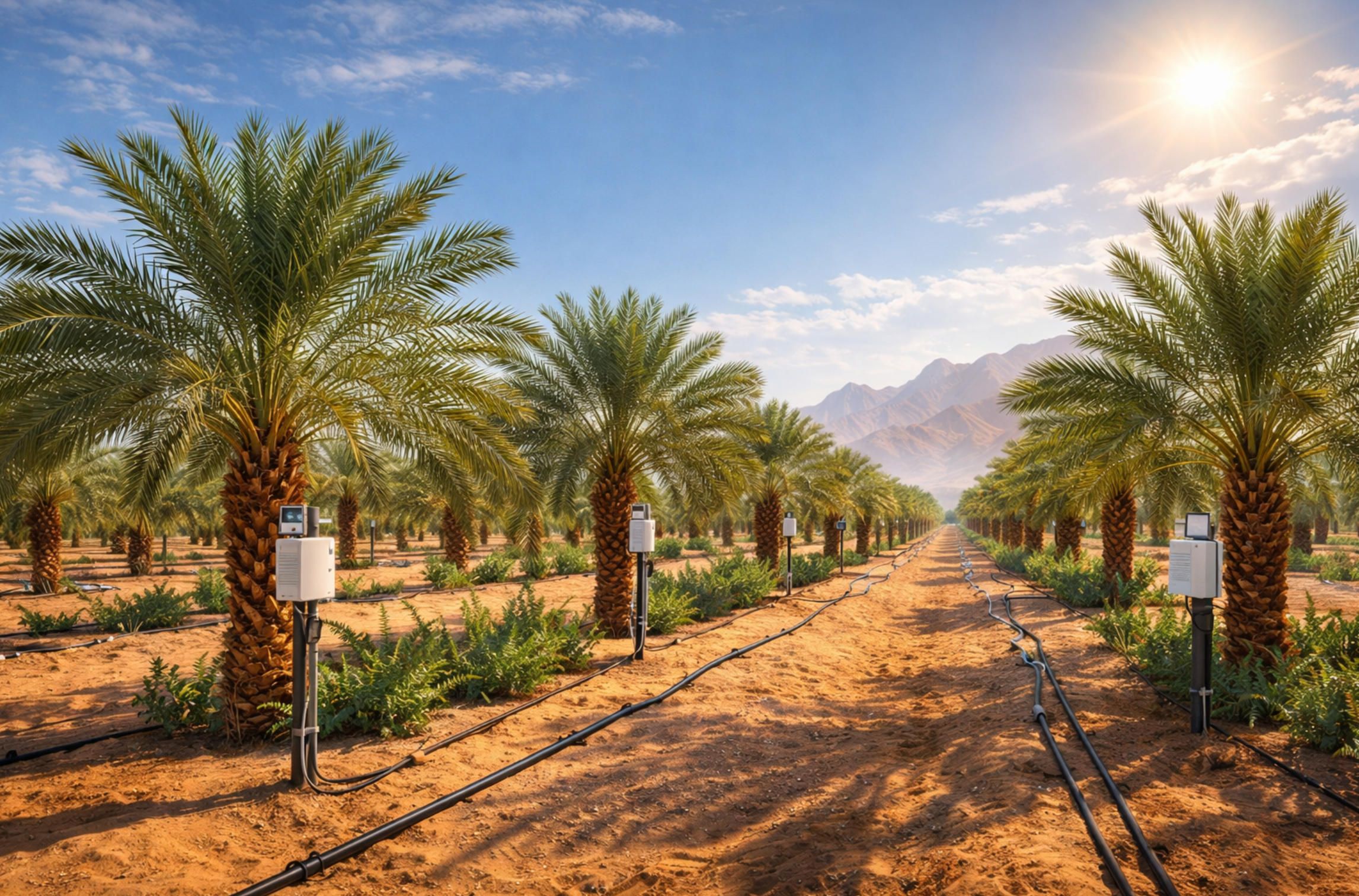
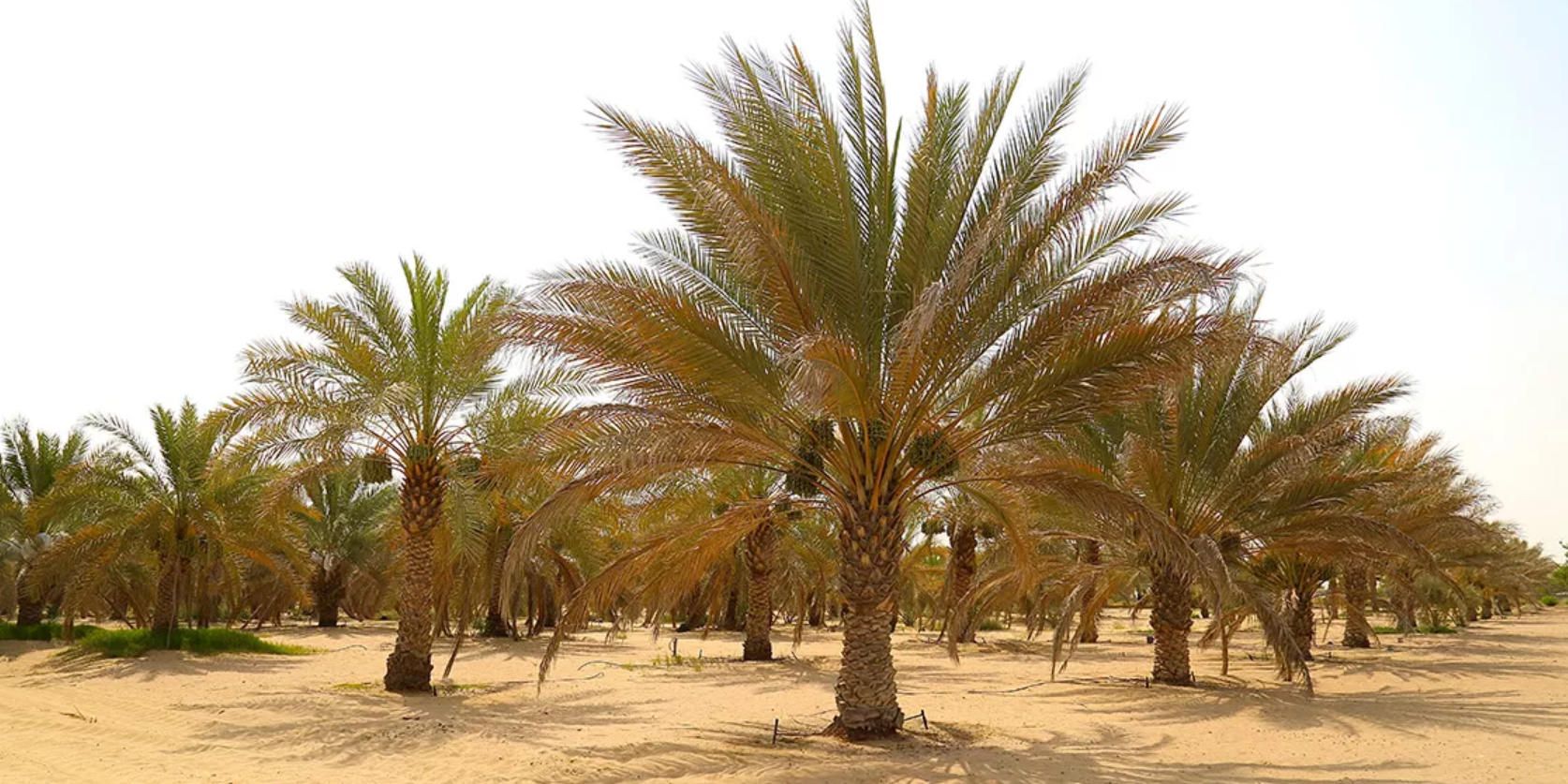
Private sector adoption accelerates as success stories demonstrate return on investment justifying initial technology costs. Commercial date palm operations employ precision irrigation systems with moisture sensors at varying depths throughout extensive root zones, automated drip irrigation valves responding to sensor readings, and mobile applications enabling irrigation managers to monitor thousands of trees across multiple farm locations from centralized control rooms. These systems reduce labor requirements for irrigation management while ensuring consistent water delivery supporting premium date production for domestic consumption and export markets demanding consistent quality and compliance documentation.

Technical Integration Challenges and Solutions
Implementing IoT agricultural systems in Saudi Arabia requires addressing several technical challenges specific to the region's extreme climate and infrastructure conditions. Ambient temperatures regularly exceeding 45°C stress electronic components, necessitating ruggedized sensor housings with thermal management features, carefully selected battery technologies maintaining capacity in high heat, and communication equipment rated for extended temperature ranges beyond standard commercial specifications. Dust and sand exposure demands sealed enclosures with appropriate ingress protection ratings, while intense solar radiation requires UV-resistant materials and reflective coatings preventing premature equipment degradation.
Wireless communication presents particular challenges in remote agricultural areas with limited cellular coverage and electrical infrastructure. Long-range wireless technologies including LoRaWAN operating in license-free bands provide connectivity over distances of 5-15 kilometers from gateway devices, enabling sensor networks across large farms without requiring cellular service at each sensor location. Solar-powered sensor nodes with battery backup maintain operation through multiple days of cloudy conditions while eliminating wiring requirements that increase installation costs and create maintenance vulnerabilities. Mesh networking configurations where sensors relay data through neighboring devices extend coverage areas and improve reliability compared to star topologies requiring direct line-of-sight to central gateways.
Data management and analytics infrastructure must handle continuous streams from hundreds or thousands of sensors while providing real-time responsiveness for critical alerts and control actions. Edge computing architectures process data locally at farm level, reducing cloud bandwidth requirements, minimizing response latency for time-sensitive irrigation control decisions, and maintaining functionality during internet connectivity disruptions. Cloud platforms provide long-term data storage, advanced analytics requiring substantial computational resources, multi-farm aggregation for agricultural consultants managing multiple client operations, and accessibility from any internet-connected device rather than requiring specific local network access.
Integration with existing farm equipment requires protocol translation and middleware development. Older irrigation controllers may use proprietary communication protocols incompatible with modern IoT platforms, necessitating custom interface development or replacement with IoT-ready equipment. Retrofitting legacy systems with wireless sensors and control capabilities often proves more cost-effective than complete replacement, particularly for large installations with substantial existing infrastructure investments. Mobile applications must accommodate this mixed environment, providing unified interfaces regardless of underlying equipment diversity while clearly indicating which systems support remote monitoring versus full automated control capabilities.
Market Dynamics and Investment Landscape
The Saudi AgriTech sector attracted over $9.8 billion in private sector investments during 2024, demonstrating robust confidence in agricultural technology opportunities. Major funding recipients include controlled environment agriculture projects establishing greenhouse facilities using advanced climate control and precision irrigation, vertical farming installations enabling production in urban areas near consumption centers reducing transportation costs and spoilage, aquaculture operations developing sustainable protein production using recirculating systems with IoT monitoring and control, and agricultural biotechnology companies developing heat-tolerant and salt-resistant crop varieties optimized for Gulf climate conditions.
International technology partnerships accelerate knowledge transfer and deployment of proven solutions. Companies from the Netherlands, renowned for greenhouse expertise, establish joint ventures with Saudi partners adapting Dutch precision horticulture practices to desert conditions. Israeli drip irrigation manufacturers supply equipment and technical support for Saudi projects despite political complexities, recognizing the Kingdom's massive market for water-efficient technologies. Chinese agricultural drone manufacturers find growing demand for aerial crop monitoring and precision spraying applications across vast commercial farms where manual scouting proves impractical and expensive.
Startup ecosystem development receives substantial government support through initiatives including agritech accelerators at KAUST and other research universities providing laboratory facilities, mentorship programs, and seed funding for promising technologies, regulatory reforms streamlining business establishment and foreign investment in agricultural technology sectors, and demonstration farm programs showcasing innovative solutions to potential customers and investors while generating performance data validating commercialization claims. The startup Arable raised $2.55 million in seed funding during 2025, with 90% from international investors, developing climate sensing and crop intelligence solutions specifically optimized for arid farming systems prevalent across Saudi Arabia and surrounding Gulf nations.
Market projections indicate sustained growth across all agricultural technology segments. The irrigation systems market expanding from $173 million to $290 million by 2030 reflects continuing deployment of smart drip irrigation, center pivot systems with variable rate capabilities, and subsurface drip installations offering maximum water efficiency in high-value permanent crops. The broader agritech market growth from $274 million to $553.6 million by 2032 encompasses precision agriculture platforms, farm management software, agricultural drones and robotics, biotechnology products, and controlled environment agriculture systems all incorporating IoT sensing and mobile application interfaces enabling sophisticated management practices.
Future Developments and Emerging Technologies
Artificial intelligence integration with IoT sensor networks represents the next evolution in precision agriculture. Machine learning models trained on multi-season data from thousands of farms can identify subtle patterns invisible to human observers, predicting disease outbreaks days before symptoms appear based on temperature and humidity patterns, optimizing irrigation timing by learning crop-specific water stress responses under varying conditions, and forecasting yields weeks before harvest enabling market planning and logistics coordination. These AI capabilities require massive datasets aggregated across many farms, creating opportunities for agricultural technology platforms that can offer enhanced analytics services leveraging collective intelligence from their user base while protecting individual farm data privacy.
Autonomous equipment integration with IoT monitoring systems enables completely automated farm operations. Solar-powered robot weeders navigate fields using GPS guidance and computer vision, eliminating herbicide use while reducing labor costs in weed management. Automated greenhouse systems adjust shade screens, ventilation, heating, cooling, irrigation, and fertilization without human intervention, maintaining optimal growing conditions 24/7 based on continuous sensor feedback. These developments require mobile applications shifting from control interfaces to monitoring and exception management tools where operators receive alerts only when automated systems encounter situations requiring human decision-making.
Blockchain technology provides tamper-proof record-keeping for agricultural operations, particularly valuable for export products requiring detailed production documentation. Every irrigation event, fertilizer application, pesticide treatment, and harvest activity records permanently on distributed ledgers accessible to buyers, certifiers, and regulators while protecting farmer proprietary information through appropriate access controls. Mobile applications integrate blockchain recording capabilities into normal workflow, automatically logging GPS-tagged activities as workers complete field tasks without requiring separate documentation processes that historically suffered from incomplete compliance and accuracy issues.
Satellite-based precision agriculture supplements ground sensors with frequent high-resolution imagery revealing crop health variations across entire farms. Services like Planet Labs provide daily imagery at 3-meter resolution while Sentinel-2 offers free 10-meter resolution data every 5 days, enabling continuous crop monitoring. Mobile applications process this imagery through vegetation indices, change detection algorithms, and prescription map generation for variable rate equipment, providing intelligence complementary to ground sensors measuring soil conditions and environmental parameters. The combination delivers comprehensive farm intelligence from satellite-scale overview to individual plant monitoring in high-value greenhouse operations.
Policy Support and Regulatory Framework
Vision 2030 agricultural priorities directly support IoT technology adoption through multiple policy mechanisms. Water conservation mandates requiring farms to demonstrate efficient irrigation practices create regulatory drivers for precision systems with documentation capabilities. Food security targets emphasizing increased domestic production necessitate yield improvements achievable through optimized growing conditions based on sensor data. Economic diversification goals promoting high-value agricultural exports favor technologically advanced operations producing premium products meeting international quality standards requiring detailed traceability only possible through comprehensive monitoring and record-keeping systems.
The Ministry of Environment, Water and Agriculture actively promotes smart farming through subsidy programs, technical assistance, and regulatory reforms. The Agricultural Development Fund provides financing for IoT equipment purchases, greenhouse construction, and technology implementation with loan terms reaching 75% of project costs at favorable interest rates. Technical extension services offer training programs teaching farmers to use monitoring systems, interpret sensor data, and implement precision management practices maximizing technology returns. Regulatory streamlining reduces permitting obstacles for agricultural technology projects while protecting farmers from predatory equipment suppliers through performance standards and consumer protection requirements.
International cooperation accelerates technology transfer and capability development. Saudi Arabia's membership in the Global Water Organization positions the Kingdom as a leader in water-efficient agriculture, facilitating partnerships with other arid nations facing similar challenges. Bilateral agreements with agricultural technology leaders like the Netherlands, Israel, Australia, and the United States enable student exchanges, researcher collaborations, and commercial partnerships bringing world-class expertise to Saudi projects. These relationships provide Saudi farmers access to proven technologies adapted for local conditions rather than requiring domestic development of every solution from scratch.
Research funding supports both applied technology development and fundamental science advancing agricultural capabilities. KAUST maintains world-class plant science programs developing salt-tolerant crop varieties, stress physiology research improving understanding of plant responses to desert conditions, and agricultural engineering programs designing equipment optimized for Saudi farming environments. King Saud University operates precision agriculture research facilities demonstrating IoT applications for extension service personnel and commercial farmers. These investments create intellectual property, trained workforce, and demonstration capabilities supporting sustained agricultural technology advancement beyond simple equipment purchases from foreign suppliers.

Economic Impact and Business Opportunities
The agricultural sector's contribution to Saudi GDP reached SAR 114 billion in 2024, representing historic growth driven substantially by technology-enabled productivity improvements. Precision irrigation systems reduce water costs while increasing yields through optimal moisture management, improving profitability particularly for high-value crops like vegetables, fruits, and herbs where quality premiums reward consistent production. Labor savings from automated monitoring and control systems help farms address workforce shortages and rising wage costs, maintaining competitiveness against imports from lower-wage countries. Export opportunities expand as technology enables year-round production of fresh produce meeting quality standards for premium international markets.
Job creation accompanies agricultural technology deployment across multiple skill levels. Field installation requires technicians trained in electrical wiring, sensor mounting, and basic troubleshooting, creating employment for vocational school graduates with practical skills. System integration needs IT professionals configuring networks, databases, and application interfaces, employing computer science graduates in rural areas previously lacking technology career opportunities. Agricultural consultants analyzing farm data and recommending management improvements represent high-value services leveraging technology platforms. Equipment maintenance, software support, and farmer training generate sustained service sector employment as IoT deployments expand across the Kingdom.
Import substitution provides major economic benefits as local production reduces dependence on foreign food supplies. Saudi Arabia currently imports approximately 80% of food consumption, representing massive foreign currency outflows and vulnerability to supply chain disruptions demonstrated during COVID-19 pandemic and geopolitical tensions. Technology-enabled agriculture produces tomatoes, cucumbers, peppers, leafy greens, and other fresh vegetables year-round, displacing imports from Europe, Turkey, and other suppliers. Dairy self-sufficiency reached 109% of domestic demand with egg production at 116%, creating export surpluses attributable partly to precision feeding and climate control systems optimizing animal productivity.
Export opportunities emerge from technology-enabled quality and traceability. Premium European markets demand detailed production documentation for organic certification, pesticide residue testing, and traceability from farm to retail. IoT systems automatically generate this documentation as normal operations byproduct, reducing compliance costs while accessing price premiums justifying technology investments. High-value crops including organic dates, premium fresh herbs, and specialty vegetables command substantial premiums when sold with appropriate certifications supported by comprehensive monitoring data demonstrating compliant production practices throughout growing cycles.
Conclusion: Technology-Driven Agricultural Transformation
Saudi Arabia's agricultural revolution through IoT technology adoption addresses existential water scarcity challenges while advancing food security objectives central to Vision 2030. Precision irrigation systems reduce water consumption by 20-30% while maintaining or improving yields, demonstrating that technology enables sustainable intensification rather than forcing choices between production and conservation. Mobile applications democratize access to sophisticated management capabilities, providing smallholder farmers analytical tools previously available only to large commercial operations with dedicated technical staff. Continued investment in IoT infrastructure, farmer education, and technology development positions the Kingdom as a global leader in desert agriculture capable of sharing innovations with other arid regions worldwide facing similar climate challenges.
The convergence of declining equipment costs, improving wireless connectivity, advancing artificial intelligence capabilities, and strong government support creates unprecedented opportunities for agricultural technology adoption. Market projections indicating sustained double-digit annual growth reflect not speculation but demonstrated results from existing deployments proving technology value propositions. Saudi Arabia's unique combination of severe agricultural challenges, substantial financial resources, technical education infrastructure, and political commitment to transformation creates an ideal environment for agricultural innovation with global significance as climate change expands arid regions worldwide requiring solutions Saudi Arabia pioneers today.
Mobile app development for agricultural IoT represents a critical enabling technology transforming sensor data into farmer decisions and automated actions. Success requires understanding both agricultural workflows and technical architecture, areas where specialized expertise proves essential for deployments achieving intended productivity improvements and water conservation outcomes. As the Saudi AgriTech market expands toward $550 million by 2032, the companies and farms investing in comprehensive IoT platforms with well-designed mobile interfaces will lead the Kingdom's agricultural transformation, demonstrating that even the world's most water-stressed nation can achieve food security through technological innovation replacing natural resource abundance with human ingenuity and digital intelligence.
FAQ Section
Q1: How much water can IoT irrigation systems save in Saudi Arabian agriculture? A: IoT-based precision irrigation systems in Saudi Arabia demonstrate water savings of 20-30% compared to traditional irrigation methods while maintaining or improving crop yields. Research shows that automated irrigation systems using soil moisture sensors and weather data can achieve up to 94.9% accuracy in predicting crop water requirements, significantly reducing waste through precise water delivery matching actual plant needs in desert conditions.
Q2: What types of sensors are most important for Saudi agricultural IoT systems? A: The most critical sensors for Saudi agriculture include soil moisture sensors measuring water content at multiple depths (typically 15cm, 30cm, 60cm), temperature and humidity sensors monitoring environmental conditions, electrical conductivity sensors detecting soil salinity critical in desert irrigation, weather stations providing localized climate data, and water flow meters tracking irrigation volumes for regulatory compliance and efficiency analysis.
Q3: How much does it cost to implement IoT agricultural systems on Saudi farms? A: Initial investment costs for IoT agricultural systems in Saudi Arabia typically exceed SAR 500,000 ($133,000) for small to medium-sized farms, though costs vary significantly based on farm size and technology complexity. Soil moisture sensors range from $50-300 per unit, weather stations cost $100-several thousand dollars, and smart irrigation controllers vary from $500-5,000. Government subsidies through the Agricultural Development Fund provide up to 75% financing for greenhouse projects and modern irrigation systems, significantly reducing farmer costs.
Q4: What mobile app features are essential for precision agriculture in Saudi Arabia? A: Essential mobile app features for Saudi precision agriculture include real-time dashboards displaying current conditions across multiple fields, automated alerts for sensor failures or threshold violations, remote irrigation control enabling valve operation from smartphones, historical data analysis showing trends in moisture and climate patterns, offline functionality maintaining operation during connectivity disruptions, Arabic language support with agricultural terminology, and integration with weather forecasts and satellite imagery for comprehensive farm intelligence.
Q5: Which Saudi regions have the highest AgriTech adoption rates? A: Al-Qassim and Riyadh regions lead Saudi AgriTech adoption with significant deployments of smart irrigation systems, greenhouse automation, and precision farming technologies. The Northern and Central regions emerge as agritech hotspots benefiting from government demonstration projects and private sector investments. Major projects also concentrate in areas like NEOM, where Topian operates climate-controlled greenhouses, and Al-Jouf, receiving strategic focus under Vision 2030 for improving food security while optimizing water usage.
Q6: How does A-Bots.com integrate agricultural sensors with mobile applications? A: A-Bots.com creates custom mobile applications connecting to agricultural sensors through standard IoT protocols including MQTT for lightweight messaging, Modbus for industrial equipment communication, and REST APIs for cloud platform integration. Our development ensures compatibility with leading sensor manufacturers (METER Group, Campbell Scientific, Acclima) while supporting regional suppliers. Applications process real-time sensor data, provide automated control interfaces, generate alerts, and present analytics through intuitive dashboards optimized for field use in Saudi environmental conditions.
Q7: What is the expected growth of the Saudi AgriTech market? A: The Saudi AgriTech market is projected to expand from $274 million in 2025 to $553.6 million by 2032, representing a compound annual growth rate (CAGR) of 10.6%. This growth is driven by Vision 2030 food security initiatives, government investments exceeding $9.8 billion in private sector agricultural projects, water scarcity requiring efficient technologies, and increasing adoption of precision agriculture systems. The broader agriculture sensor market specifically grows from $9.1 million in 2024 to $16.1 million by 2030.
Q8: Can IoT systems work reliably in Saudi Arabia's extreme temperatures? A: Yes, properly designed IoT agricultural systems operate reliably in Saudi temperatures exceeding 45°C through ruggedized sensor housings with thermal management, battery technologies maintaining capacity in high heat, communication equipment rated for extended temperature ranges, sealed enclosures with appropriate ingress protection against dust and sand, and UV-resistant materials preventing equipment degradation. A-Bots.com conducts thorough quality assurance testing simulating extreme conditions including high temperatures, dust exposure, and network instability to ensure system reliability during critical growing periods.
Q9: What government support exists for agricultural IoT adoption in Saudi Arabia? A: Saudi government provides substantial support for agricultural IoT through the Agricultural Development Fund offering up to 75% financing for greenhouse projects and modern irrigation systems, the Qatrah water conservation program subsidizing efficient technologies, Vision 2030 initiatives allocating over $1 billion for greenhouse and plant resource development, tax holidays up to 10 years for qualifying agritech investments, technical extension services providing farmer training on monitoring systems, and research grants supporting technology development at universities like KAUST.
Q10: How do IoT agricultural systems contribute to Saudi Vision 2030 goals? A: IoT agricultural systems directly support Vision 2030 objectives by improving water use efficiency toward the target of reducing per capita consumption from 263 to 150 liters daily, increasing domestic food production reducing import dependency from current 80% levels, creating technology sector jobs in rural areas, enabling sustainable intensification of agriculture without depleting groundwater resources, and positioning Saudi Arabia as a global leader in desert agriculture innovation applicable to arid regions worldwide facing similar climate challenges.
✅ Hashtags
#IoTAgriculture
#SmartFarmingSaudi
#PrecisionAgriculture
#AgriTechSaudi
#SoilMoistureSensors
#SmartIrrigation
#SaudiVision2030
#WaterConservation
#DesertFarming
#AgriculturalTechnology
#MobileAppDevelopment
#FarmAutomation
#SustainableAgriculture
#FoodSecurity
Other articles
Custom Agriculture App Development for Farmers In 2024, U.S. farmers are more connected than ever — with 82% using smartphones and 85% having internet access. This article explores how mobile applications are transforming everyday operations, from drone-guided field scouting to livestock health tracking and predictive equipment maintenance. It examines why off-the-shelf apps often fail to address specific farm needs and how collaborative, farmer-funded app development is gaining momentum. Through real-world examples and step-by-step guidance, readers will learn how communities of growers can fund, design, and launch custom apps that fit their exact workflows. A-Bots.com offers tailored development services that support both solo farmers and agricultural groups. With offline capabilities, modular design, and support for U.S. and international compliance, these apps grow alongside the farm. Whether you're planting soybeans in Iowa, raising cattle in Texas, or running a greenhouse in California — this article offers the tools and inspiration to build your own farm technology. Discover why more farmers are saying: we don’t wait for the future — we build it.
Inventory Management App Development Managing inventory with spreadsheets costs businesses thousands of dollars annually through errors and inefficiency. Research shows over 80% of spreadsheets contain mistakes, while retail shrinkage reached $132 billion globally in 2024. A custom inventory management app with barcode scanning eliminates manual data entry errors, provides real-time stock visibility, and automates low-stock alerts. This comprehensive guide covers essential features including barcode scanning, multi-location tracking, and system integrations. Development costs range from $10,000 for basic solutions to $100,000+ for enterprise systems, with typical ROI of 120-190% and payback periods under 8 months. A-Bots.com delivers custom inventory solutions tailored to your specific workflow requirements.
Virtual Queue & Smart Booking App for Private Clinics, Beauty Salons, and Repair Pros This article explains how a virtual queue and smart time-slot booking app can eliminate scheduling chaos for private clinics, beauty salons, and independent repair professionals. You will learn why generic calendars fail in real service operations, and how a purpose-built scheduling engine handles service durations, buffers, specialist availability, and shared resources. We outline a realistic MVP that a 5 - 8 developer team can deliver, including customer mobile apps and an admin dashboard with reminders, confirmations, and optional deposits to reduce no-shows. A-Bots.com can design and build this custom booking platform to match your workflow and scale.
ShiftPulse Shift Scheduling & Quick Swap App Development for Small Service Teams ShiftPulse is a custom shift scheduling and quick swap platform designed for small service teams that depend on reliable coverage. This article explains why spreadsheets and group chats fail at enforcing roles, location rules, and staffing minimums, and how a purpose-built workflow prevents risky swaps, overtime surprises, and last-minute coverage gaps. You will see a realistic MVP scope a 5 - 8 developer team can deliver: employee mobile apps, a manager dashboard, swap requests and approvals, push notifications, and basic check-in/out time tracking. A-Bots.com can build and scale this platform to match your operations.
EQ.6 vs LatteGo 5500: Coffee Quality, Milk Convenience, and the App Gap Siemens EQ.6 and Philips LatteGo 5500 sit in the same bean-to-cup category, but they win for different people. This comparison breaks down daily ownership friction, espresso intensity and customization, milk foam results, and the hidden cost of maintenance over months of use. You’ll learn which machine suits a “strong coffee and repeatability” routine and which one favors “milk convenience and low-effort cleaning.” Finally, we explain why a companion app is becoming a baseline expectation for premium coffee machines - and how A-Bots.com can build that app layer end-to-end.
Top stories

Copyright © Alpha Systems LTD All rights reserved.
Made with ❤️ by A-BOTS