
Home
Services
About us
Blog
Contacts
Inventory Management App Development: The Complete Guide to Building a Stock Tracking Solution for Small Businesses
Managing inventory sounds simple until you realize that a single misplaced decimal point or forgotten stock update just cost your business thousands of dollars. For small shop owners, warehouse managers, and even collectors tracking valuable items at home, the gap between what should be on the shelf and what actually is there represents one of the most frustrating challenges in daily operations. The good news? A well-designed inventory management app can close that gap completely.
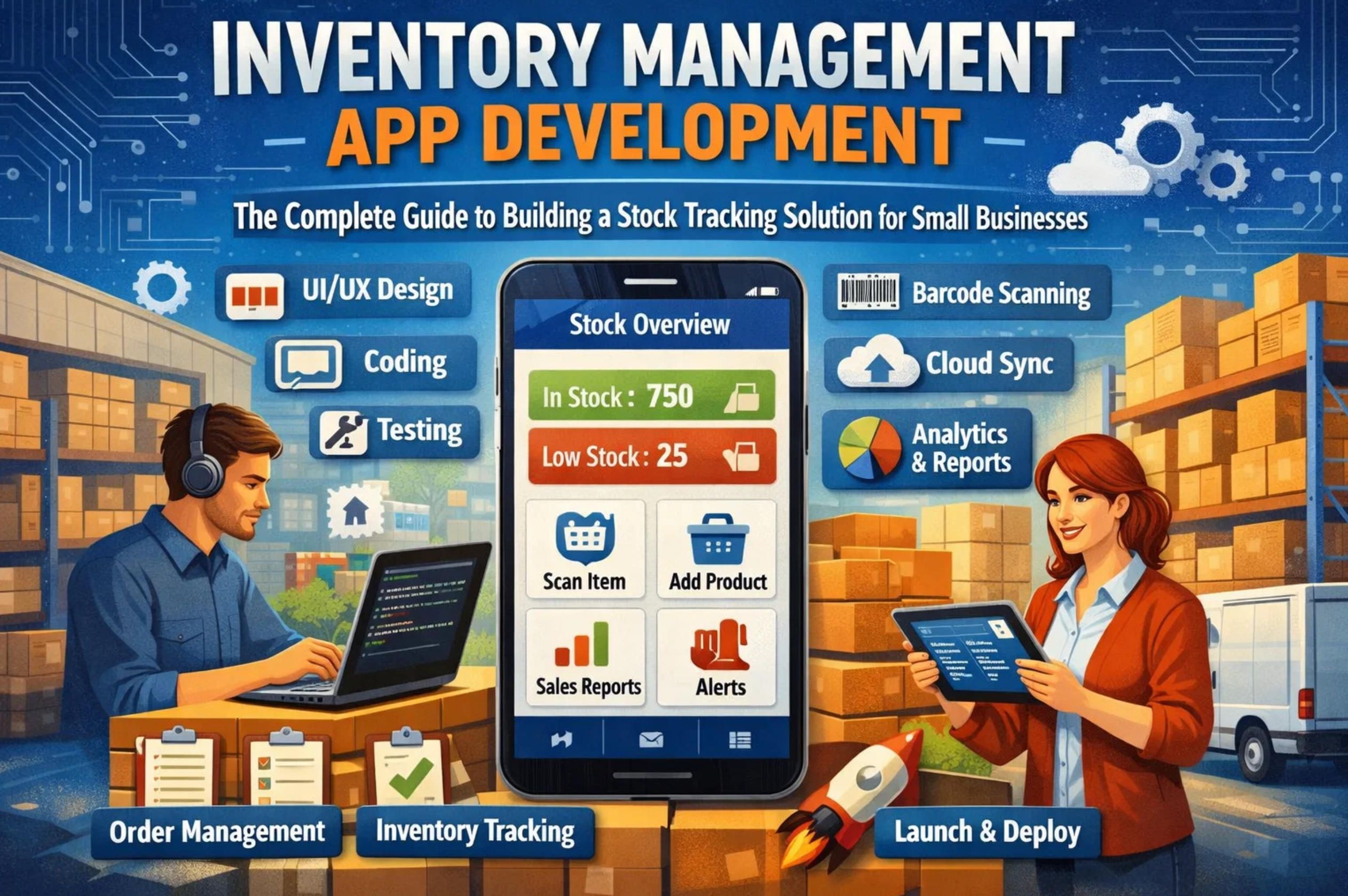
A-Bots.com specializes in developing custom mobile applications that solve real business problems. With over 70 completed projects and client relationships spanning from 1.5 to more than 5 years, our team has witnessed firsthand how inventory tracking apps transform chaotic stockrooms into organized, profitable operations. Whether you need a straightforward barcode scanner for a boutique retail shop or a multi-location inventory system for a growing warehouse business, custom development delivers exactly what off-the-shelf solutions cannot: a tool built around your specific workflow.
This guide explores everything you need to know about inventory management mobile app development. From understanding why businesses desperately need these solutions to the technical features that make them work, we cover the landscape thoroughly. Most importantly, you will discover how partnering with an experienced development team like A-Bots.com can turn your inventory headaches into a competitive advantage.

Why Inventory Management Apps Have Become Essential for Modern Businesses
The global inventory management software market reached approximately $3.9 billion in 2024, with projections showing growth at a compound annual growth rate of around 8.4% through 2033. These numbers reflect a fundamental shift in how businesses approach stock control. Companies have realized that manual methods and basic spreadsheets simply cannot keep pace with modern commerce demands.
Small and medium enterprises represent the fastest-growing segment in this market. Cloud-based solutions have made sophisticated inventory tools accessible to businesses that previously could not afford enterprise-level systems. The subscription model eliminates massive upfront investments while providing the scalability growing businesses need. According to industry research, SME inquiries for SaaS inventory solutions grew 34% year-over-year in 2024, driven largely by surging cross-border e-commerce activity.
The retail sector alone experiences staggering losses from poor inventory management. Retail shrinkage, which includes theft, administrative errors, and systemic mistakes, reached $132 billion in losses globally in 2024. The average inventory shrink rate among U.S. retailers hovers around 1.6%, with some businesses experiencing losses of 3% or higher. For a store generating $1 million in annual revenue, even a 2% shrinkage rate translates to $20,000 in lost inventory annually.
What makes these statistics particularly painful is that administrative errors and process mistakes account for roughly 27% of all retail shrinkage. These are not thefts or unavoidable losses. They are preventable mistakes that proper inventory tracking would catch immediately. A mobile inventory app with barcode scanning can reduce these errors dramatically, giving business owners real visibility into what they actually have versus what their records claim.

The Hidden Costs of Spreadsheet-Based Inventory Tracking
Many small business owners start with Excel or Google Sheets for inventory management because these tools are familiar and essentially free. This approach works reasonably well for a garage-based startup with fifty items to track. However, as businesses grow, the spreadsheet method quietly bleeds money through inefficiency and errors that compound over time.
Research consistently shows that more than 80% of spreadsheets contain errors. A study cited in the Journal of End User Computing found that 88% of spreadsheets audited across seven studies contained mistakes. Another analysis indicated that people make approximately one error for every 300 characters of data they manually input. For inventory management, where accuracy is everything, these statistics should terrify any business owner relying solely on manual entry.
The limitations extend beyond simple typos. Excel cannot provide real-time inventory updates because it requires manual input after every transaction. Only one person can edit a spreadsheet at a time, creating bottlenecks when multiple team members need to update stock levels. Version control becomes a nightmare when files get saved under different names or emailed between departments. The formula complexity required for serious inventory tracking turns spreadsheets into unwieldy documents that slow down computers and confuse anyone except their original creator.
One particularly telling case involves the Williams Formula 1 racing team, which attempted to manage 20,000 individual car parts using Excel. The operational difficulties they encountered illustrate how quickly spreadsheets become inadequate for serious inventory needs. On the financial side, J.P. Morgan suffered a $2 billion loss partly attributed to an error in an Excel-based Value-at-Risk model. While most small businesses will not face billion-dollar consequences, the percentage impact on profit margins can be equally devastating for smaller operations.
The real question is not whether spreadsheets eventually fail for growing businesses. They always do. The question is how much money, time, and customer goodwill gets lost before the business owner realizes that a dedicated inventory app would have paid for itself many times over.

Core Features Every Inventory Management App Needs
Building an effective inventory management app requires understanding which features deliver the most value. Not every business needs every possible feature, but certain core functionalities form the foundation of any useful inventory solution.
Barcode and QR Code Scanning
The ability to scan items using a smartphone camera or dedicated barcode reader represents perhaps the single most transformative feature of modern inventory apps. Barcode scanning eliminates manual data entry, which immediately reduces errors and dramatically speeds up inventory processes. Staff members who previously spent hours typing product codes into spreadsheets can now scan entire receiving shipments in minutes.
Modern scanning solutions use the camera already built into every smartphone, eliminating the need for expensive dedicated hardware. This accessibility has democratized inventory management for small businesses. A local boutique can achieve the same scanning efficiency as a national retail chain, just by installing the right app on devices the staff already carries.
The benefits extend beyond simple speed. When every inventory action gets recorded through a scan, accountability improves automatically. Managers can see exactly who scanned what item at what time, making it easy to trace discrepancies back to their source. Some businesses report up to 60% reduction in return processing costs simply because picking accuracy improved through scan verification.
Real-Time Stock Level Monitoring
Knowing exactly what you have in stock at any given moment might sound like a basic expectation, but achieving genuine real-time visibility requires thoughtful app design. The system must update instantly when items get scanned in or out, sync across all devices without delay, and present the information in a format that allows quick decision-making.
Real-time monitoring prevents two of the most common and costly inventory problems: overselling items that are actually out of stock and missing sales because the system showed items as unavailable when physical inventory existed. Either scenario damages customer relationships and hurts revenue. With accurate real-time data, businesses can confidently promise delivery times, identify slow-moving stock before it becomes a problem, and spot theft or loss patterns quickly enough to address them.
The cloud-based architecture that enables real-time updates also supports multi-location management. A business with inventory in a main warehouse, a retail location, and a fulfillment center can see unified stock levels across all sites from a single dashboard. This visibility proves essential for businesses trying to optimize inventory placement or fulfill orders from the most appropriate location.
Low Stock Alerts and Automated Reorder Points
Running out of a popular product costs more than the immediate lost sale. Customers who cannot find what they want often go to competitors and sometimes never return. Conversely, overstocking ties up cash in inventory that sits on shelves, potentially becoming obsolete or damaged before it sells.
Smart inventory apps track consumption patterns and alert managers when stock levels drop below predefined thresholds. More sophisticated systems can automatically generate purchase orders when reorder points get triggered, removing the human delay between recognizing a need and taking action. Businesses using accurate forecasting tools report reducing inventory costs by 20% to 50% by maintaining optimal stock levels rather than guessing.
The key lies in setting appropriate thresholds based on actual data. An item that sells steadily throughout the year needs different reorder logic than a seasonal product or one with long supplier lead times. Custom development allows businesses to configure these rules according to their specific situations rather than accepting whatever defaults a generic software package provides.

Product Categorization and Organization
As inventory grows, the ability to organize products into meaningful categories becomes essential for navigation and analysis. A simple list might work for a hundred items, but businesses with thousands of SKUs need hierarchical categorization, tags, and robust search functionality.
Effective categorization goes beyond simple product types. Businesses often need to track items by supplier, storage location, cost basis, expiration date, or custom attributes specific to their industry. A craft brewery managing kegs needs different organizational tools than a boutique clothing store or a medical supply distributor. Custom app development allows the categorization structure to match exactly how the business thinks about its inventory.
Good categorization also enables meaningful reporting. When products are properly organized, managers can analyze sales velocity by category, identify which suppliers deliver the best margins, or spot trends across product lines. This intelligence supports better purchasing decisions and helps businesses understand where to focus growth efforts.
Inventory Adjustment and Audit Trail
Physical counts inevitably reveal discrepancies between recorded inventory and actual stock. The app must provide straightforward mechanisms for making adjustments while maintaining a complete audit trail of every change.
The audit trail serves multiple purposes. It supports internal accountability by tracking who made what changes and when. It provides documentation for accounting and tax purposes. Most importantly, it helps businesses identify patterns in discrepancies. If shrinkage consistently occurs in a particular product category or during specific shifts, the audit trail provides the evidence needed to investigate and address the root cause.
Cycle counting functionality allows businesses to verify inventory accuracy on a rolling basis rather than shutting down for complete physical counts. The app guides staff through counting specific sections or categories according to a schedule, comparing results against recorded values and flagging discrepancies for review.

Advanced Features That Differentiate Premium Inventory Solutions
Beyond the core functionality, several advanced features can significantly enhance an inventory app's value for businesses with more complex needs.
Multi-Location and Warehouse Management
Businesses operating from multiple locations face exponentially more complex inventory challenges. Stock transfers between locations, location-specific pricing, and warehouse zone management all require careful coordination. Advanced inventory apps handle these scenarios by maintaining separate inventory records for each location while providing unified reporting and transfer management tools.
Warehouse management features include zone and bin location tracking, pick path optimization for order fulfillment, and receiving workflows that route incoming stock to appropriate locations. These capabilities overlap with dedicated warehouse management systems, though many small and medium businesses find that a well-designed inventory app meets their needs without the complexity and cost of full WMS implementation.
Integration with Existing Business Systems
An inventory app that exists in isolation creates as many problems as it solves. Modern businesses need their inventory data to flow seamlessly into accounting software, e-commerce platforms, point-of-sale systems, and supplier portals. API integration and data exchange capabilities determine how well an inventory app fits into a larger business technology ecosystem.
Common integration scenarios include automatic inventory updates when online orders ship, purchase order creation flowing directly to supplier ordering systems, and cost-of-goods-sold calculations syncing to accounting software. Each integration point requires careful development work to ensure data accuracy and handle error conditions gracefully.
Analytics and Reporting
Collecting inventory data has limited value without tools to analyze patterns and generate actionable insights. Reporting capabilities transform raw transaction records into visualizations of sales trends, inventory turnover ratios, dead stock identification, and profitability analysis.
Advanced analytics incorporate demand forecasting using historical patterns, seasonality adjustments, and even external factors like weather or economic indicators. While sophisticated forecasting once required expensive enterprise systems, machine learning approaches now make reasonable predictions accessible to smaller businesses through cloud-based services.
Offline Functionality
Warehouses, stockrooms, and retail back offices often have poor cellular signal and unreliable WiFi. An inventory app that stops working when the connection drops creates frustration and gaps in data capture. Robust offline functionality allows staff to continue scanning and recording inventory actions, with automatic synchronization once connectivity returns.
Implementing offline capability requires thoughtful architecture to handle conflicts when the same data gets modified on multiple devices before synchronization occurs. Custom development allows these conflict resolution rules to match business priorities rather than accepting arbitrary defaults.
The Custom Development Advantage
Generic inventory apps available through app stores serve certain use cases adequately. However, businesses with specific workflow requirements, unusual product characteristics, or integration needs often find that off-the-shelf solutions require painful compromises.
A-Bots.com approaches every inventory app project by first understanding how the business actually operates. What steps do staff members take when receiving shipments? How do they record sales or usage? What information do managers need to see, and how quickly? The answers to these questions shape an application designed around real workflows rather than forcing the business to adapt to software limitations.
Custom development also provides flexibility as business needs evolve. When a client opens a second location, adds a new product line, or needs to integrate with a new supplier system, the development team can modify the app accordingly. Businesses locked into generic software must either find workarounds or switch platforms entirely when their needs change.
The development process at A-Bots.com follows proven methodologies that minimize risk while delivering results efficiently. Discovery and planning phases ensure that requirements are thoroughly understood before coding begins. Iterative development with regular client feedback catches misunderstandings early when they are cheap to fix. Comprehensive testing validates functionality across devices and network conditions. Post-launch support ensures that issues get addressed quickly and that the app continues to perform as the business relies on it more heavily.

Development Costs and Investment Considerations
Understanding the investment required for custom inventory app development helps businesses make informed decisions. Development costs vary significantly based on feature complexity, platform requirements, and integration scope.
A basic inventory management system with essential features including inventory tracking, order management, and basic reporting typically costs between $10,000 and $40,000. This level suits startups or small businesses looking to automate fundamental inventory tasks with a straightforward user interface, real-time inventory updates, and basic integrations with existing systems.
More sophisticated systems that include multi-location support, demand forecasting, barcode and QR code scanning, and integration with other business systems like ERP or e-commerce platforms generally range from $40,000 to $100,000. These applications handle more complex business requirements and support scaling as the company grows.
Enterprise-grade inventory solutions with advanced analytics, AI-driven forecasting, complex warehouse management, and extensive customization can exceed $100,000. These projects typically serve larger organizations with unique requirements that justify the investment.
The return on investment for inventory management software often materializes faster than business owners expect. Companies report payback periods of 5 to 8 months, with expected ROI ranging from 120% to 190%. The returns come from reduced stockouts, optimized inventory levels, automated reporting that saves staff time, and improved operational efficiency throughout the organization.
A-Bots.com works with clients to scope projects appropriately for their current needs and growth expectations. Starting with essential features and adding capabilities over time often makes sense for smaller businesses, while companies with immediate complex requirements benefit from more comprehensive initial development.
Testing and Quality Assurance
Beyond development, A-Bots.com offers comprehensive testing services for businesses that already have inventory management solutions but need to verify their reliability and performance. Testing existing applications identifies bugs, security vulnerabilities, and usability issues before they cause operational problems.
For inventory apps specifically, testing scenarios include validating scan accuracy across different barcode types and lighting conditions, verifying data synchronization under various network conditions, confirming calculation accuracy for quantities and costs, and stress testing to ensure the app performs well as inventory volumes grow. Our testing team develops comprehensive test plans based on how the app will actually be used, not just how it was designed to work.
Businesses considering new inventory software, whether custom developed or off-the-shelf, benefit from independent quality assessment before committing to full deployment. Discovering that an app cannot handle your actual transaction volumes or fails under poor network conditions is far better learned during evaluation than after the system goes live.
Implementation Best Practices
Successfully deploying an inventory management app requires attention to several factors beyond the software itself.
Data Migration and Initial Setup
Transitioning from spreadsheets or another system requires careful data migration to ensure that product information, current stock levels, and historical data transfer accurately. Poor migration creates immediate distrust in the new system when staff members encounter incorrect information. A-Bots.com includes thorough data migration planning in our project scope, with validation steps to confirm data integrity before going live.
Staff Training and Adoption
The most sophisticated inventory app provides zero value if staff members resist using it or use it incorrectly. Training programs should address both how to operate the app and why the new processes matter. People who understand the business reasons behind changes adopt new tools more willingly than those who simply receive orders to do things differently.
Change management also requires executive commitment. When managers demonstrate that they use and trust the new system, staff follows their lead. When managers continue relying on spreadsheets "just in case," they signal that the new app is optional, undermining adoption across the organization.
Phased Rollout
Launching a new inventory system across all products, locations, and staff simultaneously creates risk concentration. A phased approach starts with a limited product set or single location, allowing the team to identify and resolve issues before they affect the entire operation. Each phase builds confidence and provides learning that improves subsequent rollout stages.

Security and Compliance Considerations
Inventory data often contains sensitive business information including supplier relationships, cost structures, and sales volumes. Protecting this data requires security measures appropriate to the risk level.
Authentication controls should limit system access to authorized users, with role-based permissions that restrict sensitive functions to appropriate personnel. Encryption protects data both in transit and at rest. Backup procedures ensure that data can be recovered if devices are lost or corrupted. Audit trails record access and changes for security review.
Certain industries face specific compliance requirements that affect inventory management. Pharmaceutical distribution requires chain-of-custody documentation. Food handling businesses must maintain traceability records. Medical device inventory falls under FDA regulations. Custom development allows compliance requirements to be built into the application workflow rather than requiring manual documentation alongside the inventory system.
Industry-Specific Inventory Challenges
Different business types face unique inventory management challenges that generic solutions often address poorly.
Retail and E-commerce
Omnichannel retailers must synchronize inventory across physical stores, online platforms, and potentially multiple marketplaces. Overselling due to synchronization delays creates customer service nightmares. Retailers now target 99% stock accuracy thresholds because any channel mismatch erodes customer loyalty and revenue. RFID technology and real-time synchronization help merchants achieve these accuracy levels while reducing manual cycle counts.
Food Service and Perishables
Inventory with expiration dates requires FIFO (first in, first out) management and batch tracking. The system must alert staff to approaching expirations and track lot numbers for recall scenarios. Waste tracking and reporting help identify ordering patterns that reduce spoilage.
Manufacturing and Assembly
Businesses that assemble products from components need bills of materials tracking that automatically adjusts component inventory when finished goods are produced. Work-in-progress tracking shows where partially completed items exist in the production process.
Collectors and Personal Inventory
Even individuals tracking personal collections like vintage records, wine cellars, or sports memorabilia benefit from inventory app capabilities. Valuation tracking, insurance documentation, and lending records serve different purposes than business inventory but share similar technical foundations.
Future Trends in Inventory Management Technology
Several emerging technologies are reshaping inventory management capabilities for businesses of all sizes.
Artificial intelligence and machine learning improve demand forecasting accuracy by identifying patterns that human analysts might miss. AI-driven systems automatically adjust reorder points based on changing conditions rather than requiring manual threshold updates.
Internet of Things devices enable automatic inventory tracking without human scanning. Smart shelves detect weight changes when items are removed. RFID readers at doorways track items entering and leaving areas. These technologies reduce labor requirements while improving accuracy, though they require capital investment that makes sense primarily for high-value or high-volume inventory.
Mobile-first design continues to dominate development priorities as businesses recognize that inventory management happens wherever the inventory is, not just at desktop computers. Progressive web apps and native mobile development ensure that staff can perform inventory tasks efficiently on the devices they already carry.
Cloud infrastructure makes sophisticated capabilities accessible to smaller businesses through subscription pricing rather than capital expenditure. Machine learning services, for example, are available through AWS, Google Cloud, and Microsoft Azure without requiring businesses to build their own AI capabilities.
Conclusion
Effective inventory management directly impacts profitability, customer satisfaction, and operational efficiency. The days when small businesses could manage growing inventories through spreadsheets and guesswork have passed. Modern inventory apps provide the accuracy, visibility, and control that competitive businesses require.
A-Bots.com brings deep experience in mobile app development to inventory management challenges. Our team understands both the technical requirements for building reliable, performant applications and the business contexts that determine which features actually matter. Whether you need a custom inventory solution built from scratch, enhancements to an existing system, or thorough testing of software you are considering deploying, our development and QA teams deliver results that make a measurable difference in how you manage stock.
The investment in proper inventory management pays returns through reduced losses, improved efficiency, and better business decisions based on accurate data. For small shops, warehouses, and even personal collectors, the right inventory app transforms chaos into control.
Contact A-Bots.com to discuss your inventory management challenges. Our team will help you identify the approach that best fits your business needs, timeline, and budget. Whether that means custom development, testing services, or simply advice on your technology options, we are here to help you solve your inventory problems and move your business forward.
Frequently Asked Questions
What is an inventory management app?
An inventory management app is mobile or web-based software that helps businesses track stock levels, manage orders, and monitor inventory movements in real time. These applications typically include barcode scanning, low-stock alerts, and reporting features that replace manual tracking methods like spreadsheets.
How much does custom inventory app development cost?
Development costs vary based on complexity. Basic systems range from $10,000 to $40,000, while more sophisticated applications with advanced features like multi-location support and integrations cost $40,000 to $100,000 or more. A-Bots.com provides detailed estimates based on your specific requirements.
Can I use my smartphone for barcode scanning?
Yes. Modern inventory apps use smartphone cameras for barcode scanning, eliminating the need for dedicated hardware. The camera quality in current smartphones is sufficient for reliable scanning in most conditions, though some businesses supplement with Bluetooth scanners for high-volume environments.
How long does it take to develop a custom inventory app?
Basic applications typically require 2 to 4 months of development time. More complex systems with extensive integrations and advanced features may take 4 to 6 months or longer. A-Bots.com provides timeline estimates during the discovery phase based on project scope.
What industries benefit most from custom inventory apps?
Any business managing physical goods benefits from inventory apps. Retail, e-commerce, manufacturing, food service, healthcare, and logistics companies see particularly strong returns. Custom development addresses industry-specific requirements that generic solutions handle poorly.
Can an inventory app integrate with my existing software?
Yes. A-Bots.com builds integrations with accounting software, e-commerce platforms, point-of-sale systems, and other business applications. API connectivity allows inventory data to flow seamlessly between systems, eliminating duplicate data entry and synchronization issues.
Do I need an internet connection to use the app?
Well-designed inventory apps include offline functionality that allows work to continue when connectivity is unavailable. Data synchronizes automatically when the connection returns. This capability is essential for warehouses and stockrooms with unreliable network coverage.
How does an inventory app reduce errors compared to spreadsheets?
Barcode scanning eliminates manual typing errors. Real-time updates prevent discrepancies from delayed data entry. Automated calculations remove formula mistakes. Validation rules catch impossible entries before they corrupt your data. Studies show spreadsheets contain errors in over 80% of cases, while properly implemented inventory systems achieve much higher accuracy rates.
What ongoing support does A-Bots.com provide after launch?
A-Bots.com offers maintenance and support services including bug fixes, security updates, minor enhancements, and technical assistance. Support arrangements are customized based on client needs, ranging from as-needed assistance to comprehensive managed services.
Can A-Bots.com test an inventory app we already have?
Absolutely. Our quality assurance team provides independent testing services for existing applications. We evaluate functionality, performance, security, and usability, delivering detailed reports that identify issues and improvement opportunities.
✅ Hashtags
#InventoryManagementApp
#BarcodeScanningApp
#StockTrackingApp
#InventoryAppDevelopment
#SmallBusinessInventory
#MobileInventoryApp
#WarehouseManagement
#CustomAppDevelopment
#InventorySoftware
#RetailTechnology
#BusinessAutomation
#RealTimeInventory
#InventoryControl
#AppDevelopment
Other articles
Dubai Find My Phone App Development | Custom iOS & Android Dubai's rapidly evolving digital landscape demands sophisticated mobile device security solutions beyond standard consumer platforms. This comprehensive guide explores find my phone app development tailored to UAE's unique telecommunications infrastructure, regulatory requirements, and multilingual population. The article examines how Apple Find My and Google Find Hub function in Dubai's environment, then details advanced custom features including web-based management dashboards, family network connectivity, and enterprise-grade remote data protection. A-Bots.com specializes in developing custom find my phone applications and locate my phone platforms that address Dubai's specific market needs—from individual device tracking to complex fleet management systems. The guide covers technical implementation considerations, quality assurance testing protocols, and market opportunities for businesses seeking reliable mobile security solutions that work seamlessly across Du and Etisalat networks throughout the UAE.
Field Service Apps for Faster Closures Field service businesses in Dubai lose time and revenue when work orders, technician updates, and proof-of-completion live across calls, WhatsApp threads, and spreadsheets. This guide explains what “faster closures” really means and how a well-designed field service app reduces repeat visits, improves on-time arrival, and produces invoice-ready reports the moment a job is completed. You will see the essential modules that cut time-to-close, practical Dubai implementation scenarios, and the key criteria for choosing a development partner. A-Bots.com builds custom field service apps that turn fragmented operations into a measurable, scalable workflow.
Building Shawarma Roulette - A Social Discovery Success Story This comprehensive case study explores how Dubai app development companies are solving real-world social challenges through innovative mobile applications. The article examines the development of Shawarma Roulette, a location-based social discovery app that transforms Dubai's iconic street food culture into spontaneous friendship opportunities. Through detailed analysis of the 5-month development process, technical architecture, matching algorithms, and user experience design, readers gain insights into professional app development methodology. The story demonstrates how A-Bots.com and similar Dubai-based development companies combine technical expertise with cultural understanding to create applications that serve Dubai's unique multicultural market. Featuring real statistics on Dubai's thriving digital economy, food delivery market growth, and startup ecosystem, this article provides valuable perspective for entrepreneurs, investors, and businesses considering custom mobile app development in the UAE.
Weekend Desert Crew - Connecting Desert Adventurers Through Custom Mobile Technology This comprehensive case study explores how Dubai app development companies are revolutionizing outdoor adventure experiences through custom mobile technology. The article examines Weekend Desert Crew, an innovative coordination app that transforms Dubai's desert camping from logistically impossible to accessible reality for thousands of residents and tourists. Through detailed analysis of the 6-month development process, offline-first architecture, real-time location tracking, safety-critical systems, and matching algorithms, readers gain insights into professional app development methodology for complex outdoor applications. Featuring real user stories, technical challenges, business model strategies, and viral growth tactics, this article demonstrates how A-Bots.com and similar Dubai-based development companies solve genuine human problems through thoughtful technology. Includes comprehensive statistics on Dubai tourism, desert safari market, and outdoor recreation trends shaping the UAE's adventure tourism sector.
Expat Docs App to Solve the Document Crisis for 11 Million UAE Residents Managing document expiration dates in the UAE is a universal challenge for the 11.06 million expatriates who make up 88.5% of the country's population. Missing a single deadline—Emirates ID, residence visa, passport, or driving license—can trigger fines exceeding AED 3,500, travel disruptions, and legal complications. This article explores how A-Bots.com, a Dubai-based mobile app development company, created Expat Docs: a simple yet critical document expiry tracker. Using intelligent reminders, OCR scanning, dependency alerts, and family account management, the app solved a problem affecting millions. Learn how straightforward technology addressing real-world problems creates genuine value, and discover A-Bots.com's approach to building practical, reliable mobile applications that improve expatriate life.
Top stories

Copyright © Alpha Systems LTD All rights reserved.
Made with ❤️ by A-BOTS