
Home
Services
About us
Blog
Contacts
Virtual Queue & Smart Booking App for Private Clinics, Beauty Salons, and Repair Pros: How to Build a Time-Slot Scheduling Platform
Private clinics, beauty salons, and independent repair pros all run on the same invisible asset - predictable time. When booking lives in phone calls, DMs, and spreadsheets, that asset leaks: double bookings happen, “quick reschedules” turn into gaps, and the front desk becomes a human router. A custom time-slot scheduling app fixes this at the system level: customers see real availability and book in seconds, while admins and specialists control the rules behind the calendar. A-Bots.com can design and build this kind of tailored scheduling product end-to-end - mobile app plus admin dashboard - aligned with how your team actually works.

Unlike generic calendar tools, a business-grade booking layer must understand services, not just time. A 30-minute manicure is not the same as a 60-minute consultation or a 90-minute device repair diagnostic. Each service has duration, buffers, prerequisites, and often a dependency on resources (a specific room, chair, tool, or specialist). A-Bots.com builds these constraints directly into the scheduling engine so customers only see slots that are truly bookable - and your staff stops firefighting scheduling conflicts.
The payoff is operational, not cosmetic. When availability is accurate and booking is frictionless, staff spend less time on coordination, utilization goes up, and no-show risk becomes manageable with confirmations, reminders, deposits, and waiting lists. Most importantly, your schedule becomes a reliable contract between customer and business. That is the core outcome a custom booking platform should deliver - and it is exactly the type of practical, scalable mobile and web solution A-Bots.com develops for service businesses.
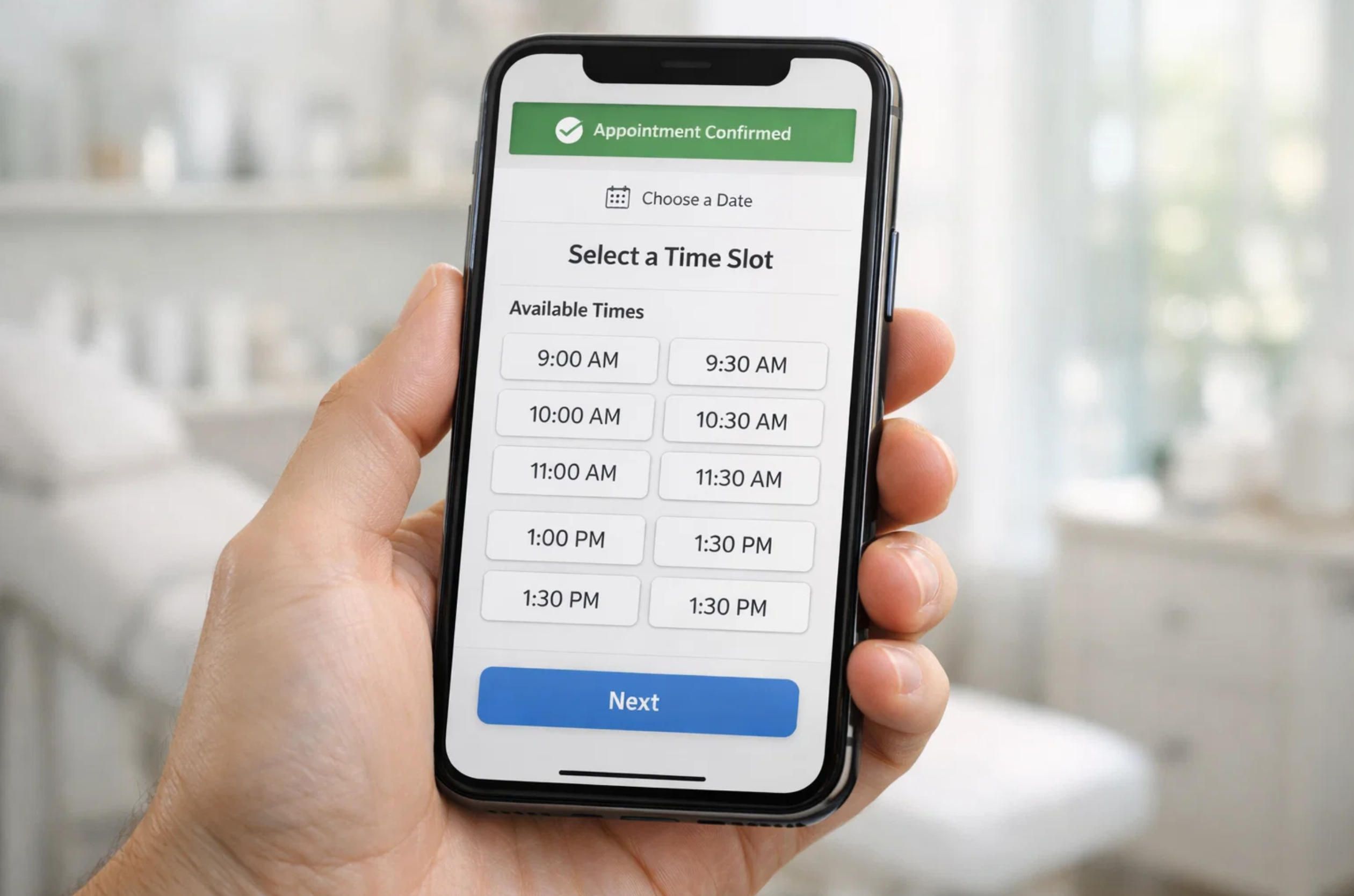
Section 1. The Problem: Why Private Clinics, Salons, and Repair Pros Need a Unified Scheduling Layer
Private clinics, beauty salons, and independent repair professionals don’t sell “appointments”; they sell predictable time. Yet in many businesses, scheduling still lives across phone calls, Instagram DMs, WhatsApp threads, and a half-maintained spreadsheet. That fragmentation creates the same operational failures everywhere: double bookings, invisible gaps between clients, last-minute reschedules that cascade through the day, and a front desk that spends more time coordinating than serving. A custom time-slot booking app resolves this by turning availability into a single source of truth - customers see real open slots and book instantly, while administrators and specialists manage the rules behind the calendar. A-Bots.com can build this kind of tailored scheduling platform from scratch - mobile apps plus an admin dashboard - designed around your workflows rather than forcing you into a generic template.
The root issue is that “time” is not a uniform commodity in service businesses. A 30-minute haircut is not the same as a 60-minute dermatology consult or a 90-minute device repair diagnostic. Each service has different durations, preparation time, cleanup buffers, skill requirements, pricing logic, and sometimes equipment or room constraints. Generic calendars and basic booking widgets do not model these realities; they model events. The result is predictable: customers book slots that look available but are operationally impossible, admins manually override bookings, and specialists lose trust in the schedule. A proper scheduling layer must understand services, resources, and constraints - and only expose slots that are truly bookable.
The financial cost of scheduling chaos is usually underestimated because it appears as “small” losses spread across the week. One missed appointment can create a dead zone of 20 to 40 minutes that cannot be sold. One double booking triggers discounts, refunds, or reputational damage. A few no-shows per week silently reduce utilization and force the business into reactive overbooking practices that hurt customer experience. The compounding effect is significant: utilization drops, acquisition costs rise (because you need more new clients to replace the wasted capacity), and the team burns out on coordination work. A unified scheduling app reduces these losses by making confirmation and rescheduling predictable, enabling waiting lists, automating reminders, and introducing no-show protection mechanisms such as deposits or cancellation policies - without turning the customer journey into a bureaucratic obstacle course.

There is also a customer-experience gap that directly affects conversion. Modern clients expect self-service: see availability, book in seconds, receive confirmation, and manage changes without calling. If booking requires back-and-forth messages, many people simply leave and choose the next option in search results. This is especially true for high-intent scenarios like same-week clinic visits, popular salon time slots, or urgent repair diagnostics. A booking experience that feels instant and reliable becomes part of the brand, not just a utility. When customers trust the schedule, they arrive on time, follow instructions, and are more likely to rebook. In practice, “fast booking” is a growth lever.
From the operations side, the schedule is not only a calendar - it is a resource allocation system. Clinics allocate rooms and staff; salons allocate chairs and masters; repair pros allocate bench time, diagnostics capacity, and pickup/drop-off windows. A unified scheduling layer must support rules that humans currently keep in their heads: service-specific buffers, breaks, working hours, maximum daily load per specialist, and exceptions (vacations, sick days, urgent walk-ins). When these rules are encoded, administrators stop acting like a control tower, and specialists stop relying on manual confirmations. The schedule becomes reliable enough to scale to multiple locations, multiple providers, and higher volume without collapsing under coordination overhead.
This is where a custom build makes strategic sense. Off-the-shelf tools often force compromises: rigid service definitions, limited resource logic, poor localization, or weak analytics. A custom platform can start with a focused MVP - core time-slot booking, admin management, confirmations, reminders, and rescheduling - and then expand into the exact capabilities your business model needs: deposits, membership packages, multi-location routing, integrations with CRM/EMR/helpdesk tools, or repair-specific flows (device intake forms, pre-diagnostic questions, and status updates). A-Bots.com builds these solutions as product-grade systems: clean customer UX, robust admin tooling, and a scheduling engine that reflects real-world constraints, so the business gains control over time - the one resource it cannot manufacture.
Section 2. The App Blueprint: Roles, Scheduling Logic, and an MVP a 5 - 8 Developer Team Can Deliver
A booking platform only works when it treats scheduling as a constrained system, not a “calendar with buttons.” The blueprint below frames the product the way a delivery team should: roles, core data model, scheduling rules, user flows, and a realistic MVP scope. This is the level where a custom build pays off, because every clinic, salon, and repair shop has slightly different constraints - and the app must enforce them automatically. A-Bots.com can implement this as a two-sided product: customer-facing mobile apps (iOS/Android) plus a web-based admin dashboard for staff and owners, backed by a reliable scheduling engine.
Roles and Permissions (Who Uses What)
The platform typically has four roles, each with different permissions:
Customer
- browses services and specialists
- sees real-time availability and books a slot
- confirms, reschedules, cancels within policy rules
- receives reminders and visit instructions
Specialist (Doctor/Stylist/Technician)
- sees their own schedule and upcoming clients
- blocks time (breaks, emergencies, maintenance)
- marks attendance and outcomes (simple status updates in MVP)
- optionally sets personal availability rules
Admin/Reception
- manages services, durations, prices, and buffers
- controls specialist schedules, exceptions, and resource allocation
- handles reschedules, cancellations, waiting lists, and confirmations
- monitors no-shows and enforces policies
Owner/Manager
- configures business rules and policies
- accesses analytics (utilization, peak hours, cancellations)
- manages multiple locations and staff access
- oversees integration settings (payments, CRM, SMS)
A critical design choice is to keep permissions strict and simple early on. In MVP, admins handle most configuration; specialists focus on availability and execution; customers get a clean booking flow.

Core Entities (What the System Must Understand)
To avoid “false availability,” the system needs a clear data model:
Service
- name, category, base duration
- buffer before/after (e.g., prep, cleanup)
- price and pricing variants (optional in MVP)
- allowed specialists and required resources
Specialist
- working hours, breaks, exceptions
- skills mapping (which services they can perform)
- capacity limits (e.g., max diagnostics per day)
Resource (optional but powerful)
- room, chair, device bench, equipment
- availability and constraints (some resources shared)
Location
- address, opening hours, time zone rules
- location-specific services/resources
Time Slot / Availability Window
- derived from working hours minus blocks and bookings
- generated dynamically based on service rules
Booking
- service, specialist, time, duration, customer details
- status lifecycle: Pending - Confirmed - Completed - No-show - Cancelled
- policy metadata: cancellation window, deposit required, etc.
Notification Events
- booking created, confirmed, reminder, rescheduled, cancelled, follow-up
This structure enables a single principle: customers only see slots the business can actually fulfill.

Scheduling Logic (The “Engine” That Makes It Business-Grade)
A real scheduling engine enforces rules automatically instead of leaving them to staff memory. Core rules:
Service-based duration + buffers
If a service is 60 minutes with a 10-minute buffer after, the calendar is blocked for 70 minutes. This prevents the “domino effect” of running late.
Specialist availability and exceptions
Working hours, vacations, sick days, and emergency blocks must be first-class inputs.
Resource constraints (when relevant)
If a clinic has two rooms or a salon has limited chairs, the engine must allocate a resource or prevent overlapping bookings that exceed capacity.
Lead time and cut-off rules
Example: no same-day bookings within 2 hours; no cancellations within 6 hours; or repair diagnostics require a 24-hour lead time.
Policy-driven booking status
A booking can be “Pending” until deposit is paid or until admin approves (useful for repair jobs with uncertain duration).
Waiting list logic (simple MVP version)
If a slot opens, notify customers who opted in for earlier availability.
The goal is deterministic scheduling: the same inputs always produce the same availability, so staff and customers trust the system.
Customer Experience (Simple, Fast, Self-Serve)
The customer flow should take under a minute:
- Select service
Clear service cards with duration, price range, and what to bring. - Select specialist or “best match”
Let customers choose a specific person or default to “first available.” - Choose time slot
Calendar view that shows only valid slots based on service + rules. - Confirm booking
Name, phone/email, optional notes, and policy acknowledgement. - Manage appointment
Reschedule/cancel within allowed windows; receive reminders; add to calendar.
Optional but high-impact additions:
- intake forms (clinic symptoms, repair device details, salon preferences)
- “arrived” check-in via QR code or numeric code
- follow-up message asking for feedback
Admin Dashboard (Where Revenue Protection Happens)
Admins need control without complexity. In MVP, the dashboard should cover:
Service configuration
- duration, buffers, pricing, assignment to specialists
- policy rules: cancellation windows, deposits, confirmation requirements
Schedule management
- drag-and-drop blocks for breaks and exceptions
- view by day/week, by specialist, and by location
- manual override with audit log (who changed what)
Booking management
- approve/decline (optional), reschedule, cancel
- status updates and internal notes
- basic client profiles and history
No-show prevention toolkit
- automated reminders
- confirmation prompts (“tap to confirm”)
- optional deposits or card-on-file holds (if the business wants it)
Analytics (lightweight but useful)
- utilization by specialist
- cancellation and no-show rate
- peak demand windows
- lead time distribution (how far ahead people book)
The admin dashboard is what differentiates a professional scheduling platform from a pretty booking screen.
MVP Scope a 5 - 8 Developer Team Can Realistically Deliver
A practical MVP focuses on the core loop: configure availability - expose valid slots - book - notify - manage changes.
MVP deliverables:
- iOS/Android customer app (often Flutter for speed and consistency)
- web admin dashboard (React or similar)
- backend with scheduling engine and booking API
- authentication and roles (customer/admin/specialist)
- notifications (push + email; SMS optional)
- basic analytics and logs
- stable deployment and monitoring
What we intentionally postpone to v2 (to keep MVP fast and robust):
- complex membership packages, promo engines, loyalty
- deep CRM/EMR integration
- dynamic pricing and advanced resource optimization
- AI triage or automated service recommendations
This sequencing matters: the scheduling engine and admin tooling must be correct before adding “nice-to-haves.”
Integrations (Add Value Without Overengineering)
Once MVP is stable, integrations can expand reach:
Payments
Deposits via Stripe and Apple Pay/Google Pay to reduce no-shows.
Messaging
SMS gateway for reminders and confirmations, especially for audiences that ignore push.
Calendar sync
Add-to-calendar, Google/Apple calendar integration for customers and specialists.
Business systems
CRM, EMR, helpdesk, or repair ticketing systems via API for a unified workflow.
The safest approach is modular: integrations are optional and do not break the core booking function.
Why a Custom Build with A-Bots.com Makes Sense
A custom scheduling platform is not about reinventing the calendar; it is about encoding your operational rules into software so the schedule becomes reliable, scalable, and profitable. A-Bots.com can implement this as a product-grade system with clean UX, a robust scheduling engine, and an admin dashboard that reduces coordination overhead. The result is a booking flow customers trust and a schedule your team can run on - across one location or many, without the daily chaos of manual coordination.
✅ Hashtags
#VirtualQueueApp
#BookingAppDevelopment
#SchedulingSoftware
#AppointmentBookingApp
#ClinicScheduling
#SalonBookingApp
#ServiceBusinessSoftware
#AdminDashboard
#MobileAppDevelopment
#FlutterAppDevelopment
#CustomSoftwareDevelopment
#NoShowPrevention
#TimeSlotBooking
#ABots
Other articles
Field Service Apps for Faster Closures Field service businesses in Dubai lose time and revenue when work orders, technician updates, and proof-of-completion live across calls, WhatsApp threads, and spreadsheets. This guide explains what “faster closures” really means and how a well-designed field service app reduces repeat visits, improves on-time arrival, and produces invoice-ready reports the moment a job is completed. You will see the essential modules that cut time-to-close, practical Dubai implementation scenarios, and the key criteria for choosing a development partner. A-Bots.com builds custom field service apps that turn fragmented operations into a measurable, scalable workflow.
Building Shawarma Roulette - A Social Discovery Success Story This comprehensive case study explores how Dubai app development companies are solving real-world social challenges through innovative mobile applications. The article examines the development of Shawarma Roulette, a location-based social discovery app that transforms Dubai's iconic street food culture into spontaneous friendship opportunities. Through detailed analysis of the 5-month development process, technical architecture, matching algorithms, and user experience design, readers gain insights into professional app development methodology. The story demonstrates how A-Bots.com and similar Dubai-based development companies combine technical expertise with cultural understanding to create applications that serve Dubai's unique multicultural market. Featuring real statistics on Dubai's thriving digital economy, food delivery market growth, and startup ecosystem, this article provides valuable perspective for entrepreneurs, investors, and businesses considering custom mobile app development in the UAE.
Weekend Desert Crew - Connecting Desert Adventurers Through Custom Mobile Technology This comprehensive case study explores how Dubai app development companies are revolutionizing outdoor adventure experiences through custom mobile technology. The article examines Weekend Desert Crew, an innovative coordination app that transforms Dubai's desert camping from logistically impossible to accessible reality for thousands of residents and tourists. Through detailed analysis of the 6-month development process, offline-first architecture, real-time location tracking, safety-critical systems, and matching algorithms, readers gain insights into professional app development methodology for complex outdoor applications. Featuring real user stories, technical challenges, business model strategies, and viral growth tactics, this article demonstrates how A-Bots.com and similar Dubai-based development companies solve genuine human problems through thoughtful technology. Includes comprehensive statistics on Dubai tourism, desert safari market, and outdoor recreation trends shaping the UAE's adventure tourism sector.
Expat Docs App to Solve the Document Crisis for 11 Million UAE Residents Managing document expiration dates in the UAE is a universal challenge for the 11.06 million expatriates who make up 88.5% of the country's population. Missing a single deadline—Emirates ID, residence visa, passport, or driving license—can trigger fines exceeding AED 3,500, travel disruptions, and legal complications. This article explores how A-Bots.com, a Dubai-based mobile app development company, created Expat Docs: a simple yet critical document expiry tracker. Using intelligent reminders, OCR scanning, dependency alerts, and family account management, the app solved a problem affecting millions. Learn how straightforward technology addressing real-world problems creates genuine value, and discover A-Bots.com's approach to building practical, reliable mobile applications that improve expatriate life.
Inventory Management App Development Managing inventory with spreadsheets costs businesses thousands of dollars annually through errors and inefficiency. Research shows over 80% of spreadsheets contain mistakes, while retail shrinkage reached $132 billion globally in 2024. A custom inventory management app with barcode scanning eliminates manual data entry errors, provides real-time stock visibility, and automates low-stock alerts. This comprehensive guide covers essential features including barcode scanning, multi-location tracking, and system integrations. Development costs range from $10,000 for basic solutions to $100,000+ for enterprise systems, with typical ROI of 120-190% and payback periods under 8 months. A-Bots.com delivers custom inventory solutions tailored to your specific workflow requirements.
Top stories

Copyright © Alpha Systems LTD All rights reserved.
Made with ❤️ by A-BOTS